Nik Cubrilovic

1.1K posts

Nik Cubrilovic

Nik Cubrilovic

@dir

data + ai engineer. @squirrelscan_ @opennem. at https://t.co/yOGtW7uHIA and https://t.co/kvkcg5TrG9

Australia Katılım Mart 2007
530 Takip Edilen338 Takipçiler
Sabitlenmiş Tweet
Nik Cubrilovic
Nik Cubrilovic@dir·
I'm very smart. Ask me anything.
Nik Cubrilovic tweet media
English
3
1
20
5.8K
Marc Köhlbrugge
Marc Köhlbrugge@marckohlbrugge·
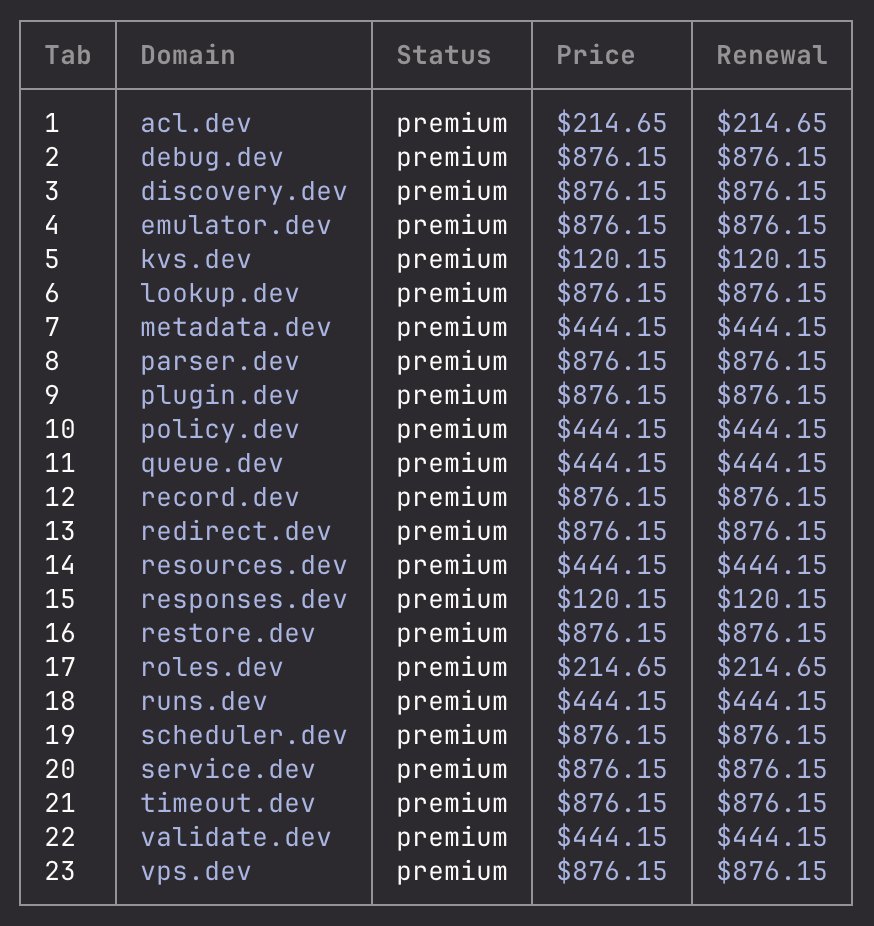
some nice premium .dev domains still available
Marc Köhlbrugge tweet media
English
12
1
65
10K
Nik Cubrilovic
@HumanHarlan I noticed the nyt, wsj and bloomberg didn't cover it - a lot of the rest was very surface level. SA had a decent article.
English
1
0
0
7
Nik Cubrilovic
I've made a conscious effort to have one workspace where it's just vim and python/rust to exercise that muscle on fun tasks. atm experimenting with sandboxes for npm/pnpm installs (topical), prev was just 10-15 minutes of writing crypto/physics etc. routines from memory. it's the exploration stuff that originally had me fall in love with programming.
English
0
0
0
352
Halvar Flake
Halvar Flake@halvarflake·
Ok, confession time: I use agentic coding *all the time* and *every day*. And have been doing so for many months. I am *terrified* of skill deterioration on my side. I see the studies, I can feel it myself. The agents make me much more productive, but I feel I need to force...
English
74
46
924
101.7K
Alex Spring
Alex Spring@_alexspring·
Scraping the web is about to require buying phones. Antibots want to know if it's a real device, not a real browser. Google's recaptcha QR code is the canary. Patched chromium dies. No more web agents, no more automation. The next moat is real phones and arm servers.
Alex Spring tweet media
English
5
0
23
9.2K
Nik Cubrilovic
@kr0der a remote OpenAI employee keeps your mouse moving to keep your laptop awake
English
4
1
329
16.3K
Zeb Evans
Zeb Evans@DJ_CURFEW·
Today we reduced headcount by 22%. The business is the strongest it's ever been. So I think it's important to be direct about what I'm seeing and why. First, I made this decision and I own it. I did it because the way to operate at the highest level of productivity is changing, and to win the future, ClickUp needs to change with it. Second, this wasn't about cutting costs. Most savings from this change will flow directly back into the people who stay. We'll be introducing million-dollar salary bands. If you create outsized impact using AI, you'll be paid outside of traditional bands. Most importantly, I have the deepest gratitude for those affected. We're doing this from a position of strength specifically so we can take care of people properly. Everyone affected receives a package aimed at honoring their contributions and easing the transition. I only see two options: wait for this to play out gradually in the market or be honest about what I'm seeing and act proactively. THE 100X ORGANIZATION The primary change is that we're restructuring around what I call 100x org. The goal is 100x output. The roles required to build at the highest level are fundamentally different than they were a year ago. Incremental improvements to existing systems won't get us there. We need new ones. That means creating enough disruption to rebuild rather than iterate on what's already broken. The common narrative is that AI makes everyone more productive. It doesn't. Many of the workflows of today, if left unchanged, create bottlenecks in AI systems. These roles will evolve. But waiting for that to happen naturally means falling behind now. The 100x org is actually heavily dependent on people - infinitely more than today. This is only possible with 10x people that have embraced and adopted new ways of working. THE BUILDERS, AGENT MANAGERS, AND FRONT-LINERS — THE BUILDERS: 10X ENGINEERS I don't think most companies have internalized what's actually happening with AI in engineering. The common narrative is that AI makes all engineers more productive. That may be true in isolation, but at an organization level - that is the farthest thing from reality. Here's what we've validated recently at ClickUp: the great engineers, the ones who can orchestrate, architect, and review, are becoming 100x engineers. They're not writing code. They're directing agents that write code. The skill is judgment. AI makes the best engineers wildly more productive, and everyone else using AI slows these engineers down. Think about it - the bottlenecks are (1) orchestration - telling AI what to do, and (2) reviewing - what AI did. Everything is leapfrogged and no longer needed. So who do you want orchestrating and reviewing code? And how do you want your best engineers to spend their time? If your best engineers are spending time reviewing other people's code, then this is inherently an inefficient bottleneck. These engineers can review their agent's code much faster than reviewing human code. The new world is about enabling your 10x engineers to become 100x. The wrong strategy is to push every engineer to use infinite tokens. Companies doing this are celebrating 500% more pull requests. But customer outcomes don't match the volume of code being generated. I call this the great reckoning of AI coding, and every company will face this soon if not already. More code is just another bottleneck to the best engineers, and ultimately to your company's impact as well. — THE BUILDERS: 10X PRODUCT MANAGERS Product management and design roles are merging. Designers that have customer focus, become more like product managers. And product managers that have intuition for UX become more like designers. The bottleneck of user research is gone. It takes us just one mention of an agent to kickoff research and analyze results. The bottleneck of product <> design iteration is also gone. The product builder iterates on their own, along with agents and skills that ensure alignment with quality and strategy. Also controversial today - I believe that the wrong strategy is to have your PMs shipping code - that just introduces another bottleneck that the best engineers will waste their time on. To be clear, PMs should be coding but they should do this in a playground to iterate, validate, and scope. That code should not go to production. Everything outside of managing systems, orchestrating AI, and reviewing output becomes a bottleneck. That's why the other roles that are critical along with these are the systems managers (to reduce bottlenecks) along with a bottleneck you can't replace - customer meeting time. — THE SYSTEM MANAGERS Ironically, the people that automate their jobs with AI will always have a job. They become owners of the AI systems - agent managers. We have many examples of these people at ClickUp. The underlying systems in which we operate are absolutely critical to get right. I think most companies are delusional to think they can iterate on existing systems and compete in this new world. You must create enough disruption so that old systems are deprecated entirely. If there's any definition for 'AI native' that's what it is. — THE FRONT-LINERS In a world that will become saturated with AI communication, the human touch will matter more than anything to customers. This is a bottleneck that you shouldn't replace - even when agents are high enough quality to do video meetings. One-on-one meeting time with customers is something that shouldn't be automated. The systems around the meetings should be - so that front-liners spend nearly 100% of their time with customers. REWARDING 100X IMPACT In a world where companies are able to do so much more with less, where does that excess money go? In our case, much of the savings in this new operating model will flow directly back to those that enabled it. We must reward people that create productivity accordingly. This aligns incentives on both sides. Plus, in a world where your best people create 100x impact, you can't afford to lose them. You should aim to retain these employees for decades. The context they have and their ability to efficiently orchestrate and review will be nearly impossible to replace. Compensation bands of today should be thrown out the door. We're introducing $1 million cash/year salary bands with a path available to nearly everyone in the company if they produce 100x impact by creating or managing AI systems. THE FUTURE Nearly every company will make changes like these. The ones that do it proactively will define what comes next. The future is not fewer people. It's different work, new roles, and better rewards for those who embrace it. We're already seeing entirely new roles emerge, like Agent Managers, that didn't exist a year ago. ClickUp is positioning to lead this shift, not just internally, but for our customers too. I've never been more certain about where we're headed.
English
1.6K
1.1K
11.6K
7.4M
Mario Zechner
Mario Zechner@badlogicgames·
> These engineers can review their agent's code much faster than reviewing human code. wat
Zeb Evans@DJ_CURFEW

Today we reduced headcount by 22%. The business is the strongest it's ever been. So I think it's important to be direct about what I'm seeing and why. First, I made this decision and I own it. I did it because the way to operate at the highest level of productivity is changing, and to win the future, ClickUp needs to change with it. Second, this wasn't about cutting costs. Most savings from this change will flow directly back into the people who stay. We'll be introducing million-dollar salary bands. If you create outsized impact using AI, you'll be paid outside of traditional bands. Most importantly, I have the deepest gratitude for those affected. We're doing this from a position of strength specifically so we can take care of people properly. Everyone affected receives a package aimed at honoring their contributions and easing the transition. I only see two options: wait for this to play out gradually in the market or be honest about what I'm seeing and act proactively. THE 100X ORGANIZATION The primary change is that we're restructuring around what I call 100x org. The goal is 100x output. The roles required to build at the highest level are fundamentally different than they were a year ago. Incremental improvements to existing systems won't get us there. We need new ones. That means creating enough disruption to rebuild rather than iterate on what's already broken. The common narrative is that AI makes everyone more productive. It doesn't. Many of the workflows of today, if left unchanged, create bottlenecks in AI systems. These roles will evolve. But waiting for that to happen naturally means falling behind now. The 100x org is actually heavily dependent on people - infinitely more than today. This is only possible with 10x people that have embraced and adopted new ways of working. THE BUILDERS, AGENT MANAGERS, AND FRONT-LINERS — THE BUILDERS: 10X ENGINEERS I don't think most companies have internalized what's actually happening with AI in engineering. The common narrative is that AI makes all engineers more productive. That may be true in isolation, but at an organization level - that is the farthest thing from reality. Here's what we've validated recently at ClickUp: the great engineers, the ones who can orchestrate, architect, and review, are becoming 100x engineers. They're not writing code. They're directing agents that write code. The skill is judgment. AI makes the best engineers wildly more productive, and everyone else using AI slows these engineers down. Think about it - the bottlenecks are (1) orchestration - telling AI what to do, and (2) reviewing - what AI did. Everything is leapfrogged and no longer needed. So who do you want orchestrating and reviewing code? And how do you want your best engineers to spend their time? If your best engineers are spending time reviewing other people's code, then this is inherently an inefficient bottleneck. These engineers can review their agent's code much faster than reviewing human code. The new world is about enabling your 10x engineers to become 100x. The wrong strategy is to push every engineer to use infinite tokens. Companies doing this are celebrating 500% more pull requests. But customer outcomes don't match the volume of code being generated. I call this the great reckoning of AI coding, and every company will face this soon if not already. More code is just another bottleneck to the best engineers, and ultimately to your company's impact as well. — THE BUILDERS: 10X PRODUCT MANAGERS Product management and design roles are merging. Designers that have customer focus, become more like product managers. And product managers that have intuition for UX become more like designers. The bottleneck of user research is gone. It takes us just one mention of an agent to kickoff research and analyze results. The bottleneck of product <> design iteration is also gone. The product builder iterates on their own, along with agents and skills that ensure alignment with quality and strategy. Also controversial today - I believe that the wrong strategy is to have your PMs shipping code - that just introduces another bottleneck that the best engineers will waste their time on. To be clear, PMs should be coding but they should do this in a playground to iterate, validate, and scope. That code should not go to production. Everything outside of managing systems, orchestrating AI, and reviewing output becomes a bottleneck. That's why the other roles that are critical along with these are the systems managers (to reduce bottlenecks) along with a bottleneck you can't replace - customer meeting time. — THE SYSTEM MANAGERS Ironically, the people that automate their jobs with AI will always have a job. They become owners of the AI systems - agent managers. We have many examples of these people at ClickUp. The underlying systems in which we operate are absolutely critical to get right. I think most companies are delusional to think they can iterate on existing systems and compete in this new world. You must create enough disruption so that old systems are deprecated entirely. If there's any definition for 'AI native' that's what it is. — THE FRONT-LINERS In a world that will become saturated with AI communication, the human touch will matter more than anything to customers. This is a bottleneck that you shouldn't replace - even when agents are high enough quality to do video meetings. One-on-one meeting time with customers is something that shouldn't be automated. The systems around the meetings should be - so that front-liners spend nearly 100% of their time with customers. REWARDING 100X IMPACT In a world where companies are able to do so much more with less, where does that excess money go? In our case, much of the savings in this new operating model will flow directly back to those that enabled it. We must reward people that create productivity accordingly. This aligns incentives on both sides. Plus, in a world where your best people create 100x impact, you can't afford to lose them. You should aim to retain these employees for decades. The context they have and their ability to efficiently orchestrate and review will be nearly impossible to replace. Compensation bands of today should be thrown out the door. We're introducing $1 million cash/year salary bands with a path available to nearly everyone in the company if they produce 100x impact by creating or managing AI systems. THE FUTURE Nearly every company will make changes like these. The ones that do it proactively will define what comes next. The future is not fewer people. It's different work, new roles, and better rewards for those who embrace it. We're already seeing entirely new roles emerge, like Agent Managers, that didn't exist a year ago. ClickUp is positioning to lead this shift, not just internally, but for our customers too. I've never been more certain about where we're headed.

English
70
37
1.2K
129.7K
Nik Cubrilovic
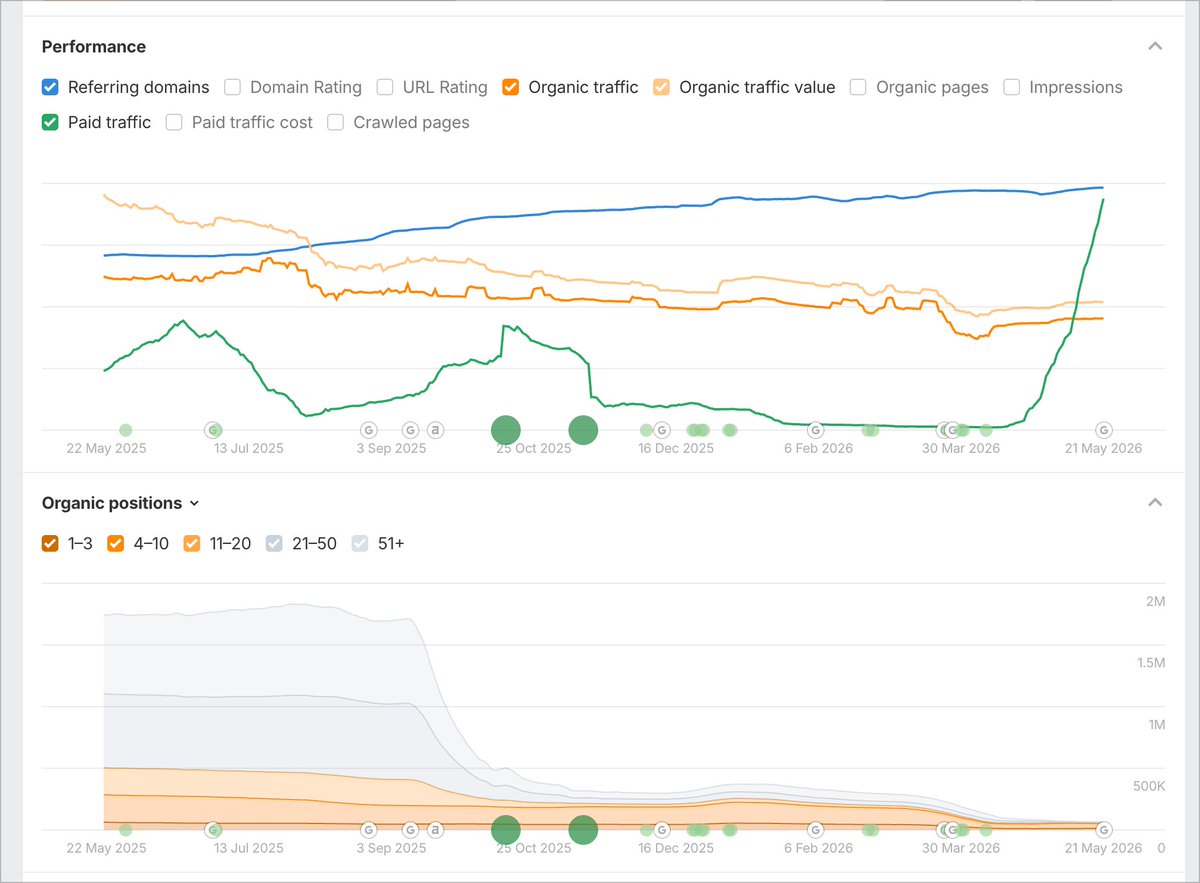
Clickup got smashed by Google for their generative AI content spam and lost 50% of their organic traffic value and had to replace it with paid ads. This is all noise covering up horrible decision making and leadership
Nik Cubrilovic tweet media
Zeb Evans@DJ_CURFEW

Today we reduced headcount by 22%. The business is the strongest it's ever been. So I think it's important to be direct about what I'm seeing and why. First, I made this decision and I own it. I did it because the way to operate at the highest level of productivity is changing, and to win the future, ClickUp needs to change with it. Second, this wasn't about cutting costs. Most savings from this change will flow directly back into the people who stay. We'll be introducing million-dollar salary bands. If you create outsized impact using AI, you'll be paid outside of traditional bands. Most importantly, I have the deepest gratitude for those affected. We're doing this from a position of strength specifically so we can take care of people properly. Everyone affected receives a package aimed at honoring their contributions and easing the transition. I only see two options: wait for this to play out gradually in the market or be honest about what I'm seeing and act proactively. THE 100X ORGANIZATION The primary change is that we're restructuring around what I call 100x org. The goal is 100x output. The roles required to build at the highest level are fundamentally different than they were a year ago. Incremental improvements to existing systems won't get us there. We need new ones. That means creating enough disruption to rebuild rather than iterate on what's already broken. The common narrative is that AI makes everyone more productive. It doesn't. Many of the workflows of today, if left unchanged, create bottlenecks in AI systems. These roles will evolve. But waiting for that to happen naturally means falling behind now. The 100x org is actually heavily dependent on people - infinitely more than today. This is only possible with 10x people that have embraced and adopted new ways of working. THE BUILDERS, AGENT MANAGERS, AND FRONT-LINERS — THE BUILDERS: 10X ENGINEERS I don't think most companies have internalized what's actually happening with AI in engineering. The common narrative is that AI makes all engineers more productive. That may be true in isolation, but at an organization level - that is the farthest thing from reality. Here's what we've validated recently at ClickUp: the great engineers, the ones who can orchestrate, architect, and review, are becoming 100x engineers. They're not writing code. They're directing agents that write code. The skill is judgment. AI makes the best engineers wildly more productive, and everyone else using AI slows these engineers down. Think about it - the bottlenecks are (1) orchestration - telling AI what to do, and (2) reviewing - what AI did. Everything is leapfrogged and no longer needed. So who do you want orchestrating and reviewing code? And how do you want your best engineers to spend their time? If your best engineers are spending time reviewing other people's code, then this is inherently an inefficient bottleneck. These engineers can review their agent's code much faster than reviewing human code. The new world is about enabling your 10x engineers to become 100x. The wrong strategy is to push every engineer to use infinite tokens. Companies doing this are celebrating 500% more pull requests. But customer outcomes don't match the volume of code being generated. I call this the great reckoning of AI coding, and every company will face this soon if not already. More code is just another bottleneck to the best engineers, and ultimately to your company's impact as well. — THE BUILDERS: 10X PRODUCT MANAGERS Product management and design roles are merging. Designers that have customer focus, become more like product managers. And product managers that have intuition for UX become more like designers. The bottleneck of user research is gone. It takes us just one mention of an agent to kickoff research and analyze results. The bottleneck of product <> design iteration is also gone. The product builder iterates on their own, along with agents and skills that ensure alignment with quality and strategy. Also controversial today - I believe that the wrong strategy is to have your PMs shipping code - that just introduces another bottleneck that the best engineers will waste their time on. To be clear, PMs should be coding but they should do this in a playground to iterate, validate, and scope. That code should not go to production. Everything outside of managing systems, orchestrating AI, and reviewing output becomes a bottleneck. That's why the other roles that are critical along with these are the systems managers (to reduce bottlenecks) along with a bottleneck you can't replace - customer meeting time. — THE SYSTEM MANAGERS Ironically, the people that automate their jobs with AI will always have a job. They become owners of the AI systems - agent managers. We have many examples of these people at ClickUp. The underlying systems in which we operate are absolutely critical to get right. I think most companies are delusional to think they can iterate on existing systems and compete in this new world. You must create enough disruption so that old systems are deprecated entirely. If there's any definition for 'AI native' that's what it is. — THE FRONT-LINERS In a world that will become saturated with AI communication, the human touch will matter more than anything to customers. This is a bottleneck that you shouldn't replace - even when agents are high enough quality to do video meetings. One-on-one meeting time with customers is something that shouldn't be automated. The systems around the meetings should be - so that front-liners spend nearly 100% of their time with customers. REWARDING 100X IMPACT In a world where companies are able to do so much more with less, where does that excess money go? In our case, much of the savings in this new operating model will flow directly back to those that enabled it. We must reward people that create productivity accordingly. This aligns incentives on both sides. Plus, in a world where your best people create 100x impact, you can't afford to lose them. You should aim to retain these employees for decades. The context they have and their ability to efficiently orchestrate and review will be nearly impossible to replace. Compensation bands of today should be thrown out the door. We're introducing $1 million cash/year salary bands with a path available to nearly everyone in the company if they produce 100x impact by creating or managing AI systems. THE FUTURE Nearly every company will make changes like these. The ones that do it proactively will define what comes next. The future is not fewer people. It's different work, new roles, and better rewards for those who embrace it. We're already seeing entirely new roles emerge, like Agent Managers, that didn't exist a year ago. ClickUp is positioning to lead this shift, not just internally, but for our customers too. I've never been more certain about where we're headed.

English
0
1
15
2K
Nik Cubrilovic
@zekramu a lot can be done on the demand side like moving household loads off the grid. australia has installed 400k home batteries in 12 months in a country with ~11M homes. thats 2-3GW, or a half dozen gas power stations, 2-3 crusoes of demand.
English
0
0
1
24
zek
zek@zekramu·
not enough people in general are thinking about energy. not as much as they should be. its all about the models and the hardware. the construction of the data centers. WHAT ABOUT THE ENERGY? the currency of the future is going to be energy. fallout type shit.
roon@tszzl

@_simonsmith seems bad because tokens from a tiny model mean very little vs from Mythos 4. earnings per kWh is the relevant metric

English
10
0
33
1.9K
Nik Cubrilovic
@yulo_tech slop poasters still doing the "x will destroy super large incumbent y" format ey
English
0
0
0
82
Yulo
Yulo@yulo_tech·
PostHog will destroy Claude Code and Codex The moat they'll have from user behavior data and error logs will for the first time give AI tasks that are actually useful and not slop features or things that don't matter Can't wait to try it
PostHog@posthog

Introducing PostHog Code, the product editor that: - Understands your product - Identifies usage patterns - Triages bugs and errors for you - Creates PRs to fix them - Continuously monitors and improves your product Join the waitlist: posthog.com/code

English
56
11
717
271.2K
Jake
Jake@iamjakestream·
It's actually kind of funny
Jake tweet media
English
2
0
8
2.2K
Nik Cubrilovic
@FredaDuan Cursor are already on another training run which leaves very little GPU at II for xAI grok. I think it implies that xAI have shifted to the cursor composer models as their best bet on a competitive outcome (they're right)
English
0
0
2
408
Freda Duan
Freda Duan@FredaDuan·
Rough guesstimates based on public information: Using the numbers below, Colossus 1 = ~$6B annual rent. That covers: 150,000 H100s 50,000 H200s 30,000 GB200s Separately, $Anthropic’s total payment to $SpaceX is $15B per year, based on the SpaceX S-1 “$1.25B per month through May 2029, with capacity ramping in May and June 2026 at a reduced fee.” This implies the payment attributable to Colossus 2 would be roughly $9B per year. Assuming a price of $6/hour, that would imply $Anthropic is renting approximately 150,000–200,000 GB200-equivalent. For context, Colossus 2’s total target capacity is reportedly 550,000 GB200/GB300s and 1GW of power. I suspect Colossus 2 is not yet at full capacity. The S-1 says: “Our AI compute facilities, COLOSSUS and COLOSSUS II, collectively provide approximately 1.0 gigawatt of compute power.” We know Colossus 1 is ~300MW, which implies Colossus 2 is currently around 700MW. So the implied math is: Colossus 2 is leasing roughly one-third of its total compute capacity to $Anthropic. Open to pushbacks/ discussions.
Jamin Ball@jaminball

Some rough math! (All napkin math...) Assume Colossus 1 has 220k GPUs Assume 150k H100s, 50k H200s, 20k GB200s Pricing Assumptions: - $2.30 / hour for H100s - $2.60 / hour for H200s - $5 / hour for GB200s - blended rental rate across the entire fleet of $2.60 / hour Assume it's all take-or-pay style deals (you pay for 24x365 usage) This translates to ~$5b of annual rev to Xai. We have a new neocloud! On top of that - on recent Dwarkesh podcast, Dario ran through some napkin math on unit economics (he framed it all as industry math vs Anthropic specific - which is important, he wasn't disclosing anything Anthropic specific). What he mentioned was take $100b of compute spend (he just picked a round number). There will be a mix shift of that spend between training and inference. Skew too much on training and you don't generate enough revenue. Skew too heavy on inference and you kneecap future R&D progress. He thought the industry is currently 50/50 on training / inference of compute spend. He said as in industry, could turn that $50b inference spend into $150b of revenue (called out these are most likely the unit economics of the industry in 1-2 years) So taking this back to the Xai deal. Under above assumptions, Anthropic paying $5b / year. Let's say they turn that into $15b / year in rev (60-70% gross margin) Win win!!

English
17
22
142
60.5K
Nik Cubrilovic
@TrulyWande44156 @alistairmbarr building models is hard! esp when you have a deadline like Google IO (explains why pro wasn't released). the others release when ready and deepseek took their time with v4
English
1
0
1
63
truly Wanderful
truly Wanderful@TrulyWande44156·
@dir @alistairmbarr yeah, i honestly feel it's unfinished. it seems less bad after the antigravity update than when it was first released so hopefully it improves a bit after a week or so.
English
1
0
0
16
Alistair Barr
Alistair Barr@alistairmbarr·
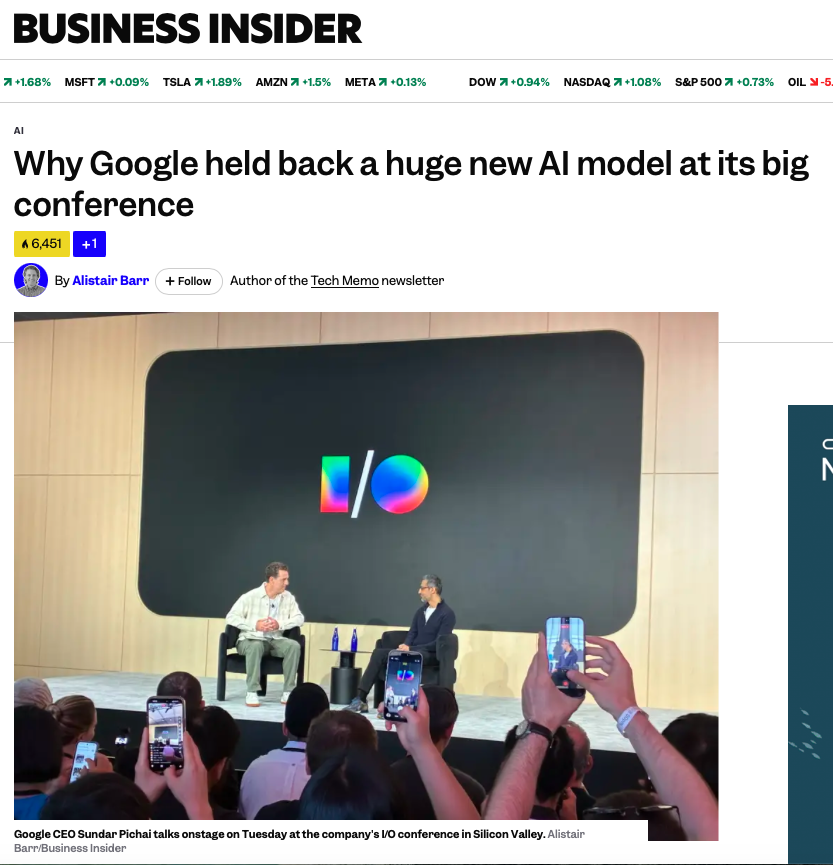
Why did Google hold back its huge new Gemini 3.5 Pro model at I/O? The audience groaned when they heard. Here's my theory, after spending a day at the conference:
Alistair Barr tweet media
English
11
1
40
21.9K
Nik Cubrilovic
@TrulyWande44156 @alistairmbarr that may be one benefit - you can use it as a proxy to google search for grounding (same way grok is used to access twitter). still feels like a regression over 3.0 flash 3.1 flash lite
English
1
0
1
30
truly Wanderful
truly Wanderful@TrulyWande44156·
@dir @alistairmbarr it's hard to explain but basically if you were building something and you explain you need it to have/why __ and to search the web for that, gather information and research then implement it's great at that. if you say i need X built with these specs. it sucks.
English
2
0
0
11