Derek Thompson

21.7K posts

Derek Thompson banner
Derek Thompson

Derek Thompson

@DKThomp

Sign up for my new newsletter! (Link below) Also: Co-author of Abundance, host of Plain English, and contributing writer at The Atlantic.

Washington, D.C. Katılım Mayıs 2009
2.1K Takip Edilen252.8K Takipçiler
Sabitlenmiş Tweet
Derek Thompson
Derek Thompson@DKThomp·
Some personal news. Today, I’m leaving The Atlantic after almost 17 years and moving my writing to Substack. It would be convenient, for the purposes of crafting an exciting departure announcement, to have a dramatic exit story: a fight, a grievance, a shouting match with an editor that ended with me hurling a bunch of leather-backed Thoreau volumes across the open-plan office. That is not the case here. I love The Atlantic, and I'll remain a contributing writer there. But after almost two decades at one publication, I wanted to write for myself. The things I've published that I'm most proud of—whether it was the original abundance agenda essay, or my piece on workism—emerged from a very personal expression of frustration, or confusion, or curiosity. I want to know what my thinking and writing is like if I lean into a more independent and personal writing life. That's brought me to Substack, which is already home to an astonishing share of my overall reading. I'm excited to join their community and excited to build my own. The name of the newsletter should be easy to remember: Derek Thompson. The newsletter will have three main pillars 1. Abundance 2. The frontier of science and technology—GLP1s, AI, biotech, energy breakthroughs—covered in a way that’s both curious and skeptical 3. The anti-social century & the social crises of anxiety and aloneness Thanks to The Atlantic for 16.8 incredible years and thanks to everybody who follows me across the river. - dt
English
317
258
6.6K
1.5M
Derek Thompson
Derek Thompson@DKThomp·
Today's pod: WHY CHINA IS WINNING THE IRAN WAR Energy crises tend to have strange ripple effects. The 1970s oil crises contributed to (among many other things): - stagflation, the demise of the New Deal order in America, & the ensuing rise of Reagan Republicanism - the rise of the electronics revolution in Japan, as high energy costs punished heavy industry in the 1970s - even the rise and fall of the Soviet petro economy in the 1980s, which was a factor in the end of the end of the Cold War Nobody really talks about Reagan and Nintendo as consequences of an energy crisis. But, in a way, they were. So, today we ask: What could be the most important unintended consequences of the Iran War? I've learned a lot from American analysts, but I wanted to talk to somebody who's seeing the chessboard from the other side of the world. As @alexbhturnbull explains today, the U.S. relies on a military presence throughout the Pacific Islands to project its power in the east. But the war in Iran is demolishing the economies of the Pacific Islands, which may allow China to engage in diesel diplomacy—we bail you out on energy, you accept a larger military presence. Meanwhile, the war has revealed the vulnerability of seaborne fossil fuels, esp those that rely on the Strait of Hormuz. This could accelerate a shift toward renewables, where the largest global exporter of solar is ... again, China.
Alex Turnbull@alexbhturnbull

Had fun on @DKThomp podcast, thanks again. pca.st/episode/1b5a02…

English
3
14
85
20.3K
Derek Thompson
Derek Thompson@DKThomp·
It really depends on the company the uber-wealthy invest in, yes? (just as it depends on the charity!) A lot of folks in the 2010s poured their wealth into social media knockoffs and doordashes for everything. perfectly legal behavior. but not exactly humanitarian. let's not even get into the amount of wealth that's gone into crypto, which I know is your absolute favorite technology ;) At the very least, I think billionaires should try harder to create -- for lack of a better term -- EA for Capitalism, from first principles. I wish there were more ppl like you and Collison, allocating their smarts and their treasure to cracking the case on hard complex diseases
English
2
0
18
1.1K
Tweets from Zach Weinberg
Tweets from Zach Weinberg@zachweinberg·
@mattyglesias The argument I hear from most very wealthy people is that giving to charity is *materially less effective at helping people* when compared to investing in for-profit companies building amazing products for consumers (which better improve lives overall).
English
14
2
104
9.1K
Matthew Yglesias
Matthew Yglesias@mattyglesias·
There’s nothing wrong with getting rich — if you built up a net worth of billions you probably did something useful. But spending all that money on high living or your own kids rather than giving some to those in need is genuinely problematic. slowboring.com/p/the-real-pro…
English
142
28
421
39.4K
Derek Thompson
Derek Thompson@DKThomp·
@oren_cass Two questions that I think are fair and that I’m asking sincerely, not knowing your answer to. 1. What is the statistic that you think best showcases that American reindustrialization is underway? 2. Why is that statistic a positive result of the tariffs?
English
5
12
558
33.1K
Oren Cass
Oren Cass@oren_cass·
Would love to know Derek’s definition of “the economy got worse at manufacturing.” Output, in long decline, went up. Productivity, in long decline, went up. Industry sentiment improved. This is why we compiled and presented the data. I understand that’s harder than just pontificating, but I’d argue it’s worth the effort.
Derek Thompson@DKThomp

Trump threatened to cut off the economy’s hand (Liberation Day) and then people freaked out, and then he said “fine fine I’ll just chop off the economy’s pinkie above the knuckle” (the adjusted exempted tariffs) and then the economy got worse at everything involving the full use of five fingers (manufacturing etc), and Oren Cass is triumphant that this is a victory for all advocates of digital amputation.

English
21
4
69
72.7K
Derek Thompson retweetledi
jerry
jerry@jerrrrrrryyyyy·
Bsky devs are the bravest people known to man
jerry tweet media
English
72
255
6.8K
809.3K
Derek Thompson
Derek Thompson@DKThomp·
@zdch Correct. The hand was never amputated. But the analysis seems to be “LOL at these economists who are tying to tell you that hand amputation is bad”
English
3
2
143
5.5K
Zac Hill
Zac Hill@zdch·
@DKThomp What I perpetually don’t understand about this discourse is that to the extent ‘what economists said would happen didn’t happen,’ it’s because Trump didn’t do the things he said he’d do. For the things he did do, what economists said would happen…happened!
English
2
4
159
4.6K
Derek Thompson
Derek Thompson@DKThomp·
Trump threatened to cut off the economy’s hand (Liberation Day) and then people freaked out, and then he said “fine fine I’ll just chop off the economy’s pinkie above the knuckle” (the adjusted exempted tariffs) and then the economy got worse at everything involving the full use of five fingers (manufacturing etc), and Oren Cass is triumphant that this is a victory for all advocates of digital amputation.
Oren Cass@oren_cass

1/10 This week marks one year since Liberation Day. You may recall predictions of doom from economists, and constant claims of failure from commentators, so let's take a look at the actual economic data from the past year, shall we? 🧵

English
15
178
2K
244K
Derek Thompson retweetledi
Brad Stulberg
Brad Stulberg@BStulberg·
Loved this conversation with @DKThomp. So much in here. My favorite part: unpacking that you can driven toward achievement/success (it's not a bad thing!) while at the same time realizing the top of the mountain is narrow all the life is on the sides.open.spotify.com/episode/3bJnf1…
English
0
3
25
10.8K
Derek Thompson
Derek Thompson@DKThomp·
Yes. The thinking is this space is extremely muddy bc people have an ideological bias against AI as a “creative” intelligence and it’s leading to woolly-headed thinking about whether writers are still “writers” if their work relies on an external intelligence to form its quality. People who think it’s cheating to have an outside entity massage your prose should google “Gordon Lish and Raymond Carver.” The tough question is “if a stern and pithy fiction writer in 2027 used a Gordon Lish-esque LLM to help him write better fiction, is he a plagiarist, a fraud, or just a new kind of writer?” I don’t know the answer to that question but I can imagine all the writers QTing me have a very strong feeling. Okay, fine. I just think their certainly is ideological rather than pragmatic. I don’t think machines replacing people in the writing loop is *good* in a moral social sense. But my point is: writing is a loop, and it has always been a loop, and the idea that automating one or several parts of that loop eviscerates the ontology of writing is not so clear to me.
English
0
0
1
172
Tom Scheinfeldt
Tom Scheinfeldt@foundhistory·
@DKThomp Think about how many classical thinkers used an amanuensis. Do we really imagine those people (often wives and other women ignored by history) never added a word or turn of phrase to the dictation?
English
2
0
0
204
Derek Thompson
Derek Thompson@DKThomp·
Writing is thinking, and people who outsource the full writing process to AI will find their screens full of words and their minds empty of thought. But also: All writing involves and has always involved “outsourcing”—reaching outside of the writer’s mind to pull in pieces of the world, before and after the work of making words. Writers draw their ideas from other people, books, articles; after writing they often rely on outside copy editors, fact checkers, transcribers. Some of this stuff is just going to be done by AI in the future, and the boundaries between “good behavior” and “bad behavior” will have some blurry lines, and we should be honest and open about the blur rather than declare everybody with an open Claude window a part of the slopclass. Anybody who says AI transcription of long interviews obliterates the identity of a writer is being a little silly. But what about copy editing? Claude is a fast and decent copy editor, but it is inhuman to rely on it for that function? Is it moral to google “Econ papers on income transfers for child poverty” but immoral to write the same thing as an AI prompt? What about throwing 500 muddled words into ChatGPT and saying “does this make any sense? what do you think I’m trying to say here?” That’s going to be useful for some people. At an aesthetic level, I don’t like copy-pasting AI paragraphs into articles and pressing publish. That feels like me cheating myself. It feels like de-skilling. But the idea that “using AI” is anathema to the identity of being a writer is, in a few years, going to sound an awful lot like claiming that “using a computer” is a violation of the craft of writing. (Which, haha, maybe it is and we should all just go back to Steinbeck and his pencils; but talk about ships that have sailed.)
Emily Gould@EmilyGouldNYmag

using AI to "be a writer" is like .. playing a porn video game where you make your avatar cum

English
54
75
600
146.4K
Spiritually New Afrikan: The Negro Subversive
“What about throwing 500 muddled words into ChatGPT and saying “does this make any sense? what do you think I’m trying to say here?” This sounds an awful lot like asking AI to do your thinking for you.
Derek Thompson@DKThomp

Writing is thinking, and people who outsource the full writing process to AI will find their screens full of words and their minds empty of thought. But also: All writing involves and has always involved “outsourcing”—reaching outside of the writer’s mind to pull in pieces of the world, before and after the work of making words. Writers draw their ideas from other people, books, articles; after writing they often rely on outside copy editors, fact checkers, transcribers. Some of this stuff is just going to be done by AI in the future, and the boundaries between “good behavior” and “bad behavior” will have some blurry lines, and we should be honest and open about the blur rather than declare everybody with an open Claude window a part of the slopclass. Anybody who says AI transcription of long interviews obliterates the identity of a writer is being a little silly. But what about copy editing? Claude is a fast and decent copy editor, but it is inhuman to rely on it for that function? Is it moral to google “Econ papers on income transfers for child poverty” but immoral to write the same thing as an AI prompt? What about throwing 500 muddled words into ChatGPT and saying “does this make any sense? what do you think I’m trying to say here?” That’s going to be useful for some people. At an aesthetic level, I don’t like copy-pasting AI paragraphs into articles and pressing publish. That feels like me cheating myself. It feels like de-skilling. But the idea that “using AI” is anathema to the identity of being a writer is, in a few years, going to sound an awful lot like claiming that “using a computer” is a violation of the craft of writing. (Which, haha, maybe it is and we should all just go back to Steinbeck and his pencils; but talk about ships that have sailed.)

English
1
1
4
6K
john
john@johnoffthebench·
@DKThomp Derek I’m obsessed with how out of every tweet in this discourse you could have QT’d to make this point, you picked this one 😭😭😭😭
English
2
0
19
1.8K
Derek Thompson
Derek Thompson@DKThomp·
@cjsewall9 Practically all of the RCTs show that phones have negative effects. The researchers behind the RCTs, like Gentzkow, say phones have negative effects. The best phone ban studies show that they improve scores among low-performing students. What's been falsified?
English
2
0
2
424
Derek Thompson
Derek Thompson@DKThomp·
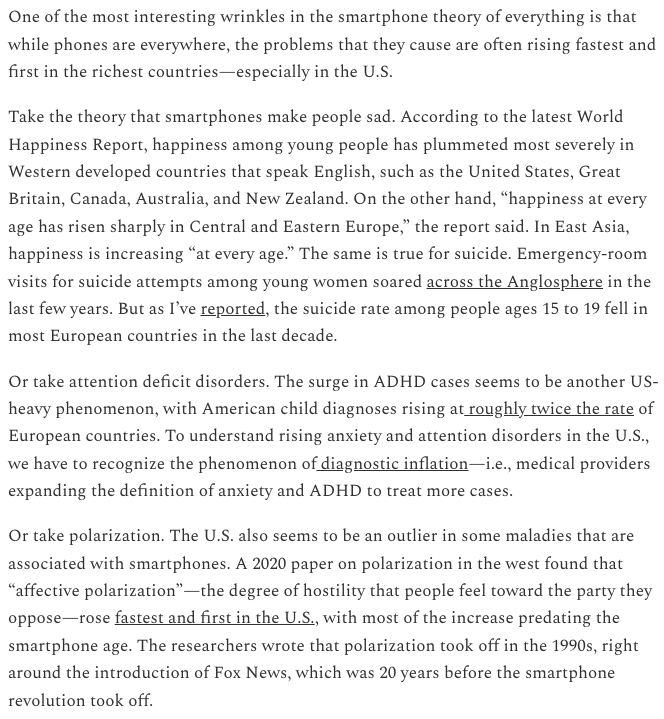
New newsletter: THERE'S SOMETHING VERY WEIRD ABOUT PHONES AND AMERICA The most interesting thing about the Smartphone Theory of Everything is that it's really a Smartphone Theory of Everything in America and the English-Speaking World. While phones are everywhere, the problems that they cause are often rising fastest and first in the richest countries, especially in the U.S. Youth sadness? Surging in the Anglosphere, but almost nowhere else. Attention disorders? Skyrocketing in the U.S., but not Europe. Populism, distrust, polarization? Much larger effects in the U.S. than other countries. The version of the SToE that is most defensible given the best data we have is something like this: Compulsive phone use along with under-regulated social media produce widespread youth anxiety, attention issues, polarization, populism, and institutional distrust in: 1. highly individualistic societies, with 2. a culture of diagnostic inflation [i.e., expanded diagnostic guidelines for anxiety and ADHD], plus 3. negative-affect prevalence [i.e., people online constantly talking about their anxiety and ADHD], and finally 4. high levels of negativity in their news ecosystem ... and post-2010 America was simply the first and most dramatic example of all these ingredients coming together.
Derek Thompson tweet media
English
38
93
676
103.2K
Malcolm Harris
Malcolm Harris@BigMeanInternet·
@DKThomp Why be blurry? Why not be open, honest, and specific? I use AI the way you describe with search, not as a full replacement but I'll ask it to give me the most cited books on a topic. Just free tier. Any more than that'd feel like I'm sabotaging my work quality. What about you?
English
3
1
56
6.3K
Derek Thompson retweetledi
Carl Quintanilla
Carl Quintanilla@carlquintanilla·
Four-byline alert: 🚨 “.. A broker for Pete Hegseth, the US defence secretary, attempted to make a big investment in major defence companies in the weeks leading up to the US-Israeli attack on Iran, according to three people familiar ..” @FT ft.com/content/744ea8…
Carl Quintanilla tweet media
English
269
2.2K
4.7K
572.1K