
Devin Thorne

5K posts

Devin Thorne banner
Devin Thorne

Devin Thorne

@D_Thorne

Researching China. On here for news, analysis, and ideas to look into.

Katılım Ekim 2017
795 Takip Edilen2.8K Takipçiler
Sabitlenmiş Tweet
Devin Thorne
Devin Thorne@D_Thorne·
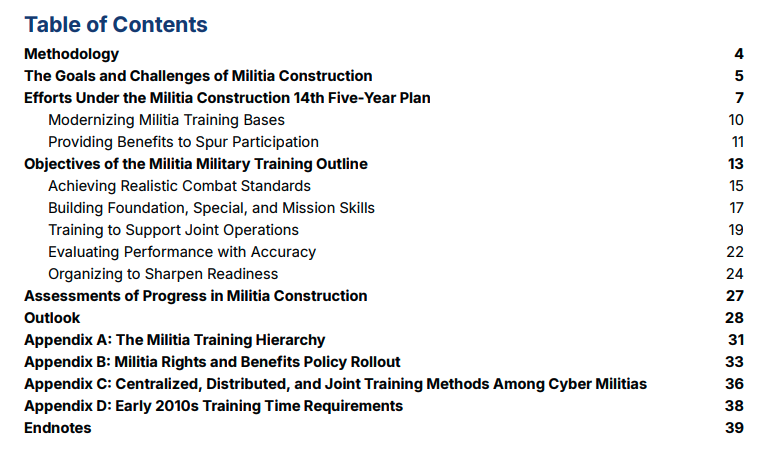
🚨 NEW RESEARCH — The ability of China’s militia forces to support the People’s Liberation Army (PLA) across all domains is likely improving. My latest explores war-oriented militia training reforms since 2018 1/x (link and key findings below)
Devin Thorne tweet mediaDevin Thorne tweet mediaDevin Thorne tweet mediaDevin Thorne tweet media
English
1
19
33
4.3K
Devin Thorne
Devin Thorne@D_Thorne·
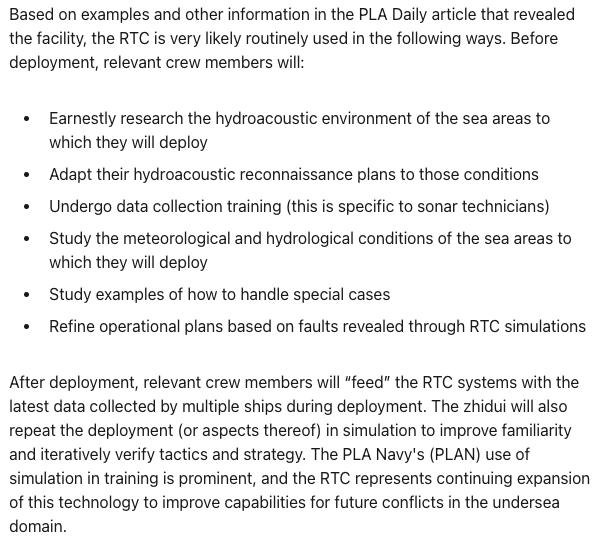
The Southern Theater Command Navy 9th Destroyer Zhidui has likely set up a new facility to centralize data from ship sensors and enable simulation-based training, red-blue confrontation exercises, & operational planning for anti-submarine warfare. Link to my short write-up below
Devin Thorne tweet mediaDevin Thorne tweet media
English
1
6
12
530
Devin Thorne retweetledi
Matthew James Brazil
Matthew James Brazil@matthew_brazil·
I’ve consolidated my recent writing and research on Chinese intelligence, technology transfer, and influence operations into a single site: mattbrazil.com The material is intended as a resource for policymakers, analysts, and business leaders…
English
1
9
28
2K
Devin Thorne retweetledi
Jonathon P Sine
Jonathon P Sine@JonathonPSine·
An interactive website of warfare across Chinese imperial history. 3,735 battles geolocated and split by dynastic period. Drawn from the PLA Press' comprehensive chronology of Chinese warfare (中国历代战争年表) All data on site: chinawarfare.pages.dev
Jonathon P Sine tweet media
English
8
138
585
47.7K
Devin Thorne retweetledi
Institute for the Study of War
NEW: Silent Shadows: Tracking Disguised PRC Vessels In The Taiwan Strait And South China Sea People’s Republic of China (PRC) incursions pose an ongoing and increasing threat to Taiwan, its outlying islands, and the South China Sea. The PRC uses disguise and concealment to confuse its adversaries, conduct sabotage and surveillance, clutter the information space, and ultimately set the conditions for further aggression. “Dark fleets” and disguised vessels lay the groundwork for maritime incursions that risk sparking military tensions at critical flashpoints.
Institute for the Study of War tweet media
English
31
114
318
157.5K
Devin Thorne retweetledi
Andrew Erickson 艾立信
Andrew Erickson 艾立信@AndrewSErickson·
My statement for the record—an #OpenSource assessment of #China’s #Undersea #Warfare—is live on the @USCC_GOV website: uscc.gov/sites/default/… Honored to support #USCC’s Hearing on “Part of Your World: U.S.-China Competition Under the Sea”! uscc.gov/hearings/part-… My statement represents my personal views but draws on the @NavalWarCollege @ChinaMaritime Studies Institute’s 20+ years’ research in this area, with many links to #CMSI’s recent work & highlighting of our latest conference volume—Chinese Undersea Warfare: Narrowing the Gaps (#NavalWarCollege Press, forthcoming 2026). As part of the world’s most dramatic military buildup in general—& naval buildup in particular—since World War II, China is engaged in the most dramatic large-scale improvements in undersea capabilities since the Cold War. This is driven in part by the uniquely powerful efforts of PRC paramount leader Xi Jinping, the world’s foremost navalist statesman today & the greatest navalist head of state since World War II. Under Xi’s ambitious direction, China’s Navy has acquired 2 new layers of strategy, the 1st additions since the service received its inaugural service-specific strategy in 1986. In 2015 Beijing officially affirmed that China’s Navy had acquired a 2nd layer of strategy: “Far Seas Protection,” to safeguard burgeoning PRC overseas interests. By 2018, China’s Navy had acquired a 3rd layer of strategy: “Near Seas Defense, Far Seas Protection, [Global] Oceanic Presence, & Expansion into the 2 Poles.” While this latest strategic layer is currently being operationalized, it is already clear that the undersea domain & seabed are receiving unprecedented PRC emphasis. China’s Navy already has by far the world’s largest fleet, with >400 battle force ships including >60 submarines. Notably, continued modernization of China’s submarine force includes a possible shift to focusing on the production of nuclear-powered submarines only—the absolute global gold standard. A related element to watch will be the Type 041 Zhou-class SSN, produced not at Huludao but in Wuhan’s recently-relocated-&-expanded Wuchang Shipyard & powered by a micro nuclear reactor. If China has successfully resolved the issues responsible for the 1st hull’s pierside sinking, a rapid & numerically significant buildout of these relatively small & affordable submarines may ensue, giving China’s Navy a set of all-nuclear-powered platforms ideally suited for lurking quietly in the Near Seas & performing anti-submarine warfare (ASW) there. China is relentlessly transforming the undersea domain from a longstanding U.S. overwhelming advantage into a contested battlespace through a comprehensive, system-level buildup that extends well beyond submarines to include seabed sensors, oceanographic research, & military-civil fusion-enabled infrastructure. While the United States retains clear qualitative advantages in submarine stealth, operational experience, & global reach, these margins are eroding as China fields a growing, mission-focused force optimized for regional sea denial—particularly within the First Island Chain—alongside rapidly improving ASW capabilities & an emerging, more survivable sea-based nuclear deterrent. China does not believe it needs to match U.S. global undersea dominance to achieve its objectives; it rather believes that it needs only to secure localized advantage sufficient to deter or undercut U.S. intervention, especially in a Taiwan contingency. Accordingly, the central strategic risk is not immediate parity, but rather the steady narrowing of U.S. advantages in the very theater where they would matter most. This underscores the urgency of sustaining undersea superiority; reinforcing allied integration; investing in resilient, distributed sensing & strike capabilities; & exploiting remaining PRC vulnerabilities.
English
1
11
22
3.7K
Devin Thorne retweetledi
Jean Christopher (Chris) Mittelstaedt
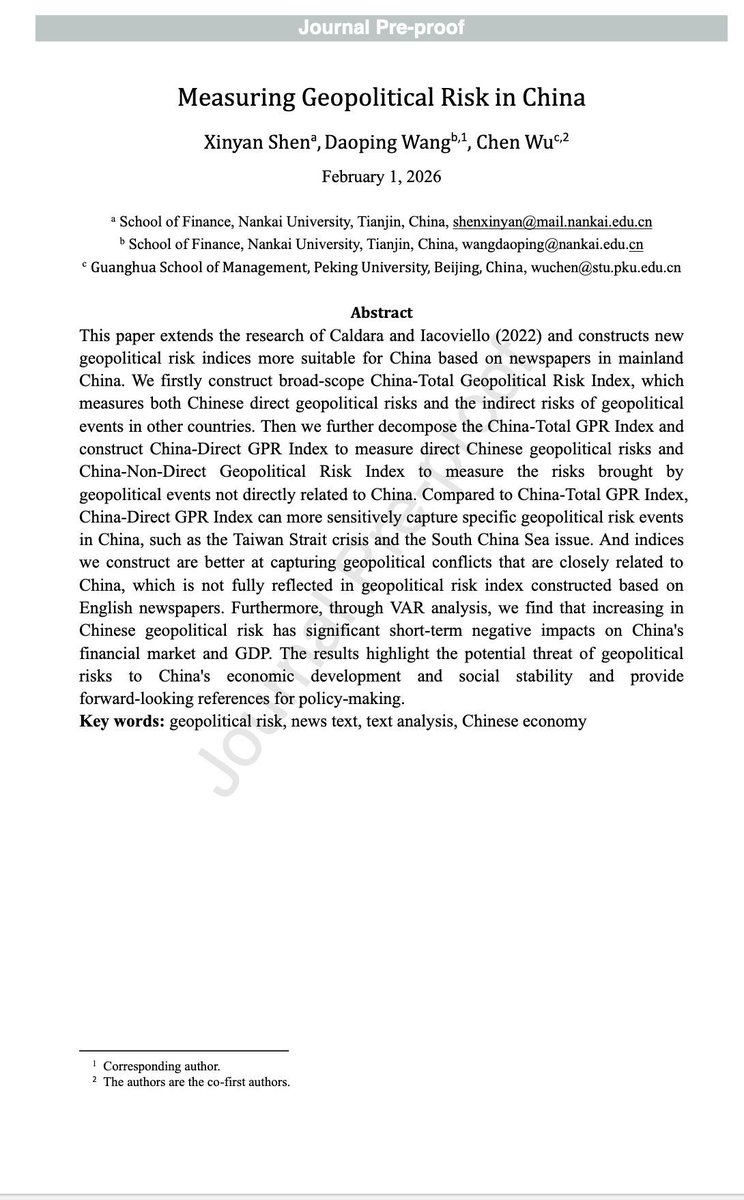
"This paper constructs new geopolitical risk indices more suitable for China based on newspapers in mainland China and analyzes the impact of geopolitical risk on China's macroeconomy"
Jean Christopher (Chris) Mittelstaedt tweet media
English
2
3
30
2.1K
Devin Thorne retweetledi
Paul Huang
Paul Huang@PaulHuangReport·
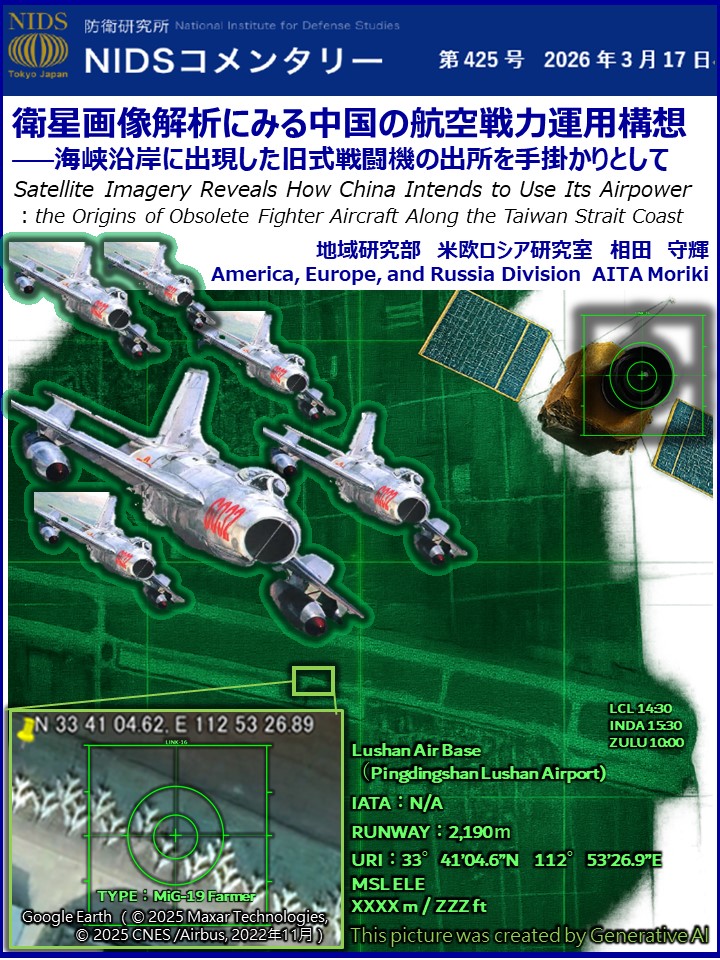
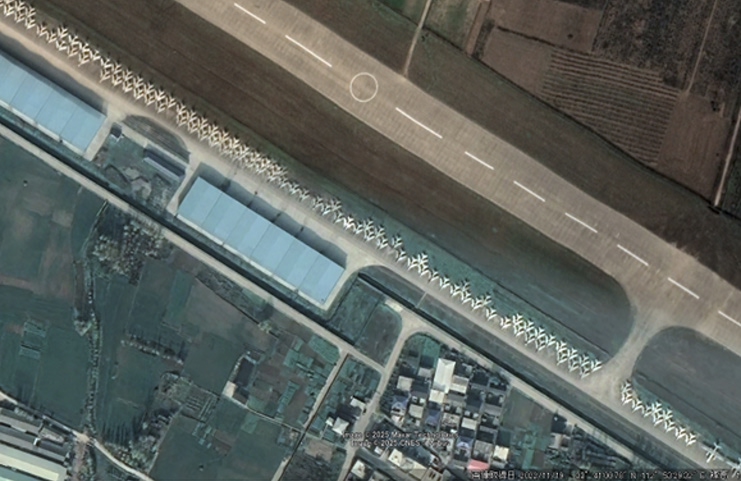
New report by Aita Moriki, of Japan's Institute for Defense Studies @Nids1952 under @ModJapan_jp, shows China has converted en masse outdated J-6 jets into unmanned suicide drones that could exhaust Taiwan's air defense missiles at the beginning of a war. nids.mod.go.jp/publication/co…
Paul Huang tweet mediaPaul Huang tweet media
English
21
176
552
148.7K
Devin Thorne retweetledi
China Media Project
China Media Project@cnmediaproject·
In case you missed it — have a read through our recent report "The Great Broadcasting Retreat" on how China is shutting down hundreds of local TV and radio channels. And rebuilding its propaganda apparatus online. lingua-sinica.org/the-great-broa…
China Media Project tweet media
English
1
31
48
4.1K
Devin Thorne retweetledi
James Leibold
James Leibold@jleibold·
Check out this new tool propagandascope.org created by the wonderfully talented @Soyonbo1 Borjgin. It scans 20 regional newspapers revealing real-time propaganda trends. Essential for understanding the CCP's messaging.
English
1
7
12
1.3K
Devin Thorne retweetledi
U.S.-China Commission
U.S.-China Commission@USCC_GOV·
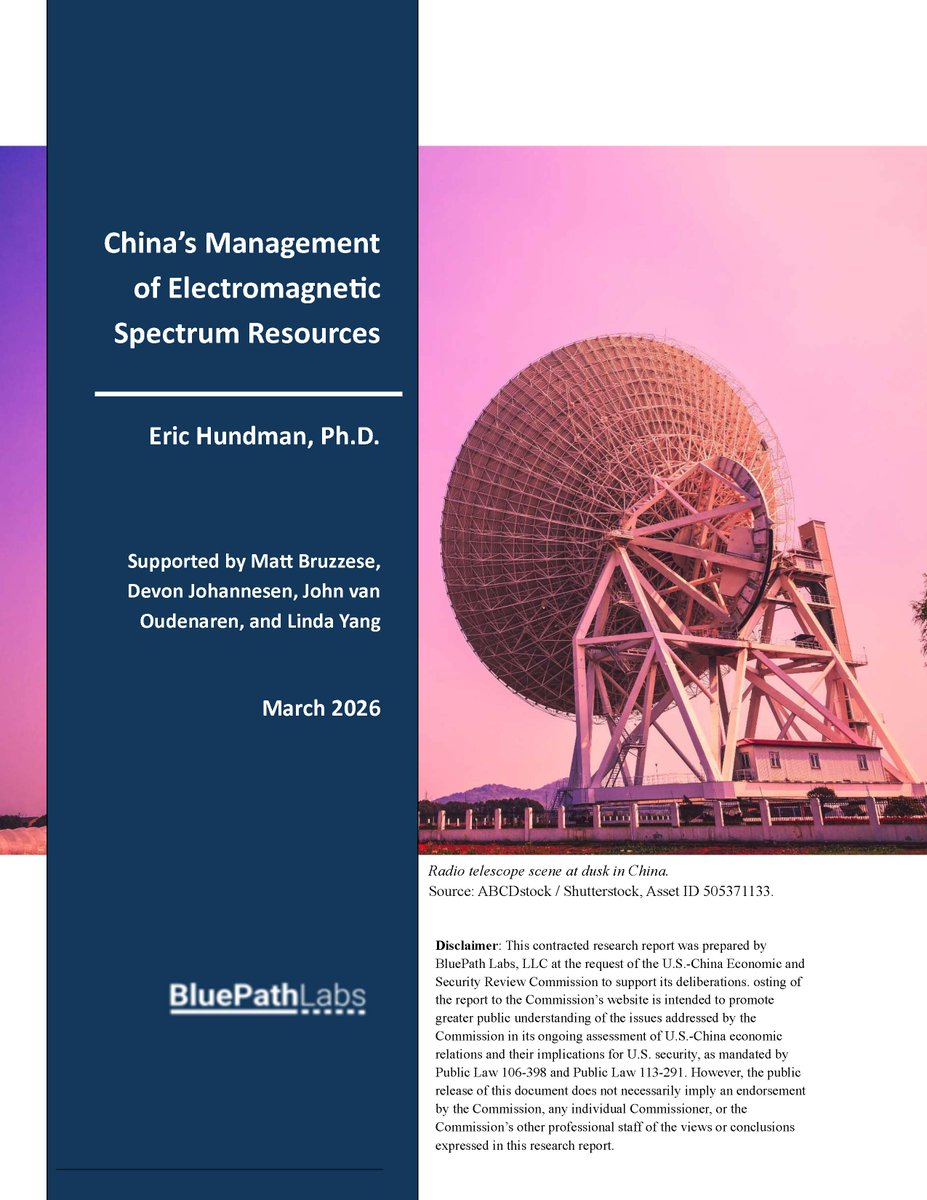
📡New: China’s Management of Electromagnetic Spectrum Resources EM spectrum is an increasingly important arena of economic statecraft & military modernization in U.S.-China strategic competition, due to advancements in wireless tech. Contracted report via @BluePathLabs ⬇️
U.S.-China Commission tweet media
English
1
11
19
2.9K
Devin Thorne retweetledi
John Delury
John Delury@JohnDelury·
I recently reviewed a very interesting book for @GlobalAsiaEAF about how the US would fight China over Taiwan, and why the US military-political strategy would fail.
John Delury tweet media
English
3
13
44
6.3K
Devin Thorne
Devin Thorne@D_Thorne·
And finally my report with Zoe Haver on the PLA’s likely conceptualization of cyber operations in the Taiwan Strait and China’s whole-of-nation effort to develop cyber weapons and talent recordedfuture.com/research/from-…
English
1
1
1
379
Devin Thorne
Devin Thorne@D_Thorne·
Also my broad 2024 survey of the NDMS for @USCC_GOV that observed organizational, procedural, and legal reforms which have likely strengthened/are strengthening the system uscc.gov/sites/default/…
English
1
1
1
380
Devin Thorne
Devin Thorne@D_Thorne·
Excited to find four of my publications cited in INDSR’s 2025 assessment of CCP politics and military! Three on China’s national defense mobilization system (NDMS) and militia forces, and one on PLA strategic thinking re:cyber coercion and warfare indsr.org.tw/respubcationme…
English
1
4
10
1.3K