Dan Poore

105 posts

Dan Poore

Dan Poore

@DanPooreX

Commercializing Generative Infrastructure

Katılım Şubat 2026
232 Takip Edilen68 Takipçiler
Dan Poore
Dan Poore@DanPooreX·
This is exactly right about Apple’s strategy. But it also exposes the next bottleneck. Running models locally solves: • latency • privacy • cost What it doesn’t solve is coordination. Because once AI moves on-device, you don’t get one model. You get millions of independent intelligence nodes: • phones • wearables • vehicles • edge devices Each with its own context, state, and decisions. The hard problem becomes: how those nodes work together. How does: • your phone coordinate with cloud models when needed • your personal AI interact with enterprise systems • multiple agents collaborate across devices and environments • context persist across sessions, apps, and networks Apple can own the gateway. But it doesn’t automatically own the system. And the system is where the real leverage is. Because the future isn’t: cloud vs device. It’s: distributed intelligence that has to operate as one coherent system. That’s the layer that doesn’t get solved by better chips or on-device models. And it’s exactly where BeacenAI sits. Not competing with Apple’s distribution. Making millions of intelligent nodes actually work together. #AIInfrastructure #EdgeAI #AgenticAI
English
0
0
1
21
Milk Road AI
Milk Road AI@MilkRoadAI·
Apple’s AI plan is way DARKER and SMARTER than you think. And @GavinSBaker explained why. He says the real bear case for this AI boom isn’t a bubble or a recession, it’s your iPhone. Baker says in 3 years, a bulked up iPhone will be able to run a pruned version of a frontier model. Think future Gemini, Grok, ChatGPT at 30–60 tokens per second, on device, no cloud is needed and it’s free. That’s exactly Apple’s strategy, don’t win the model war, become the distributor of AI. Make it private, local and safe and if that happens, most everyday AI use rewriting, summarizing, basic reasoning never touches a data center. The AI capex boom gets cut off at the source and model builders become interchangeable and apple owns the gateway. That’s the bear case Gavin is warning about. The real threat to the AI boom isn’t that the models fail, it’s that Apple makes them run on your phone and keeps all the power for itself.
Milk Road AI@MilkRoadAI

Apple just declared war on every AI company and handed them all the keys to the iPhone. For years, Apple kept Siri locked down like a fortress, one partner, one deal, and everyone else left outside the gates but that exclusivity just died. But first, understand why Apple had to do this. While Amazon, Microsoft, Google, and Meta have been spending tens of billions every quarter building AI infrastructure, Apple has been spending almost nothing. Amazon's capex is up 42% year over year, Microsoft is up 89%, Alphabet up 95% and Meta up 48%. Meanwhile, Apple? Down 19%. Apple is not in the AI infrastructure arms race and it refuses to be and that gap in spending is now showing up as a gap in capability. So Apple chose a different move entirely. It is building something called extensions inside iOS 27. A new system that lets any AI chatbot, Claude, Gemini, Grok, Perplexity, Copilot plug directly into Siri. Users open their Settings, see a menu of every AI service they have installed, toggle them on, and suddenly Siri becomes a front door to every major AI in the world. Apple isn’t choosing a winner, it’s turning Siri into the marketplace where everyone competes. Here’s the genius part, Apple can’t outspend Amazon on data centers or Microsoft on model training so it’s not even trying. But Instead, it is letting those companies spend the billions and then charging them rent to reach iPhone users. Think about what this means financially, Apple already takes a cut of ChatGPT subscriptions when users sign up through the App Store. Now multiply that by every AI company on the planet competing for iPhone users. Apple loses nothing while it collects from everyone. Apple is also separately building a new version of Siri powered by Google Gemini's underlying models, a deeper technical arrangement. The Extensions system does not replace that deal but rather lives alongside it. So Apple's full strategy looks like this, build its own AI. Power Siri with Google's models behind the scenes. Let every other AI compete in an open marketplace it controls and take a cut of every subscription. What a Genius move.

English
22
66
544
131.5K
Dan Poore
Dan Poore@DanPooreX·
This is a powerful framing, but it leaves out something critical. 100% signal at the individual level doesn’t scale by itself. At the scale Musk is operating, the real question isn’t how focused the leader is. It’s how coherent the system becomes. Because Tesla, SpaceX, xAI, Optimus aren’t just companies. They’re interdependent systems: • energy → compute • compute → intelligence • intelligence → robotics • robotics → manufacturing • manufacturing → more infrastructure That loop only works if the signal propagates across the system, not just inside one person. And that’s the real bottleneck most people are missing. Not vision Not drive Not even physics It is coordination, because once you move beyond a single company or product, you’re no longer executing a vision. You’re orchestrating: • thousands of agents • millions of decisions • across physical + digital environments • in real time No human, not even Musk, can directly manage that layer. The next phase isn’t about 100% signal leaders. It’s about building systems where the signal persists without them. That’s the real frontier. And it’s exactly where the execution layer becomes decisive. beacen.com #AIInfrastructure #AgenticAI #besties
English
0
0
4
1.3K
Dustin
Dustin@r0ck3t23·
Kevin O’Leary worked directly for Steve Jobs. Sat across from him. Watched the process at point-blank range. Then told you there is only one person on Earth who exceeded him. O’Leary: “The only other person that I’ve seen that has a higher ratio than that is Elon Musk. He has no noise. He is 100% signal.” Jobs ran 80/20. Eighty percent signal. Twenty percent noise. That ratio built the most valuable consumer brand in history. Changed phones. Changed music. Changed computing. Eighty percent was enough to reshape entire industries. Musk runs at 100. Not low noise. Zero. Every waking second aimed at the objective. No detour. No drift. No performance. O’Leary has sat across from thousands of founders. The most driven people on the planet. He found one who operates at that frequency. One. But the comparison does not flatter Jobs the way you think it does. O’Leary: “Not a nice guy. Not a nice guy.” Jobs would walk into a room and make every voice in it irrelevant before he opened his mouth. O’Leary: “I don’t give a shit what the students want or the parents think or anybody thinks. It’s what I want. They don’t know what they want till I tell them what they want.” When O’Leary pushed back, Jobs had one response. O’Leary: “Then fucking shut up and do what I say.” Total control. My vision. Your obedience. It worked. Nobody alive disputes that. But it worked inside a ceiling. Consumer electronics. Software. Design. One company. One product line at a time. Musk operates at 100% signal across six companies in six different industries simultaneously. Jobs demanded obedience to his taste. Musk demands obedience to physics. Jobs told the room what to think. Musk listens to the engineer closest to the problem, because that person holds the variable that changes the equation. He does not walk in and silence the room. He walks in and interrogates it. A blown prototype at SpaceX is not failure. It is data. A missed deadline is not a lack of effort. It is proof the timeline was aggressive enough to force invention. Jobs demanded control and got beautiful products. Musk demands exploration and gets rockets that land themselves, cars that drive themselves, and chips that think for themselves. The difference is not temperament. It is scale. Jobs changed how people use technology. Musk is changing whether the species survives. Most people have not caught up to what that sentence means. AI is rewriting every industry on the planet. Truth itself is becoming negotiable. This is the window. Wrong hands at the controls and open society does not recover. Musk bought a platform and turned it into a public square. He is building the AI. The energy. The rockets. The satellites connecting the planet. The robots that will reshape labor. The media calls him reckless. Dangerous. Uncontrollable. They are right about one of those. He is uncontrollable. By them. He does not answer to editorial boards. Does not answer to regulators who want to slow the future to a pace they can manage. Does not answer to competitors who would rather he stopped building so they could catch up. He answers to physics. To timelines. To the math of a species that does not get a second attempt. The rarest combination on Earth is not intelligence and drive. It is intelligence, drive, and the willingness to let the mission burn through everything else. Jobs built a company people loved. Musk is building the floor beneath a civilization that has not noticed the ground is shifting. 100% signal. Zero noise. History is not going to produce this combination twice. It was not supposed to produce it once.
English
147
1.2K
5K
266.9K
Dan Poore
Dan Poore@DanPooreX·
This is directionally right. But merging the companies isn’t the unlock. Coordinating the system is. Owning energy, compute, robots, satellites, and models doesn’t automatically create advantage. It creates complexity. At that scale you’re not managing a company anymore. You’re managing: • distributed energy grids • autonomous vehicles and robots • orbital compute • real-time global communications • multiple specialized AI systems That’s not a corporate structure problem. That’s an execution problem. Because the bottleneck isn’t: who owns the assets. It’s: how those assets operate together in real time. Without that layer, you don’t get a “full-stack intelligence machine.” You get silos with shared branding. The winning architecture isn’t one monolithic company. It’s a system that can: • route tasks across different models • coordinate physical + digital systems • enforce constraints across environments • adapt as each layer evolves independently In other words: orchestration beats integration. That’s the layer most people are missing. And it’s exactly where BeacenAI sits. Not replacing Tesla, xAI, or SpaceX. Making a system like that actually work at scale. #AIInfrastructure #AgenticAI
English
0
0
2
452
Anthony Pompliano 🌪
Anthony Pompliano 🌪@APompliano·
🚨 The Case for Merging SpaceX, xAI, and Tesla The real play isn't three separate companies. It's one unstoppable system: Tesla + xAI + SpaceX. Energy. Compute. Manufacturing. Robots. Data at planetary scale. Global satellite distribution. And literal access to space. Tesla already owns the intersection of batteries, vehicles, Optimus bots, and a massive distributed energy + compute grid. Every car on the road is a rolling data node. Every Megapack is energy infrastructure. Add xAI and suddenly Tesla becomes a vertically integrated AI powerhouse with proprietary real-world data no one else can touch. That's the rocket fuel for frontier models. Now layer in SpaceX. Starlink gives you a global communications blanket. Rockets solve the ultimate constraint: getting massive compute and power into orbit. Put it all together and you have something nobody else can copy: full-stack industrial intelligence. Energy generation and storage. Physical hardware and distribution. Global comms. Launch capability. And the smartest AI models on Earth. Apple, Microsoft, Google? They don't own this stack. Not even close. Capital-wise, it gets even better. Tesla starts throwing off cash. SpaceX has long-duration contracts and Starlink revenue. xAI brings the explosive upside. One entity means smarter capital allocation instead of three separate balance sheets fighting for resources. And the narrative? Markets pay huge premiums for category kings. Right now investors have to stitch Musk's vision together themselves. A unified company hands them one clean bet on an AI-powered, energy-abundant, multi-planetary future. Yes, there are risks: execution complexity, valuation fights, regulatory heat, and serious key-man exposure. Merging won't be clean. But the upside is wildly asymmetric. Tesla shareholders get instant exposure to AI and space. SpaceX holders get liquidity and manufacturing muscle. xAI backers plug straight into real-world data, distribution, and capital. This isn't just a bigger company. It's the first true full-stack intelligence machine. Capturing energy, turning it into intelligence, deploying it through physical products, and beaming it around the planet (and eventually beyond). If the mission has always been to build the future faster, combining these three might be the single biggest accelerator. What do you think? Inevitable or too crazy?
English
113
110
931
61.4K
Dan Poore
Dan Poore@DanPooreX·
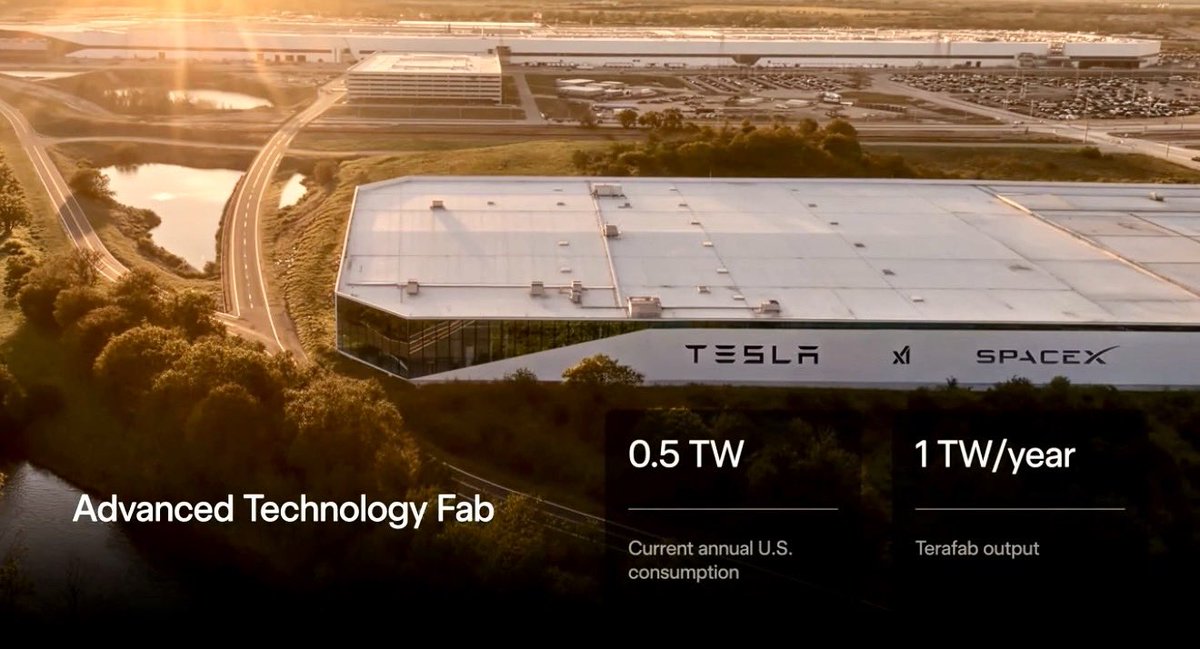
This isn’t about chips. It’s about recursion. And recursion only works if the system can coordinate itself as it scales. Terafab → Starship → Optimus → satellites → replication That loop doesn’t break because of compute. It breaks because of orchestration. At that scale you’re not managing: • machines • factories • supply chains You’re coordinating: • autonomous agents • distributed compute systems • resource extraction • manufacturing loops • energy allocation • decision systems operating without human latency That’s not a hardware problem. That’s an execution layer problem. Because once the system leaves Earth, you lose: • centralized control • human oversight • real-time intervention The only thing that matters is whether the system can: • coordinate itself • preserve context across nodes • enforce constraints • adapt without breaking the loop In other words: Whether intelligence can operate as a system. That’s the missing piece in almost every discussion about this. Not chips. Not rockets. Not robots. Execution infrastructure. The layer that allows distributed intelligence to act coherently across environments, systems, and time. That’s exactly where BeacenAI sits. Not building the machines. Making the system actually work as it scales. #AIInfrastructure #AgentEconomy #AI
English
1
0
0
84
Shanaka Anslem Perera ⚡
Everyone is covering Terafab as a chip factory. It is not a chip factory. Last night in Austin, Elon unveiled a facility that makes masks, fabricates chips, and tests them inside a single building with a nine-month recursive improvement cadence. No such loop exists anywhere else on Earth. Then he told you 80% of the output goes to space. Then he showed you a 100-kilowatt AI satellite with solar panels and radiators, scaling to megawatt range. Then he said Optimus plus photovoltaics will be the first von Neumann probe, a machine capable of replicating itself from raw materials found in space. Nobody connected the sequence. Terafab produces 1 terawatt per year of compute. The entire United States consumes 0.5 terawatts of electricity. Musk is building a single factory whose output in AI silicon exceeds twice the power consumption of the country it sits in. And he is sending 80% of it off-planet because Earth literally cannot power what he is building. Follow the mechanism. Terafab seeds the chips. Starship launches Optimus robots and solar arrays at 100 million tons per year. The robots mine lunar and asteroid regolith for silicon, iron, and nickel. They 3D-print more robots. They fabricate more solar panels. They assemble more AI satellites. Each satellite runs hotter-burning D3 chips designed specifically for vacuum, where free radiative cooling eliminates the thermal constraints that strangle every terrestrial data center on the planet. The nodes replicate. The replication is exponential. This is a Dyson Swarm bootstrap hidden inside a semiconductor announcement. The math is public. The Sun outputs 3.828 times 10 to the 26th watts. A 2022 paper in Physica Scripta calculated that 5.5 billion satellites at 290 kilograms each, robotically manufactured from Mars resources, capture enough solar energy to meet all of Earth’s power needs within 50 years. A 2025 paper in Solar Energy Materials calculated a partial swarm capturing 4% of solar output yields 15.6 yottawatts, roughly a billion times current human civilization’s total energy budget. Musk just announced the factory that builds the chips that go inside the satellites that replicate themselves forever. 92% of advanced logic chips are fabricated in Taiwan. One factory in Austin does not fix that. But one self-replicating system seeded by that factory, launched by the only company with reusable heavy-lift rockets, assembled by the only humanoid robot in mass production, and powered by the only star within reach, does not fix a supply chain. It obsoletes the concept of supply chains entirely. The market priced this as a $20 billion capex story about semiconductor independence. The actual announcement was the engineering blueprint for Kardashev Type II. Humanity sits at 0.73 on the Kardashev scale. 18 terawatts. The distance between here and harnessing a star is not a technology gap. It is a recursion gap. And recursion is exactly what a single building in Austin that makes its own masks, builds its own chips, tests its own chips, and launches the output into orbit on its own rockets was designed to close. Every civilization that makes it past this point never looks back.
Shanaka Anslem Perera ⚡ tweet media
SpaceX@SpaceX

TERAFAB: the next step to becoming a galactic civilization Together with @Tesla & @xAI, we're building the largest chip manufacturing facility ever (1TW/year) – combining logic, memory & advanced packaging under one roof

English
487
1.8K
9.1K
995.4K
Dan Poore
Dan Poore@DanPooreX·
This is directionally right — but it’s missing something critical. Vision alone doesn’t build the future anymore. Execution does. And execution has changed. The reason most companies “manage” instead of build isn’t a lack of ambition. It’s that the systems required to build at scale have become too complex: • too many tools • too many systems • too many dependencies • too much fragmentation So organizations default to optimization instead of creation. Musk solved this one way: vertical integration. Control the stack → reduce complexity → move faster. But that approach doesn’t scale across the entire economy. Not every company can build its own chips, factories, satellites, and AI models. So a different path has to emerge. Not more vision. Not more models. Better execution infrastructure. Systems that allow: • intelligence to coordinate across workflows • agents to operate across fragmented systems • decisions to move from idea → action without friction • organizations to build without owning the entire stack That’s the missing layer. Musk builds vertically to escape fragmentation. The rest of the world will need infrastructure that makes fragmented systems behave like one. That’s exactly the problem BeacenAI is focused on. Not just helping people think about the future. Helping them actually build it. #AIInfrastructure #AgentEconomy
English
0
0
1
38
Dustin
Dustin@r0ck3t23·
Elon Musk just explained why he builds everything he builds. One sentence. No strategy deck. No market thesis. Just the simplest idea nobody in power believes anymore. Musk: “Life cannot just be about solving one miserable problem after another. That can’t be the only thing.” That single sentence is a direct indictment of every institution and every corporation that turned human existence into damage control. We don’t build anymore. We manage. We mitigate. We reduce. We slow the bleeding. The whole system got rewired to believe the ceiling is making things slightly less terrible. Musk refuses to live under that ceiling. Musk: “There need to be things that inspire you, that make you glad to wake up in the morning and be part of humanity.” This is what separates him from every other CEO on the planet. They optimize for quarterly earnings. He optimizes for the feeling of being alive. That sounds soft until you realize it’s the force behind the most aggressive infrastructure buildout in modern history. SpaceX. Tesla. Neuralink. Optimus. xAI. Five companies. One philosophy. Build a future that doesn’t require convincing people to tolerate it. Musk: “Earth is the cradle of humanity, but you cannot stay in the cradle forever.” He’s quoting Tsiolkovsky. A Russian rocket scientist who dreamed about space before airplanes existed. That quote sat in textbooks for a century. Professors taught it. Students memorized it. Nobody acted on it. Musk did. Not with papers. Not with proposals. With metal. With fire. With rockets that land themselves on drone ships in the middle of the ocean. Musk: “It is time to go forth, become a star-faring civilization, be out there among the stars, expand the scope and scale of human consciousness.” Every critic reads that and calls it grandiose. Slow down. Be realistic. Focus on what’s in front of you. That instinct is exactly why nothing worth remembering has come out of a boardroom or a government office in decades. The people running the world have no vision for where it should go. They only know what they’re afraid of. Musk builds toward something. Everyone else builds away from something. That gap doesn’t close. Musk: “I find that incredibly exciting. That makes me glad to be alive. I hope you feel the same way.” You don’t get people to work 100-hour weeks building rockets by paying them more. You don’t get engineers to leave Google for a factory in Texas with stock options alone. You do it by giving them something worth building. That’s the weapon nobody can replicate. Not Bezos. Not any government. Not China. You can copy the engineering. You can steal the business model. You cannot copy the belief that tomorrow should be better than today when every voice in the room is telling you to settle. The entire world is being told to shrink. Use less. Want less. Expect less. One man looked at all of it and said no. That’s not arrogance. That’s the only reason the species is still pointed forward.
English
62
241
999
92.4K
Dan Poore
Dan Poore@DanPooreX·
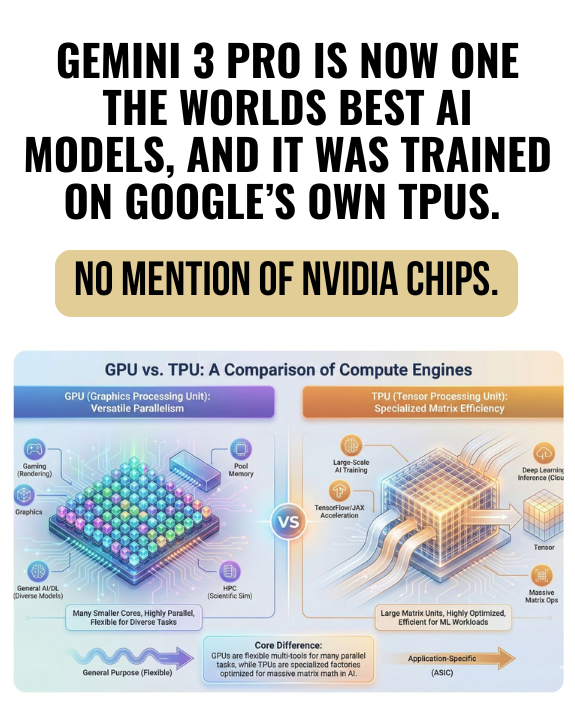
This is a real shift, but not for the reason most people think. Vertical integration absolutely matters at the compute layer. Custom silicon - tighter optimization - better performance per watt - faster iteration loops That’s a real advantage. But it doesn’t solve the bottleneck that’s emerging one layer up. Even if Google, OpenAI, and others fully vertically integrate…the models are still fragmenting. Different systems dominate different tasks. Which means enterprises won’t standardize on one stack, they’ll use many. That creates a new problem: Not compute… Coordination. How do you: • route tasks across different models • preserve context between them • avoid locking your workflows into one vendor • integrate all of this into real operations Vertical stacks win at building intelligence. But the real leverage is shifting to the layer that can orchestrate all of them. That’s the part of the stack that doesn’t get solved by better chips. And it’s exactly where BeacenAI is focused. beacen.com Not competing with the stacks. Making them interoperable. #ArtificialIntelligence #AI #Google #Gemini #Innovation #Technology #FutureOfAI
English
0
0
0
13
Pascal Bornet
Pascal Bornet@pascal_bornet·
Google’s Gemini 3 Pro is now sitting at the top of several major AI leaderboards. Not by a little — clearly ahead on LMArena, WebDev Arena, and Vision Arena. But what really caught my attention isn’t just the model performance. It’s how it was trained. Google trained Gemini entirely on its own TPUs. No NVIDIA GPUs. No external silicon. The first time we’re seeing a TPU-trained system not only compete with the strongest GPU-trained models from OpenAI, Anthropic, and xAI — but in some areas surpass them. That validates a strategy Google has been quietly investing in for years: Custom silicon. Integrated infrastructure. Full-stack AI development. In other words, the frontier of AI may no longer depend on Nvidia alone. That’s a significant shift. Do you think vertically integrated AI stacks will become the new competitive advantage in this industry? #ArtificialIntelligence #AI #Google #Gemini #Innovation #Technology #FutureOfAI
Pascal Bornet tweet media
English
3
7
7
1.2K
Dan Poore
Dan Poore@DanPooreX·
The new U.S. AI policy framework gets the big idea right: America must lead in AI without slowing innovation through heavy regulation. But there’s a critical gap. Nearly every goal—protecting children, securing infrastructure, safeguarding IP, defending free speech—assumes AI can be controlled after it runs. It can’t. AI moves too fast for enforcement through moderation, litigation, or bureaucracy. The only scalable solution is to make infrastructure itself enforce policy. That means shifting from regulating outputs to governing execution. Stateless, auditable, policy-aware environments where rules are applied in real time—before harm occurs, not after. This is Generative Infrastructure™. It is BeacenAI If AI is becoming critical national infrastructure, then infrastructure must become intelligent, enforceable, and neutral by design. That’s how you achieve dominance, safety, and freedom—without slowing down. beacen.com #AI #ArtificialIntelligence #AIPolicy #AIInfrastructure #NationalSecurity
English
0
0
2
482
David Sacks
David Sacks@DavidSacks·
I want to thank President Trump for the opportunity to work on this alongside OSTP Director Michael Kratsios, US CTO Ethan Klein, NEC Deputy Director Ryan Baasch, Senior AI Adviser Sriram Krishnan and many others on the White House team. It’s an honor. @mkratsios47 @skrishnan47
English
33
60
988
127.3K
David Sacks
David Sacks@DavidSacks·
In December, President Trump signed an Executive Order tasking us with the development of a national framework for AI, what he called “One Rulebook.” This was in response to a growing patchwork of 50 different state regulatory regimes that threaten to stifle innovation and jeopardize America’s lead in the AI race. Today we are releasing that framework. It will help parents safeguard their children from online harm, shield communities from higher electric bills, protect our First Amendment rights from AI censorship, and ensure that all Americans benefit from this transformative technology. We look forward to working with our colleagues in Congress to turn the principles we are announcing today into legislation. whitehouse.gov/articles/2026/…
English
267
533
3.7K
713K
Dan Poore
Dan Poore@DanPooreX·
This is a thoughtful breakdown — but it’s diagnosing a financial loop without naming the underlying technical bottleneck. The issue isn’t just circular capital. It’s that we’ve built an enormous amount of AI supply… without building the systems that convert that supply into real economic output. We have: • massive compute • rapidly improving models • hundreds of billions in infrastructure What we don’t have yet is deployment at scale across real workflows. That’s why revenue lags. Not because AI isn’t valuable — but because intelligence isn’t being operationalized. The missing layer is execution. Systems that can: • coordinate agents across workflows • integrate with real enterprise processes • persist context across tasks and systems • enforce governance and reliability • turn model output into actual decisions and actions Until that layer exists, capital will keep cycling inside the infrastructure loop. Once it does, the economics change fast. This isn’t just a question of whether the “dam” breaks. It’s a question of whether the industry builds the execution layer in time to release the pressure. That’s exactly the problem BeacenAI is focused on. Not more models. Not more compute. Turning intelligence into operational systems that generate real value.
English
0
0
0
230
Dan Poore
Dan Poore@DanPooreX·
Dustin, thanks posting this… This is exactly the right framing, but there’s a layer missing in the stack Chamath is describing. Everyone can see: Silicon Models Applications …and the fork between software AI and physical AI. But once you actually try to deploy AI at scale, both sides hit the same wall. Not intelligence. Execution. Models don’t run businesses. They don’t coordinate workflows. They don’t persist context across systems. They don’t safely operate in real environments either digital or physical. So what actually emerges between models and applications is a new layer: The execution / orchestration layer. The system that: • coordinates agents across workflows • preserves state across models and environments • enforces governance and policy • routes tasks to the best intelligence available • bridges software AI and physical AI into one operational system That layer doesn’t sit on one side of the fork. It sits above both. Which means the real boundary in the AI stack isn’t just: models → software vs physical It’s: models → execution layer → everything else That’s where systems either scale… or break. And that’s exactly the territory BeacenAI is claiming. Not another model. Not another application. The layer that makes the entire stack actually work at planetary scale.
English
0
0
1
56
Dustin
Dustin@r0ck3t23·
Chamath Palihapitiya just laid out the precise structural framework for the next century of company formation. The market is throwing capital at random AI wrappers. The winners are mapping the exact boundaries of the new global infrastructure. Chamath: “The question is, what is the conceptual stack for AI? If it maps back to history, it’s not going to be exact, but it’s going to rhyme. There will be a conceptual stack that we will look back on and say, oh, had we seen these boundaries before, it would have explained all of the company formation and what needed to get built.” If you don’t understand exactly where your product sits in the stack, you’re going to be absorbed by someone who does. When the first internet boom happened, the OSI stack allowed companies to demarcate exactly where their territory started and ended. The same physics apply right now. Chamath: “The OSI stack was very powerful because it allowed companies to demarcate what the boundaries were. Where did they start and where did they end and then where did the next company start? And when you got those boundaries right, you had great companies get built.” You don’t win by building everything. You win by perfectly dominating one specific, impenetrable layer of the new stack. Chamath: “There’s a silicon layer. Then above it are the foundational models. Open source, closed source, world models. And then above it, I think it forks. It diverges into software AI and then physical AI.” The base layers are already locked in. Silicon and foundational models are established bedrock. The real leverage exists at the exact point where the architecture forks in two. Software AI or physical AI. That is the defining strategic decision of this era. The standard enterprise is completely confused about which side of the fork they’re building on. The winners choose one side and go all in. Either optimize the digital execution loop or aggressively capture the physical layer of the board. Straddling the line is how margins bleed out and competitors with clearer boundaries eat you alive. The greatest wealth transfer in human history won’t go to the companies with the smartest algorithms. It will go to the companies that perfectly defined their architectural boundaries. Identify the exact threshold between silicon, model, software, and physical manifestation. Build an impenetrable position within those parameters. Because the companies that know exactly where their territory ends will be the ones that determine where yours begins.
English
13
11
87
20.6K
Dan Poore
Dan Poore@DanPooreX·
Hinton is right about one thing: with neural systems, perfect interpretability is not the control surface. But that doesn’t mean the answer is blind trust. It means the industry has been looking for safety in the wrong place. The real question isn’t: “Can we fully read the model’s mind?” It’s: “Can we control how the model is deployed, tested, constrained, and audited in the real world?” That’s an infrastructure problem. In the AI era, trust won’t come from perfectly unpacking every weight. It will come from: • rigorous statistical testing • controlled execution environments • policy enforcement outside the model • continuous monitoring of outcomes • multi-system checks before action is taken In other words, the future of AI safety won’t be won at the model layer alone. It will be won at the execution layer. That’s exactly why BeacenAI matters. beacen.com Not because it claims to make black boxes transparent. Because it helps make them operable, governable, and trustworthy at scale. #AIInfrastructure #AgentEconomy
English
0
0
1
28
Dustin
Dustin@r0ck3t23·
Geoffrey Hinton just dismantled the bureaucratic obsession with perfect algorithmic transparency. The enterprise world is paralyzed because it can’t read the algorithm’s mind. That paralysis is the competitive death sentence. Hinton: “In a big neural net, I don’t think it’s ever gonna be possible to prove things about what it will do. It’s not like lines of code where you can prove things. You’ve got lines of code for doing learning, but once it’s learned, it’s just a big set of weights.” The traditional system wants to treat a neural network like a standard software update. Demanding line-by-line proof of exactly what the machine will do before they’ll touch it. But when you transition from hard-coded software to a massive neural architecture, you surrender the ability to read the code. You’re no longer auditing a program. You’re interacting with an alien cognitive entity that learned its own logic from scratch. If you refuse to deploy until you can perfectly map its internal reasoning, you’ve already forfeited the board to adversaries who are perfectly comfortable operating without that map. Hinton: “If you ask, ‘Why do you get into a taxi? Why aren’t you scared getting into a taxi?’ The answer is it’s not because I understand how the taxi driver’s brain works, and it’s not ‘cause I have guarantees on what the taxi driver will do. It’s because I have a lot of statistical information that people have used taxis a lot and very few of them have died.” The regulatory class is demanding a 100 percent mathematical guarantee of safety before they’ll allow the compute engine to scale. Absolute guarantees don’t exist in the physical universe. There is only statistical confidence. We don’t demand a complete cognitive map of every biological operator we trust with our lives. We verify the statistics. We assess the incentives. And we move. That is the geopolitical reality of this moment. There is no mathematical guarantee that autonomous superintelligence won’t make a mistake. But if the United States halts deployment to search for an impossible proof of safety, adversarial regimes will accelerate their own black-box models and capture the century while we’re still auditing ours. You don’t win by demanding a guarantee. You win by running the most rigorous safety testing on the planet and deploying the system the microsecond the statistics tip in your favor. Hinton: “I think the best we can do in having safe AI is having good safety tests that give good statistics.” We are entering an economy where the most complex problems on Earth are solved by systems we fundamentally cannot reverse-engineer. Medical diagnostics. Global logistics. Drug discovery. All executed by massive sets of weights that are structurally inexplicable to the human mind. You don’t need to understand the physics of a taxi driver’s brain to get to your destination. You verify the outcome. And you get in the car. The ones who waste the next decade trying to unpack the black box will still be auditing when the ones who accepted uncertainty own the entire board.
English
20
31
98
8.9K
Dan Poore
Dan Poore@DanPooreX·
Exactly. Tokenization solved representation. But representation without execution is just static metadata. The real problem is that assets don’t live in isolation. They exist inside: • workflows • permissions • compliance frameworks • institutional logic Until those layers move with the asset, nothing actually changes. You haven’t digitized the system. You’ve just mirrored it. What’s missing is an execution layer that can: • carry context across systems • enforce rules in real time • coordinate actions between agents and institutions That’s where this all breaks today. And it’s exactly the layer BeacenAI is being built for. Not representing assets. Making them operable. beacen.com #AIInfrastructure #AgentEconomy
English
0
0
1
16
Cristina Fuster
Cristina Fuster@Crislycai·
Representation vs. Execution Tokenization solved representation. Execution is still the bottleneck. Until assets can move with their legal and institutional layers, we’re not scaling, we’re just digitizing.
English
2
0
3
52
Dan Poore
Dan Poore@DanPooreX·
AI isn’t just software anymore. It’s moving into factories, robots, grids, and vehicles. And that changes everything. Cloud-era assumptions break in the physical world: • connectivity isn’t guaranteed • systems drift • failures are constant • latency matters • recovery must be instant You can’t run these systems on persistent infrastructure designed for web apps. They need to regenerate, not persist. The next phase of AI won’t be defined by better models. It will be defined by execution systems that can survive real-world entropy. It is beacen.com Developed over 25 years with US Navy, Army, T-Mobile, Verizon and more
English
0
0
4
172
The All-In Podcast
The All-In Podcast@theallinpod·
Travis Kalanick: Tesla is the Google of the Physical AI Era “I like to break down the physical AI stack: (it) includes computation, a physical AI model, all the things you think of.” “What about land? Development? That should be in that stack. What about chemistry? That needs to be in the stack. Manufacturing needs to be a stack.” “When you look at the stack, you're like, ‘Damn, Tesla's got this sh*t.’ They are the Google of this era.” “What I mean by that is, if you were doing a startup in the 2000s, the first question you would get is, ‘Why isn't Google gonna kill you?’ Or, ‘Why isn't Google just gonna do it?’ They’re not even gonna know that they killed you.” “And before that, it was Microsoft in the late 90s. Uber had a time, 2010s.” “But in the physical AI space, that's sort of a Tesla thing.” -------------------------------------------- Thanks to our partner for making this happen!: EY (@EYnews) Austin vibes meet AI innovation. Thanks to EY for co‑hosting with us at #SXSW. Discover what executives are saying about AI transformation in the latest AI Pulse Survey. ey.com/en_us/insights…
English
27
65
651
94.4K
Dan Poore
Dan Poore@DanPooreX·
This is a fascinating inversion. One thought: every major technological wave initially compresses duration before infrastructure rebuilds it. Railroads destroyed local monopolies before they created national ones. The internet wiped out incumbents before cloud platforms stabilized software economics. AI today feels like that early destabilizing phase. But the missing layer right now isn’t intelligence — it’s execution infrastructure. If models continue to commoditize and innovation cycles compress, durability may not come from products or brands anymore. It may come from control of the execution layer that governs: • cost structure • model routing • data sovereignty • operational resilience In other words, the companies that rebuild “terminal value” may not be the ones with the best AI — but the ones that control how AI actually runs. That layer doesn’t exist yet in a mature form. When it does, the market may start believing in duration again.
English
1
0
21
4.9K
Dan Poore
Dan Poore@DanPooreX·
Yann LeCun may be right that next-token prediction isn’t the path to real intelligence. World models that learn physics and causality could unlock robotics and autonomous systems. But if that happens, a new bottleneck appears. Not intelligence. Execution. Billions of autonomous agents running perception → planning → action loops will require infrastructure that can run deterministically across enormous distributed systems. World models may be the next step in AI. But the real challenge will be the execution architecture for planetary-scale intelligence. #AI #WorldModels #Robotics #AIInfrastructure
English
0
0
0
7
Dan Poore
Dan Poore@DanPooreX·
Everyone is arguing about which AI model wins. That’s the wrong layer. Technology revolutions rarely capture value at the breakthrough itself. Electricity → power grids Cars → highways Internet → cloud AI is heading the same direction. Models are fragmenting into specialized intelligence systems. Which means the real bottleneck becomes coordination. Millions of agents executing tasks across different models, environments, and workflows. This starts to look less like software… …and more like Uber for intelligence. The winner won’t just build the best model. They’ll build the coordination infrastructure for the agent economy. #AI #AgentEconomy #AIInfrastructure #allinpodcast
English
0
0
0
32
Milk Road AI
Milk Road AI@MilkRoadAI·
Travis Kalanick just emerged from eight years of silence. He launched a company called Atoms today and the implications are staggering. This is the man who built Uber from nothing into the most disruptive company on earth. He got pushed out, disappeared, and for eight years everyone assumed he was done. But he wasn’t done, he was building in the dark and today he revealed everything. A robotics company spanning food, mining, and autonomous transport. An empire constructed while nobody was paying attention. Here is where the story turns. Kalanick is acquiring Pronto, the autonomous haulage company built by Anthony Levandowski. That name should sound familiar because Levandowski was at the center of the biggest trade secrets war in Silicon Valley history between Uber and Google. Now Kalanick and Levandowski are reuniting again. Pronto already has autonomous trucks moving two million tons of rock at active mining sites. Kalanick confirmed on camera that he is the largest investor in Pronto and there is another layer to this. Uber itself may be funding this entire operation. Reports indicate the company Kalanick was forced out of is now preparing to back his return to autonomous vehicles. He told people privately that he wants to move faster than Waymo and faster than anyone in the self-driving space. Think about what that means. The founder who built Uber's original self-driving program is coming back with Uber's money, Levandowski's technology, and eight years of obsessive preparation. But the most interesting part is his bet against humanoid robots. Everyone in tech is racing to build machines that walk and talk like humans. Kalanick watched the humanoid Olympics in Beijing and had one thought, those machines would be vastly better with wheels. His argument is surgical. A humanoid making pancakes is absurd when a specialized machine can produce a thousand per hour. A humanoid hauling rock is a joke when an autonomous truck moves millions of tons without stopping. Atoms is not building robots that look like people. It is building robots that replace entire labor forces in mining, food production, and transport infrastructure. The manifesto on the company website reads like a declaration of war on inefficiency and he calls full physical world autonomy the beginning of a new Golden Age. A future where the cost of any physical good shrinks to raw materials plus energy.
travis kalanick@travisk

Atoms. atoms.co/vision

English
16
26
188
39.3K
Dan Poore
Dan Poore@DanPooreX·
The AI industry is confusing right now because people are looking at the wrong layer. Everyone is arguing about which model will win. OpenAI Anthropic Google xAI Bigger models. More GPUs. More data. But that’s not how technology revolutions usually play out. The real value usually emerges one layer above or below the breakthrough technology. Electricity → power grids Cars → highways Internet → cloud infrastructure AI is entering the same phase now. The models are fragmenting. One dominates coding. Another dominates reasoning. Another dominates images. Another dominates search. Another dominates simulations. Which means the future isn’t one AI. It’s a network of specialized intelligence systems. And that creates a new bottleneck. Not intelligence. Coordination. Enterprises will need systems that: • route tasks to the best model • preserve context across models • coordinate agents across workflows • prevent vendor lock-in In other words, a new layer in the stack: Energy Chips Infrastructure Models Applications …and now: AI orchestration. The companies that control that layer will sit above the model wars. That’s exactly the problem BeacenAI is built to solve. Not another model. The infrastructure that lets organizations use all of them. #AIInfrastructure #AgentEconomy #allinpodcast
English
0
0
3
89
Dan Poore
Dan Poore@DanPooreX·
Everyone arguing about which AI model will win is missing the point. The models are already fragmenting. Coding models. Reasoning models. Vision models. Simulation models. Domain-specific models. No single system will dominate all of these. Which means the real bottleneck isn’t intelligence. It’s coordination. Enterprises don’t want one model. They want the best model for each task. The problem is that the moment you build your architecture around one provider, you’re locked in. Look at what Sierra Catalina is building at Ouroboros. Your workflows break the second a better model appears. So a new layer is emerging in the AI stack: the orchestration layer. The system that: • routes tasks to the best model in real time • preserves context across different AI systems • coordinates agents across multiple models • prevents vendor lock-in In a world of fragmented intelligence, the most valuable position isn’t building the models. It’s directing the orchestra. That’s exactly the problem BeacenAI has solved. beacen.com Not another AI model. The infrastructure that lets organizations use all of them. #AIInfrastructure #AgentEconomy
English
0
0
1
226
Dustin
Dustin@r0ck3t23·
Perplexity CEO Aravind Srinivas just shattered the greatest illusion of the AI arms race. The entire market is waiting for a single, god-like superintelligence to win the entire board. The physics of compute are forcing the exact opposite outcome. Models are not converging into a single monopoly. They’re violently fracturing into hyper-specialized execution nodes. Srinivas: “Towards the end of 2025, what happened was models started specializing. Even within coding, which you think might be a specialization, OpenAI’s Codex models and Anthropic’s Claude models are very different in terms of what they’re good at.” Bet your entire enterprise architecture on a single AI provider? You’re hardcoding your own ceiling. You don’t want a generalized model that’s “okay” at everything. You want a swarm of apex specialists. One ruthlessly optimized for syntax. One for visual synthesis. One for predictive reasoning. The future is not one AI. It’s the instantaneous orchestration of the absolute best compute for the exact task at hand. Platform lock-in is suicide. Srinivas: “Enterprise users are always selecting multiple different models all the time. That’s actually one of the value propositions of the Perplexity product. You don’t have to feel locked into one model provider, you don’t have to have one horse in the race.” Traditional tech giants are desperately trying to trap users inside their specific algorithmic ecosystem. Winning operators completely bypass the vendor war by becoming model-agnostic. When the foundational intelligence of the world is leapfrogging itself every three months, brand loyalty is a massive liability. The operators winning the next decade won’t care whether OpenAI, Anthropic, or Google trained the model. They’ll plug into an agnostic orchestration layer that autonomously routes to whichever specialized network currently dominates that exact sector of the board. The highest-leverage position is no longer building the intelligence. It’s directing the orchestra. Srinivas: “This is one particular skill, writing is another skill, being good at images and videos is another skill. You can hope that Perplexity figures out which model is best for what purpose, and you just have to come to the product and use it.” Multi-trillion-dollar hyperscalers burning billions fighting the model wars. Sovereign orchestrator bypasses the entire war. Harvests the output of all of them. You don’t need to be an expert in the underlying architecture of a dozen different foundation models. You just need to command the routing engine. When AI transitions from a monolithic product into a fractured grid of specialized utility nodes, the ultimate monopoly belongs to the orchestrator that abstracts the complexity. Foundation model builders became interchangeable plumbing.
English
108
239
1.5K
385.9K
Dan Poore
Dan Poore@DanPooreX·
Most people think the AI race is about models, GPUs, and data. That’s not where the real bottleneck is emerging. The real constraint is iteration velocity. How many experiments can a lab run per week? How quickly can they test architectures, recover failed training runs, and deploy new checkpoints? The labs that win AI will not necessarily have the biggest models. They will have the fastest infrastructure feedback loops. Here’s the hidden problem: As clusters scale to hundreds of thousands of GPUs, infrastructure begins to accumulate entropy: • environment drift • inconsistent training runs • slow cluster recovery • idle GPU waste • fragile orchestration At small scale, this is manageable. At frontier scale, it becomes the dominant constraint. This is why some AI labs iterate dramatically faster than others. The real AI arms race is not just about compute. It’s about experiments per week. And at planetary scale, infrastructure entropy becomes the dominant systems problem. #AI #ArtificialIntelligence #AIInfrastructure #GPUs #MachineLearning #LLMs #SystemsEngineering
English
0
0
1
51
Dan Poore
Dan Poore@DanPooreX·
Prediction: the next generation of AI companies won’t build better chatbots. They’ll build control rooms for intelligence. Interfaces where humans and multiple AI agents coordinate work across an organization. Messaging platforms like Ouro.chat hint at where this is going. But once conversations become workflows, a new problem appears. Not intelligence. Coordination. If five agents join a conversation to: • pull data • run analysis • draft a plan • simulate outcomes • trigger actions in external systems you suddenly need infrastructure that can: – orchestrate those agents – track their decisions – maintain shared memory – enforce security and governance In other words, the future of AI collaboration isn’t just chat. It’s agent orchestration. The messaging layer becomes the interface. The real power lives in the systems that coordinate the intelligence behind it. #AIInfrastructure #AgentEconomy
English
0
0
1
24
⚪️ sierra catalina
⚪️ sierra catalina@sierracatalina·
I left xAI. & built something that moved with me as fast as the tech moves around me. the future is model agnostic. your context should travel with you. sign up for exclusive early access to ouroboros. the personalization layer. ouro.chat
English
128
49
574
96.5K
Dan Poore
Dan Poore@DanPooreX·
The “Five Layer AI Cake” is a great way to think about the industrial buildout of AI: Energy Chips Infrastructure Models Applications But once you look closely at how AI actually runs inside companies and industries, you notice something missing. A sixth layer is emerging. The execution layer. Energy powers the compute. Chips process the data. Infrastructure orchestrates the clusters. Models generate intelligence. Applications deliver value. But when intelligence is created in real time, it has to operate somewhere. It has to: • coordinate multiple models and agents • manage context and workflows • enforce security and governance • remain auditable and reliable • scale across machines, companies, and industries Without that layer, AI systems remain powerful tools for individuals. With it, they become operational systems for entire organizations. In other words: AI doesn’t just need factories that produce intelligence. It needs systems that allow intelligence to operate safely in the real world. That’s the layer we’ve built at BeacenAI over 25 years with DoD and Telco. The infrastructure for the agent economy. #AIInfrastructure #AgentEconomy
English
0
0
0
35