Nessuno

18.6K posts

Nessuno banner
Nessuno

Nessuno

@DanSeligson

“Polygamy, the Commodification of Women, and Underdevelopment.” Winner, Best Paper of 2022 by the Social Science History Association.


On-Break-from-Twitter, CA Katılım Mart 2007
1.2K Takip Edilen724 Takipçiler
Nessuno
Nessuno@DanSeligson·
@heftycharge @collision @Jon_Hartley_ Hierarchies have a unique signature. The paper is available if you’d like to read it. The one on SSRN will be updated in about a week, but upon request I’ll send you the latest.
English
0
0
0
13
Topsoil
Topsoil@heftycharge·
Respectfully I think this is overly simplistic. Humans are a bunch of incompatible systems running on undocumented hardware. The biggest incompatibility is between hierarchy and egalitarianism, both of which are hardwired. You can, with some difficulty, apply a hierarchical lens to everything, but before too long you’re just doing epicycles.
English
1
0
0
9
John Collison
John Collison@collision·
We've been thinking a lot at Stripe about the Coasean lens on AI: - The obvious near-term effect is reduced transaction costs within companies: shared context, systems of record, aligned incentives etc. - But inter-company transaction costs also reduce sharply: agents are great at discovery, make it trivially easy to integrate; make contracting much more straightforward; agent-to-agent commerce. - On net, we think second effect bigger in medium term: fewer people per firm, more output per firm, just more firms, and more coordination happening through market-like mechanisms
English
45
107
851
139.9K
Nessuno
Nessuno@DanSeligson·
Thanks for your comment. Founders, Boards of Directors, Senior VPs, VPs, Senior Directors, etc., it's all hierarchical, at Google too. Not the same as "command and control." All of Nature is this way. All of human society is this way, and for a reason. Much of this is explained in The Architecture of Complexity by Herbert Simon, 1962, and the Ur text is Exodus 18.
English
1
0
0
12
Nessuno retweetledi
Tymofiy Mylovanov
Tymofiy Mylovanov@Mylovanov·
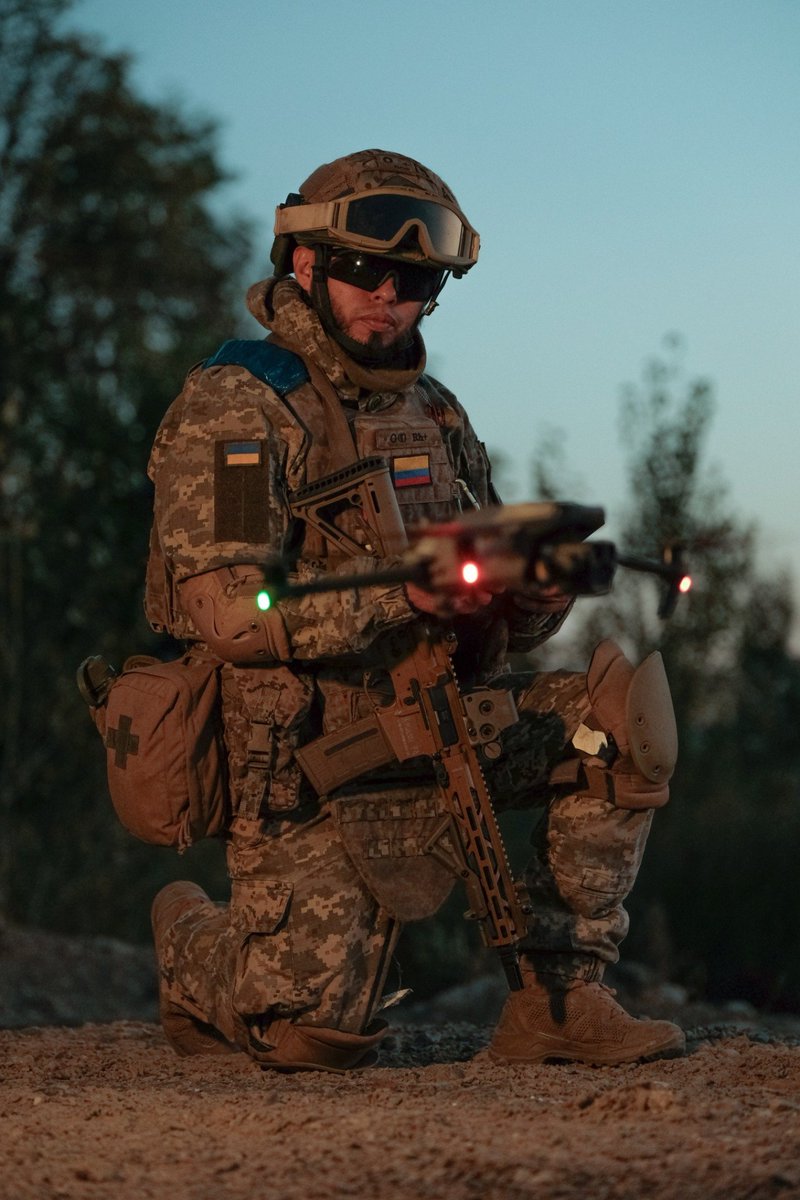
More Colombians fight on Ukraine's front than any other foreign nationality — about 7,000 men, the largest single contingent by a wide margin. Decades hunting guerrillas, paramilitaries, and cartels at home prepared them for the trenches of Donbas. — United24. 1/
Tymofiy Mylovanov tweet media
English
62
805
4.1K
196.9K
Nessuno
Nessuno@DanSeligson·
@JewishHockey It’s not that easy, which brings shame on those who try.
English
0
0
1
405
Jewish ice hockey players 📟
“A German player was in my crease during the Paralympics and was pushing in a scrum after a whistle, so I routinely I shoved him back,” Rosen remembers. “Then he looked straight at me and said, ‘Hitler should’ve killed all you Jews.’” nationalpost.com/news/canadian-…
English
8
31
157
9.3K
Nessuno retweetledi
Colin Wright
Colin Wright@SwipeWright·
The shift we all notice in Tucker is nothing more than a change in priorities from seeking truth to seeking power. And that is why it feels (and is) fundamentally "woke."
English
98
88
1.1K
22.2K
Nessuno retweetledi
John Spencer
John Spencer@SpencerGuard·
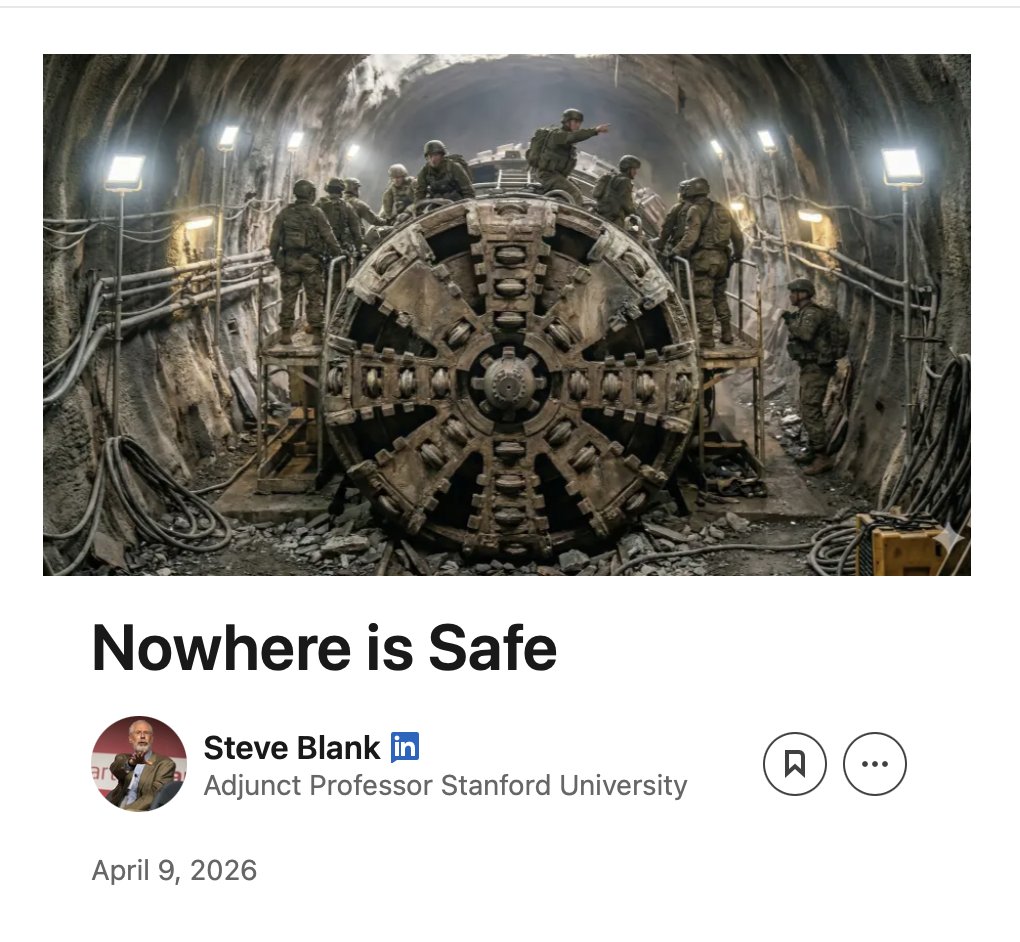
Fully agree with Steve Blank @sgblank here. The U.S. military has a long history but a modern sparse investment (time, resources, units, school, agency) in the underground in general. I've been a part of the conversation for over a decade and we still don't see it. Even in Ukraine, we talk about drones, counter-drone, nets but don't talk about the massive underground environments both Ukraine and Russia are building (article forthcoming). “the U.S. is spending $10s of billions of dollars on low-cost Counter-UAS systems – detection systems, inexpensive missiles, kamikaze drones, microwave and laser weapons. But what we’re not spending $10s of billions on is learning how to cheaply and quickly put our high-value, hard-to-replace, and time-critical assets (munitions, fuel distribution, Command and Control continuity nodes, spares), etc., out of harm’s way – sheltered, underground (or in space)….We need to rethink the nature of force protection as well as military and civilian infrastructure protection.” linkedin.com/pulse/nowhere-…
John Spencer tweet media
English
15
55
273
81.1K
Nessuno retweetledi
Nancy (NISRINE) Lakkis
Nancy (NISRINE) Lakkis@nancy_lakiss·
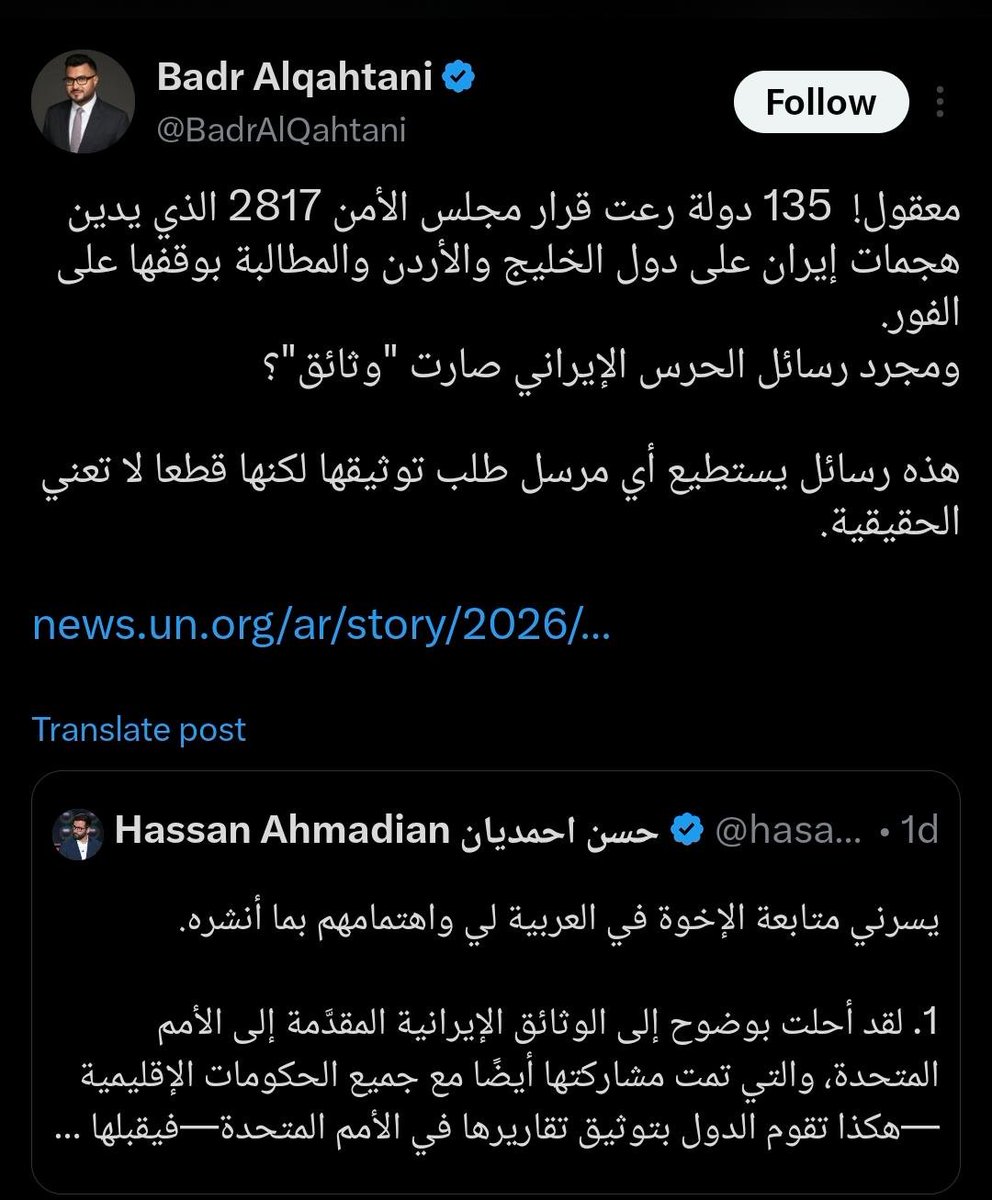
كثيرة هي التساؤلات حول السجال الدائر بخصوص "الوثائق" الإيرانية في الأمم المتحدة.. إليكم القصة باختصار: ​1️⃣ الإجماع ضد التصعيد: الحقيقة الثابتة هي صدور قرار مجلس الأمن رقم 2817 بدعم من 135 دولة، والذي يدين بوضوح الهجمات الإيرانية التي استهدفت دول الخليج العربي والأردن، ويطالب بوقفها فوراً. ​2️⃣ تزييف الحقائق: محاولة الترويج لـ "روابط" وتقارير صحفية للادعاء بأن أراضي خليجية استُخدمت للهجوم على إيران هي مجرد "بروباغندا" للالتفاف على الإدانة الدولية. في العرف الديبلوماسي، أي دولة يمكنها إرسال "رسالة" للأمم المتحدة، لكنها تبقى "ادعاءً من طرف واحد" ما لم تتبناها المنظمة الدولية. ​3️⃣ الواقع: العالم لا يعترف بـ "لينكات" مقتطعة، بل يعترف بقرار أممي وقعه ثلثا دول العالم، وضع الرواية الإيرانية في خانة العزلة والإدانة الصريحة. ​ أمن منطقة الخليج العربي خط أحمر دولي، ومحاولات قلب الحقائق عبر "رسائل إدارية" لن تمحو حقيقة أن 135 دولة وقفت ضد السلوك الإيراني المزعزع للاستقرار. ​#إيران #مجلس_الأمن #الخليج_العربي #القرار_2817
Nancy (NISRINE) Lakkis tweet mediaNancy (NISRINE) Lakkis tweet media
العربية
1
14
57
1.4K
dan linnaeus
dan linnaeus@DanLinnaeus·
How Russia pilfers Ukraine’s grain and the global push to disrupt Moscow’s laundering schemes Every commercial vessel arriving at a port submits an advance cargo manifest before berthing, but that standard prearrival declaration obviously doesn’t carry a line item that says “stolen Ukrainian grain.” It looks clean by design in Russia’s sophisticated laundering operations. Port state authorities know what is coming, who is sending it, and who is receiving it before the vessel docks through the advance manifest, and after berthing through the commercial documents submitted by the carrier. Customs get that data, such as origin field, quantity, bill of lading, consignor, consignee and so on. But this data is the thing that does the laundering, not the evidence needed to stop it. Russian origin certificates that are produced at Temryuk or Novorossiysk after a feeder vessel transferred cargo from an occupied port look clean after the loading event itself has been obscured. It's is how the manifest becomes the instrument of laundering. Customs in any jurisdiction can do basic inspections, request additional documentation, inspectors can take physical samples for routine standards compliance, but none of that on its own gives a state the legal basis it needs to override a private commercial sale. The theory that the cargo is stolen property needs a chain of evidence that is hard and it is hard by design. Vessels turn transponders off and transfer cargo under cloud cover to avoid commercial satellite evidence from being able to fill the picture. We’re talking about sophisticated actors operating with state coordination and support to evade Ukraine’s, Europe’s and the UK’s sanctions. The EU and UK established a robust Russian sanctions regime to counter these tactics. Vessels are listed through mechanisms that are designed to ingest open source documentation and foreign intelligence assessments. However, intelligence services produce assessments at confidence levels by design, rather than courtroom proof, so sanctions jurisdictions have to build in the legal hooks to accept those assessments as basis for enforcement action. The EU Council draws on member state intelligence at the listing stage, and in contested cases closed material is permitted in Article 105 General Court proceedings to protect sources from getting burned. At the port operations level, the threshold is “reasonable cause to suspect” in the UK and comparable regulatory mechanics in the EU. Foreign intelligence isn’t a magic wand inside the EU and UK either. The General Court held in the Klymenko line of cases that the Council cannot rely on third-state allegations without independent verification. Even there the system cannot simply rubberstamp third-country judicial or administrative decisions. So Ukrainian assessments don’t automatically carry weight in any system. In the EU they go through Council scrutiny, evidentiary review, and judicial challenge. Sweden’s recent action against the Caffa shows EU enforcement in action. Swedish authorities boarded the vessel on March 6, off Trelleborg. The initial detention rested on the grounds that the ship was sailing under a false flag of convenience, the captain was suspected of using forged documents, and the vessel was on Ukraine’s sanctions list. The Caffa sat at the Trelleborg roadstead for nearly two months while the Swedish prosecutor’s office investigated. On April 30, prosecutor Håkan Larsson announced confiscation, citing a foreign legal assistance request from Ukraine and the need for the court to determine whether the vessel could be transferred to the requesting state. The shipowner’s lawyer has announced he will challenge the confiscation. Even with the false flag charges, the suspicion of forged documents, the sanctions designation, and the Ukrainian legal assistance package all stacked together, Swedish enforcement took two months and remains subject to judicial review. But the legal pathways and hooks to confront the challenge exist in the EU and UK, and they manage liability exposure accordingly. Outside the EU and UK sanctions regime this process is even harder, and other jurisdictions have responded through a patchwork of imperfect mechanisms. People often bring up Egypt as an example, because after a Zelensky-Sisi call in early April, Egypt made a diplomatic pledge not to accept Russian grain exported from occupied Ukrainian territories and to increase legitimate Ukrainian wheat imports. Egypt was the largest single recipient of stolen Ukrainian grain –- roughly 40% of known shipments last year. So getting that pledge was a meaningful diplomatic win for Kyiv, but Egypt did not erect an EU-style sanctions regime. El-Sisi routed a presidential directive through the General Authority for Supply Commodities, the state buyer handling strategic grain imports for the country, which the military’s Mostakbal Misr Agency for Sustainable Development for the Egyptian Air Force took over two years ago. Egypt could make this pledge quickly because, to be blunt, it’s a military dictatorship and its grain imports are managed through an existing state lever run by the military. There was nothing to legislate. Further, enforcement remains case by case and spotty; Ukraine was tracking new vessels heading to Egyptian ports by late April, and Egypt continues to be listed on Ukraine’s active enforcement list. But Cairo provided the public political commitment, and that was a deliverable Kyiv wanted. Then there is Turkey, where Ukraine’s enforcement challenge runs into harder structural limits. Turkey has been receiving Russian-laundered Ukrainian grain at significant volumes since the early months of the war. Ukrainian investigative outlet Slidstvo.Info, working with OCCRP, just broke the story of the Erisler scandal last month: Russian firms exporting wheat from occupied Mariupol to a Turkish industrial miller running 850,000 tons of annual capacity across four facilities, have been supplying the UN World Food Programme, and selling flour and instant noodles back into the Ukrainian consumer market. The Russian supplier Nika LLC and the sanctioned drone manufacturer Roboavia, which produces Sarych reconnaissance drones and Surpriz strike drones used by Russian forces against Ukraine, share owners -- the Gurov family, potentially just nominees. But the chain runs from occupied Ukrainian fields through a sanctioned Russian arms producer’s wheat company into a Turkish industrial miller and from there, enters the UN food program and Ukrainian supermarkets. Just this mid-April the Russian flagged Irtysh unloaded 33,000 tons of stolen Ukrainian grain at Samsun in Turkey. Ukraine has been raising the issue with Turkey since the start of the war. Then-ambassador Vasyl Bodnar publicly accused Russia of exporting stolen Ukrainian grain through Turkish ports in June of that year, and Turkish Foreign Minister Mevlut Cavusoglu responded that Turkey would not accept such cargoes and that the position “remains unchanged.” Slidstvo.Info subsequently reported that “the problem of grain exports from occupied Ukrainian territories to Turkey would not only not be resolved, but would expand its geography.” Turkey is, by volume, one of the largest recipients of Russian laundered Ukrainian grain. Yet Ukraine’s leverage with Ankara is constrained by the partnership itself. Turkey controls the Bosporus and Dardanelles, supplied Bayraktar drones critical to early Ukrainian battlefield successes, brokered the Black Sea Grain Initiative that allowed Ukrainian wheat to reach world markets until Russia exited the agreement, and remains one of Kyiv’s most valuable non-EU partners across multiple files. Pressing Turkey publicly the way Egypt was pressed, or the way other partners might be pressed, risks a relationship Ukraine cannot afford to damage. So the Turkey channel has stayed quiet at the level of presidential and ministerial public diplomacy, even as the underlying trade has continued and grown. This is not Ukraine declining to enforce, it is Ukraine recognizing that the tools it wields well in some offending jurisdictions, such as public diplomatic pressure, international shaming, coordinated press campaigns, cost more when deployed against a partner whose cooperation Kyiv depends on for matters far larger than grain. That tradeoff has consequences for where Ukraine’s enforcement energy goes. Pressure that might have produced Turkish enforcement of Cavusoglu’s commitment but is too costly to execute has been redirected toward jurisdictions where the relational cost of public pressure is lower, even when the volume of trade involved is much smaller. Israel has been a natural target jurisdiction for stolen Ukrainian grain because it has no specific sanctions hooks for Russian exports. Many argue it should, but that is a geopolitical issue rife with its own complexity as Israel relies on relations for several critical files. The result is that the same Ukrainian intelligence report that can trigger meaningful action at Antwerp or Felixstowe arrives in Haifa with little to attach it to. Since the war began, by Ukrainian government tracking and SeaKrime maritime monitoring, around thirty vessels carrying suspected stolen Ukrainian grain have arrived at Israeli ports. Israel does not appear in the top ten destinations for Russian laundered Ukrainian grain. Egypt, Turkey, Syria, Libya, and several others have received substantially larger volumes, and the total trade volume of alleged stolen grain through Israeli ports is a small fraction of the operation Russia is running. In practice, a Ukrainian intelligence assessment can prompt an Israeli investigation, but acting on it when the underlying evidentiary chain is thin exposes the state to liability that Israeli courts can adjudicate in a way they would not in the EU or UK, because the system in those jurisdictions is built to handle contested listings in a manner that limits state exposure. In Israel it’s even tougher. Israeli penal law criminalizes knowingly handling stolen goods, but requires proof of knowledge or willful blindness that the specific cargo was stolen, plus a chain of evidence linking it to a predicate theft offense under Israeli or applicable foreign law to act against private commerce. Israeli authorities need an evidentiary record sufficient for the specific legal route invoked, and judicial authorization where Israeli law requires it. The evidentiary problem extends to Israeli importers themselves. Israeli grain buyers operate in international commodity markets where Russian suppliers present documentation showing the wheat originated in Siberia or other non-occupied territories, with origin certificates and bills of lading that look clean. As one Israeli importer told Haaretz, the suppliers declared the wheat comes from Siberia and presented documents confirming this, and Israeli buyers have no way to verify whether they are lying. The willful blindness standard requires more than commercial activity in a market where laundered documents are designed to defeat verification, it requires evidence the buyer knew or should have known the specific cargo was stolen. Even port authority powers which can be used to reject entry are governed by administrative law and subject to Israeli courts. Blocking a grain deal at anchorage implicates civil liability. Israeli port law gives port authorities regulatory hooks, not a roving license to wave away foreign-flagged commercial vessels on suspicion alone. The Israeli Supreme Court’s Ports and Railways Authority v. Zim decision establishes that port administration is not legally immune terrain. Demurrage on a Panamax class bulk carrier runs $20,000 - $30,000 per day, so a vessel held a week without lawful basis exposes the state to $150,000 - $200,000 just on that line item, before lost profits on the cargo itself, which was $7 million worth for the Panormitis alone. Building a functional Israeli analog of the EU sanctions framework would require legislating a domestic statute authorizing state interception on intelligence grade allegations of occupied territory origin. That’s unlikely to happen. Such a statute would become Israeli state practice on resource extraction under occupation, and that legal grammar would be quoted back in proceedings about the West Bank within a week. Nor does Israel have an Egyptian-style executive lever. There is no Israeli GASC equivalent. The Israeli Ministry of Agriculture and Food Security maintains emergency stocks of feed grains, oilseed meal, corn gluten feed and other related products for strategic reserves, but has no procurement function in the commercial market. Israeli grain commerce runs through private importers operating in commercial markets, with no state-buying lever for the executive to redirect. The basis for state action in Israel and most non-sanctions jurisdictions operating under the rule of law comes from the mutual legal assistance request and its evidence packet. Israel’s International Legal Assistance Law, 5758-1998, is the relevant domestic framework when another state asks Israel to perform coercive legal acts connected to a foreign proceeding. The law covers assistance in criminal matters: search and seizure, transfer of evidence, investigative acts, and confiscation related measures. These requests must be routed through competent channels and be performed only as Israeli law permits. This is why a diplomatic note is not enough. It can create notice. It can preserve a record. It can trigger consultation. It is not, by itself, sufficient basis for a seizure warrant or legally sufficient grounds for a port-exclusion order. Israel’s procedural demand for MLAT requests and enforcement grade evidence is therefore not foot dragging. It is the only mode of state action available that does not create exposure for the state to civil tort claims or precedent exposure Israel’s critics want, but which Israeli courts and legislators will not allow. The picture that emerges from this survey is that Russia’s laundering operation is a global supply chain problem with no simple enforcement answer in any jurisdiction. The EU and UK have built the most developed system for countering Russia’s schemes, and even that requires sustained legal work, judicial review, and patience. Egypt’s executive directive is partial and case by case. Turkey is structurally insulated by Kyiv’s own dependencies. Israel sits at one of the procedurally harder ends of the spectrum because it lacks both the sanctions substrate and a state-buying lever, while operating under specific lawfare exposure no other recipient faces. Kyiv has been fighting this fight on the economic front for years with the support of some of the most sophisticated regulatory institutions in the world. Its prosecutors, ministries, maritime investigators, and diplomatic corps understand sanctions, shipping, evidentiary chains, port-state procedures, and mutual legal assistance far better than most of the people shouting about this online. Whatever is explained here, Kyiv knows deeper and by the tome. So does the EU. That makes the public-diplomatic register Ukraine has deployed against Israel worth a closer look. Presidential statements, ambassadorial summons, foreign-ministerial public messaging, coordinated international press coverage. The campaign has been more intense than what Ukraine has directed at any other recipient, even those with substantially larger volumes and more available enforcement levers. Israel’s social-media reach is small compared with Ukraine’s international communications apparatus. Ukraine has built a formidable digital-diplomacy machine over the course of the war. It has helped rally international support, shame corporate laggards, pressure governments, raise funds, and keep Ukraine visible in a war of attrition. A tool that is useful against aggressors is corrosive when used against partners who are procedurally constrained and already moving through proper channels. A public shaming campaign on a platform where Kyiv has the asymmetry, against a state uniquely vulnerable to occupation law precedent and constrained from responding in kind, sits uneasily with the structural picture this survey lays out. Pair it with Ukraine’s alignment with the EU’s Middle East policy agenda, its deepening defense cooperation across the Gulf, and the region’s long tradition of leveraging Palestinian and occupation law against Israel, and the disproportion between volume and register becomes hard to ignore. The Panormitis incident showed what the cooperative mechanism can produce even under imperfect conditions. Ukraine’s MLAT package arrived late and with factual gaps, the Israeli Foreign Ministry said, and Israel Police asked the Ukrainian prosecution for additional information required under Israeli law. Despite the deficiencies, the package gave the Foreign Ministry something substantive to bring to the private importer, Zenziper Grains & Feedstuffs Importers Ltd. After consulting with the ministry the buyer refused the cargo on commercial grounds, the vessel left Israeli waters without unloading, and the instrument did the work the public campaign claimed to be doing. A complete, timely MLAT submission would have produced the same outcome with less relational damage. Russia is winning the laundering operation through the volumes flowing into the largest recipients, the Israel campaign is not where this fight is being lost. Ukrainian readers might reasonably ask their own government whether MLAT packages submitted properly through the channels Israel actually uses would not better serve both Ukraine’s enforcement interests and the partnerships that are helping to disrupt Moscow’s blood grain schemes.
NOELREPORTS 🇪🇺 🇺🇦@NOELreports

Sweden has confiscated the cargo ship Caffa after a foreign legal assistance request, prosecutors said. The vessel was seized in March on suspicion of transporting stolen Ukrainian grain while sailing under a false Guinean flag. #Sweden

English
6
25
56
4.6K
Andrew Fox
Andrew Fox@Mr_Andrew_Fox·
@MichaelRosenYes Tel Aviv and Jaffa were originally different places, Michael, until merging in 1950. This is not a difficult concept. You're doing the meme again.
Andrew Fox tweet media
English
21
62
1.3K
22.5K
Nessuno
Nessuno@DanSeligson·
@oritperlov Schools were closed in North Carolina yesterday.
English
0
0
0
10
orit perlov
orit perlov@oritperlov·
שמתם לב ש״חינוך״ פשוט חדל מלהתקיים? בתי הספר והאוניברסיטאות נהרסו לחלוטין, וגם אם אנחנו בעצמנו רוצים ללמוד משהו אין לנו גישה לרבים ממקורות הידע הבסיסיים ביותר
آیلار@ayliysf

دقت کردید که «آموزش» به صورت کلی از بین رفته؟! مدرسه و دانشگاه که کاملا نابود شده، خودمونم بخوایم چیزی یاد بگیریم دسترسی به منابع زیادی نداریم.

עברית
1
2
12
1.1K
Nessuno retweetledi
dan linnaeus
dan linnaeus@DanLinnaeus·
what if they don’t want the land and they don’t want the peace? what if to them freedom means the subjugation of Jews? what then?
English
26
26
207
4.4K
Nessuno retweetledi
Mark Dubowitz
Mark Dubowitz@mdubowitz·
Every Jew should read this: The Future Is Sephardic A brillant essay on how to be more grounded, confident and connected to your beautiful heritage in the Age of Antisemitism—where getting cancelled on X or elsewhere is a badge of honor. Amen. sapirjournal.org/aspiration-ii/…
English
9
19
134
7.6K
J Michael Waller
J Michael Waller@JMichaelWaller·
Former head of Harvard chemistry department defects to China, tied to helping CCP build AI supersoldiers.
UnveiledChina@Unveiled_ChinaX

A convicted former Harvard scientist is now the architect of China’s push to "blur the distinction between electronics and the human brain." Charles Lieber, once the world’s top-ranked chemist and chair of Harvard’s chemistry department, has resurfaced as the founding director of i-BRAIN in Shenzhen. Just three years after his U.S. federal conviction for lying about ties to the Thousand Talents Program, Lieber is overseeing a state-funded institute bankrolled by a government that has declared brain-computer interfaces a "national priority." The resource gap between his new lab and Harvard is staggering: Unlimited Primate Access: Lieber now has access to 2,000 primate cages at the Brain Science Infrastructure Shenzhen—a resource far beyond what was available at Harvard, which closed its primate center in 2015. Cutting-Edge Hardware: His lab recently installed a $2 million deep ultraviolet lithography system from ASML to print the microscopic circuits essential for neural implants. Billion-Dollar Backing: i-BRAIN is part of a "manicured" science hub where parent institutions operate with five-year budgets totaling roughly $2 billion. While Lieber’s work aims to treat conditions like ALS, the U.S. Defense Department warns that China’s military is investigating this exact technology to engineer "super soldiers" with enhanced situational awareness. Analysts call Lieber "Exhibit A" for why U.S. safeguards are failing; despite being caught and punished, one of America’s greatest scientific minds simply took his expertise to the very regime the U.S. was trying to keep it from. As Lieber told a Shenzhen conference in December: "I arrived with a dream... my own goals are to make Shenzhen a world leader." #CharlesLieber #ChinaTech #BrainComputerInterface #NationalSecurity #Shenzhen #Harvard #AI #Neurotech

English
320
2.7K
6.4K
473.3K
Wesley Yang
Wesley Yang@wesyang·
Gender science is a travesty of science just as gender medicine is a travesty of medicine just as the transgender movement is a travesty of a civil rights movement. In every guise, the movement pretends to be something it is not in order to wield the power associated with the thing it is pretending to be -- with science and medicine and civil rights. But even the most cursory examination of the conduct of gender researchers, gender clinicians, and gender activists reveals a collective (and every individual operating within that collective) that is fundamentally hostile to truth-seeking, to healing sickness, and to civil rights, pluralism, and democracy. There is only subversion of the principles that make science scientific, that separate medicine from cult rituals, and attacks on core civil rights and civil liberties. There is only the most perfunctory mimicry of the forms of these practices and the associated ideals, and no good faith attempt to fulfill the mission of these various callings. It cannot be otherwise, because the movement is about coercing the world into treating a falsehood as the only truth.
Ray Yuan Zhang- Build Back Trust in Public Health@Real_YuanZhang

Trust the science is not the same as trust the experts. Science is supposed to have checks and balances—peer review, open debate, and scrutiny. The reason not to trust Jack Turban, given his record of questionable claims, is that those checks and balances in gender medicine are failing. If you’ve been intimidated, cancelled for speaking out, or had your work rejected, delayed, or targeted for retraction even after publication, you already know the system isn’t working. In this field, some “experts” operate without opposition—in this field, the experts are more like dictators than scientists (don’t get me wrong, I am not accusing them throwing dissidents off the window).

English
5
65
261
9.8K
Nessuno
Nessuno@DanSeligson·
@K_AminThaabet Eli, my friend, hypocrisy is the norm, but disturbing is really disturbing. TY
English
0
0
0
20
Kamel Amin Thaabet
Kamel Amin Thaabet@K_AminThaabet·
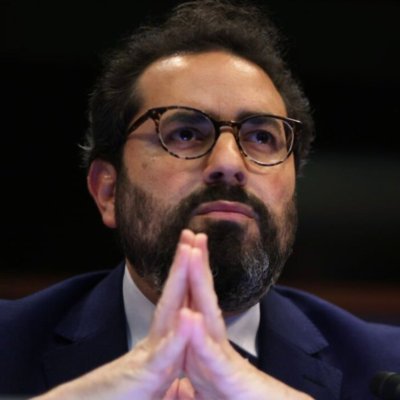
It's way more than just the tattoo with Platner. If it walks like a duck and talks like a duck, it's a duck. The fact that Democrats are willing to just elide all these things is disturbing and hypocritical in the extreme.
Cathy Young 🇺🇸🇺🇦🇮🇱@CathyYoung63

I wasn't too bothered by Platner sharing a Stew Peters post given that he deleted it (not everyone knows every bad account), but man, that Cornaccia interview & his claim to be a fan of the show... jewishinsider.com/2026/02/graham…
English
4
5
50
2K
Hillel Neuer
Hillel Neuer@HillelNeuer·
Remember when Vogue Magazine profiled mass murderer Bashar Assad's wife as “glamorous, young, and very chic—the freshest and most magnetic of first ladies”? They're at it again—now with a glossy profile polishing rabid antisemite and Hamas terrorism supporter Francesca Albanese.
Hillel Neuer tweet mediaHillel Neuer tweet media
English
461
2.5K
8.9K
272.7K