
Sabitlenmiş Tweet
Dan Thomson
521 posts

Dan Thomson
@DanThomson22
christian husband father sports bettor
Las Vegas, NV Katılım Kasım 2011
1.6K Takip Edilen454 Takipçiler
@owroot Our two year old loves Little Bear! It’s super chill.
English

My kids watch extremely minimal tv/movies but they have watched Little Bear and Kipper the Dog as we are closing in on the last hours of a long car trip.
They are both from the 90s and they are so slow and relaxing. The VOs, the music, the animation - all of it is basically as gentle as you get in tv form.
I believe a lot of kids shows are totally psychotic and make their brains more addled than they need to be. I don't feel that with Little Bear or Kipper the Dog though. They don't annoy me when I hear them. They feel like 1997 PBS and that's basically the least brain frying option and the best you can get.
Old Media@oldmedia
Little Bear (1995)
English
Dan Thomson retweetledi

Playing the victim is easy. Getting up, finding God, and becoming somebody worth following, that’s the hard part
English
@BartHanson The impossible hand / changing cards dream is common among players.
English

Anyone else have the occasional dream of shoving all-in with the nuts, getting called, and then at showdown your cards magically change to something basically random?
English
@mitsevox @quentinJpapert @VanjaPoker I rank game difficulty by how much profit can be extracted. If a player is an expected loser in a game I would say that game is difficult for them.
English

@DanThomson22 @quentinJpapert @VanjaPoker it's literally not. this isn't how you rank game difficulty
English
@quentinJpapert @mitsevox @VanjaPoker The point is nl100 online players would not win at 10/20 live.
English

@DanThomson22 @mitsevox @VanjaPoker You’re still missing the point lol. It’s not saying a NL100 player would beat a live 10/20 player it’s about how tough the game is if “X” third party person were playing against these games
English
@LloydLegalist What’s so bad about making it fun, relevant and comfortable?
English

@mitsevox @VanjaPoker Of course you would. You’d make 10x more money if you were a winning player. You think nl100 regs want to struggle to make rent and simply choose not play in a far more profitable game?
English
@DanThomson22 @VanjaPoker pretty sure that is all factored in. it really depends on the online site and how casual it is, but live poker, even higher stakes like $10/20, tends to be easier than NL100. I would much rather play $10/20 live as a professional if I had the bankroll
English
@mitsevox @VanjaPoker These are all components of competence. Theoretical knowledge is only half the battle the ability to perform and execute your A game is equally if not more important. And that’s where it will fall apart.
English
@DanThomson22 @VanjaPoker bankroll and player psychology isn't the argument. the post is strictly comparing opponent competence
English
@VanjaPoker You can’t take someone and throw them into a game 20x larger and play 1/10th the hands per hour and interact face to face with opponents and be totally out of their comfort zone and expect them to be able to execute their A game and avoid meltdown. Different skill sets.
English

@DanThomson22 Definitely not.
Avg 10/20 live is softer than avg 100 online, that’s no debate.
Best 10/20 live reg is better than best NL100 reg, I agree, but we are talking about the average toughness of the game.
English

Not gonna lie I’ve made probably a hundred bigger folds in my life than this Robl hand and seen a hundred bigger folds by others in my career. This still takes great awareness by Robl and credit to the fold but the absolute only reason he should ever call this river is so that all these fish he plays with will continue to play with him. That’s it. Sorry 😀
PokerGO@PokerGO
HOLY MOTHER OF GOD WHAT A HAND BETWEEN @ANDREW_ROBL AND JUSTIN GAVRI WE ARE NOT WORTHY Stream High Stakes Poker on PokerGO.com, live and on demand.
English
@vrexec Not missing anything don’t buy it if you’re gonna sell it a few years later. The massive upside is 20 years down the line. Imagine if you could lock in the same rent on a 30 year lease.
English

I'm doing some back of the envelope math on buying vs renting.
Say you buy a $1M house with 20% down at about 6% mortgage rate and plan to stay there for five years.
Your principal paydown in the first five years is about $57,000, but you've paid about $230,000 in interest.
You've also paid roughly $100,000 in property taxes, insurance, and maintenance.
Say the house appreciated 2.5% every year — so when you sell it's worth about $1.13 million.
Your all-in costs to sell are about 7.5% — brokerage commissions, transfer taxes, attorney fees, title insurance, and the inevitable post-inspection negotiation. On a $1.13M sale that's about $85K in fees.
So you net about $1.046M. You still owe $743K on the mortgage. You walk away with about $303K in cash — your $200K down payment back, your $57K in principal, and about $46K in net profit from appreciation.
Your non-recoverable costs — interest, property tax, insurance, maintenance — were about $330K over five years, or about $5,500/month. That's your effective rent.
But you "made" $46K selling, or about $770/month — so your effective rent was about $4,700/month.
Not bad, but you tied up $200K for five years to get there. And if appreciation was 1.5% instead of 2.5%, that net gain basically disappears and you're paying $5,400+/month in effective rent.
And this assumes there's appreciation at all — and that something doesn't go wrong with your house that needs a major remodel or repair.
On a five-year horizon at 6% rates, you need everything to go right on appreciation just to make ownership competitive with renting.
The transaction costs eat most of your upside.
What am I missing? Anything?
English
@RobKuhn_ It’s not that crazy of a hand but nonetheless hands like this are the essence of what makes the game of NLHE fun.
English
Dan Thomson retweetledi

His books and forum were among the biggest influences on me and so many others getting into poker.
In terms of transitioning poker from a game for crooks/gamblers, into rivaling chess/go for highest skill ceiling game out there- I'd say no one played a larger role than Sklansky
PokerNews@PokerNews
PokerNews is saddened to learn that poker legend and author David Sklansky, who wrote 18 gambling books—including one of the most influential poker strategy books ever—has passed away at 78. A look back at his life and impact 👇 pokernews.com/news/2014/02/p…
English
Dan Thomson retweetledi

Let me explain exactly why every new subdivision in America looks like the top photo, because the math is wild.
A mature tree increases a home's value by 7 to 19 percent. On a $400,000 house, that's $28,000 to $76,000. A single shade tree produces the cooling equivalent of ten room-size air conditioners running 20 hours a day. One tree on the west side of a house cuts energy bills by 12 percent within 15 years. The bottom photo is worth more, costs less to live in, and sells faster. This has been documented by the University of Washington, Clemson, Michigan State, and the USDA. The data is not in dispute.
Removing those trees saves the builder roughly $5,000 per lot. Concrete trucks need twice the dripline radius of every standing tree. Utility trenches need flat ground. A bulldozer flattens 200 lots in an afternoon. Preserving trees adds weeks and thousands per home.
So the developer pockets $5,000 in savings and the buyer eats $50,000 in lost value for the next two decades. The person making the decision and the person paying for it have never been in the same room.
The Woodlands, Texas is the proof of what happens when they are. George Mitchell bought 28,000 acres of Houston timberland in 1974 and preserved 28% as permanent green space. He forced McDonald's to build behind the tree canopy. That McDonald's became one of the highest-volume locations in Texas. The first office building, designed to reflect the surrounding forest so you couldn't see it from the street, leased completely.
The Woodlands median home price today: $615,000. Katy, a comparable Houston suburb that clear-cut: $375,000. Named #1 community to live in America two years running.
Fifty years of data. The trees are worth more than removing them saves. Developers clear-cut anyway because they sell the house once and leave. You live in it for 30 years.
bitfloorsghost@bitfloorsghost
we ruined such a good thing
English
Dan Thomson retweetledi

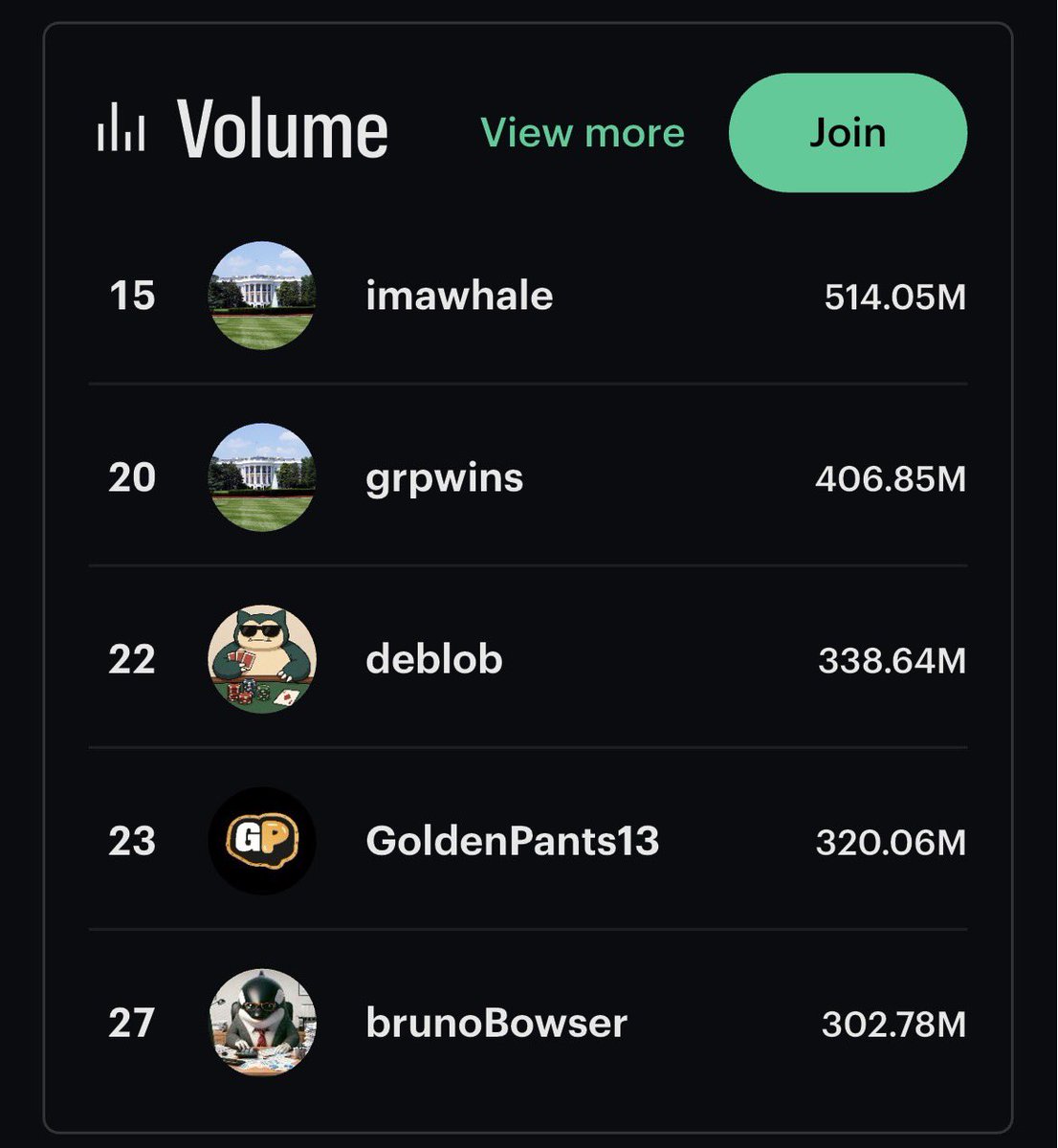
Imawhale is going all-in on prediction markets.
$500M+ in volume
#1 on Kalshi volume leaderboard (opt ins)
This is just the starting point.
We’re building the leading PM trading platform.
Strategic partners + hires:
imawhale.com
English
What kind of person? An intentional parent? As opposed to the kind of person that publicly (and ignorantly) mocks someone else’s parenting style to farm engagement? It’s not ungrateful at all to make a suggestion or share your parenting goals. I’d much get rather get this message than have my gift be instantly thrown in the trash the moment I leave and amount to wasted consumerism.
English


I worked 20 years for a child sex trafficking rescue group. I want you to know this:
90% of Lost Children Are Found Within 30 Minutes.
That statistic should both comfort you and wake you up.
Most lost children are found quickly. But the ones who aren’t? They usually made one mistake.
And here’s the uncomfortable truth:
It’s often the exact thing most parents teach them.
We tell our kids:
“If you get lost, come find me.”
It sounds logical. It sounds empowering.
It’s WRONG!
The Mistake Most Lost Children Make:
When children realize they’re separated, they do three things almost automatically:
They panic.
They wander.
They try to find you.
Every step makes them harder to locate.
From a search standpoint, movement creates chaos.
Parents retrace their steps.
Security scans zones.
Staff lock down areas.
Search works best when movement stops.
When a child keeps walking, they move outside the original search radius. Helpers are looking where they were last seen — not where they’ve wandered.
Stillness increases probability.
Movement expands the problem.
The first lesson is not “go find me.”
It’s this:
Stop. Stay. Yell.
Why Stillness Wins:
Think like a search team.
If a child stays put:
Parents can retrace steps.
Security can scan systematically.
Helpers converge to one fixed location.
The search radius remains small.
If a child keeps moving:
The search area expands.
Adults pass each other.
Missed connections multiply.
Minutes stretch into hours.
Stillness keeps the math on your side.
Teach Them Who to Approach:
The second mistake we make as parents?
We say, “Find an adult.”
Not any adult. Not the nearest stranger. Children need a filter.
Teach them to look for, if at all possible:
A mother with children.
Caregivers who already have kids with them are statistically among the safest people to approach in public settings. They are visible, stationary, and more likely to engage quickly.
It’s a clear, concrete instruction.
Children don’t process vague categories like “safe adult.”
They process visuals.
“Find a mom with kids” is visual.
A Phone Only Helps If the Number Is Known:
We often assume phones solve everything.
They don’t — unless your child can use one. Even young children can memorize a 10-digit phone number with repetition.
But you must train it.
Practice it like a song.
Sing it in the car.
Chant it at bedtime.
Turn it into rhythm.
Repetition becomes recall.
In an emergency, recall matters more than theory.
The Code Word Rule:
One more layer of protection.
Choose a private family code word.
Something only your household knows.
If someone approaches and says:
“Your mom sent me.”
Your child asks:
“What’s the code word?”
No word.
No go.
This simple rule eliminates manipulation attempts instantly.
It gives your child agency without requiring them to evaluate character.
Real Safety Is Training — Not Luck!
We don’t get safer by hoping.
We get safer by practicing.
Teach:
• Phone number
• Code word
• Stop, stay, yell
• Find a mom with kids
Multiple skills.
Simple instructions.
Clear visuals.
Five minutes of training can replace hours of panic. This isn’t about fear. It’s about preparation.
Because when a child gets separated, the clock starts.
And what they do in the first minute determines what the next thirty look like.
That’s real protection.
English