
Julian
188 posts


@Daniel2o2 Sounds good! What name did you enroll under? We'll share with you 2K integration credits for some extra fuel
English
$10,000. One winner. One week (July 21–28)
Build anything you want straight from your preferred IDE or AI agent, deployed on Base44's backend (database, auth, realtime, integrations, and hosting - all included).
Here’s some cool ideas for applications you can build:
-Full-stack SaaS
-Chrome-extensions
-Internal tools
-Chat Bots
-Headless APIs
-Smartwatch widgets
or anything else you can think of!
Grab 2,000 extra Integration credits by enrolling and telling us what you plan on building in the comments.
Link to enroll is in the comments>>>
English

2k followers giveaway is coming!✨
Replies to this post that receive 0 likes will share 2000 TRX worth a total of around 700 USDT!!💰
Winners will be determined tomorrow at 12:00 PM (UTC Time).
All participants must meet the requirements before the results are released. Airdrop results will be announced afterwards.

English

Migma launches tomorrow.
Today, I am giving 100 people early access + $3,000 in Amazon gift cards.
In return I want one thing:
a full report of every bug you find.
Comment “Migma” and I will send the link.

English


Your agents forget everything between sessions. agents[.]md fixes that.
Run /init to generate project memory in Command Code. Scans your project and files to understand:
- Your architecture decisions
- Your logging patterns
- Your team conventions
New session, new agent, same context every time.
English
Julian retweetledi

🚨 Massive World Cup Offer AND $100K Giveaway 🚨
If your team takes the lead in 90 minutes but doesn't win in regulation time, we'll still pay your bet as a winner. 💰
Plus, we're giving away $100,000 to 10 lucky winners! 🎁
Repost and comment below to enter 👇
Full T&Cs apply
#FIFAWorldCup

English
Julian retweetledi
$100k massive Giveaway 🚨
$10000 x 10 lucky winners
To enter simply:
🔁Repost this post and follow @gamdom
English
#SiliconFlowWorldCup ⚽ This is the game I developed for FIFA 2026. It has three modes: shooter, goalkeeper, and 11 vs. 11. @SiliconFlowAI I used the hy3 model. You can try it out, and I hope you really like it: fifa-world-2026-six.vercel.app. And sorry if it's in Spanish :c
English
@CanopyWave_AI I'm building an open-source skill that works and functions like a full team of expert frontend web designers. I'm currently testing it and it's going great!
English

GLM-5.2 is now available in Canopy Wave Coding Plan Pro!
To celebrate this upgrade, we're opening 10 seven-day Coding Plan experiences access for developers.
How to enter:
✅ Follow @CanopyWave_AI
❤️ Like this post
💬 Comment: What are you building with AI these days?
⏰ Giveaway ends in 3 days.
10 winners will be selected at random and contacted via DM.

English
@ZhihuFrontier Hi, I wrote to you about the prize, but I didn't receive a response 😿😿
English

🧱 DeepSeek-V4 is not just 1M context. It is a full system rebuild.
Zhihu contributor THU-PACMAN 实验室 shared a deep technical breakdown of DeepSeek-V4, based on an internal PACMAN report sharing by Guo Minkun.
The core point is simple: 1M-token context is not just a larger number in a config file.
It is an end-to-end systems problem across attention, KV cache, MoE communication, training stability, post-training, and agent product design.
1️⃣ The real problem is not context length. It is context cost.
Long-context models are easy to advertise and hard to serve.
In code, it may look like increasing max_position_embeddings.
In a real system, it means:
🔹 more attention compute
🔹 larger KV cache
🔹 heavier memory bandwidth pressure
🔹 harder MoE communication
🔹 more unstable long-context training
🔹 longer tool-call and reasoning histories in agent workflows
DeepSeek-V4 treats 1M context as a cost problem, not just a capability problem.
The report gives the key numbers:
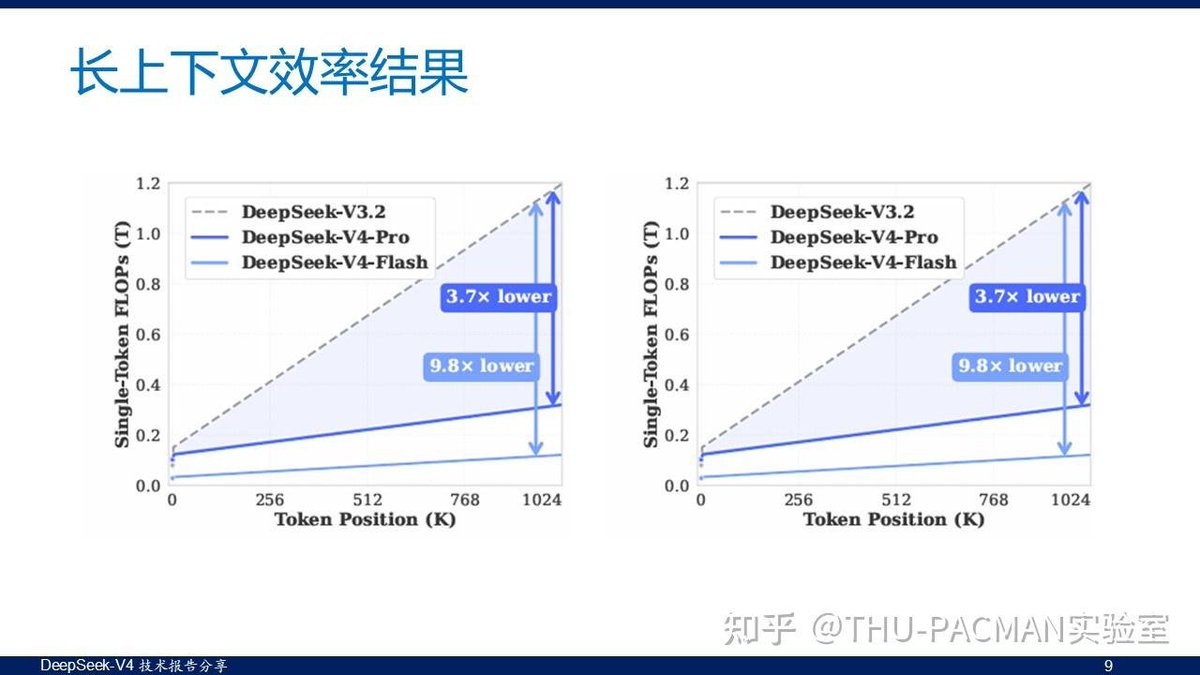
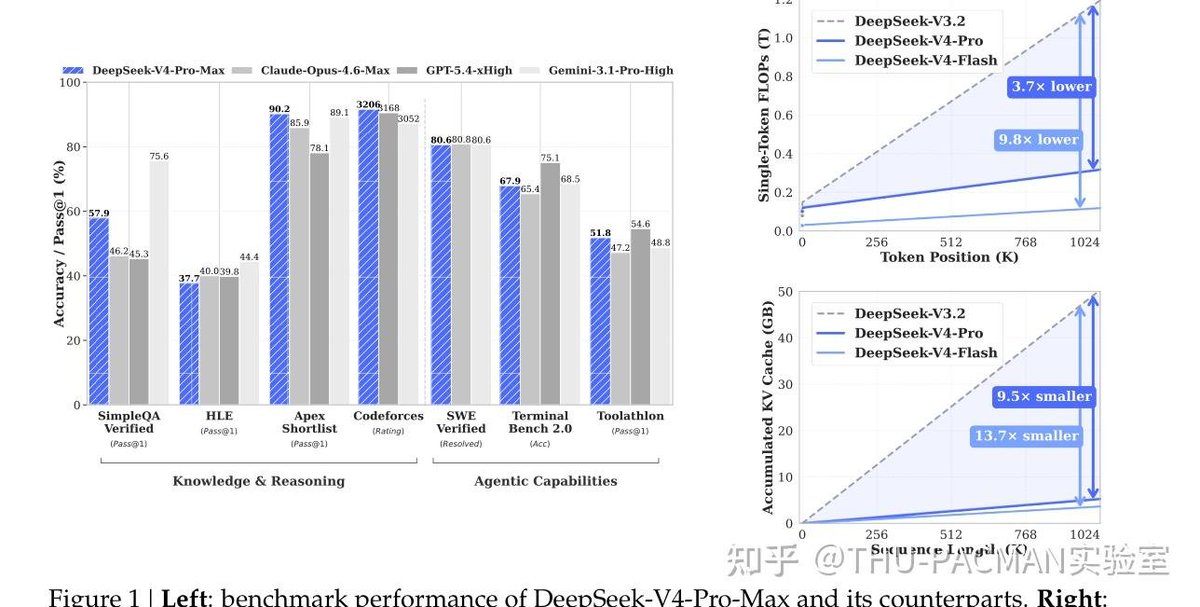
✅ At 1M context, V4-Pro uses about 27% of DeepSeek-V3.2’s single-token inference FLOPs, with about 10% of the KV cache.
✅ V4-Flash goes further: about 10% FLOPs and 7% KV cache versus V3.2.
That is the interesting part. V4 is not only making the window bigger. It is making each new token cheaper to generate inside that window.
2️⃣ Two models, one long-context system design
The report lists two DeepSeek-V4 variants:
🔹 DeepSeek-V4-Pro
1.6T total parameters, 49B active parameters, native 1,048,576-token context.
🔹 DeepSeek-V4-Flash
284B total parameters, 13B active parameters, native 1,048,576-token context.
From the outside, this looks like “one large model + one smaller model.”
From a systems view, it is more like one long-context architecture deployed at two cost points.
Pro pushes capability. Flash pushes routine serving cost.
3️⃣ V4 keeps the V3 foundation, but changes the objective
DeepSeek-V3 already had a strong infra base:
🔹 DeepSeekMoE to reduce active parameters
🔹 MLA to reduce inference state
🔹 MTP for extra training signals and speculative decoding
🔹 DualPipe, custom all-to-all, and FP8 training for large-scale MoE
V4 does not throw that away.
Instead, it asks a sharper question:
If 1M context becomes native, what has to change so the system remains trainable, cheap, and serviceable?
That is why the changes are spread across the stack.
Attention moves from MLA to CSA/HCA hybrid attention.
Residual connections move to mHC, or Manifold-Constrained Hyper-Connections.
The optimizer shifts from mostly AdamW to mostly Muon.
The MoE router changes form, the number of active experts per token drops, and the early layers become more aggressively MoE-based.
This is not one trick. It is a coordinated redesign.
4️⃣ CSA/HCA splits long-context attention into layers of responsibility
The most important architectural change is hybrid attention.
DeepSeek-V4 alternates two mechanisms: CSA and HCA.
🔹 CSA: compressed sparse attention
CSA first compresses KV entries along the sequence dimension. In the typical V4 setting, every 4 tokens are compressed into one entry.
Then a Lightning Indexer decides which compressed entries are relevant to the current query.
Only the top entries are used for attention: 512 for V4-Flash, 1024 for V4-Pro.
CSA also keeps a 128-token sliding window of uncompressed local KV, so recent local details are not lost.
Think of CSA as long-distance retrieval: compressed first, then selectively attend.
🔹 HCA: heavily compressed attention
HCA compresses much more aggressively, with a typical ratio of 128 tokens into one entry.
Unlike CSA, it does not do top-k sparse selection. It performs dense attention over the heavily compressed entries.
HCA is not designed for fine-grained detail. It is a cheap global channel.
The combined design is the key:
✅ CSA handles precise long-range retrieval.
✅ HCA keeps a low-cost global view.
✅ Sliding window preserves local detail.
DeepSeek-V4 is basically saying: long context should not be scanned uniformly. Global awareness, remote retrieval, and local precision should be handled differently.
5️⃣ mHC gives deep models more stable information paths
Standard Transformer residuals use one stream:
x_{l+1} = x_l + F_l(x_l)
That single residual stream has served the field extremely well, but it also forces all cross-layer information through one shared path.
V4 introduces mHC, which maintains multiple residual streams. In the config, hc_mult = 4, meaning four residual streams are maintained.
The model can read from, write to, and mix across these streams.
The risk is scale instability. If cross-stream mixing is unconstrained, repeated matrix products across dozens of layers can amplify some directions and suppress others.
So V4 constrains the mixing matrix to be doubly stochastic:
🔹 non-negative entries
🔹 each row sums to one
🔹 each column sums to one
🔹 projected with Sinkhorn-Knopp iterations
The intuition is elegant: the matrix becomes closer to redistributing information than arbitrarily stretching it.
mHC is not solving token-to-token attention. It is solving cross-layer information flow.
That matters more when the model is deep, sparse, long-context, and full of routing dynamics.
6️⃣ Muon and stability tricks make the architecture trainable
V4 uses Muon for most modules, while keeping AdamW for embeddings, prediction heads, RMSNorm, and several special components.
Muon treats weight updates as matrix updates, not just independent scalar updates.
It approximately orthogonalizes the update direction using a hybrid Newton-Schulz procedure: the first steps push singular values toward 1, and the later steps stabilize them.
Why does this matter?
Because V4 stacks several instability-prone ideas:
🔹 CSA/HCA compression and sparse selection
🔹 mHC multi-stream residual mixing
🔹 MoE routing
🔹 long-context training
🔹 low-precision kernels
The report also mentions several practical stability choices:
✅ RMSNorm on attention queries and KV entries to avoid logit explosion.
✅ Progressive context training from 4K to 16K, 64K, and then 1M.
✅ Dense-attention warmup for V4-Flash before sparse attention is introduced.
✅ Anticipatory Routing to break bad routing/outlier feedback loops.
✅ SwiGLU clamping to keep activation outliers under control.
Some of these are still empirical engineering tools. They work, but the full theory is not settled.
That is part of what makes this report interesting: it shows how much frontier model training still depends on system-level judgment.
7️⃣ The infra work is as important as the model architecture
MoE saves compute on paper, but it creates a communication problem.
Tokens must be dispatched to experts, computed, and combined again. If dispatch and combine are slow, the matrix multiplications do not matter.
V4 addresses this through expert-parallel communication-compute overlap.
The report describes fused mega-kernels that combine:
🔹 Dispatch
🔹 Linear-1
🔹 SwiGLU / FP8 cast
🔹 Linear-2
🔹 Combine
These are organized into expert waves, so communication, computation, and result return can overlap.
Other infra details point in the same direction:
🔹 TileLang for faster fused-kernel development
🔹 Host Codegen to reduce Python-side overhead
🔹 deterministic kernels for debugging and reproducibility
🔹 FP4 QAT for MoE expert weights and CSA indexer paths
🔹 lower-precision index scoring to accelerate top-k selection
The pattern is clear: once the architecture becomes this complex, kernels, cache layout, precision, communication, and debugging all become part of the model.
8️⃣ Post-training also becomes a systems problem
V4 replaces mixed RL with On-Policy Distillation, or OPD.
The reason is interference.
Math, coding, agent tasks, instruction following, tool use, and long-context reasoning do not always optimize cleanly under one reward setup.
V4 first trains domain experts. Then a unified student learns from multiple teachers on its own on-policy trajectories, minimizing KL to teacher behavior with weighted importance.
It also exposes different reasoning-effort modes:
🔹 Non-think
🔹 Think High
🔹 Think Max
This turns capability into a trade-off between model size and inference budget.
Flash can approach Pro on some reasoning tasks when given more thinking budget. But dense knowledge, complex agents, and long-horizon tasks still benefit from Pro’s capacity.
✅ Core takeaway
DeepSeek-V4’s real contribution is not “1M context.”
It is showing what has to be rebuilt when 1M context becomes a default service target.
Attention has to become layered.
Residual streams have to become more stable.
MoE communication has to be fused and overlapped.
KV cache has to be treated as a first-class system object.
Post-training has to avoid capability interference.
Agent products have to decide what history to preserve, compress, or discard.
The report is also careful about limits.
Long context does not solve agents by itself. Real agent systems still need planning, verification, failure recovery, sandboxing, permissions, cost control, and state management.
But V4 makes one thing much more plausible:
👉 Long-context intelligence is becoming less like a benchmark feature, and more like a full-stack infrastructure problem.
🔗 Full analysis:
zhuanlan.zhihu.com/p/205932895737…
#DeepSeek #AIInfra #LLM #LongContext #MoE #Inference #Agents


English
@ZhihuFrontier @MiniMax_AI @PPF12138 @ghalz_ @mav3ri3k Hello? I already messaged you privately but no one is replying 😿
English
🎉 Giveaway winners announced!
Thanks everyone for celebrating 10K followers with us and @MiniMax_AI.
We verified the entries based on the rules:
✅ Follow @ZhihuFrontier & @MiniMax_AI
🔄 Repost the giveaway post
Congrats to our 10 winners:
@PPF12138
@ghalz_
@mav3ri3k
@dk_zhen19
@http425
@ThieuPhuc31706
@Yananan_309
@awa_omg
@Daniel2o2
@agnisantra
Winners, please DM @ZhihuFrontier within 72 hours to claim your prize! 🙌
We will never ask for payment, passwords, wallet info, or verification codes.
Zhihu Frontier@ZhihuFrontier
🎉 10K followers! Thank you! To celebrate, we're teaming up with @MiniMax_AI for a giveaway! ✅ Follow @ZhihuFrontier & @MiniMax_AI 🔄 Repost this post 🎁 We'll randomly select 10 winners to receive: • 1-month MiniMax Token Plan (Plus level) with full access to the MiniMax model family (M3 / M2.7 / image / speech / music) • 1-month Zhihu Knowledge VIP 📅 Ends July 4. Every follow, every repost, every AI discussion has helped @ZhihuFrontier grow into the community it is today. ❤️ Here's to the next 10K—and many more conversations about AI. 🚀 #Zhihu #MiniMax #AI #Tech
English
English

Axiom now on Robinhood
Faster, Smarter. You’re wasting time trading elsewhere.
Try it now 👇
@haspi" target="_blank" rel="nofollow noopener">axiom.trade/@haspi
Axiom@AxiomExchange
🌿HOOD, now on Axiom. $100k, first come first serve!
English
@ZhihuFrontier @MiniMax_AI @PPF12138 @ghalz_ @mav3ri3k Thanksss! I wonder if I can still claim it? I just saw the post 👍😿 please 🥹 I already sent them a DM
English

这两天看球之余做了个免费的GLM-5.2 API服务:
glm.babel.town
这个服务是完全免费的,不需要注册或登录。可以在龙虾或Hermes里使用,也可以用于各种coding agent。
所有Token费用由我自掏腰包,为了避免浪费,每个API Key设定了有效期一小时,过期后再重新点击申请一个就行

中文

