@ScoringChanges I’ve wondered about this same issue with sac bunts. What do you do in the reconstructed inning if the batting team uses a sac bunt to advance a runner that wouldn’t exist but for an error?
ANALYSIS: The issue is the throwing error followed by an intentional walk. Originally, the scorer felt that if not for the error, you wouldn't have an intentional walk, which is correct in theory since Freeland would be on first.
But as I've mentioned before, an intentional walk is treated like a walk for reconstruction purposes, so error or not, Freeland is going to be on second because Ohtani walked. So he is on second, regardless of the error, meaning he scores on the Tucker single, so that's why this was changed to earned.
🚨CHANGE 12🚨
4/7 @Dodgers at @BlueJays
T9 the run scored by Alex Freeland has been changed to earned for pitcher Jeff Hoffman, instead of unearned
Change 2 for TOR
#Dodgers#BlueJays50
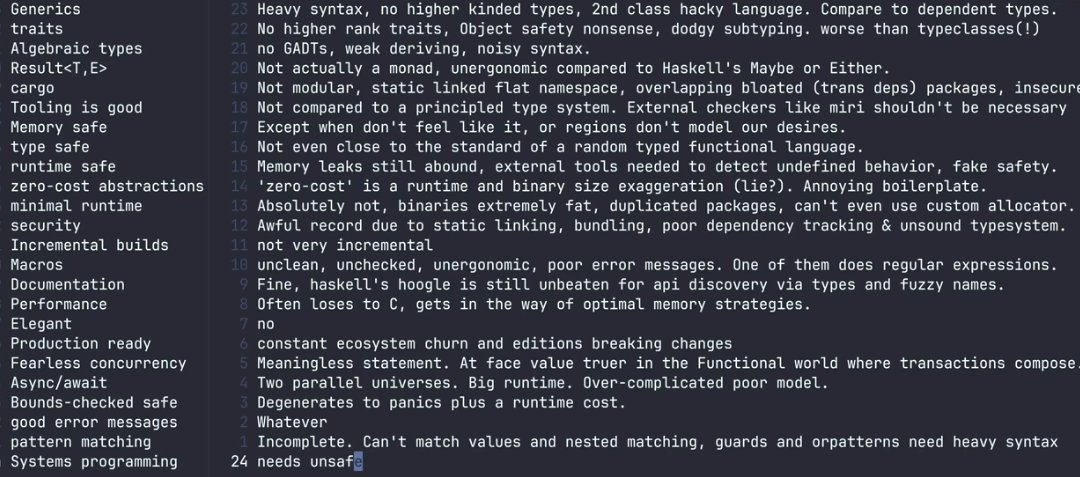
@analytichegel Does this person want Rust to be Haskell or C? It’s an attempt to combine those things. You can’t have all the best parts of both worlds.
@_chenson__ Yes normal mistakes are still possible. I would suspect most such mistakes are possible in normal math too though. So Lean strictly removes categories of errors. I could be wrong though! Looking forward to this article.
@DanielJamesNZ I think it is certainly true that adversarial input is more common, but I can think of a few situations where it is possible to make a genuine (human written) mistake!
I'm strongly considering writing a blog post along the lines of "How to Believe a Lean-Checked Proof" given the recent flurry of discussion. Does anyone have any questions or comments they'd like to make sure I address?
@davidmbudden@Aron_Adler I agree you can write bad definitions in Lean. But you can do the same in paper math. Lean has the advantage that you know the proofs are correct for whatever you have specified the definitions to be. Do you think Lean makes you especially more likely to write bad definitions?
It genuinely concerns me how many mathematicians have told me these week "if it compiles in lean we know it's true". Lean is great, but that's dangerously untrue.
Here are 50 ways to prove 1 == 0 in Lean. That compile. Depending on what version you use.
(link in comments)
@davidmbudden I think it is pretty easy to not write axiom or sorry. And no this isn't anywhere near 50 ways. It is only two: axiom and sorry. Everyone knows you don't use those in real proofs.
@DanielJamesNZ If you can compile something this explicitly dumb in these 50(ish, ffs) ways, my claim is, it's trivial enough to accidentally make an entire lean proof utterly irrelevant -- and hard enough to detect -- it should not be trusted as blindly as it seems to be.
@frawaurhts Simple generalizations of Collatz are undecidable, so it doesn't seem that impossible that Collatz is too. #Undecidable_generalizations" target="_blank" rel="nofollow noopener">en.wikipedia.org/wiki/Collatz_c…
@haskallcurry@BorisBartlog@tomieinlove If I understood correctly the second answer was saying that if ZF has no such set that neither does any extension. Since ZFC has such a set so must ZF. But I could be reading it wrong. Most of that page goes over my head.
@DanielJamesNZ@BorisBartlog@tomieinlove I'm not sure this answers the question, at least I don't see it.
But in the comments there was a nice example for ZFC: the set of well-orderings of the reals.
@BorisBartlog@haskallcurry@tomieinlove The trouble is to do that you have to have the set of all definable reals. Which its not clear you can actually construct. The question is, is "ZFC can define x" a sentence in ZFC?
@DanielJamesNZ@haskallcurry@tomieinlove Since you can define sets using complements ... so long as some portion of the reals are not 'closed form' (however that's defined), you can just use ℝ \ C to define the set of reals not in your set of closed form numbers. But maybe that doesn't count somehow?
@DanielJamesNZ@BorisBartlog@tomieinlove Do you know if there's some set S that is "closed form", inhabited, yet doesn't have a "closed form" inhabitant (in ZF)?
I have a vague suspicion that there might not be such a thing, though I don't really know.
@BorisBartlog@haskallcurry@tomieinlove But extension via the epsilon operator, which would allow you to pick any element of a set as a closed term, is *not* a conservative extension. In particular it allows you to prove the axiom of choice. So in summary I think your original statement was correct.
@BorisBartlog@haskallcurry@tomieinlove IMO this is kinda crazy because it makes each definition into an axiom. (To be safe you have to check metamathematically that the extension is conservative.) Hence the benefit of the iota operator which requires just one conservative extension and has the same expressive power.
@haskallcurry@BorisBartlog@tomieinlove IMO the best way to understand ZFC term definitions is to extend the language with Hilbert's iota operator. In that case exists x s.t. p is not the same as actually having one. You can use the epsilon operator that doesn't require uniqueness but that actually implies choice.