peacefare.net

41K posts

peacefare.net banner
peacefare.net

peacefare.net

@DanielSerwer

Prof @SAISHopkins. Former Special Envoy @StateDept and VP @USIP. Dad of @JaredSerwer + @AdamSerwer. @Palgrave published my Strengthening International Regimes.

Washington DC Katılım Ekim 2010
806 Takip Edilen7.1K Takipçiler
peacefare.net retweetledi

Robert E Kelly
Robert E Kelly@Robert_E_Kelly·
My latest for @19_forty_five The biggest lesson China will draw from the Iran War is that the US military is too small and too ‘exquisite’ - the navy has too few ships, missile defense is too costly, and so on - resulting in overextension 19fortyfive.com/2026/03/the-ir…
English
137
647
2.5K
115.5K
peacefare.net
peacefare.net@DanielSerwer·
I don't agree with all the conclusions, but the basic point is correct: the US has lost this war.
Policy Tensor@policytensor

Seconded for the most part. Let me add a few notes. — There are three theories of air power. We know Douhetist terror bombing has never destroyed the will of the enemy to fight. Decapitation has now failed. As long as the US remains ‘up in the air’ there is only one path to avoiding strategic defeat: winning the interdiction war to disarm Iran. — The interdiction theory of victory is ‘analytically attractive’ because it empirically testable in real time. If Iranian strike tempo is dwindling to zero, the US is winning; otherwise it is losing outright. — The all-important interdiction war is going very poorly. I look at the attached map every day from ACLED, the gold standard of conflict data (acleddata.com/iran-crisis-li…). Iranian strike tempo shows no sign of dwindling. To the contrary, depletion of interceptor inventories and the use of heavier missiles has dramatically increased the effectiveness of Iranian missile strikes, as we are seeing in the strikes on Israel. — The Iranians’ interdiction/counterforce campaign has been surprisingly successful. At least 10 radars have been destroyed, partially blinding US forces and interceptor systems. US bases in the region have been largely evacuated, forcing the US to use European bases. — There have been some big kills. Two dozen heavy drones and a half a dozen manned aircraft have been lost to Iranian fire/accidents, not clear which, including an F-35. A mighty carrier group has been put out of business. — Iran enjoys escalation dominance. This was confirmed when Trump had to walk back his ultimatum. Iran has a very powerful threat at the top of the escalation ladder: the O&G infrastructure and water desalinization systems in the gulf are both under Iranian fire control. — Iran holds horizontal escalation options in reserve. The Houthis have their ‘fingers on the trigger.’ That is a deterrent to keep the Saudis out of the war, and may be used at any time to expand the war and impose greater costs on the West. — Iran retains a firm grip on the Hormuz weapon. No serious military option to retake Hormuz exists as long as the interdiction war is not won. No matter where you land the marines, they will be fully exposed to Iranian fire, including artillery fire. US force protection requirements, ultimately a function of casualty intolerance, mean that the Kharg idea etc are just not going to fly. — The United States is at a crossroads. Either it swallows this military humiliation and accepts a ceasefire largely on Iranian terms, or it must send in ground forces to in a bid to retake Hormuz and restore US military prestige. — If the US chooses a negotiated ceasefire, Iran will emerge as a regional hegemon with the Hormuz weapon firmly in its hands; and, having defeated the US in a high-intensity conventional war, as a great power in the international system. — If the US chooses to escalate to a ground war, the war will last for years. This is because both force protection and the overriding objective of fire suppression will drive ever greater commitment of ground forces. But the US cannot win the ground war under any circumstances because the division math (x.com/policytensor/s…) is even more forbidding than the drone math (x.com/policytensor/s…). This means that the choice facing the aggressor is between accepting strategic defeat now at limited costs, or later at far, far higher costs. — So the United States has already suffered a catastrophic military defeat. The multipolar world was a hypothesis until last month. Now it is a demonstrated military fact. It has obtained due to the diffusion of military technology (x.com/policytensor/s…). The US monopoly in precision-strike is now gone. Deterrence in Asia is now dead. This cannot but fail to have far-reaching geopolitical consequences, which I will lay out in detail in a forthcoming interview on @MultipolarPod with @admcollingwood later today.

English
0
0
0
67
peacefare.net retweetledi
Trip Gabriel
Trip Gabriel@tripgabriel·
Trump was outraged over a $1.7b transfer to Iran as part of the 2015 nuke deal Now he is offering Iran a $14b windfall to sell its oil -- during a war "This is asking them to please, please, please sell oil because the market is going haywire.” nytimes.com/2026/03/23/bus…
English
98
1.1K
2.8K
200.2K
peacefare.net retweetledi
Ryan Goodman
Ryan Goodman@rgoodlaw·
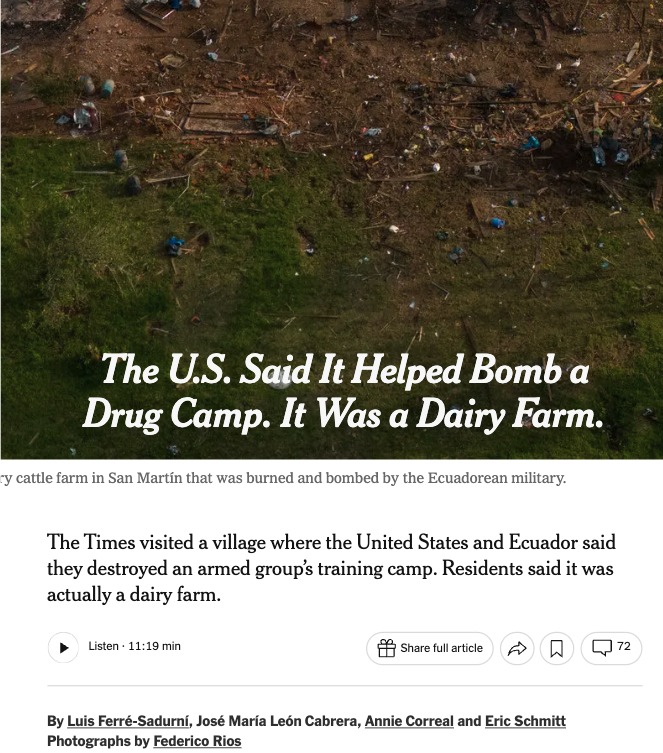
This is utterly extraordinary. If Hegseth et al got this wrong, think what else is happening with the drug boat strikes and much more. The U.S. Said It Helped Bomb a Drug Camp. It Was a Dairy Farm. Gets worse as you read it. 1/
Ryan Goodman tweet media
English
173
4.8K
10.4K
262.7K
peacefare.net retweetledi
Danny (Dennis) Citrinowicz ,داني سيترينوفيتش
Told @BBCNews that From the Iranian side, they're winning, not losing, so they'll demand compensation and guarantees. On the other side, you have Trump thinking that [Iran] will approve all the requirements of the US from the get-go. To get an agreement,Trump and Netanyahu will either have to change the regime, or forego their requirements. This regime is not going to capitulate - they're not going to give the Americans something they didn't give them before the war. They control the bottleneck of the international economy – the Strait of Hormuz – one of the world's busiest oil routes, which Iran has blocked - and they feel they have the upper hand in negotiations. bbc.com/news/articles/…
English
29
111
413
53.3K
peacefare.net retweetledi
Daractenus
Daractenus@Daractenus·
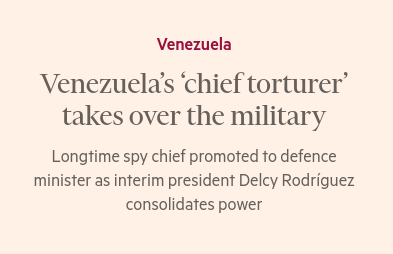
If you were wondering what has happened to Venezuela since Donald Trump brought "freedom and democracy" to it, the man who oversaw Venezuela’s torture program under Maduro has now risen to the very top of the power structure to now lead the country’s military.
Daractenus tweet media
English
35
1K
1.8K
38.9K
peacefare.net retweetledi
Republicans against Trump
Republicans against Trump@RpsAgainstTrump·
Steve Bannon: “We can use this, ICE helping at airports, as a test run, a test case, to really perfect ICE’s involvement in the 2026 midterms. Mike Davis: “I think we should have ICE agents at the polling places” Saying the quiet part out loud.
English
896
7.8K
16.7K
1.5M
peacefare.net retweetledi
InteractivePolls
InteractivePolls@IAPolls2022·
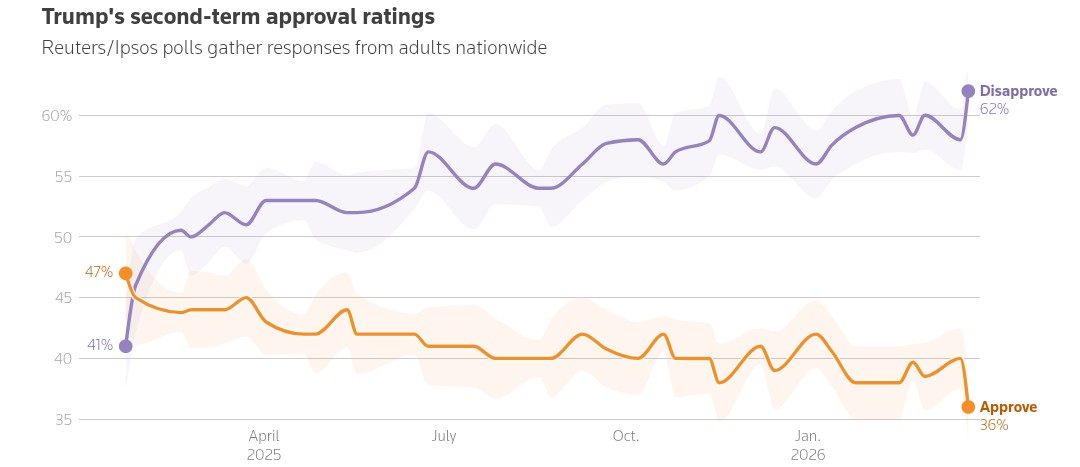
REUTERS/IPSOS - Trump Approval Approve: 36% (-4) Disapprove: 62% (+4) —— Trump's net approval on key issues 🟤 Immigration: -13 🔴 Foreign policy: -27 (new low) 🔴 Economy: -33 (new low) 🔴 Cost of living: -41 (new low) —— U.S. strikes on Iran Approve: 35% (-2) Disapprove: 61% (+2) —— 3/2/-23 | 1,272 A reuters.com/world/us/trump…
InteractivePolls tweet media
English
96
1.1K
2.9K
351.7K
peacefare.net retweetledi
Abas Aslani
Abas Aslani@AbasAslani·
BREAKING: US, via intermediaries, has proposed talks between US VP JD Vance & #Iran’s Parliament Speaker Ghalibaf. Iran has not responded to the idea yet. The idea seemingly stems from deep-seated Iranian distrust of Steve Witkoff and his involvement in any negotiation process.
Iran Nuances@IranNuances

SCOOP: US, via intermediaries, has proposed talks between US VP JD Vance & #Iran’s Parliament Speaker Ghalibaf. Iran has not responded to the idea yet. The idea seemingly stems from deep-seated Iranian distrust of Steve Witkoff and his involvement in any negotiation process.

English
72
286
1.4K
798.4K
peacefare.net retweetledi
Ilhan Niaz
Ilhan Niaz@IlhanNiaz·
A fair question:
Ilhan Niaz tweet media
Français
131
4.5K
17K
443.7K
peacefare.net retweetledi
Sina Toossi
Sina Toossi@SinaToossi·
Israel’s Channel 12 has now leaked what it claims is a U.S. “15-point document” to end the war with Iran. The reported mechanism is a one-month ceasefire, during which there will be negotiations over these terms. That alone is likely a non-starter for Tehran. Iran has been clear it does not want another temporary pause that allows the U.S. and Israel to rearm, rebuild, and return to the fight—as has already happened before. It is seeking a permanent settlement that allows it come out of economic isolation. Then there are the terms themselves. Much of this reads like a familiar maximalist wishlist: no enrichment on Iranian soil, dismantling core nuclear infrastructure, abandoning regional alliance network. In other words, demands that Iran has consistently rejected—before the war, and likely even more so now given the leverage it believes it has gained. At the same time, there is a notable U.S. offer: the reported offer of full sanctions relief, including removal of snapback threats. That suggests Washington may be signaling openness to a broader strategic tradeoff. So there may be the outline of something workable here. But as an opening bid, much of this still looks fundamentally misaligned with what Iran would accept—and therefore unlikely to get serious traction in Tehran without significant revision.
Sina Toossi tweet media
English
46
129
309
256.3K
peacefare.net retweetledi
Danny (Dennis) Citrinowicz ,داني سيترينوفيتش
Told @TheNationalNews we shouldn’t underestimate the US and Israeli achievements, especially on the conventional side regarding command and control and decapitation of senior leadership [...] this is not accumulating into a strategic effect as the regime wasn’t toppled, and it managed to overcome Khamenei’s decapitation. If the war ends today, despite the achievement, we can’t call it a success. We still have the same regime, which is weaker but more emboldened. The war was operationally planned quite well, but nobody thought about the implications thenationalnews.com/news/mena/2026…
English
9
21
62
8.6K
peacefare.net retweetledi
Joe Weisenthal
Joe Weisenthal@TheStalwart·
Approval of Trump's handling of the economy, per the newest Reuters/Ipsos poll, is now lower than at any time during the Biden admin. reuters.com/world/us/trump…
Joe Weisenthal tweet media
English
98
820
3.3K
380.2K
peacefare.net retweetledi
Shaiel Ben-Ephraim
Shaiel Ben-Ephraim@academic_la·
The addition of the 82nd Airborne Division to the troops sent to the region is significant. They are added to: 1) The 31st and 11th Marine Expeditionary Units (close to five thousand marines). 2) A company-sized element from the 75th Ranger Regiment (152 Rangers). They are are specialists in seizing airfields and conducting surgical raids to capture or kill high-value targets or secure nuclear materials. 3) 50,000 U.S. troops permanently stationed in Kuwait, Qatar, and Jordan and roughly 18,000 reinforcements. This is a force large enough for a mission to seize and hold Kharg Island, and not enough for an invasion of the mainland. They will be ready to operate by the end of the month. Trump gave a deadline for March 27 and is trying to how he means business if they say no. They will say no. The potential for escalation to a full ground war to secure bridgeheads and avenge losses will be great.
Barak Ravid@BarakRavid

🚨בכיר אמריקני אומר לי: מפקדת הדיוויזיה המוטסת ה-82 קיבלה הוראה מהפנטגון לצאת לפריסה במזרח התיכון יחד עם כמה חטיבת חי״ר של אלפי חיילים 🚨למה זה חשוב: מדובר בתגבורת משמעותית נוספת בסד״כ האמריקני באזור לקראת פעולה קרקעית אפשרית באיראן

English
43
56
196
33K
peacefare.net
peacefare.net@DanielSerwer·
Trump is negotiating with himself and will no doubt announce that he has won. He has already lost and the US is far worse off than before the war.
Danny (Dennis) Citrinowicz ,داني سيترينوفيتش@citrinowicz

Prospects for U.S.–Iran Negotiations A. There have likely been indirect message exchanges between the parties, but no substantive negotiations are currently underway. B. The gaps between the sides remain extremely wide. Iran appears to be operating from a position of perceived strength following the recent conflict, and is demanding both security guarantees against future attacks and compensation for war-related damages. C. Former President Trump seems to assume that the figure he is “engaging” with like Parliament Speaker Mohammad Bagher Ghalibaf has the authority to deliver on core U.S. demands. In reality, this assumption is flawed. Decision-making power in Iran is concentrated elsewhere, primarily with the Supreme Leader and the Islamic Revolutionary Guard Corps (IRGC). D. At this stage, the likelihood of a breakthrough is low unless Washington is prepared to make significant concessions. From Israel’s perspective, there appears to be limited concern for now due to the wide gaps, but if an agreement is reached, it is unlikely to meet Israeli requirements, and Israel may have limited ability to block it. E. Trump faces a difficult set of options. Reaching a deal would require meaningful concessions to the Iranian regime on core issues. Alternatively, military options whether strikes on infrastructure, limited operations (e.g., Kharg Island), or broader moves such as controlling the Strait of Hormuz that would be highly complex and carry no guarantee of success. F. Iran’s internal dynamics further complicate negotiations. Power is heavily influenced by the IRGC, the Supreme Leader’s functional capacity is uncertain, and the prevailing narrative inside Iran is one of resilience and defiance against the U.S. and Israel. G. The Strait of Hormuz adds another major layer of complexity. It is highly unlikely that Iran will roll back its position regarding control and leverage over this strategic chokepoint, particularly given its economic significance. H. Given all of the above, the chances for a near-term diplomatic breakthrough remain low. Trump may choose to extend his ultimatum, but the core strategic dilemma will likely intensify again as the deadline approaches. #iran

English
0
0
2
199
peacefare.net retweetledi
Chris Murphy 🟧
Chris Murphy 🟧@ChrisMurphyCT·
$1.5 BILLION. Let me say it again - a $1.5 BILLION BET. Bigger than any futures purchases made at the time. 5 minutes before Trump's post. Who was it? Trump? A family member? A White House staffer? This is corruption. Mind blowing corruption.
unusual_whales@unusual_whales

BREAKING: Just five minutes before Trump's announcement to halt the attacks on Iran, massive trades reportedly hit the market. In one move, $1.5 billion in S&P 500 (ES) futures was bought while $192 million in oil (CL) futures was sold. These orders were 4–6x larger than anything else at the time. The trader seemingly made huge gains. Unusual.

English
1.8K
17.3K
66.9K
2.7M
peacefare.net retweetledi
Mike Levin
Mike Levin@MikeLevin·
Donald Trump called mail-in voting “mail-in cheating” on Monday. That same day, news broke that he just voted by mail in a Florida special election. His polling place is a 15-minute drive from Mar-a-Lago. He spent the last two weekends there. He mailed it anyway. He is now holding the entire country hostage to pass a bill making it harder for you to vote the way he just voted. Shameless hypocrisy. nytimes.com/2026/03/24/us/…
English
932
13.1K
32K
613.5K
peacefare.net retweetledi
Vali Nasr
Vali Nasr@vali_nasr·
While there is a lot of attention on Ghalibaf the appointment of former IRGC General Zolqadr deserves more attention. Ghalibaf may be the hot ticket for WH but Zolqadr is the reality on the ground. Zolqadr is Mojtaba’s man, and the selection shows that Mojtaba is in charge. It also confirms that all Israel’s decapitation has achievec is to transfer power in Tehran to the most hawkish part of IRGC. Zolqadr comes from that wing of IRGC. He was so extreme as Deputy Commander of IRGC that Soleimani decided to leave IRGC, Khamenei personally called him back and put him in charge of Qods Force. Zolqadr had a hand in suppressions of protesters in 1999 and 2009 and was instrumental in Ahmadinejad’s elections to presidency. His selection to replace Larijani does not suggest there will be talks with U.S. but rather a much more aggressive Iranian posture.
English
95
833
2.4K
509.4K