

刀盾🛡
505 posts

GM! Happy Sunday 🌞
I’m getting ready to upload a long-form New York vlog! 👀

English








今天又领悟了不少,
每次深度思考都感觉维度、空间穿透了
今天学到了 「空性」
对进入人生下一个阶段的重要性。
一切事物都没固定、独立、永恒的本质,它们都是依赖『因缘』而生灭的。
看似简单,但要分离自己的分析思考,
关闭大脑回路,放弃定义,不被捆绑,
了解及执行是很困难的。
不小心跟ai聊了一个凌晨…
才对「空性」等多一点感悟,
执行上还需努力
有时候研究得太开心了..
现在只好补眠1、2小时.. 🫠
中文

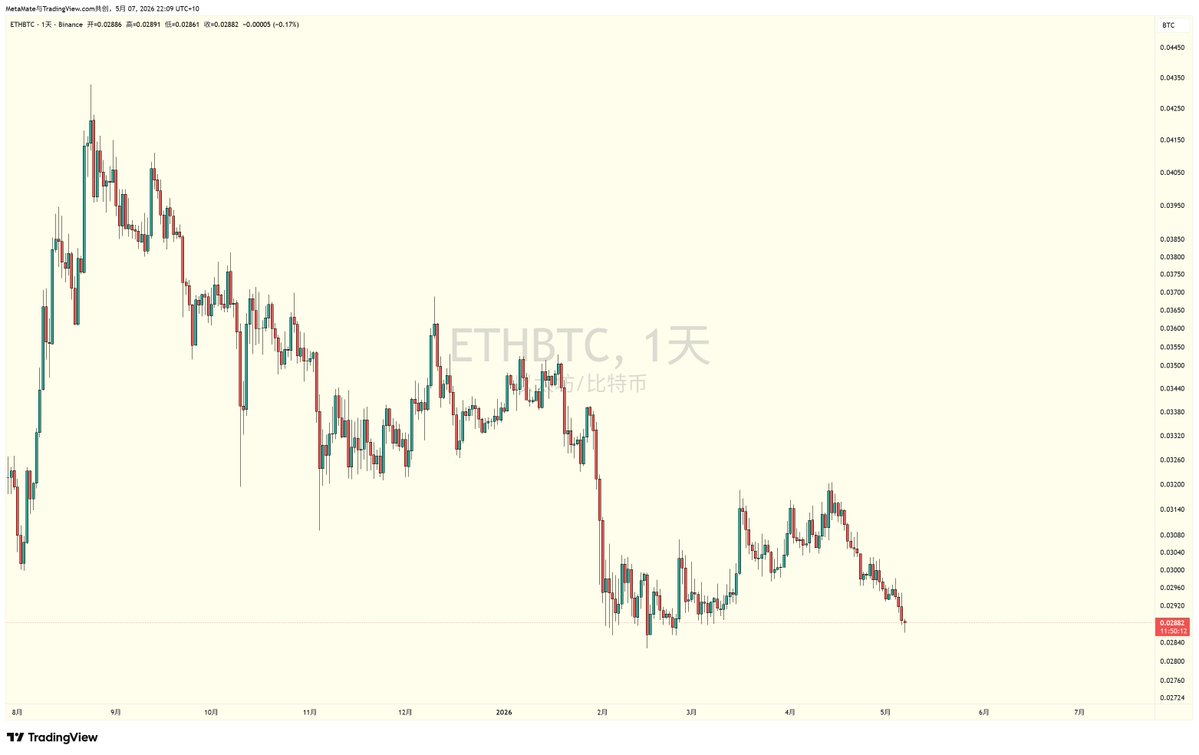
似乎好久没人聊ETH/BTC的汇率,
而ETH/BTC比率逼近0.0288,
又是周内新低,距离最近一年新低也不远了,
可以说ETH今年的走势就两个字:狗屎。
X上也很少看到E卫兵了,
现在除了Tom的 @BitMNR ,
似乎也没人买E,全是抛售的消息,
好奇10年之后,ETH会归零还是To the Moon。🫡
中文



我发现有一类KOL是这样的,他们永远说对的话。
涨的时候,他会讲,不要追多。
跌的时候,他会讲,不要追空。
涨的狗都知道牛回的时候,他会讲:回踩哪里,可以考虑做多。但是牛回的时候,根本不会有什么回踩。
跌的时候也是一样。
害🤷
中文







Keyed nonces are not just a way to add stronger in-protocol support for privacy solutions. They are also a potential first foray into a new state scaling strategy for Ethereum: create new types of storage that are more optimized for handling categories of use cases that we care about, with restrictions on their use that make them usable at extreme scale while preserving the protocol's decentralization.
Let's zoom in on this case (in-protocol nullifiers). Let's say we get to 2000 TPS of privacy-preserving transactions onchain, for eight years. Then we get 2^11 tx/sec * 2^25 sec/year * 2^3 years = 2^39 [ie. 500 billion] nullifiers stored onchain (the challenge with nullifiers is that they are fundamentally not possible to prune).
It's actually far easier to keep Ethereum decentralized if we have 500 billion nullifiers onchain in a dedicated nullifier store, than if we just let them grow in the current state. The reason is that the more restrictive structure of nullifiers (only used to check validity, and we can require the nullifier ID to be explicitly specified in the tx) enables more decentralized ways of handling them. This includes:
* Sharding: each node (incl builders) can hold a small percentage of nullifiers, and make sure to have a connection to an honest peer in each other shard
* Bloom filters: see this somewhat wacky idea here for reducing the VOPS requirement for nullifiers to ~8 bits per nullifier: #k=UT7Btd6tyqHgOj47t-TX06F8D6OpcpM_2PKdf7s4tGE" target="_blank" rel="nofollow noopener">docs.fileverse.io/d/020001fc0012…
Both techniques are not possible to use for dynamically accessible state. And so builders would have to download the full 16 TB to become viable (not just optimal, viable!), and privacy protocol users would not be able to use FOCIL without providing a Merkle branch proving that their nullifier is unspent, and there would be very few nodes capable of providing such a branch...
Zooming back out, the moral of the story is that fully dynamic state is much harder to handle at extreme scale (tens to hundreds of TB) than state that is more controlled and restricted in how it can be used. And so if we can move the majority of usage into these more specialized forms of state (which we can make much cheaper in terms of gas), then we can keep Ethereum decentralized, and highly scalable, and keep the fully dynamic state available for applications (eg. defi) that really need its full functionality.
soispoke.eth@soispoke
🔐 New EIP-8250: Keyed Nonces for Frame Transactions 🔐 by @soispoke, @nero_eth, @lightclients and @VitalikButerin This replaces the single sender nonce with (nonce_key, nonce_seq), giving frame transactions independent replay domains. For privacy protocols, the key can be derived from a nullifier: concurrent withdrawals from a shared sender become possible, with inclusion atomically marking the nullifier spent. Target fork: Hegota Links below 👇
English