

Dark Knight
245 posts

Dark Knight
@DarkKnight1825
| Crypto | | Solana |
Spain Katılım Mayıs 2024
47 Takip Edilen20 Takipçiler
Dark Knight retweetledi

Dark Knight retweetledi

I am willing to serve the D.O.G.E (Department Of Government Efficiency)
一 Elon Musk
English
Dark Knight retweetledi

Dark Knight retweetledi

D.O.G.E. - “Naturally, our official mascot will be the Doge” - Elon Musk
English
Dark Knight retweetledi
Dark Knight retweetledi

I have high hopes for the Cardinals protocol as it continues to innovate within the Dogecoin ecosystem. $CARDI is showing strong potential, and I believe it will play a key role in the future of decentralized finance on Dogecoin. My confidence in $DOGE remains unshaken as we build a stronger, more connected future. 🚀🐕 #Cardinals #DOGE #CARDI
English
@doge_fdn My luck is so worse, that I got nothing after replying my address twice. Anyway thank you for the opportunity.
English
Dark Knight retweetledi
10,000 $WDOGE has been successfully distributed! 🎉 We have more DRC20 inscriptions lined up for the future. Looking forward to seeing more DOGE community members join in! 🐕🚀 #WDOGE #DRC20 #Dogecoin #Airdrop #Cardinals
Doge Cardinals@cardi_doge
A batch of WDOGE has already been distributed, but we still have some left! Drop your address in the comments. If you’ve already received it, no need to apply again. Make sure to follow this account! 🐕🚀 #WDOGE #Dogecoin #Airdrop #Cardinals
English
Dark Knight retweetledi
Cardinals Protocol: Expanding the Dogecoin Ecosystem
Introduction
As the blockchain landscape continues to evolve, new protocols and frameworks emerge to extend the capabilities of established networks. Cardinals is one such protocol that aims to revolutionize the Dogecoin ecosystem by introducing advanced functionalities, improving scalability, and expanding its use cases beyond simple peer-to-peer transactions. This article provides a comprehensive overview of the Cardinals protocol, its key features, and how it integrates into the Dogecoin blockchain.
1. What is the Cardinals Protocol?
The Cardinals Protocol is a cutting-edge framework designed to enhance the functionality of the Dogecoin blockchain. Built on Dogecoin’s foundation, it introduces new tools for decentralized finance (DeFi), NFTs, and decentralized exchanges (DEX), optimizing how users interact with the Dogecoin network. Cardinals addresses many of the scalability issues that other protocols like Bitcoin and Ethereum face, while remaining true to the decentralized ethos of Dogecoin.
Cardinals supports the DRC20 token standard, allows for the creation of NFTs, and enables decentralized trading through its swap protocols. It also improves upon Bitcoin-like networks by optimizing the use of UTXOs (Unspent Transaction Outputs), allowing multiple transactions within a single block without congesting the network.
2. Key Features of Cardinals Protocol
a. UTXO Optimization
One of the most significant features of Cardinals is its focus on UTXO (Unspent Transaction Output) optimization. Traditional blockchains like Bitcoin often suffer from inefficiencies in handling UTXOs, leading to network congestion and higher transaction fees. Cardinals tackles this issue by allowing multiple inscriptions within a single UTXO, reducing redundancy and preventing network bloat.
By doing so, Cardinals can maintain high throughput and keep transaction costs low, which is critical for Dogecoin’s scalability as it aims to support a global decentralized financial system.
b. DRC20 Token Standard
The DRC20 token standard is an integral part of the Cardinals protocol. Similar to Ethereum’s ERC20 standard, DRC20 tokens enable the creation of fungible tokens on the Dogecoin network. These tokens can represent anything from digital assets, governance tokens, to utility tokens within decentralized applications (dApps).
The introduction of DRC20 opens the door for a wide range of DeFi applications, including staking, yield farming, and token swaps. It also allows Dogecoin to support more complex ecosystems, such as decentralized autonomous organizations (DAOs) and decentralized finance projects.
c. Decentralized Exchanges (DEX) and Swap Protocols
Cardinals introduces decentralized exchange (DEX) functionality to the Dogecoin ecosystem. Through its swap protocols, users can trade tokens directly on the blockchain without the need for intermediaries. This functionality is similar to Uniswap on Ethereum but is optimized for Dogecoin’s UTXO-based model.
The swap protocol in Cardinals allows for peer-to-peer token exchanges, liquidity pools, and automated market-making. This provides Dogecoin holders with a secure and decentralized way to trade assets, while also contributing to the liquidity of the ecosystem.
d. NFTs (Non-Fungible Tokens)
Beyond DRC20 tokens, Cardinals also supports NFTs (Non-Fungible Tokens). NFTs allow for the creation of unique digital assets, which can represent art, collectibles, or virtual property. By enabling NFTs on Dogecoin, Cardinals extends its functionality beyond financial transactions, allowing artists, creators, and developers to build on the network.
Cardinals’ NFT capabilities can lead to the development of new markets for digital art, gaming assets, and virtual property on Dogecoin, enhancing the ecosystem’s diversity and appeal.
3. How Cardinals Works
The Cardinals protocol operates through a combination of on-chain smart contract logic and off-chain governance. The process of creating tokens, NFTs, or executing trades is carried out through smart contracts that interact with the Dogecoin blockchain.
a. Minting DRC20 Tokens
To mint a DRC20 token, a user interacts with the Cardinals smart contract by submitting a transaction with parameters defining the token’s properties (e.g., total supply, decimal places, and name). Once validated and confirmed, the tokens are issued on the Dogecoin blockchain, ready for trading, staking, or use in decentralized applications.
b. Swapping Tokens on the DEX
Users wishing to trade DRC20 tokens can do so directly through the Cardinals DEX. By connecting their Dogecoin wallet, users can create liquidity pools or perform swaps between different tokens using an automated market-making algorithm, ensuring that trades are settled on-chain without intermediaries.
c. Creating and Trading NFTs
Artists or developers can use the Cardinals protocol to mint NFTs by defining unique properties for each token. These NFTs can be listed on decentralized marketplaces built within the Dogecoin ecosystem, allowing for trustless trading of rare digital assets.
d. Cross-Chain Compatibility
The Cardinals protocol also aims for cross-chain compatibility in the future, allowing assets and tokens from other blockchains to be transferred to Dogecoin and vice versa. This interoperability is essential for expanding Dogecoin’s use cases beyond its own chain and integrating it with other major networks like Ethereum or Bitcoin.
4. Advantages of Cardinals Over Other Protocols
a. Efficiency and Scalability
Unlike Bitcoin’s Ordinals or Ethereum’s ERC20, the Cardinals protocol is designed with scalability in mind. By optimizing UTXO management, it allows Dogecoin to support high transaction throughput while keeping fees low. This scalability is crucial for enabling global adoption of Dogecoin as a currency and a decentralized financial platform.
b. Flexibility
The Cardinals protocol is highly flexible in its design, allowing it to evolve and adapt to the changing needs of the Dogecoin community. It can support new token standards, integrate with dApps, and accommodate the creation of complex financial instruments like derivatives and options.
c. Decentralized Governance
Cardinals adheres to the decentralized principles of the Dogecoin network. All protocol upgrades and changes are governed by the community, ensuring that no central authority has control over the protocol’s direction. This promotes trust and security in the system, making it more resilient to censorship or manipulation.
5. Use Cases and Applications
The introduction of Cardinals to the Dogecoin network opens up a wide range of use cases, making Dogecoin more than just a meme coin. Here are some potential applications:
a. Decentralized Finance (DeFi)
With the support of DRC20 tokens, liquidity pools, and staking protocols, Dogecoin can become a major player in the DeFi space. Users can lock up their DOGE in liquidity pools, earn rewards, and participate in decentralized lending or borrowing protocols.
b. Tokenized Assets
Businesses and projects can issue their own tokens on Dogecoin through the Cardinals protocol. These tokens can represent shares in a company, governance rights in a DAO, or utility in a decentralized application. This provides new opportunities for crowdfunding, decentralized governance, and community engagement.
c. Digital Art and Collectibles
The introduction of NFTs to Dogecoin enables artists and creators to tokenize their work and sell it in a decentralized marketplace. This could lead to Dogecoin becoming a hub for digital art and collectibles, similar to Ethereum’s NFT market.
6. Challenges and Future Developments
While Cardinals brings significant improvements to Dogecoin, there are still challenges to overcome. The protocol needs widespread adoption from both developers and users to realize its full potential. Additionally, it must ensure compatibility with other blockchain networks to facilitate cross-chain operations.
a. Adoption and Education
For Cardinals to succeed, developers must be encouraged to build on the platform. The Dogecoin community also needs to be educated on the benefits of using DRC20 tokens and NFTs, as well as how to participate in decentralized exchanges and liquidity pools.
b. Future Protocol Upgrades
As blockchain technology evolves, Cardinals will need to introduce new features and upgrades to stay competitive. This includes improving cross-chain interoperability, enhancing security, and expanding the range of financial products available on the platform.
Conclusion
The Cardinals Protocol represents a significant advancement for the Dogecoin ecosystem, bringing decentralized finance, NFTs, and tokenized assets to the Dogecoin blockchain. With its focus on scalability, flexibility, and decentralization, Cardinals is poised to drive innovation and expand Dogecoin’s use cases far beyond its original design. As the protocol continues to evolve, it could become a cornerstone of the Dogecoin ecosystem, empowering users and developers to build the future of decentralized applications. #DOGE #Cardinals @elonmusk @dogecoin @a16z
English
Dark Knight retweetledi
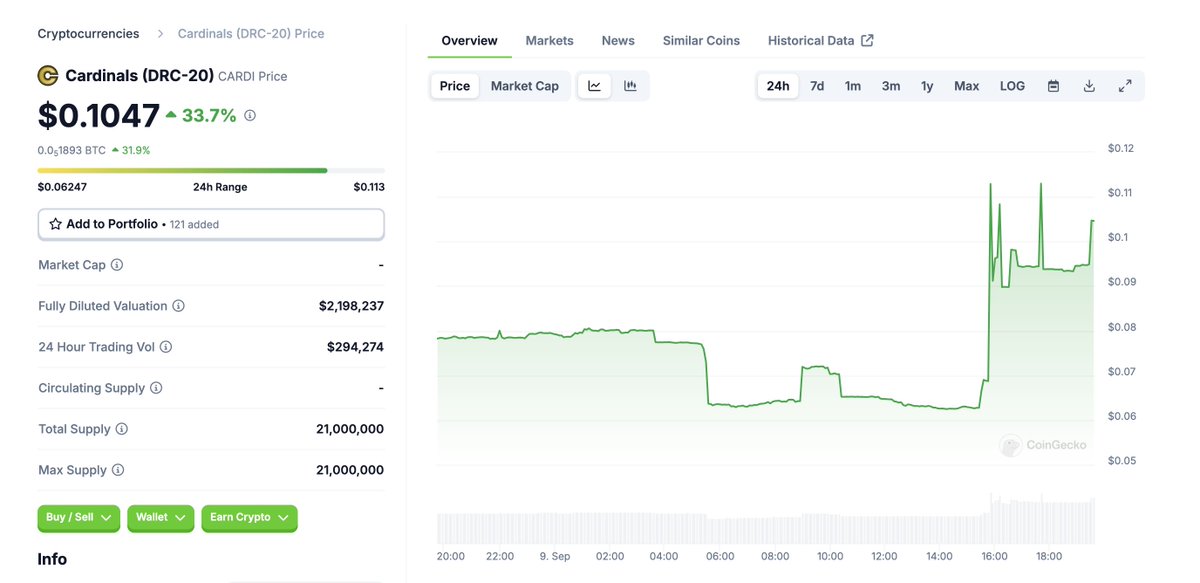
Despite another round of sell pressure, $CARDI has risen again. The future rise of DOGE is closely tied to the DRC20 Cardinals protocol. 🚀🐕 #CARDI #DOGE #Cardinals #DOGECOIN
English
Dark Knight retweetledi

Dark Knight retweetledi

❤️ Thanks everyone for your support and love!
Last month I got interviewed by police for 4 days after arriving in Paris. I was told I may be personally responsible for other people’s illegal use of Telegram, because the French authorities didn’t receive responses from Telegram.
This was surprising for several reasons:
1. Telegram has an official representative in the EU that accepts and replies to EU requests. Its email address has been publicly available for anyone in the EU who googles “Telegram EU address for law enforcement”.
2. The French authorities had numerous ways to reach me to request assistance. As a French citizen, I was a frequent guest at the French consulate in Dubai. A while ago, when asked, I personally helped them establish a hotline with Telegram to deal with the threat of terrorism in France.
3. If a country is unhappy with an internet service, the established practice is to start a legal action against the service itself. Using laws from the pre-smartphone era to charge a CEO with crimes committed by third parties on the platform he manages is a simplistic approach. Building technology is hard enough as it is. No innovator will ever build new tools if they know they can be personally held responsible for potential abuse of those tools.
Establishing the right balance between privacy and security is not easy. You have to reconcile privacy laws with law enforcement requirements, and local laws with EU laws. You have to take into account technological limitations. As a platform, you want your processes to be consistent globally, while also ensuring they are not abused in countries with weak rule of law. We’ve been committed to engaging with regulators to find the right balance. Yes, we stand by our principles: our experience is shaped by our mission to protect our users in authoritarian regimes. But we’ve always been open to dialogue.
Sometimes we can’t agree with a country’s regulator on the right balance between privacy and security. In those cases, we are ready to leave that country. We've done it many times. When Russia demanded we hand over “encryption keys” to enable surveillance, we refused — and Telegram got banned in Russia. When Iran demanded we block channels of peaceful protesters, we refused — and Telegram got banned in Iran. We are prepared to leave markets that aren’t compatible with our principles, because we are not doing this for money. We are driven by the intention to bring good and defend the basic rights of people, particularly in places where these rights are violated.
All of that does not mean Telegram is perfect. Even the fact that authorities could be confused by where to send requests is something that we should improve. But the claims in some media that Telegram is some sort of anarchic paradise are absolutely untrue. We take down millions of harmful posts and channels every day. We publish daily transparency reports. We have direct hotlines with NGOs to process urgent moderation requests faster.
However, we hear voices saying that it’s not enough. Telegram’s abrupt increase in user count to 950M caused growing pains that made it easier for criminals to abuse our platform. That’s why I made it my personal goal to ensure we significantly improve things in this regard. We’ve already started that process internally, and I will share more details on our progress with you very soon.
I hope that the events of August will result in making Telegram — and the social networking industry as a whole — safer and stronger. Thanks again for your love and memes 🙏
English