
DataCamp

12.5K posts

DataCamp banner
DataCamp

DataCamp

@DataCamp

Learn data and AI skills from scratch with 620+ courses. Master Python, ChatGPT, SQL, Power BI, and more.

New York Katılım Temmuz 2013
474 Takip Edilen108K Takipçiler
DataCamp
DataCamp@DataCamp·
This is the stuff bootcamps skip over. Real data is messy, and cleanup, it's where you actually learn to understand the data. If anyone wants to practice this hands-on, we've got 30 projects at different levels (several focused on real-world data wrangling): datacamp.com/blog/data-anal…
English
0
0
0
94
TheDataJoy©
TheDataJoy©@femininow·
I worked on data cleanup for a core banking system migration. It completely changed how I see data. Here are 6 lessons every beginner analyst should learn:
English
6
17
206
10.1K
DataCamp
DataCamp@DataCamp·
Solid roadmap, especially starting with Python + NumPy before jumping into ML! One thing we'd add: don't sleep on the fundamentals of how models make decisions (not just how to call .fit()). We put together a pretty comprehensive guide that maps out each stage with resources: datacamp.com/blog/how-to-le…
English
0
0
0
8
Shruti Codes
Shruti Codes@Shruti_0810·
Most people try to learn ML randomly. That’s why they quit. Here’s the clean roadmap from 0 → AI Expert: 🟢 Beginner (0–4 Months) 1️⃣ Python + NumPy/Pandas 2️⃣ Linear Algebra + Probability 3️⃣ SQL + Data Pipelines 4️⃣ ML Fundamentals (Scikit-learn) 5️⃣ Ship 1 real project At this point → You’re job-ready. --- 🔵 Advanced (5–12 Months) 6️⃣ Deep Learning (PyTorch) 7️⃣ Specialize (CV / NLP / Recsys) 8️⃣ MLOps (MLflow + Kubeflow) Now you’re an ML Engineer. --- 🔴 Expert (12–18 Months) 9️⃣ Agentic AI systems 🔟 Production scale (Ray + Vertex AI) Now you build AI systems — not just models. --- Most people stop at Stage 4. The top 1% finish all 10. Save this. Consistency > intelligence. 🚀
Shruti Codes tweet media
English
9
61
360
13.8K
DataCamp
DataCamp@DataCamp·
@krishdotdev The AI Agent Orchestrator role is the one to watch, it's basically the new full-stack but for AI systems. The barrier to entry for most of these? Strong Python + understanding how LLMs actually work under the hood. 🐍
English
0
0
0
16
Kr$na
Kr$na@krishdotdev·
These 2026 job roles sound fake... but they’re already real. - Claude Code Specialist - Codex Specialist - AI Agent Orchestrator - Prompt/Context Engineer - AI Workflow Architecht - AI Reviewers/Debuggers - Forward deployed engineer
English
9
0
83
3.5K
DataCamp
DataCamp@DataCamp·
You don't need to spend hours Googling "best data science courses." ✋ DataCamp Premium is 50% off—and we did it for you 👇 → Top picks across Python, SQL & ML → For every skill level → Updated for 2026 AI workflows 👉 ow.ly/PIre50YUuzI #DataScience
DataCamp tweet media
English
1
0
11
785
Nitēsh A Malap
Nitēsh A Malap@uxdesign_nitesh·
@DataCamp I become premium customer on 30th April and now with your updates I’m not able to access any of the courses. Is this how you are handling Data of your users?
English
2
0
0
16
DataCamp
DataCamp@DataCamp·
"Will AI replace data analysts?" It's the question keeping a lot of people up at night. The fear is real. But data analysts aren't becoming obsolete. They're becoming more powerful—IF they know how to work alongside AI. Here's the roadmap. Same 5 steps. But with an AI upgrade for 2026: Step 1: SQL BEFORE: Write queries manually, debug by trial and error NOW: AI generates first drafts, explains query logic, catches performance issues Step 2: Excel/Sheets BEFORE: Build pivot tables and dashboards by hand NOW: AI suggests layouts, auto-generates formulas, flags data quality issues Step 3: Python for automation BEFORE: Write scripts from scratch, Google every function NOW: AI drafts boilerplate, explains libraries, debugs 10x faster Step 4: Portfolio projects BEFORE: Explore datasets manually, write up findings alone NOW: AI as thought partner: Brainstorm angles, validate hypotheses Step 5: Land the job BEFORE: Prep from memory NOW: AI simulates mock interviews, gives feedback, researches companies The analysts who thrive aren't the ones who ignore AI. They use it like a superpower. Which step are you working on? Drop it in the comments. #DataAnalyst #AI #CareerAdvice #DataScience #Upskilling #FutureOfWork
English
3
9
37
2.9K
DataCamp
DataCamp@DataCamp·
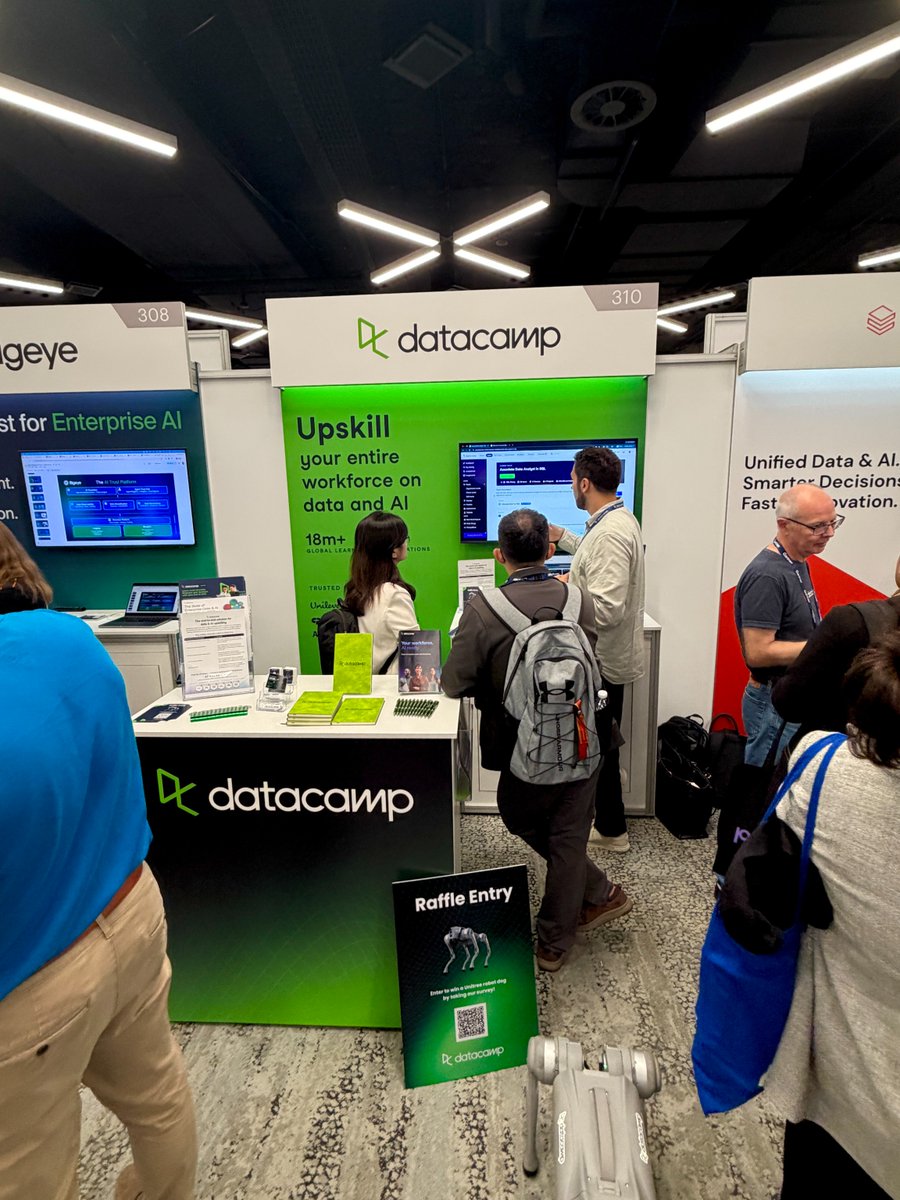
That's a wrap on Learning Technologies London! AI literacy is urgent; upskilling at scale is L&D's #1 priority. Thanks to everyone at the DataCamp booth!
DataCamp tweet mediaDataCamp tweet mediaDataCamp tweet media
English
1
0
15
1K
DataCamp
DataCamp@DataCamp·
This week, learn how to build AI agents, automate research, optimize complex systems, and transform how your team finds information—all in free 1-hour webinars. 👇 Mon, May 4—Len Ward (Commexis) shows how to build custom GPTs for go-to-market research automation. Tue, May 5—Greg Michaelson & Jason Hillary (Zerve AI) dive into using AI agents for power grid optimization. Wed, May 6—Yuval Belfer (AI21 Labs) breaks down the four gaps that keep AI agents from reaching production. Thu, May 7—Marin Smiljanic (OmniSearch) & Christian Ward (Yext) explore how AI is transforming enterprise search. All sessions start at 11 AM ET. Register below and join the ones that interest you most! 🔗 ow.ly/wopV50YSy8r
DataCamp tweet mediaDataCamp tweet mediaDataCamp tweet mediaDataCamp tweet media
English
0
1
16
1.1K
DataCamp
DataCamp@DataCamp·
Great roadmap! Having that visual path makes a huge difference when you're starting out. We actually mapped out a 12-month SQL learning plan that pairs well with this: datacamp.com/blog/sql-roadm…. Covers everything from foundations through performance optimization with hands-on projects along the way.
English
1
0
2
256
Dhanian 🗯️
Dhanian 🗯️@e_opore·
SQL Developer Learning Roadmap |-- Database Fundamentals | |-- What is a Database? (Relational vs Non-Relational) | |-- Tables, Rows, Columns & Schemas | |-- Primary Keys & Foreign Keys | |-- Data Types (INT, VARCHAR, DATE, BOOLEAN) | |-- Normalization Basics (1NF, 2NF, 3NF) |-- Basic SQL Queries | |-- SELECT Statements | |-- WHERE Clause & Filtering | |-- ORDER BY & Sorting | |-- LIMIT / OFFSET | |-- DISTINCT & Aliases |-- Data Manipulation (DML) | |-- INSERT Data into Tables | |-- UPDATE Existing Records | |-- DELETE Records Safely | |-- Bulk Inserts & Imports | |-- Transactions (BEGIN, COMMIT, ROLLBACK) |-- Joins & Relationships | |-- INNER JOIN | |-- LEFT JOIN / RIGHT JOIN | |-- FULL OUTER JOIN | |-- Self Joins | |-- Cross Joins |-- Aggregations & Grouping | |-- COUNT, SUM, AVG, MIN, MAX | |-- GROUP BY | |-- HAVING Clause | |-- Aggregation with Joins | |-- Window Functions (ROW_NUMBER, RANK, DENSE_RANK) |-- Subqueries & Advanced Queries | |-- Subqueries (Nested Queries) | |-- Correlated Subqueries | |-- Common Table Expressions (CTEs) | |-- Recursive Queries | |-- Set Operations (UNION, INTERSECT, EXCEPT) |-- Indexing & Performance Optimization | |-- Indexes (B-Tree, Hash) | |-- Query Execution Plans | |-- Query Optimization Techniques | |-- Avoiding Full Table Scans | |-- Caching & Materialized Views |-- Database Design | |-- Schema Design Principles | |-- ER Diagrams & Relationships | |-- Normalization vs Denormalization | |-- Constraints (NOT NULL, UNIQUE, CHECK) | |-- Data Integrity & Consistency |-- Stored Procedures & Functions | |-- Creating Stored Procedures | |-- User-Defined Functions | |-- Triggers & Events | |-- Error Handling in SQL | |-- Automating Database Logic |-- Security & Access Control | |-- User Roles & Permissions | |-- GRANT & REVOKE | |-- Data Encryption & Masking | |-- Backup & Recovery Strategies | |-- Auditing & Logging |-- Working with SQL in Applications | |-- Connecting SQL with Backend (Node.js, Python, Java) | |-- ORMs (Sequelize, SQLAlchemy, Hibernate) | |-- Writing Efficient Queries in Apps | |-- Pagination & Data Streaming | |-- API + Database Integration |-- Data Analytics & Reporting | |-- Writing Analytical Queries | |-- Time-Series Analysis | |-- Data Warehousing Basics | |-- ETL Processes | |-- Dashboards & BI Tools (Power BI, Tableau) |-- Real-World Projects | |-- Build a Blog Database System | |-- Design an E-Commerce Database | |-- Create a Reporting Dashboard Backend | |-- Optimize Slow Queries in a Large Dataset | |-- Build a Data Analytics Pipeline |-- Continuous Learning & Growth | |-- Practice SQL Challenges Daily | |-- Explore Different Databases (PostgreSQL, MySQL, SQLite) | |-- Read Database Documentation | |-- Learn Advanced Optimization Techniques | |-- Stay Updated with Data Engineering Trends Get the SQL Playbook Ebook codewithdhanian.gumroad.com/l/hjmix This playbook walks you through real SQL scenarios, query optimization techniques, and practical database projects to help you move from basic queries to advanced data handling and performance tuning.
Dhanian 🗯️ tweet media
English
8
30
154
4.1K
DataCamp
DataCamp@DataCamp·
@NanouuSymeon 100% this. Docker is one of those skills that separates "I can write code" from "I can ship code." If anyone's looking for a data-science-specific Docker guide, this one breaks it down from setup to dockerizing ML apps: datacamp.com/tutorial/docke…
English
0
0
1
227
• nanou •
• nanou •@NanouuSymeon·
A lot of beginners learn Python or JavaScript… …but skip Docker. Big mistake. Docker is one of the most useful skills you can learn because it helps you run apps consistently, package projects cleanly, and work more like a real developer. Here’s the roadmap I’d follow to learn Docker from zero:
English
10
15
141
5.6K
DataCamp
DataCamp@DataCamp·
@mdancho84 Solid stack! And the best part is you can go from zero to building real LangChain apps faster than most people think. We put together a hands-on tutorial that walks through building LLM applications step by step: datacamp.com/tutorial/how-t…
English
0
0
1
146
DataCamp
DataCamp@DataCamp·
"I keep hearing about Claude Code, but how do I actually USE it as a data scientist?" Fair question. Here's a practical starting point. Claude Code runs directly in your terminal and understands your entire codebase. Not just the file you're in—the whole thing. Here's where that actually changes your workflow: -> Debugging import errors across a complex dependency tree? Describe the error, Claude traces it back to the root cause and patches it—no more hunting across 5 files manually -> Working with a repo you didn't write? Ask Claude to explain the architecture, then have it add docstrings that actually reflect what the code does (not just what it looks like it does) -> Tired of formatting PRs before review? Set up a hook that auto-runs black and your linter every time Claude writes a Python file—zero extra steps #Claude #AI #DataScience #Tutorial #Python #LLM #DataAnalyst
English
1
0
11
1.8K
DataCamp
DataCamp@DataCamp·
We're heading to Gartner Data & Analytics Summit EMEA, May 11–13 at ExCeL London. If you're building out your organization's data and AI capabilities, come say hello at Booth #716. We'd love to chat about how teams are using DataCamp to upskill at scale, close skill gaps faster, and actually measure the impact of learning programs. Whether you're exploring AI literacy for the wider business or training specialist teams on advanced ML and engineering, we've got something to talk about. See you there?
DataCamp tweet media
English
2
1
3
686
DataCamp
DataCamp@DataCamp·
How to become a data analyst in 2026—5 real steps: 1. Learn SQL first (not Python)—it's in 90%+ of job postings 2. Master Excel/Sheets—stakeholders still live there 3. Use Python for automation, not for show 4. Build 3 portfolio projects that tell a story (skip Titanic) 5. Apply before you feel ready—you'll learn 80% on the job
DataCamp tweet media
English
2
3
25
1K
DataCamp
DataCamp@DataCamp·
Know basic Python? Build these OpenClaw projects: -> Reddit summarizer bot -> PDF research assistant -> Self-healing pipeline Most cost $0-$5/mo: ow.ly/GZhq50YR3u1 #AI #Python
DataCamp tweet mediaDataCamp tweet mediaDataCamp tweet mediaDataCamp tweet media
English
1
0
12
938
DataCamp
DataCamp@DataCamp·
Data science salaries in 2026 vary—a lot. A Data Analyst and an ML Engineer can sit worlds apart in compensation, and even within the same role, the gap between entry-level and senior pay is significant. What sits between the bottom and top of those ranges usually comes down to experience, specialization, and what you can actually demonstrate. In practice, projects tend to do more heavy lifting than credentials. A portfolio that shows you've solved real problems is often what gets you the interview. That said, certifications are far from useless—they signal to hiring managers that your skills have been assessed against a real standard, not just self-declared. Think of them as a complement to the work you're building, not a substitute for it. DataCamp certifications are built with industry experts to validate job-ready skills across Data Analyst, Data Scientist, and Data Engineer tracks—tested on what actually matters in the role. Explore our certifications: ow.ly/1m2c50YPaQx
English
2
5
16
1.7K
DataCamp
DataCamp@DataCamp·
Courses teach syntax. Projects teach thinking. DataCamp Projects give you real datasets and real questions—no hand-holding. ow.ly/kR2i50YPaCM
English
1
0
7
867