Dave Conroy
1.1K posts

Dave Conroy
@DaveConroy8
Principal - Rayleigh Elementary & Heffley Creek Elementary
Kamloops, British Columbia Katılım Haziran 2017
225 Takip Edilen249 Takipçiler

Sabres aim to surprise at high school hoops provincials; Vikes relishing B.C. championship experience | CFJC Today Kamloops cfjctoday.com/2026/02/24/sab…
English

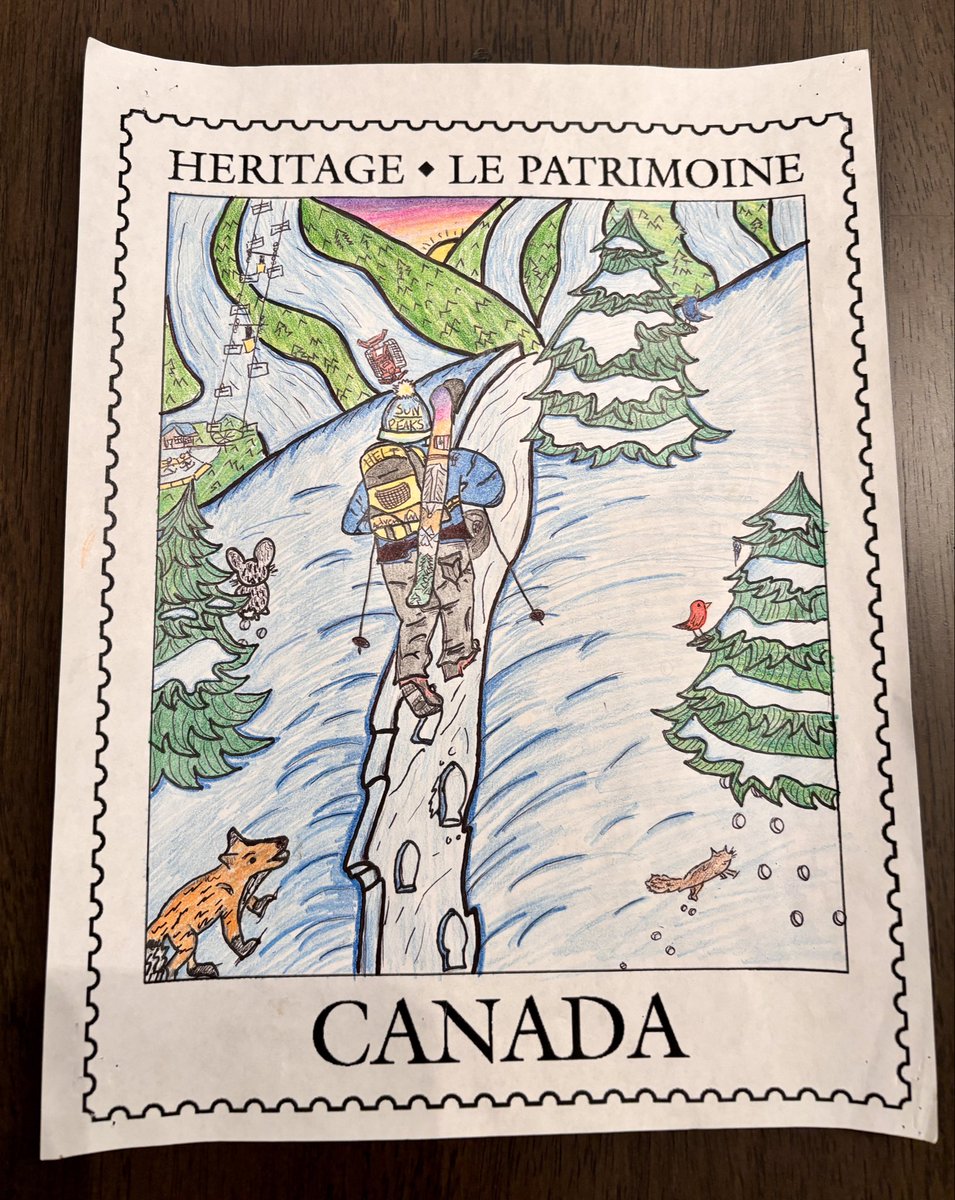
On behalf of the District Heritage Fair Committee, we are excited to share that the 2026 Heritage Stamp Contest winner is Quinn Holmes from Rayleigh Elementary. His stamp project focused on improving avalanche safety and the Sun Peaks Ski Patrol program. @Kamloops_SD73

English
Dave Conroy retweetledi

Norway is once again dominating the winter Olympics.
And this is their youth sports program:
Participation trophies for all kids.
No keeping score until 13.
No national travel competitions in youth sports.
No posting youth results online.
Motto: “Joy of Sport for All.”
They let kids be kids. And it works.
But…it’s the winter Olympics,right? Recently, they have had tremendous success in summer sports.
Karsten Warholm demolished the 400 meter hurdles world record. Kristian Blummenfelt broke the Ironman triathlon record and won Olympic gold. His training partner, Gustav Ivan, won the 2022 Ironman World Championship. Casper Ruud reached world number two in tennis. Viktor Hovland is a top ten golfer in the world. Erling Haaland set the record for the most goals in a season in the Premier League. Beach volleyball champs, a surge of elite runners. By any metric, Norway’s elite athletes are achieving on a global stage. Yet, if we turn to their youth sports, their programs are the opposite of the US.
Norway doesn’t allow for official scorekeeping until the age of thirteen. They dissuade early national travel teams in favor of local leagues. You can’t even post the results of youth games online without being fined. And almost sacrilegious in certain American circles, Norway doesn’t allow trophies unless everyone gets one.
As Tore Ovrebo, Norway’s director of elite sport, told USA Today writer Dan Wolken, “We think the biggest motivation for the kids to do sports is that they do it with their friends and they have fun while they’re doing it and we want to keep that feeling throughout their whole career.” Their youth sporting model can be summed up with their chosen slogan, “Joy of Sport for All.”
But not keeping score, giving out trophies, not being “win at all costs”...that’s anti-American! How can they be competitive?
Research backs their approach up.
1. The fire has to come from within
If you look at research on prodigies who eventually become standout adult performers, a deep intrinsic drive is paramount. Researchers found that intrinsically motivated football players were 3.5x more likely to make it to the next level, and athletes in general 2x more likely.
The problem is that early success often pulls young people away from this inner drive. Kids start playing soccer (or violin or chess—this isn’t just about sports) because it is exciting and fun. As they improve, they gain accolades and praise from their parents, coaches, and teachers. They start winning trophies or seeing their names in online commentary. Without even realizing it, their intrinsic drive gets replaced by external validation and a need to please and impress others.
The quickest way to kill that internal motivation? Hype achievements and be a crazy controlling parent or coach.
The best way to create and maintain intrinsic motivation is to let kids dabble, explore, and find something with which their interests and talents align. Then, let them enjoy it without an undue emphasis on success. Praise effort, character, and teamwork, not results. This is easy to talk about but hard to do. Find ways to reward and incentivize the values you want to instill. That means not taking the easy road and talking about who set a new mile best or scored the most points, but instead highlighting who hustled during the fourth quarter, rallied after it seemed like the match was over, or displayed exemplary sportsmanship.
2. Go Broad over Specialization
Even if the entire point of youth sports was to create future champions (which it’s not), we’d still adopt something similar to the Norwegian model. An analysis of over 6,000 athletes explored what separates athletes who reached world class and those who came up short.
Those who reached world-class had during their youth:
-More multi-sport than specialized practice
-Started their primary sport later
-Accumulated less overall formal practice
-Initially progressed slower than national class peers
Those who performed well when young, but didn’t progress:
-Started their primary sport earlier
-Specialized, engaging in more practice in one sport
-Made quicker initial progress
Norway doesn’t have 300 plus million people and an NCAA system to funnel talent. They have to develop theirs. And they realize the best way to do that is keep as many people in the system as possible.
Why? Because you can’t predict talent development very well! Just go look at the age group record books. It’s easy to fool yourself into thinking early performance equals talent and potential. The kid running a 6-minute mile at 10 looks way better than the one running 6:45. But if the faster one is at track practice 5 days a week and the slower one rolls out of gym class in jeans and runs it off “fitness” from just playing, well I’m betting on the slower one!
When we assess performance early on, we’re not measuring talent, we’re looking at training age and opportunity. And we’re crowning winners based on who started grinding first.
America gets away with the insane achievement model because we can burn out 9 kids to get 1 survivor. Norway can’t afford to do that. They take the longer, more sustainable model.
Rethinking Youth Sports:
The whole point of youth sports should be for kids to learn, develop, have fun, and want to come back and play again next season! The best chance of developing a D1 scholarship athlete is essentially to do the exact opposite of what our current youth sports fiasco promotes. Even the poster child for early specialization, Tiger Woods, acknowledged it’s not a good thing for parents to push their kids too hard: “Don’t force your kids into sports,” he says. “I never was. To this day, my dad has never asked me to go play golf. I ask him. It’s the child’s desire to play that matters, not the parent’s desire to have the child play. Keep it fun.”
While youth sports in America aren’t going to adopt the Norwegian model anytime soon, we can rebalance the equation. As I outlined in my book, it’s not getting rid of competitiveness, it’s rebalancing the equation to make sure that crazy mom, dad, or coach don’t extinguish the fire that makes great competitors (and sport fun!).
In research on performance orientation and grades in school, a teaching environment that supported and emphasized mastery[PA1] , where students focused on the process of learning and comprehension instead of a comparison to others, was also linked to better grades. But it wasn’t the direct relationship that an outcome orientation had. Instead, in one study on college students, a mastery approach was linked to challenge-seeking, which in turn predicted end-of-the-year grades. In another study, mastery goals predicted higher levels of interest and enjoyment. Mastery works on our approach system without activating avoidance. It frees us up to take on a challenge and pursue our interests without getting bogged down by the pressure or judgment that often comes with an obsession with outcomes. The same findings hold true when looking at sport or the workplace. In a large meta-analysis that analyzed the impact of goal setting in sports, process-orientated goals had a large effect on performance. Outcome goals had little to no effect.
These two paths represent a fast versus slow road to success. Both a mastery or outcome focus can lead to better performance, but the latter is akin to taking a shortcut. Obsession over outcomes is the most direct path to improvement, but it comes with some downsides that shift us toward avoidance. The slow path takes a longer, indirect route. It helps improve our performance not by focusing on the results themselves but by supporting the foundation that ultimately leads to better performance. It stokes the fire of enjoyment and interest to sustain our curiosity and work ethic over the long haul. It pushes us toward challenge-seeking so that when we inevitably hit a roadblock, we’ll take it on instead of trying to protect our ego. Both approaches work. One is more sustainable, providing success with less angst. Society has thrown us so far out of balance that we can’t even see the slow route right in front of us.
We can either instill a love of sport in our youth, or we can turn sport into a burden where kids are exhausted, stressed, and scared. We’ve seen this go both ways, and the results couldn’t be more different. One leads to happy, healthy, and better young athletes. The other leads to burnout, family tension, mental health challenges, and quitting. As parents, volunteers, coaches, and community members, let’s all do what we can to minimize the latter and champion the former.
-Steve
English
Dave Conroy retweetledi

Studies show family meals are literally linked to better grades.
According to a Columbia University study by the National Center on Addiction and Substance Abuse (CASA), children who frequently share dinner with their families achieve higher grades in school.
The data reveals that teens eating five or more family meals weekly are far more likely to earn excellent marks and demonstrate advanced communication and vocabulary abilities.
This research underscores how routine family engagement fosters a nurturing, stable setting that enhances emotional well-being and self-assurance—vital factors in scholastic achievement.
The advantages go further: shared mealtimes provide a secure forum for self-expression, absorption of family principles, and honing of analytical thinking. Notably, the study also shows that adolescents with more family dinners are markedly less prone to risky activities like smoking or alcohol use. In today’s world of packed agendas and digital distractions, these findings highlight how the straightforward act of dining together can significantly influence a child’s trajectory.
[Columbia University, National Center on Addiction and Substance Abuse (CASA). April 2025]

English
Dave Conroy retweetledi

Following yesterday’s lockdown at NorKam Secondary, Kamloops RCMP reported today that police have found no credible evidence to suggest there was a person with a firearm at the school on Thursday.
Read the latest update here:
ow.ly/7cvA50XoMxb

English
Dave Conroy retweetledi

TimBit Player of the Night Applications Open! 🏒
Your U7 hockey player could join the Blazers on the ice before a game as the Tim Hortons TimBit Player of the Night!
📅 Apply by: Friday, January 9
✉️ Selected families will be contacted by email
Apply | bit.ly/4ncmyMg

English
Dave Conroy retweetledi

Future star in the family? 🌟🎙️
Kids 9–12 can apply to be Jr. Reporters & Jr. Announcers for our Kids Nights!
Apply by Sept 21 ➡️ bit.ly/3HUm9Pv

English
Dave Conroy retweetledi

This was a neat one. Fella used his e-bike to get to cancer treatment. It was stolen. @983cifm morning show host @NikkiOmen and listeners hopped into action — cfjctoday.com/2025/09/09/sti…
English
Dave Conroy retweetledi

@Kamscan Fire fighters have done an incredible job of responding. This photo was from about an hour ago. They are mostly in hotspot mop up stage now.

English
Dave Conroy retweetledi

Welcome Back to School!
The first day of classes starts at 10:30 am on Tuesday, September 2, 2025. Follow the link for important information on dismissal times, bussing, transportation, and more. ow.ly/YjZE50WKjHm

English
Dave Conroy retweetledi