Davíð Roach retweetledi
Davíð Roach
7.1K posts

Davíð Roach
@DavidRoachG
What I've got here ... is a failure to communicate.
Katılım Nisan 2015
910 Takip Edilen1.3K Takipçiler

Stellan & Kidman kveikja sér í sígó. Tríerinn flissar. Þegar blaðamannafundir voru kúl.
Emir Han@RealEmirHan
nicole kidman smoking at the cannes press conference for dogville
IS
Davíð Roach retweetledi

The Case for Childhood Boredom.
A strange thing has quietly disappeared from childhood.
Boredom.
For most of human history, boredom was unavoidable. Childhood unfolded in long, uneven stretches of time that nobody bothered to organize. Summer afternoons drifted by without a schedule, car rides lasted hours with nothing but the passing landscape, and children spent entire days outside with only a loose instruction to be home before dinner.
And something curious tended to happen in those empty spaces.
Children invented things.
A stick became a sword, and then a fishing rod, and then, without warning, a wand capable of defeating imaginary monsters. A patch of grass became a battlefield. A cardboard box became a spaceship. Entire worlds emerged out of nothing more than idle time and a restless mind.
Neuroscientists now understand that the brain behaves differently in those moments. When external stimulation fades, a network deep in the brain called the default mode network begins to activate. It is the circuitry associated with imagination, memory integration, and abstract thinking. When the mind has nowhere specific to go, it begins to wander, and while it wanders it starts connecting dots that rarely meet during structured activity.
Creativity often lives in that wandering.
Modern childhood, however, has undergone a quiet redesign. Empty time has been steadily replaced with organized activity. Sports leagues, tutoring sessions, music lessons, enrichment programs. Even the small gaps between activities tend to be filled with screens engineered with extraordinary precision to eliminate boredom the moment it begins to appear.
Parents worry when boredom surfaces. A child announcing “there’s nothing to do” can feel like a problem waiting to be solved, a signal that the environment lacks sufficient stimulation.
But boredom is simply the brain beginning a different mode of operation.
The mind starts generating its own stimulation instead of consuming someone else’s.
Look closely at the childhoods of unusually creative people and a pattern emerges. Steve Jobs spent long stretches wandering the neighborhoods of Silicon Valley, exploring electronics shops and experimenting in garages. Albert Einstein famously described hours of quiet daydreaming as a child, staring out windows and imagining physical problems in his head. J.K. Rowling began inventing elaborate stories long before she had any audience for them.
Each of them had something that has become surprisingly rare.
Psychological whitespace.
Modern childhood often resembles a corporate calendar. Every hour accounted for. Every activity supervised. Every quiet moment quickly filled by a glowing rectangle designed by teams of behavioral scientists whose job is to make sure attention never drifts into silence.
And yet many of the qualities parents hope their children will develop—creativity, resilience, independence—tend to emerge from precisely the conditions we have learned to eliminate.
Unstructured time confronts a child with a deceptively simple problem.
What should I do next?
That question trains the brain in powerful ways. It forces the mind to generate ideas, to tolerate the mild discomfort of inactivity, and eventually to invent something interesting enough to fill the gap.
Children who rarely encounter boredom often struggle to resolve it on their own.
They wait.
They look outward for stimulation rather than inward for possibility.
Childhood boredom, in that sense, becomes a kind of workshop. It is the place where imagination practices building things from nothing, where the mind experiments freely without instruction, and where curiosity slowly learns how to entertain itself.
Left alone long enough, the mind begins to wander.
And wandering minds have a peculiar habit of discovering entirely new worlds.

English
Davíð Roach retweetledi

@itgeorgs Rakel Sveinsdóttir og "Fréttir af mannauðsmálum"-dálkurinn hennar á Vísi er stöðug uppspretta kjánahrolls
IS

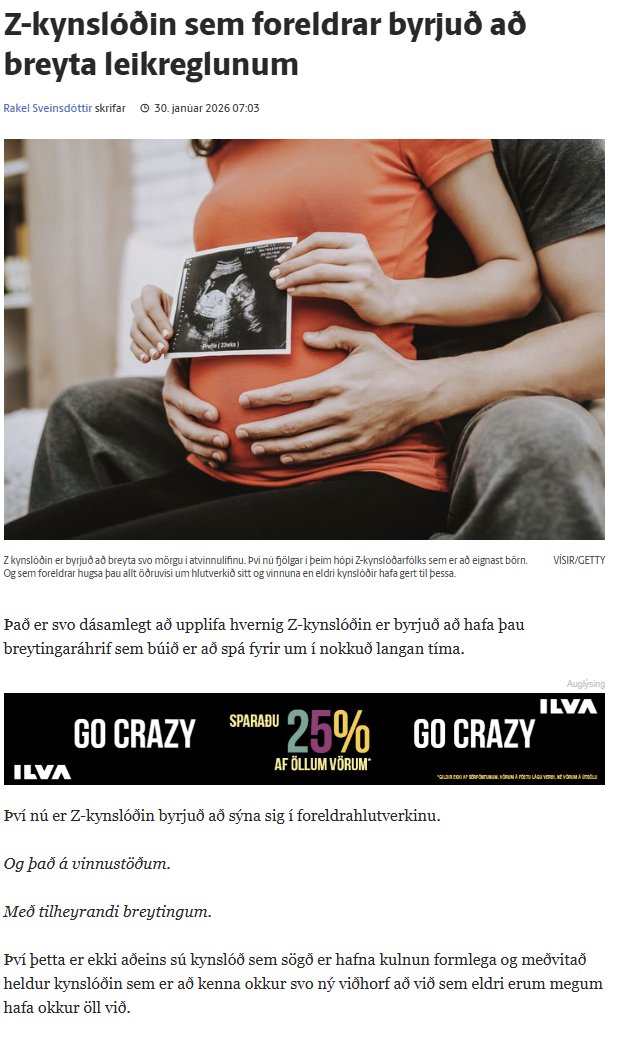
Ætla að taka daginn frá í að stúdera þessa grein og undirbúa mig fyrir Z-kynslóðina.
Þessi verðlaunagrein er skrifuð með skáletri, feitletrun og svo eru svona bestu tilvitnanirnar settar fyrir miðju. Það gleymist reyndar að vitna í einhverjar rannsóknir en það er algjört aukatriði því þetta er þýtt frá erlendum stórmiðli.
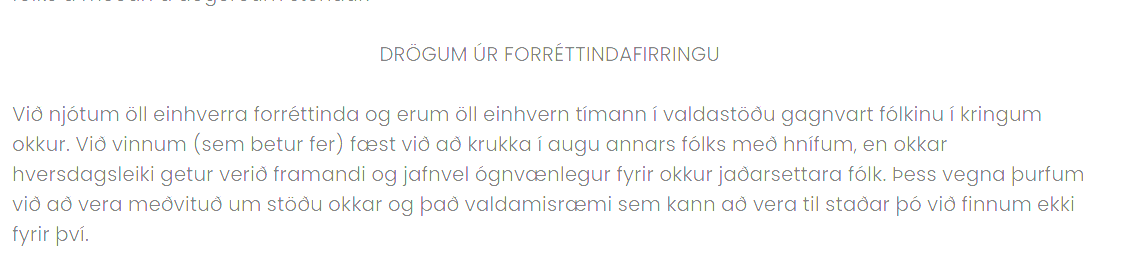
Hér er þráður fyrir 5 bestu setningarnar í þessari grein.

IS

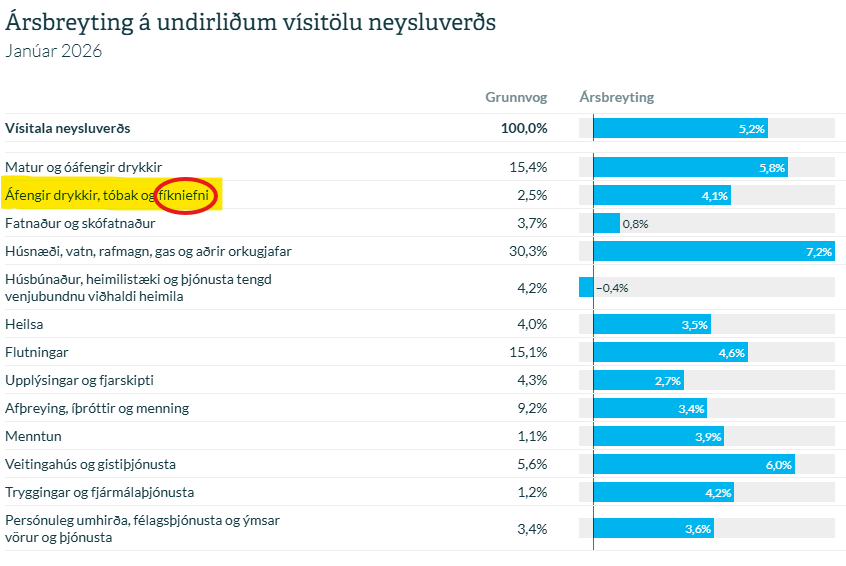
@kubeinid @GuTryggvi Sem er rétt. Og það merkilega er er að dóphagkerfið er miklum mun stöðugra heldur en raunhagkerfið. Ég segi við fáum bara Svedda Tönn framseldan frá brasilíu og skipum hann seðlabankastjórahttps://www.mbl.is/frettir/innlent/2022/06/10/engin_verdbolga_a_fikniefnamarkadnum/
IS

@GuTryggvi Það eru einfaldlega gögn frá SÁÁ.
Sjúklingar sem efu lagðir inn svara stuttri könnun hvað fíkniefni kosta
IS

@JonHelgiJonsson Hæfniviðmið í lesskilningi þarfnast frekari þjálfunar
IS

@DavidRoachG Af hverju? Hverjum er ekki slétt sama um Ruv og bubba m.
IS