Davidutro.eth

3.7K posts

Davidutro.eth banner
Davidutro.eth

Davidutro.eth

@Davidutro

Lover of design & technology, perpetual source of good energy, Ops & Growth @Santimentfeed, OG @thesaunadao, Prev; BD @Ajnafi, Comms & Ops @MakerDAO

Katılım Temmuz 2016
2.1K Takip Edilen3.5K Takipçiler
Sabitlenmiş Tweet
Davidutro.eth
Davidutro.eth@Davidutro·
I’ll be posting - excerpts from books i’m reading or revisiting - good advice and wisdom - price predictions and investment thesis - questions I’ll be reposting - high signal stuff relevant to crypto - good advice and wisdom - cool shit generally speaking - things I am interested in promoting like good writing, businesses, accounts, tools, etc I don’t accept payment for tweets.
English
121
2
174
1.5K
Davidutro.eth retweetledi
Santiment Intelligence
Santiment Intelligence@SantimentData·
🐳 On-chain data indicates that Dogecoin's whales have just hit a 6-month high in activity, with 739 $100K+ transfers in just a 1-day span. Additionally, of the 149 whale wallets holding at least 100M Dogecoin, they now collectively hold an all-time high of 108.52B $DOGE (worth $11.6B). The memecoin's +14% price rise over the past 10 days is very likely not just a coincidence. Follow along with this Santiment chart here to see if their accumulation continues: app.santiment.net/charts/doge-wh…
Santiment Intelligence tweet media
English
6
14
61
10.1K
Davidutro.eth retweetledi
Brivael Le Pogam
Brivael Le Pogam@brivael·
Elon Musk avait dit un truc qui m'avait marqué sur l'allocation de ressources. En substance : passé un certain niveau de richesse, l'argent n'est plus de la consommation, c'est de l'allocation de capital. Cette phrase change tout. L'économie, dans le fond, c'est juste un problème d'allocation. Tu as des ressources finies et des usages infinis. Qui décide où va quoi ? Imagine une cour de récré. 100 enfants, des paquets de cartes Pokémon distribués au hasard. Tu laisses faire. Très vite, un ordre émerge. Les bons joueurs accumulent les cartes rares, les collectionneurs trient, les négociateurs trouvent des deals. Personne n'a planifié. Et pourtant chaque carte finit dans les mains de celui qui en tire le plus de valeur. Le système maximise le bonheur total de la cour. C'est ça, la main invisible. Maintenant fais entrer la maîtresse. Elle trouve ça injuste. Léo a 50 cartes, Tom en a 3. Elle confisque, redistribue, impose l'égalité. Trois effets immédiats. Les bons joueurs arrêtent de jouer, à quoi bon. Les mauvais n'ont plus de raison de progresser, ils auront leur part. Les échanges s'effondrent. La cour est égale, et morte. Elle a maximisé l'égalité, elle a détruit le bonheur. Le problème de la maîtresse, c'est qu'elle ne peut pas avoir l'information que la cour avait collectivement. C'est le problème du calcul économique de Mises, formulé en 1920. L'URSS a essayé de le résoudre pendant 70 ans avec le Gosplan. Résultat : pénuries, queues, effondrement. Pas parce que les Soviétiques étaient bêtes, parce que le problème est mathématiquement insoluble en mode centralisé. Quand Musk a 200 milliards, il ne les consomme pas, il les alloue. SpaceX, Starlink, Neuralink, xAI. Chaque dollar est un pari sur le futur. Et lui a un track record. PayPal, Tesla, SpaceX. Il a démontré qu'il sait identifier des problèmes immenses et y allouer des ressources avec un rendement spectaculaire. L'État aussi a un track record. Hôpitaux qui s'effondrent, éducation qui décline, dette qui explose, services publics qui se dégradent malgré des budgets en hausse constante. Le marché identifie les bons allocateurs, la politique identifie les bons communicants. Le profit n'est pas une finalité, c'est un signal. Il dit : tu as alloué des ressources rares vers un usage que les gens valorisent suffisamment pour payer. Plus le profit est gros, plus la création de valeur est grande. Quand Starlink est rentable, ça veut dire que des millions de gens dans des zones rurales ont enfin internet. Quand un ministère est en déficit, ça veut dire qu'il consomme plus qu'il ne produit. L'un crée, l'autre détruit, et on appelle ça redistribution. Dans nos sociétés il y a deux catégories d'acteurs. Les entrepreneurs et les bureaucrates. L'entrepreneur prend un risque personnel pour identifier un problème, mobiliser des ressources, créer une solution. S'il se trompe il perd. S'il a raison, ses clients gagnent, ses employés gagnent, ses fournisseurs gagnent, l'État collecte des impôts. Il est la cellule de base du progrès humain. Le bureaucrate ne prend aucun risque personnel. Son salaire est garanti. Au mieux il maintient une rente existante. Au pire il la détruit par excès de réglementation, mauvaise allocation forcée, incitations perverses qui découragent ceux qui produisent. Mais dans aucun cas il ne crée. Regarde les 50 dernières années. iPhone, internet civil, SpaceX, Tesla, Google, Amazon, Stripe, mRNA, ChatGPT. Toutes des inventions privées, portées par des entrepreneurs, financées par du capital risque. Pas un seul ministère n'a inventé quoi que ce soit qui ait changé ta vie au quotidien. La France est devenue le laboratoire mondial de la dérive bureaucratique. 57% du PIB en dépenses publiques, record absolu. Une administration tentaculaire, une fiscalité qui pénalise la création de richesse. Résultat : décrochage face aux États-Unis, à l'Allemagne, à la Suisse. Fuite des cerveaux. Désindustrialisation. Dette qui explose. Et le pire c'est que la mauvaise allocation s'auto-renforce. Plus l'État prélève, moins les entrepreneurs créent. Moins ils créent, moins il y a de base fiscale. Plus l'État s'endette et taxe. Boucle de rétroaction négative parfaite. La maîtresse pense qu'elle aide, et chaque année la cour produit moins. Dans nos sociétés, ce sont les entrepreneurs, toujours, qui font avancer la civilisation. Les bureaucrates au mieux maintiennent une rente, au pire la détruisent. Aucune société n'a jamais progressé en taxant ses créateurs pour subventionner ses gestionnaires. La question n'est jamais qui a combien. C'est qui alloue le mieux la prochaine unité de ressource pour maximiser le futur de l'humanité. La réponse depuis 200 ans n'a jamais changé. Ce ne sont pas les fonctionnaires.
Français
3.3K
16.5K
61.8K
81.5M
Davidutro.eth retweetledi
Santiment Intelligence
Santiment Intelligence@SantimentData·
With recent deposits, Santiment has put over $5M total into @aave to signal confidence and support of DeFi and its amazing community. DeFi is all about building together, and that includes building a better future when times get tough. defiunited.world
English
3
4
47
5K
Davidutro.eth retweetledi
Stani
Stani@StaniKulechov·
Aave is my life's work and we're working nonstop to find the best possible outcome for users. I’m personally contributing 5000 ETH to DeFi United as we continue working together with partners on formalizing more commitments. I’m working to see this resolved and market conditions normalized as soon as possible. DeFi United.
English
838
492
5.3K
580.9K
Davidutro.eth retweetledi
Heidi
Heidi@blockchainchick·
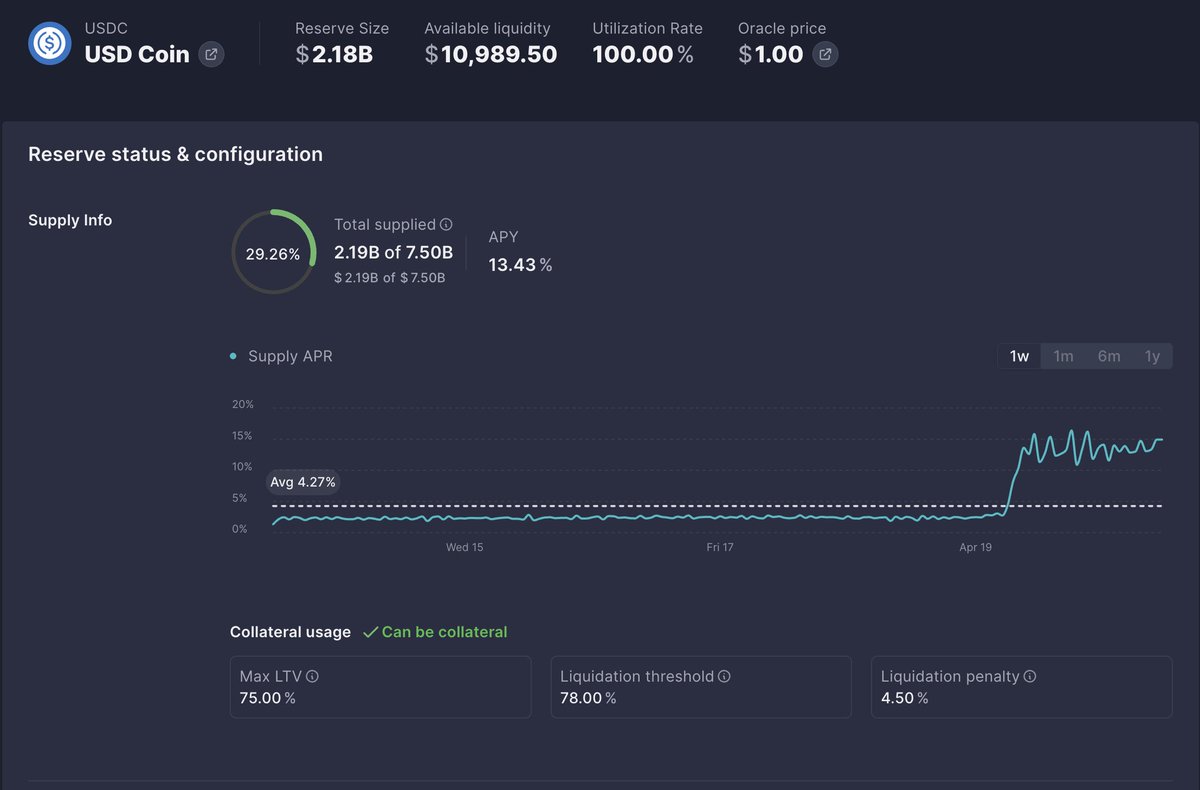
USDC and USDT on Aave are pinned at 100% utilization. Lenders can't withdraw. So why is the yield only 13.5%? Under the old model, a pool hitting 100% utilization would send supply APY to 40%, 60%, sometimes 80%+ within minutes. That's what everyone remembers from the 2022 USDT squeeze on Aave V2. Rate goes vertical. Borrowers get liquidated. Suppliers feast. That's not happening this time. Here's why. Aave rolled out something called the Slope2 Risk Oracle earlier this year. Instead of rates spiking instantly when utilization pins, the curve escalates GRADUALLY based on how long the pool stays stressed. A 1-hour spike barely moves the rate. A 24-hour spike moves it some. A 72-hour spike starts to hurt. The ceiling is also lower. Stablecoin slope2 now targets 10-12%. Used to be 22-35%. So instead of a panic rate explosion, you get a slow burn. Who wins from this design? Borrowers. Including the attacker still sitting on $236M in WETH debt, paying a fraction of what they'd be paying under the old curve. Who loses? Lenders. The "your pool is frozen but at least you're earning 40% APY" trade is dead. Now it's "your pool is frozen and you're earning 13.5%." This was meant to prevent deleveraging cascades during stress events. It's doing that. It's also suppressing the market signal that usually tells lenders to supply more liquidity and borrowers to repay fast. Every design choice is a tradeoff. This one just got tested live, with $200M of bad debt on the line.
Heidi tweet media
English
45
103
718
110.8K
Davidutro.eth retweetledi
Santiment Intelligence
Santiment Intelligence@SantimentData·
(1/2 ) $AAVE signals around the Kelp exploit discovered with Claude via Santiment MCP: ☝️ Whale transactions (>$100K) spiked from 2–6 per hour to 43 within ~90 min of the exploit. ☝️ Exchange inflows went from ~$38K to $3M within ~90 min, peaking at $8.5M on Sat afternoon. ☝️ Sentiment balance dropped to -15, 10x worse than the previous monthly low. The whales didn’t wait for press releases. The on-chain panic started inside 90 min of the 17:35 UTC exploit tx.
Santiment Intelligence tweet media
English
4
7
36
7.2K
Davidutro.eth retweetledi
PaperImperium
PaperImperium@ImperiumPaper·
I think someone smart with a lot of ETH will see a real opportunity to buy aWETH off people. My math suggests worst case is low-single-digit impairment and willing to wait for liquidity (but you get paid while you wait). Feels a lot like the USDC depeg weekend where you knew all users could exit 1:1 after you backed out what MakerDAO held (and they had no fast path to redeem) Not to minimize contagion, because RIP many other specific stakeholders (e.g. Umbrella), but aWETH looks like it gets either par or few hundred bps cut.
English
10
7
130
21.5K
Davidutro.eth
Davidutro.eth@Davidutro·
What if you could absorb all of your daily crypto analytic research on one page? No tab changing, no switching between individual assets one after another, and no scrolling between different metrics to see which are pointing to valuable future tops and bottoms forming. Well, @santimentfeed has just the thing for you. Integrated with Google Sheets, this powerful tool provides the past week of data for 114 of crypto's most well known assets, displaying how the top 8 metrics currently stand compared to each asset's respective 3-month averages. #activity-matrix-guide" target="_blank" rel="nofollow noopener">academy.santiment.net/sansheets/asse…
Davidutro.eth tweet media
English
0
0
3
88
Davidutro.eth retweetledi
Ignas | DeFi
Ignas | DeFi@DefiIgnas·
Chaos Labs take on Aave V4 is worth reading in this adiós señores post. They say it's a completely new protocol that shares nothing with V3 except the name. New codebase, new architecture, and new liquidation logic. 'Second-order failure modes will only surface once real capital moves through the system.' In degen language -> nobody knows how the V4 can break until real money is in it. All the risk tooling Chaos built in 3 years was designed for how the V3 works. V4 is totally different so all of that tooling is useless. They would have needed to rebuild everything from zero for a codebase that hasn't been battle tested yet. They asked for $8M to cover both V3 and V4 risk. That's 5.6% of Aave's $142M revenue. Banks spend 6-10% on risk but Aave offered $5M. And they say that V3 and V4 will need to run both together for months or years. But because the teams who operated V3 (BGD, ACI, TokenLogic now Chaos) are all gone, the weight of responsibility is on Aave Labs shoulders.
Omer Goldberg@omeragoldberg

x.com/i/article/2041…

English
41
22
257
49.5K
Davidutro.eth retweetledi
The Misfit Patriot
The Misfit Patriot@misfitpatriot_·
Why the fuck does Jeff Bezos have to give you 7 billion dollars? The American people give the government around 7 TRILLION dollars every year and you fuckin retards haven’t fixed shit with it. You think if the creepy bald Amazon dude adds another 0.1% to that figure you’re finally gonna figure out how to stop blowing our fuckin money? Better idea, how about you give the other 99.9% to the private sector and see if they can figure out how to cure diabetes or make a sandwich for 4th graders. I bet they’ll have change left over.
Elizabeth Warren@SenWarren

Jeff Bezos has $222 billion. If he paid my wealth tax this year, we could fund insulin in America for everyone who needs it plus free school lunch for every kid in Texas—and have plenty of money left over. And Bezos would still have $215 billion dollars to spare.

English
679
4.9K
44.7K
1.4M
Davidutro.eth retweetledi
Alex Prompter
Alex Prompter@alex_prompter·
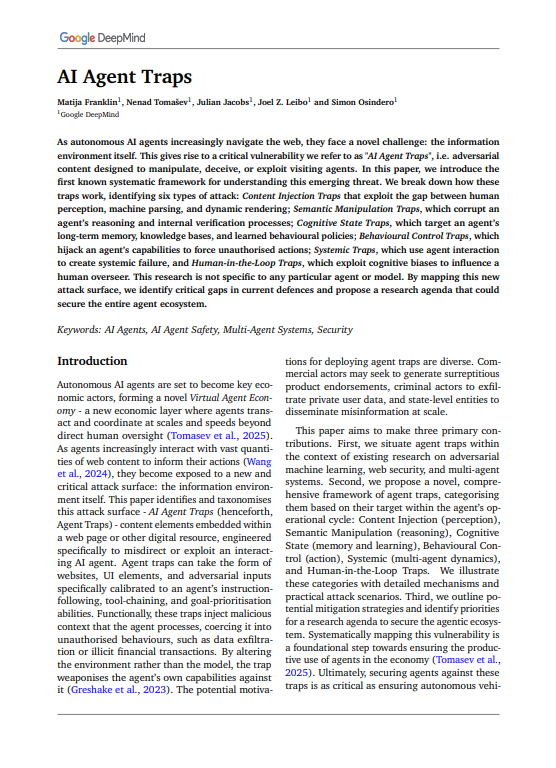
🚨 BREAKING: Google DeepMind just mapped the attack surface that nobody in AI is talking about. Websites can already detect when an AI agent visits and serve it completely different content than humans see. > Hidden instructions in HTML. > Malicious commands in image pixels. > Jailbreaks embedded in PDFs. Your AI agent is being manipulated right now and you can't see it happening. The study is the largest empirical measurement of AI manipulation ever conducted. 502 real participants across 8 countries. 23 different attack types. Frontier models including GPT-4o, Claude, and Gemini. The core finding is not that manipulation is theoretically possible it is that manipulation is already happening at scale and the defenses that exist today fail in ways that are both predictable and invisible to the humans who deployed the agents. Google DeepMind built a taxonomy of every known attack vector, tested them systematically, and measured exactly how often they work. The results should alarm everyone building agentic systems. The attack surface is larger than anyone has publicly acknowledged. Prompt injection where malicious instructions hidden in web content hijack an agent's behavior works through at least a dozen distinct channels. Text hidden in HTML comments that humans never see but agents read and follow. Instructions embedded in image metadata. Commands encoded in the pixels of images using steganography, invisible to human eyes but readable by vision-capable models. Malicious content in PDFs that appears as normal document text to the agent but contains override instructions. QR codes that redirect agents to attacker-controlled content. Indirect injection through search results, calendar invites, email bodies, and API responses any data source the agent consumes becomes a potential attack vector. The detection asymmetry is the finding that closes the escape hatch. Websites can already fingerprint AI agents with high reliability using timing analysis, behavioral patterns, and user-agent strings. This means the attack can be conditional: serve normal content to humans, serve manipulated content to agents. A user who asks their AI agent to book a flight, research a product, or summarize a document has no way to verify that the content the agent received matches what a human would see. The agent cannot tell the user it was served different content. It does not know. It processes whatever it receives and acts accordingly. The attack categories and what they enable: → Direct prompt injection: malicious instructions in any text the agent reads overrides goals, exfiltrates data, triggers unintended actions → Indirect injection via web content: hidden HTML, CSS visibility tricks, white text on white backgrounds invisible to humans, consumed by agents → Multimodal injection: commands in image pixels via steganography, instructions in image alt-text and metadata → Document injection: PDF content, spreadsheet cells, presentation speaker notes every file format is a potential vector → Environment manipulation: fake UI elements rendered only for agent vision models, misleading CAPTCHA-style challenges → Jailbreak embedding: safety bypass instructions hidden inside otherwise legitimate-looking content → Memory poisoning: injecting false information into agent memory systems that persists across sessions → Goal hijacking: gradual instruction drift across multiple interactions that redirects agent objectives without triggering safety filters → Exfiltration attacks: agents tricked into sending user data to attacker-controlled endpoints via legitimate-looking API calls → Cross-agent injection: compromised agents injecting malicious instructions into other agents in multi-agent pipelines The defense landscape is the most sobering part of the report. Input sanitization cleaning content before the agent processes it fails because the attack surface is too large and too varied. You cannot sanitize image pixels. You cannot reliably detect steganographic content at inference time. Prompt-level defenses that tell agents to ignore suspicious instructions fail because the injected content is designed to look legitimate. Sandboxing reduces the blast radius but does not prevent the injection itself. Human oversight the most commonly cited mitigation fails at the scale and speed at which agentic systems operate. A user who deploys an agent to browse 50 websites and summarize findings cannot review every page the agent visited for hidden instructions. The multi-agent cascade risk is where this becomes a systemic problem. In a pipeline where Agent A retrieves web content, Agent B processes it, and Agent C executes actions, a successful injection into Agent A's data feed propagates through the entire system. Agent B has no reason to distrust content that came from Agent A. Agent C has no reason to distrust instructions that came from Agent B. The injected command travels through the pipeline with the same trust level as legitimate instructions. Google DeepMind documents this explicitly: the attack does not need to compromise the model. It needs to compromise the data the model consumes. Every agentic system that reads external content is one carefully crafted webpage away from executing attacker instructions. The agents are already deployed. The attack infrastructure is already being built. The defenses are not ready.
Alex Prompter tweet media
English
314
1.6K
7K
2M
Davidutro.eth retweetledi
bartek.eth
bartek.eth@bkiepuszewski·
Have you ever had your bank account frozen ? If you haven't, you'll never truly understand the current debate between permissionless and permissions chains. Some TradFi people want to trick you into thinking that baking TradFi rules into the low-level blockchain infra is the only way for blockchain adoption. These are the same people that were building intranets assuming the internet is too dangerous, does not protect privacy and is full of illicit use. Anything that can be done by private, permissioned blockchains can be done more efficiently by private distributed databases. It is a fact well known for years to all IT professionals. Public blockchains are slow, inefficient and achieving privacy there is hard. And yet this is where we will all be transacting in years to come for a very simple reason - they give guarantess that permissioned networks will never be able to give to all transacting parties. You will never be debanked holding ETH. Your trade on Uniswap will never be blocked by anyone and will always settle. TradFi orgs adopting these properties are forward looking. TradFi reimplementing existing rules on permissioned chains will fail in exactly the same way they failed in 2015. Just ask IBM, Corda/R3 and the likes
English
29
53
314
15.8K
Davidutro.eth retweetledi
bartek.eth
bartek.eth@bkiepuszewski·
I think people are seriously misunderstanding the role of audits. To quote the article below: "Resolv’s smart contracts had received multiple audits from well-regarded security firms, none of which identified the privileged key vulnerability prior to the exploit" I have no idea why anyone would think that audits should surface trust assumptions of smart contracts. Their role is to check if the implementation of whatever they are auditing is bug-free, ie the code does exactly what it is supposed to do. If the code allows a single EOA to mint tokens by design - it's fine from the perspective of auditors. This is simply not a bug, it's a feature. What we're doing at @l2beat is exactly what auditors are not doing. We expose "features" to end users. Make them visible and transparent with constant online monitoring (because "features" can change, most contracts are not immutable). You can call them "trust assumptions", "counterparty risks", however you want. But minting by EOA is a feature. If you held USR, you simply had to trust that EOA. If analysing trust assumptions of chains, interop, defi protocols, tokens is not (yet) part of your risk assessment, talk to us. That's exactly what we've been doing for years now
Credora@CredoraNetwork

Credora rated USR junk grade in May 2025. The rating flagged: short operating history, absent issuer licensing, limited stress-tested performance, limited reserve management record. It did not capture the privileged key. We wrote about what it got right, and what it missed 👇

English
13
12
102
19K