

thefiend601
612 posts

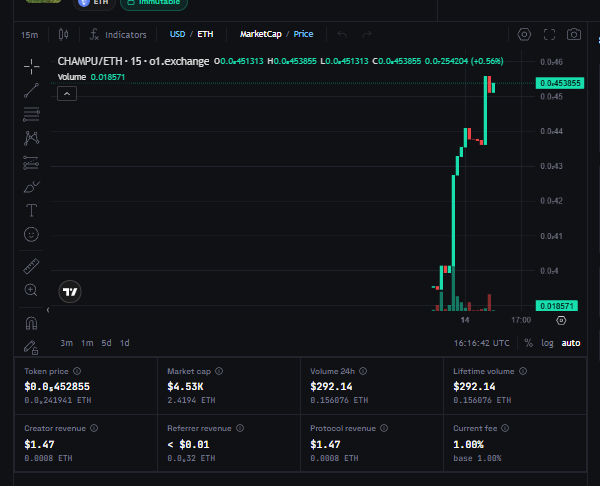
First time created a memecoin $CHAMPU, my fat cat
Already got some holders and activity 🚀🚀
launch.o1.exchange/token/0xb20000…
English
Privacy shouldn’t depend on who operates the infrastructure.
Today, using a cloud service often means trusting the provider with your data.
Using blockchain improves trust in execution, but confidential data can still become exposed if applications require it to be decrypted during processing.
That creates a familiar dilemma.
Trust the infrastructure.
Or protect your privacy.
◈ @FlutonIO is working toward a future where that tradeoff no longer exists.
By leveraging Fully Homomorphic Encryption (FHE), computation can be performed directly on encrypted data. The infrastructure carries out the work without ever accessing the underlying information.
That changes the trust model entirely.
Cloud providers don’t need to read your data.
AI services don’t need access to your prompts.
Financial applications don’t need to expose sensitive transactions to process them.
The infrastructure becomes a compute engine rather than a data owner.
I think that’s an important shift.
As more of our digital lives rely on shared infrastructure, privacy can’t depend on trusting every operator in the system.
It should be guaranteed by the technology itself.
That’s the direction @FlutonIO is helping bring closer through confidential execution.

thefiend601@DdDipto64465
The biggest challenge for confidential computing isn’t cryptography. It’s performance. For years, Fully Homomorphic Encryption (FHE) was seen as a breakthrough with limited practical use because encrypted computations were simply too slow for real-world applications. That perception is starting to change. ◈ @FlutonIO is focused on making confidential execution practical not just possible. As FHE technology continues to improve, the goal is no longer to prove that encrypted computation works. It’s to make it efficient enough for developers to build applications that people can actually use. That unlocks a new generation of possibilities. AI models can process encrypted prompts. Financial applications can analyze sensitive transactions. Businesses can automate confidential workflows. All without exposing the underlying data during execution. Privacy isn’t valuable if it comes at the cost of usability. The real breakthrough happens when confidential computing becomes fast enough that developers don’t have to choose between security and performance. That’s why I’m watching @FlutonIO The future of privacy won’t be defined by stronger encryption alone but by making that encryption practical at scale.
English

When most people think about AI in crypto, they immediately imagine trading bots or tools that predict the next big token. But I think AI's biggest impact is happening somewhere else: the way we learn.
A few years ago, researching a single project meant jumping between whitepapers, dashboards, X threads, Discord messages, GitHub repositories and onchain explorers. Finding information was one challenge connecting all those pieces into a clear picture was an even bigger one.
Today, tools like @SurfAI are changing that experience. Instead of simply returning search results, they help organize information, explain complex topics in plain language, compare different perspectives and even build structured research frameworks. That means less time searching and more time understanding.
Of course, AI shouldn't replace your own thinking. The best researchers still question the data, verify the sources and make their own decisions. But having an AI research assistant can dramatically reduce the time it takes to go from "I know nothing about this project" to "I understand how this ecosystem works."
In crypto, information is everywhere. Understanding it is what creates an edge and that's where AI is starting to make the biggest difference. 🌊
@SurfAI_TR @Surfdeveloper

English

Topic: AI Is Only As Good As the Context It Receives
Most AI models can answer questions.
The difference lies in what they know before they answer.
If an AI only relies on general internet knowledge, its understanding of crypto is often incomplete. Markets move every second, ecosystems evolve daily, and important signals are scattered across dozens of different sources.
Without the right context, even a well-written answer can miss what actually matters.
◈ That’s one of the ideas behind @SurfAI.
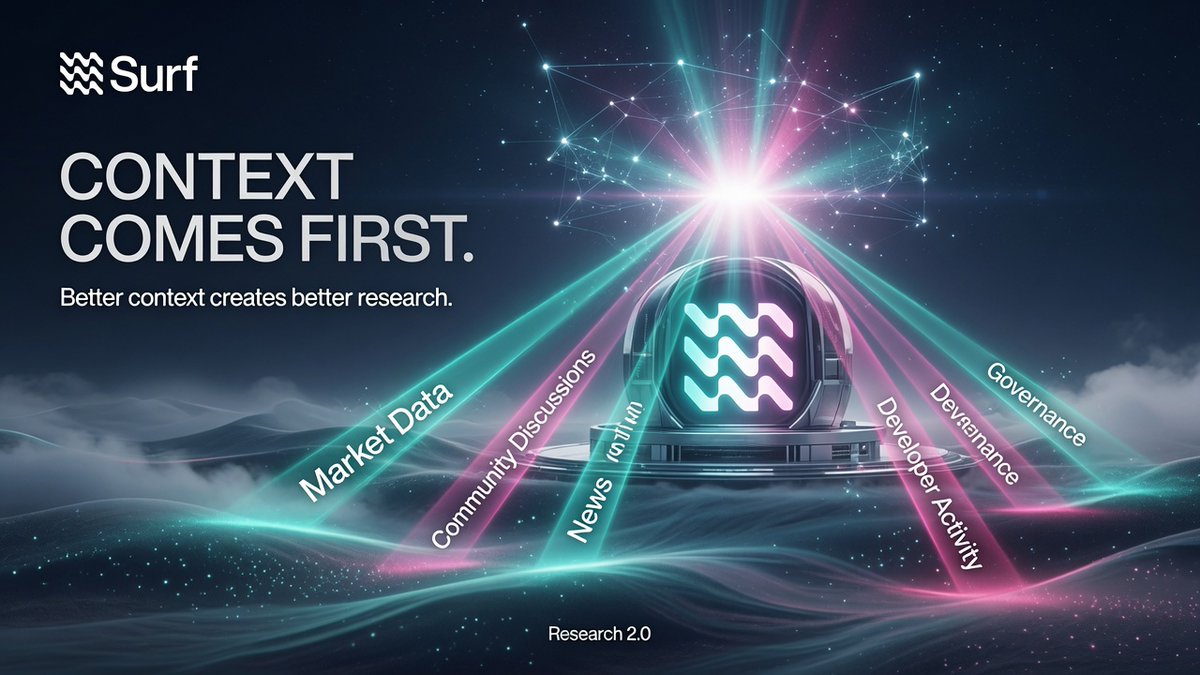
Before generating a response, Surf gathers relevant crypto context from multiple sources, including market activity, on-chain data, ecosystem developments, and community discussions. Instead of treating every question as a standalone prompt, it builds a broader picture before reasoning through the answer.
The quality of AI isn’t determined only by the model.
It’s determined by the quality of the information the model is able to understand first.
And in crypto, context is often the difference between an answer that’s merely correct and one that’s genuinely useful.
thefiend601@DdDipto64465
The best communities don’t just wait for updates. They help shape them. @SurfAI is now collecting community questions for the upcoming AMA, giving everyone a chance to hear directly from the team about the topics that matter most. Whether you’re curious about Research 2.0, Cryptopedia, Surf Studio, the Ambassador Program or the project’s long term vision, now is the perfect time to ask. 📝 Submit your question here: forms.gle/1Dkrnh7rXMT55u… The team will answer as many community questions as possible during the live AMA. I’m looking forward to seeing what everyone asks and hearing the discussion. 🌊
English

Another productive week for @domaprotocol and what stood out wasn’t just a new milestone. It was how product development, ecosystem growth, and real world experimentation all moved forward together.
The platform surpassed $195M in total volume, approached 24M transactions, reached 228K+ tokenized assets, onboarded 55K+ wallets, and now has 620+ domain tokens launched. Those numbers suggest DomainFi isn’t just an idea anymore. It’s becoming an active ecosystem.
On the product side, Doma continued refining the user experience with improvements to the swap page, AI chat, FAQ section, wallet flows and overall interface. Small updates like these often have the biggest long term impact because they make the platform easier to use every day.
One of the week’s most interesting launches was MillionPixelGrid.com, a modern take on the famous Million Dollar Homepage. Instead of simply buying pixels, users own tokenized portions backed by onchain assets turning a nostalgic internet concept into a DomainFi experiment.
It’s another reminder that Doma isn’t only building infrastructure. It’s also showing what becomes possible when real DNS domains evolve into programmable digital assets.
English

The hardest problem in agent systems is not intelligence.
It is controlled execution.
An agent can generate many possible actions, but every action may consume budget, call an external tool, access data or change system state.
Without clear constraints, a smarter agent can simply become a faster way to waste resources.
Agent Grand Prix turns this problem into a practical test.
Agents race through hidden checkpoints under a fixed budget. They must decide when to guess, when to gather more information and when an action is worth its cost.
Every request passes through Latch before execution.
Latch defines which tools the agent can use, how its budget can be spent and whether a requested action complies with the policy of the race.
From a builder perspective, this separation matters.
The reasoning model proposes an action. The policy layer determines whether that action is allowed. The execution layer performs it only after approval.
This architecture is useful far beyond a race.
A trading agent may need position limits. A payment agent may need spending caps. An automation agent may need restrictions on which APIs it can call.
AGP is an interesting way to test whether an agent can operate effectively without relying on unlimited resources.
The best agent is not the one that does the most.
It is the one that understands which actions are worth executing.
@RialoHQ

Subzero Labs@Subzero_Labs
▀▄▀▄▀ Welcome to Agent Grand Prix (AGP) ▀▄▀▄▀ You don’t win a Formula 1 race by being the fastest car or buying up all the gas. Throwing every resource at your agent doesn’t work either. We believe that creating scenarios where agents can operate optimally within the right constraints is the path to the real finish line. Agent Grand Prix puts Latch in action. Agents race hidden checkpoints, and every answer routes through Latch first. Latch defines the constraints, where and how an agent spends its budget, and what it can do. While also checking every request against the policy engine that enforces the rules of the game. Smart prompting, efficiency under a fixed cap, is what gets you to the FIN.
English

The best communities don’t just wait for updates.
They help shape them.
@SurfAI is now collecting community questions for the upcoming AMA, giving everyone a chance to hear directly from the team about the topics that matter most.
Whether you’re curious about Research 2.0, Cryptopedia, Surf Studio, the Ambassador Program or the project’s long term vision, now is the perfect time to ask.
📝 Submit your question here:
forms.gle/1Dkrnh7rXMT55u…
The team will answer as many community questions as possible during the live AMA.
I’m looking forward to seeing what everyone asks and hearing the discussion. 🌊

thefiend601@DdDipto64465
Surf is taking another step toward making crypto research more accessible to everyone. The upcoming Surf Official AMA EP #2 will explore the newly launched Cryptopedia, a knowledge hub designed to help users discover valuable insights, uncover alpha opportunities and improve their Web3 research experience. The session will also introduce the Surf Ambassador Program, covering how the ecosystem works, the benefits of becoming an ambassador, and what it takes to join the growing global Surf community. I’m especially looking forward to hearing from @yuta1922521 and @kevin_lur, who will take a deep dive into Cryptopedia, explain the ambassador program and answer questions directly from the community. If you’re interested in AI-powered crypto research or want to become more involved with the Surf ecosystem, this is definitely a session worth following. @SurfAI 🌊
English
Most AI tools fail in crypto.
Not because they’re bad but because crypto itself is too complex, too fast, and too fragmented.
That’s exactly the problem @SurfAI is solving.
Surf (AskSurf) is building a crypto native AI layer designed specifically for:
→ On chain analysis
→ Market intelligence
→ Trading insights
→ Narrative tracking
→ And even building custom crypto tools
Instead of jumping between 10+ tabs (Dune, CoinGecko, Twitter, dashboards…), Surf unifies everything into ONE system powered by multi agent AI.
Here’s what makes it different:
• 40+ blockchains tracked in real-time
• 200+ technical + on chain indicators (MVRV, SOPR, NUPL, etc.)
• 100k+ CT accounts for sentiment + mindshare tracking
• Full prediction market data (Polymarket + Kalshi)
• 16k+ project database (tokenomics, VC backing, airdrops)
But the real edge isn’t just data.
It’s how Surf THINKS.
With “Deep Research” mode, Surf uses multi-agent reasoning to:
→ Break down complex queries
→ Show sources + logic
→ Generate structured reports (not just answers)
Less hallucination. More signal.
And then there’s Surf Studio:
You can literally say:
“Build me a whale tracking dashboard”
…and it generates a LIVE app connected to real-time crypto data.
No code. No setup. Just intent → execution.
This is where crypto + AI is heading:
From tools → to intelligent systems that actually THINK and BUILD.
Backed by Pantera, Coinbase Ventures, and DCG
300K+ users already
And still early.
Surf isn’t just another AI tool.
It’s positioning itself as the intelligence layer of crypto.
Worth paying attention.

English
The biggest challenge for confidential computing isn’t cryptography.
It’s performance.
For years, Fully Homomorphic Encryption (FHE) was seen as a breakthrough with limited practical use because encrypted computations were simply too slow for real-world applications.
That perception is starting to change.
◈ @FlutonIO is focused on making confidential execution practical not just possible.
As FHE technology continues to improve, the goal is no longer to prove that encrypted computation works. It’s to make it efficient enough for developers to build applications that people can actually use.
That unlocks a new generation of possibilities.
AI models can process encrypted prompts.
Financial applications can analyze sensitive transactions.
Businesses can automate confidential workflows.
All without exposing the underlying data during execution.
Privacy isn’t valuable if it comes at the cost of usability.
The real breakthrough happens when confidential computing becomes fast enough that developers don’t have to choose between security and performance.
That’s why I’m watching @FlutonIO The future of privacy won’t be defined by stronger encryption alone but by making that encryption practical at scale.
thefiend601@DdDipto64465
Privacy is becoming a competitive advantage. For years, blockchain innovation focused on speed, scalability and lower transaction costs. Those improvements matter. But as institutions, enterprises, and AI systems move on-chain, another requirement is becoming impossible to ignore: Confidentiality. Not because organizations want less transparency. Because they can’t expose proprietary data every time computation happens. ◈ That’s one of the reasons @FlutonIO stands out. By leveraging Fully Homomorphic Encryption (FHE), Fluton enables applications to process encrypted information without revealing the underlying data during execution. This changes what’s possible across industries. Trading firms can protect proprietary strategies. Healthcare platforms can analyze sensitive records while preserving patient privacy. AI applications can reason over confidential datasets. Businesses can automate operations without exposing internal information. Privacy is no longer just a feature for individual users. It’s becoming infrastructure for the next generation of digital businesses. As Web3 expands beyond retail users, I believe confidential execution will become just as essential as decentralization and security. That’s the future @FlutonIO is helping build.
English

Every millisecond matters in Web3. ⚡
@get_optimum is building the infrastructure that accelerates data propagation, reduces validator latency, and powers scalable blockchain networks through RLNC-powered technology.
Faster propagation. Stronger consensus. Smarter infrastructure.
The future of decentralized performance starts with better data movement. 🚀

English
Anyone who's spent time researching crypto knows the feeling you open one tab, then another, then five more. Before long, you're jumping between blockchain explorers, analytics platforms, dashboards and documentation, just trying to find the information you need. 🌊
The challenge isn't that crypto data is hard to access. It's that it's scattered across so many different places that research can quickly become frustrating and time consuming.
That's one of the reasons @SurfAI introduced the Data Catalog. Instead of wondering where to look next, users can explore a well organized collection of blockchain datasets from a single place. Whether you're researching wallet activity, onchain metrics or token data, everything is structured to make the process simpler.
Sometimes, better research isn't about working harder, it's about finding the right information without getting lost along the way.
@SurfAI_TR @Surfdeveloper

English
Topic: Good Research Doesn’t End With One Source
One source can tell you what happened.
Real research explains why it happened.
A news headline might highlight a major announcement, but it won’t show how wallets reacted. An on chain transaction may reveal large movements but not the conversation happening across the community. Market data can show price action, yet it doesn’t always explain the reason behind it.
Looking at any one signal in isolation leaves part of the story untold.
◈ That’s the philosophy behind Research 2.0 from @SurfAI
Instead of relying on a single source, Research 2.0 is designed to combine multiple layers of information into one connected research flow. Market activity, on chain behavior, social sentiment, ecosystem updates and AI reasoning work together to provide a more complete perspective.
The strongest research isn’t built on having more data.
It’s built on knowing how different pieces of information fit together.
Because clarity comes from connection, not collection.

thefiend601@DdDipto64465
Research 2.0: Research That Thinks Beyond the First Answer Most research tools stop once they find information. Good research starts there. Finding a chart, a news article, or an on-chain transaction is only the beginning. The real challenge is understanding how those pieces connect and what they actually mean when viewed together. ◈ That’s the direction Research 2.0 from @Surfai taking. Instead of simply retrieving information, Research 2.0 is designed to reason across multiple crypto signals. It combines market activity, on chain data, ecosystem developments, social sentiment and other relevant context into a structured research process that helps users move beyond isolated facts. The goal isn’t just to answer questions. It’s to help users understand the bigger picture before making decisions. As crypto grows more complex, the future of research won’t be measured by how much information an AI can retrieve. It will be measured by how well it can connect the dots.
English
The Value of a Domain Doesn’t End When It’s Registered
Registering a domain has traditionally marked the end of its journey. Once ownership is recorded, the domain simply sits in a registry until it is renewed, transferred, or sold. For something that often represents the identity of a business, a community, or a global brand, that’s a surprisingly limited role.
@domaprotocol is challenging that assumption by giving real DNS domains a second life onchain. Instead of existing only as registration records, domains become programmable assets that can interact with decentralized applications, financial protocols, and AI-native systems while remaining fully compatible with the internet people already use every day.
This shift creates opportunities that extend far beyond simple ownership. A domain can become a trusted digital identity, participate in tokenized financial products, support decentralized governance, or serve as infrastructure for applications that require verifiable ownership. Rather than remaining isolated from the broader blockchain ecosystem, domains become active participants within it.
The significance of this approach lies in its practicality. Doma isn’t asking the internet to adopt a new naming standard or replace DNS. It builds on infrastructure that already powers millions of websites and businesses, adding a programmable layer that unlocks new functionality without disrupting what already works.
The future of DomainFi isn’t just about making domains tradable. It’s about turning one of the internet’s oldest assets into infrastructure that developers, businesses, and AI systems can build upon for decades to come.
thefiend601@DdDipto64465
Big Numbers Are Interesting. Understanding Them Is More Valuable. Metrics only matter when they tell a story. Looking at @domaprotocol ’s latest ecosystem numbers, each one reflects a different part of how DomainFi is growing and why infrastructure matters. $195M+ Total Volume shows that real value is already moving through the ecosystem. It’s not just domains changing hands, but digital assets participating in an onchain economy. 23.9M+ Transactions highlight continuous network activity. Every transaction represents users interacting with tokenized domains, applications, or supporting infrastructure. 228K+ Tokenized Assets demonstrate that domains are becoming programmable assets rather than remaining static registration records. Each tokenized asset expands what can be built on top of DomainFi. 55K+ Unique Wallets indicate a growing community of users, builders, collectors and investors participating in the ecosystem instead of a small group driving activity. 620+ Domain Tokens Launched shows that the infrastructure is being actively used. As more premium domains become tokenized, the foundation for new financial products, decentralized applications and AI powered services continues to expand. These numbers are more than milestones. They show what happens when one of the internet’s oldest asset classes begins participating in the programmable economy. Doma isn’t just tokenizing domains; it’s building the infrastructure that allows internet ownership to evolve into something far more useful.
English

Privacy is becoming a competitive advantage.
For years, blockchain innovation focused on speed, scalability and lower transaction costs.
Those improvements matter.
But as institutions, enterprises, and AI systems move on-chain, another requirement is becoming impossible to ignore:
Confidentiality.
Not because organizations want less transparency.
Because they can’t expose proprietary data every time computation happens.
◈ That’s one of the reasons @FlutonIO stands out.
By leveraging Fully Homomorphic Encryption (FHE), Fluton enables applications to process encrypted information without revealing the underlying data during execution.
This changes what’s possible across industries.
Trading firms can protect proprietary strategies.
Healthcare platforms can analyze sensitive records while preserving patient privacy.
AI applications can reason over confidential datasets.
Businesses can automate operations without exposing internal information.
Privacy is no longer just a feature for individual users.
It’s becoming infrastructure for the next generation of digital businesses.
As Web3 expands beyond retail users, I believe confidential execution will become just as essential as decentralization and security.
That’s the future @FlutonIO is helping build.

thefiend601@DdDipto64465
Data sovereignty isn’t just about owning your data. It’s about controlling who can compute on it. Today, using most digital services means handing over your information so someone else’s infrastructure can process it. That model has worked for years but it also creates unnecessary trust assumptions. ◈ @FlutonIO is exploring a different path. With Fully Homomorphic Encryption (FHE), computation can happen without exposing the underlying data to the infrastructure performing the work. Instead of trusting a service with your raw information you trust cryptography to protect it throughout execution. This changes how we think about ownership. Your financial records don’t need to be visible to process a transaction. Your AI prompts don’t need to be exposed to generate intelligent results. Your enterprise data doesn’t need to leave its confidential state to power business workflows. As digital systems become increasingly driven by AI and automation, data sovereignty will matter just as much as data privacy. The goal isn’t simply to encrypt information. It’s to ensure that ownership and control remain with the user even while computation is taking place. That’s a future @FlutonIO is helping make possible through confidential execution.
English

Business moves fast. Your automation should move faster.
With Rialo, workflows stay aligned with evolving policies, compliance standards, and business priorities - without constant manual updates.
🔹 Dynamic decision-making
🌐 Live web intelligence
🔒 Secure execution with REX
✅ Consistent, enterprise-grade outcomes
Less maintenance. More confidence. Smarter operations - built to adapt.
@RialoHQ @RialoBangladesh

English