Dangme Royal

4.8K posts

Dangme Royal banner
Dangme Royal

Dangme Royal

@DeHermit

DigiMarketer|Project Manager||@SDSNYouth|@DangmeBible #DangmeRoyal #DangmeTwitter

Ghana Katılım Mayıs 2020
4.9K Takip Edilen640 Takipçiler
Dangme Royal retweetledi
Jaynit
Jaynit@jaynitx·
Walter Isaacson literally revealed the secret to Elon Musk's productivity in just 6 minutes: Lex Fridman asks about time management, noting that Elon runs six or seven companies depending on how you count. Isaacson responds: "Musk is in a league of his own. Steve Jobs had to run Pixar and Apple for a while. But Musk, every couple of hours, is switching his mindset from how to implant the Neuralink chip and what will the robot that implants it in the brain look like, to the heat shield on the Raptor engine, to human imitation machine learning for full self-driving." He shares a story from the night Twitter accepted Elon's offer: "On the night the Twitter board agreed to the deal, this is huge, around the world, 'Musk buys Twitter', I thought, okay. But then he went to Boca Chica in South Texas and spent time fixating on, if I remember correctly, a valve in the Raptor engine that had a methane leak issue. And what were the possible ways to fix it. All the engineers in that room, I assume, are thinking, 'This guy just bought Twitter, should we say something?' And he's like..." Isaacson continues: "Then he goes with Kimball to a roadside joint in Brownsville. Just sits in the front and listens to music. Nobody noticing him." On how Elon actually works: "One of his strengths, and sort of weaknesses in a way, is that in a given day, he'll focus serially, sequentially, on many different things. He'll worry about uploading video onto X or the payment system, then immediately switch to some issue with the FAA giving a permit for Starship, or how to deal with Starlink and the CIA." Isaacson explains the key distinction: "When he's focused on any of these things, you cannot distract him. It's not like he's also thinking, 'I'm dealing with Starlink, but I've got to also worry about the Tesla decision on the new $25,000 car.' No. He'll, in between these sessions, process information, then let off steam." He describes the release valve: "For better or worse, he lets off steam by either playing a friend in Polytopia or firing off some tweets, which is often not a healthy thing. But it's a release for him." Isaacson clarifies a common misconception: "I once said he was a great multitasker, and that was a mistake. People corrected me. He's a serial tasker. Which means he focuses intensely on a task for an hour, almost has a, what do they call it at restaurants, a palette cleanser. He does some palette cleanser with Polytopia. And then focuses on the next task." On whether others can learn from this: "There are some things these people do where you say, 'Okay, I can be that way. I can be more curious. I can question every rule and regulation.' But I just don't think anybody should try to emulate Musk's time management style. Because it takes a certain set of teams to deal with everything else other than the thing he's focusing on, and a certain mind that can shift. Just like his moods can shift." Isaacson contrasts himself: "You and I go through transitions. If I'm thinking about what I'm going to say on this podcast, I'm also thinking about the email my daughter just sent about a house she's looking at. I'm multitasking. He doesn't actually do that. He single-tasks sequentially with a focus that's hardcore." On the fierce urgency: "The fierce urgency that drives him is important, and it's sometimes ginned up. Like the fierce urgency of getting to Mars. On a Friday night at the launch pad in Boca Chica, at 10pm, there are only a few people working because it's a Friday night. They're not supposed to launch for another eight months. And he orders 'The Surge.' He says, 'I want 200 people here by tomorrow working on this pad. We have to have a fierce sense of urgency, or we will never get to Mars.'" Lex reflects: "That sense of urgency is also a vibrancy, like really taking on life fully. Even the mundane can be full of this richness. You just have to take it in intensely. The switching enables that kind of intensity, because most of us can't hold that intensity on any one task for a prolonged period of time." On knowing yourself: Isaacson offers perspective: "It goes back to: know who you are. There are people who can focus intensely. And there are people who can see patterns across many things. Leonardo da Vinci, he was not all that focused. He was easily distracted. It's why he has more unfinished paintings than finished paintings in his canon. But his ability to see patterns across nature, and in some ways procrastinate, be distracted, that helped him some. But Musk is not that way." He describes Musk's pattern: "Every few months, there's a new surge. You don't know where it'll be. But all of a sudden it'll be on solar roofs, and there has to be 100 solar roofs built by tomorrow. Or 'Make a Starship dome by dawn.' Surge and do it. There are people who are built that way." Isaacson closes with a caution: "It is inspiring. But let's also appreciate that there are people who can be really good, but also can savor the success, savor the moment, savor the quiet. Musk's big failing is he can't savor the moment or the success. And that's the flip side of hardcore intensity."
English
36
113
1.4K
58.2K
Dangme Royal retweetledi
Jaynit Makwana
Jaynit Makwana@JaynitMakwana·
This 2 hour Stanford lecture on AI careers will teach you more about getting hired, building real AI products, and staying ahead of tools than 2 years of scrolling AI content online. Bookmark this & give it 2 hours, no matter what. It’s the most productive thing you can do this week.
English
12
100
333
51.1K
Dangme Royal retweetledi
Africa Today Media Group
Africa Today Media Group@africatodayMG·
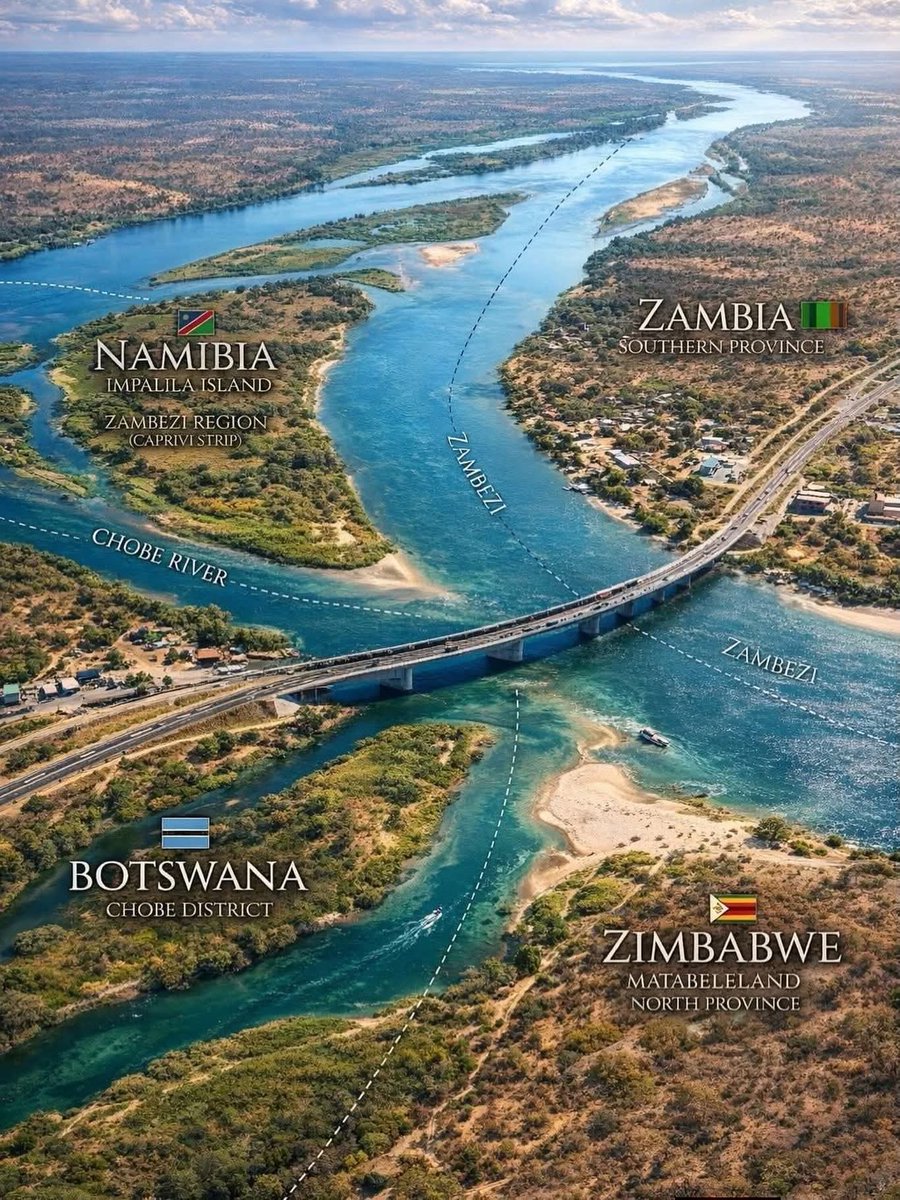
It is the only location in the world where the borders of four neighboring countries meet. The Kazungula region, situated on the banks of the Zambezi River in southern Africa, is a unique geographical point. It is the only location in the world where the borders of four neighboring countries meet: Zambia, Namibia, Zimbabwe and Botswana. You can see (or boat all four countries from one spot, and the new Kazungula Bridge (opened 2021) between Zambia and Botswana passes right through this zone.
Africa Today Media Group tweet media
English
16
79
218
13.6K
Dangme Royal retweetledi
Ghana Investment Promotion Centre
Parliament has passed the Ghana Investment Promotion Authority (GIPA) Bill, marking a major step toward transforming Ghana’s investment landscape. With a more modern, transparent, and investor-friendly framework, Ghana is strengthening its position as a gateway to Africa under AfCFTA, while promoting inclusive growth and supporting local enterprises. #GIPC #GIPABill #FDI #GhanaIsOpenForBusiness
Ghana Investment Promotion Centre tweet media
English
5
36
163
8.2K
Dangme Royal retweetledi
The Data of Everything
The Data of Everything@TheDataHubX·
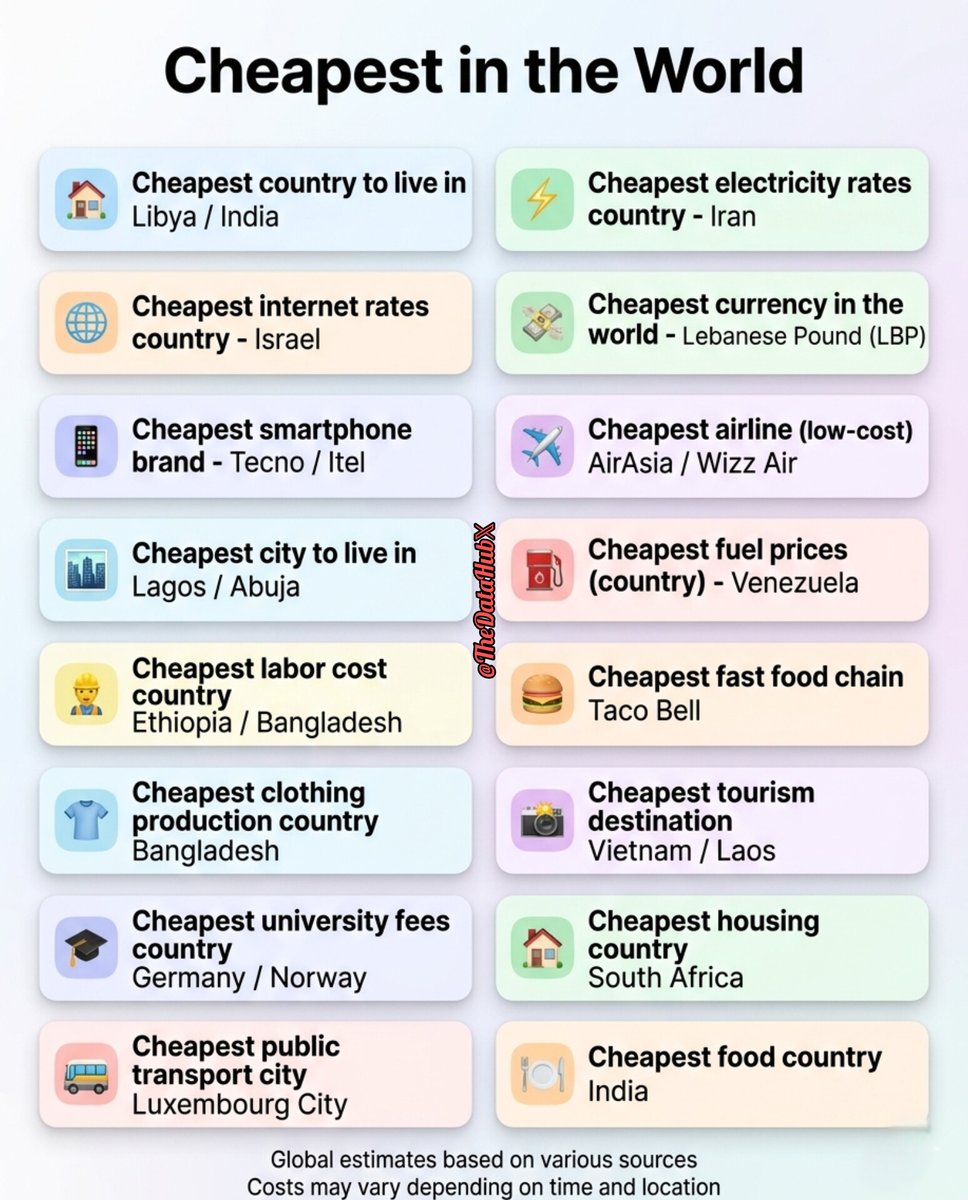
Cheapest in the World 1) Cheapest country to live in - Libya / India 2) Cheapest electricity rates country - Iran 3) Cheapest internet rates country - Israel 4) Cheapest currency in the world - Lebanese Pound (LBP) 5) Cheapest smartphone brand - Tecno / Itel 6) Cheapest airline (low-cost) - AirAsia / Wizz Air 7) Cheapest city to live in - Lagos / Abuja 8) Cheapest fuel prices (country) - Venezuela 9) Cheapest labor cost country - Ethiopia / Bangladesh 10) Cheapest fast food chain - Taco Bell 11) Cheapest clothing production country - Bangladesh 12) Cheapest tourism destination - Vietnam / Laos 13) Cheapest university fees country - Germany / Norway 14) Cheapest housing country - South Africa 15) Cheapest public transport city - Luxembourg City 16) Cheapest food country - India Note: These are general estimates and may vary depending on economic conditions, location, and time.
The Data of Everything tweet media
English
0
26
69
3.2K
Dangme Royal retweetledi
NewMindset
NewMindset@newauramindset·
NewMindset tweet media
ZXX
2
267
1.3K
37.1K
Dangme Royal retweetledi
The Deal Trader
The Deal Trader@TheDealTrader_·
Understanding Profit
English
0
424
1.5K
72.1K
Dangme Royal retweetledi
Movez
Movez@0xMovez·
This 1 hour MIT lecture on "Probabilistic Analysis" using Markov Chains will teach you more about prediction markets than a 2-month Wall Street Quant firm internship. Bookmark this & give it 1 hour today, no matter what. It’s the most productive start you can give your week. Then read article below
Movez@0xMovez

x.com/i/article/2041…

English
31
363
2.1K
227.4K
Dangme Royal retweetledi
Rony
Rony@Ronycoder·
Instead of watching Netflix for 2 hours, watch this guy explain why some people become successful while others stay average.
English
54
1.2K
4.2K
406.6K
Dangme Royal retweetledi
Modern mastery
Modern mastery@Modernmastery_·
The Marketing lessons they don’t teach you in school:
Modern mastery tweet media
English
12
57
169
14.5K
Dangme Royal retweetledi
True market Leader
True market Leader@TmarketL·
The 3 Steps Of Building Wealth From Nothing Using Game Theory
English
1
26
67
4.3K
Dangme Royal retweetledi
Anish Moonka
Anish Moonka@anishmoonka·
Eric Jorgenson spent 5 years and thousands of hours studying Elon Musk. He distilled every interview, every essay, every biography into his new book, "The Book of Elon." Then David Senra sat him down for nearly two hours. My notes (10 min read, 30 sec one in 🧵) 𝟭. 𝗗𝗼𝗻'𝘁 𝘀𝘁𝗮𝗿𝘁 𝗰𝗼𝗺𝗽𝗮𝗻𝗶𝗲𝘀 𝗳𝗼𝗿 𝗺𝗼𝗻𝗲𝘆. 𝗦𝘁𝗮𝗿𝘁 𝘁𝗵𝗲𝗺 𝗯𝗲𝗰𝗮𝘂𝘀𝗲 𝘁𝗵𝗶𝗻𝗴𝘀 𝗻𝗲𝗲𝗱 𝘁𝗼 𝗵𝗮𝗽𝗽𝗲𝗻. Elon started SpaceX because nobody else was crazy enough to work on multiplanetary life. He started Tesla because the world needed cheap electric cars. He does not run risk-adjusted return calculations. He asks one question: what useful thing do I wish existed in the world? The paradox is that the thing nobody else is working on is actually more likely to succeed because you are solving a real problem instead of competing in a crowded market. 𝟮. 𝗧𝗵𝗲 𝗔𝗹𝗴𝗼𝗿𝗶𝘁𝗵𝗺 𝗶𝘀 𝗳𝗶𝘃𝗲 𝘀𝘁𝗲𝗽𝘀 𝗮𝗻𝗱 𝘁𝗵𝗲 𝗼𝗿𝗱𝗲𝗿 𝗺𝗮𝘁𝘁𝗲𝗿𝘀. Question requirements. Delete. Simplify. Accelerate. Automate. Elon repeats this so often that people in meetings can predict what he is about to say. He made the mistake of automating before deleting at Tesla and spent years undoing it. Most engineers instinctively leap to steps 3, 4, and 5. The entire point of the algorithm is to force you to sharpen the axe before you start chopping. 𝟯. 𝗧𝗵𝗲 𝗯𝗲𝘀𝘁 𝗽𝗮𝗿𝘁 𝗶𝘀 𝗻𝗼 𝗽𝗮𝗿𝘁. Tesla's Model 3 started with over 10,000 parts. That number keeps falling. Every attachment between two parts creates a joining method, a tolerance, an assembly step, and a new failure mode. Elon got the idea for giant single-piece underbody castings from toy cars. Five casting companies said no. One said maybe. He took the 'maybe' as a 'yes'. I keep coming back to this principle because it applies to everything: products, teams, processes, and meetings. Every time you add a layer of complexity, you are compounding drag. 𝟰. 𝗘𝗻𝗴𝗶𝗻𝗲𝗲𝗿 𝘆𝗼𝘂𝗿 𝗼𝗿𝗴𝗮𝗻𝗶𝘇𝗮𝘁𝗶𝗼𝗻 𝘁𝗼 𝗳𝗮𝗶𝗹 𝘀𝗺𝗮𝗹𝗹 𝗮𝗻𝗱 𝗳𝗮𝗹𝗹 𝗳𝗮𝘀𝘁. If you are not adding back 10% of the things you removed, you are not taking out enough. Elon sets deadlines at 50% probability. Missing half your deadlines means you are moving as fast as possible. Hitting all of them means they were set too far out. When he interviews engineers, he asks them to describe four ways they messed something up. If they cannot, they were not the ones doing the real work. 𝟱. 𝗣𝗵𝘆𝘀𝗶𝗰𝘀 𝗶𝘀 𝗮 𝗹𝗮𝘄. 𝗘𝘃𝗲𝗿𝘆𝘁𝗵𝗶𝗻𝗴 𝗲𝗹𝘀𝗲 𝗶𝘀 𝗮 𝗿𝗲𝗰𝗼𝗺𝗺𝗲𝗻𝗱𝗮𝘁𝗶𝗼𝗻. If your beliefs are incompatible with the rocket reaching orbit, the rocket will not reach orbit. Elon treats reality as the only valid test. He does not care what the spreadsheet says, what the industry standard is, or what the 1983 regulation requires. Does it fly? How much payload reaches orbit? One metric, one test, everything else gets subordinated. This is the hardest lesson to internalize because most of us have been trained to optimize for looking right rather than being right. 𝟲. 𝗧𝗶𝗺𝗲 𝗶𝘀 𝘁𝗵𝗲 𝗼𝗻𝗹𝘆 𝘁𝗿𝘂𝗲 𝗰𝘂𝗿𝗿𝗲𝗻𝗰𝘆. In early SpaceX, the burn rate was $100K per day. But Elon expected $10M in revenue per day within a decade. Every wasted day was $10M in future value gone forever. This is why he authorized $60K in jet fuel to fly a part to Hawaii, which saved one workday. Sounds irrational until you do the math. At Tesla, he calculates that every high-quality minute of thinking has a million-dollar impact. A single half-hour meeting has added $100M to Tesla's enterprise value more than once. 𝟳. 𝗦𝗽𝗲𝗲𝗱 𝗶𝘀 𝗯𝗼𝘁𝗵 𝗼𝗳𝗳𝗲𝗻𝘀𝗲 𝗮𝗻𝗱 𝗱𝗲𝗳𝗲𝗻𝘀𝗲. Over 3,000 missiles were fired at the SR-71 Blackbird. None connected. It had almost no defense systems. All it did was go faster. Tesla open-sourced its patents. Go ahead, copy them. By the time a competitor produces what Tesla shared, Tesla is five to ten years further ahead. The decisive factor in modern war is the speed of technological innovation, not the size of the army. A factory moving twice the speed is another factory. That is one of those lines that sounds obvious until you realize almost nobody acts on it. 𝟴. 𝗩𝗲𝗿𝘁𝗶𝗰𝗮𝗹 𝗶𝗻𝘁𝗲𝗴𝗿𝗮𝘁𝗶𝗼𝗻 𝗶𝘀 𝗮𝗯𝗼𝘂𝘁 𝘃𝗲𝗹𝗼𝗰𝗶𝘁𝘆, 𝗻𝗼𝘁 𝗽𝗵𝗶𝗹𝗼𝘀𝗼𝗽𝗵𝘆. Elon did not vertically integrate because he read a business strategy book. He did it because the supply chain moved too slowly. When he ran the numbers on early rocket costs, 98% of the price was not raw materials. The money was disappearing through layers of contractors hiring sub-contractors, who hired sub-contractors. Henry Ford did the same thing a century ago and eventually bought a railroad to control logistics. The lesson repeats itself across every generation of great builders. 𝟵. 𝗧𝗵𝗲 𝗦𝘁𝗮𝗿𝗹𝗶𝗻𝗸 𝘄𝗮𝗿 𝗿𝗼𝗼𝗺 𝗶𝘀 𝘁𝗵𝗲 𝗮𝗹𝗴𝗼𝗿𝗶𝘁𝗵𝗺 𝗶𝗻 𝗮𝗰𝘁𝗶𝗼𝗻. Starlink was 10x too expensive and produced one-tenth the volume needed. Two orders of magnitude from success. Elon grabbed a rocket scientist who had never touched satellites, flew a team to Seattle, fired the entire leadership team, and sat them in a war room. Within months, they made the leap. The product is now worth tens of billions of dollars on a standalone basis. People who have never worked in a domain often outperform incumbents because they carry no inherited assumptions about what is and is not possible. 𝟭𝟬. 𝗕𝘂𝗿𝗻 𝘁𝗵𝗲 𝗯𝗼𝗮𝘁𝘀. 𝗧𝗵𝗲𝗻 𝗯𝘂𝗿𝗻 𝘁𝗵𝗲 𝗮𝘀𝗵𝗲𝘀. Elon put $200M into SpaceX and Tesla before asking anyone else to invest a dollar. Jorgenson cannot name another entrepreneur who risked going back to zero and public humiliation after reaching a nine-figure net worth. And he keeps doing it: his current Tesla pay package pays a trillion dollars if the company reaches $10T, and nothing if it does not. Plan B should be to make Plan A work. Jeff Bezos said it. Schwarzenegger said it. Elon lives it at a scale that makes both of them look conservative. 𝟭𝟭. 𝗧𝗵𝗲 𝗟𝗼𝗹𝗹𝗮𝗽𝗮𝗹𝗼𝗼𝘇𝗮: 𝘁𝗵𝗲𝘀𝗲 𝗶𝗱𝗲𝗮𝘀 𝗰𝗼𝗺𝗽𝗼𝘂𝗻𝗱. Working on the most important thing with manic intensity for 100 hours a week instead of 40 does not create a 2.5x advantage. It creates an orders-of-magnitude advantage because every principle reinforces the others. First principles thinking makes deletion possible. Deletion makes speed possible. Speed makes iteration possible. Iteration drives cost down. Lower costs expand the market. The Lollapalooza effect (a term Charlie Munger coined) is what people miss when they reduce Elon to "he works hard." This is why isolating any single Elon principle and applying it in a vacuum misses the entire point. The power is in stacking them. 𝟭𝟮. 𝗜𝗳 𝘄𝗲 𝗱𝗼𝗻'𝘁 𝗺𝗮𝗸𝗲 𝘀𝘁𝘂𝗳𝗳, 𝘁𝗵𝗲𝗿𝗲 𝗶𝘀 𝗻𝗼 𝘀𝘁𝘂𝗳𝗳. Too many smart people go into finance and law. Manufacturing is underrated. The economy is not a magic thing that automatically produces goods. Elon's plea: go build a thing that makes somebody else's life better. Create wealth, create jobs, and add a new capability to humanity. The greatest entrepreneurs in history, Carnegie, Rockefeller, and Vanderbilt, all built physical things. Jorgenson's stated goal for the book is to generate one million Musk. Not people who start electric car companies, but people who find a unique problem nobody else is solving and dedicate their lives to it. The full podcast in Thread.
Anish Moonka tweet media
English
10
41
166
12.9K
Dangme Royal retweetledi
Wise Mentor | Leadership
Wise Mentor | Leadership@thewisementor·
WHY PEOPLE TAKE YOU FOR GRANTED AFTER YOU CARE TOO MUCH...
Wise Mentor | Leadership tweet media
English
16
25
129
34.5K
Dangme Royal retweetledi
Aspireachieve
Aspireachieve@Aspireachievee·
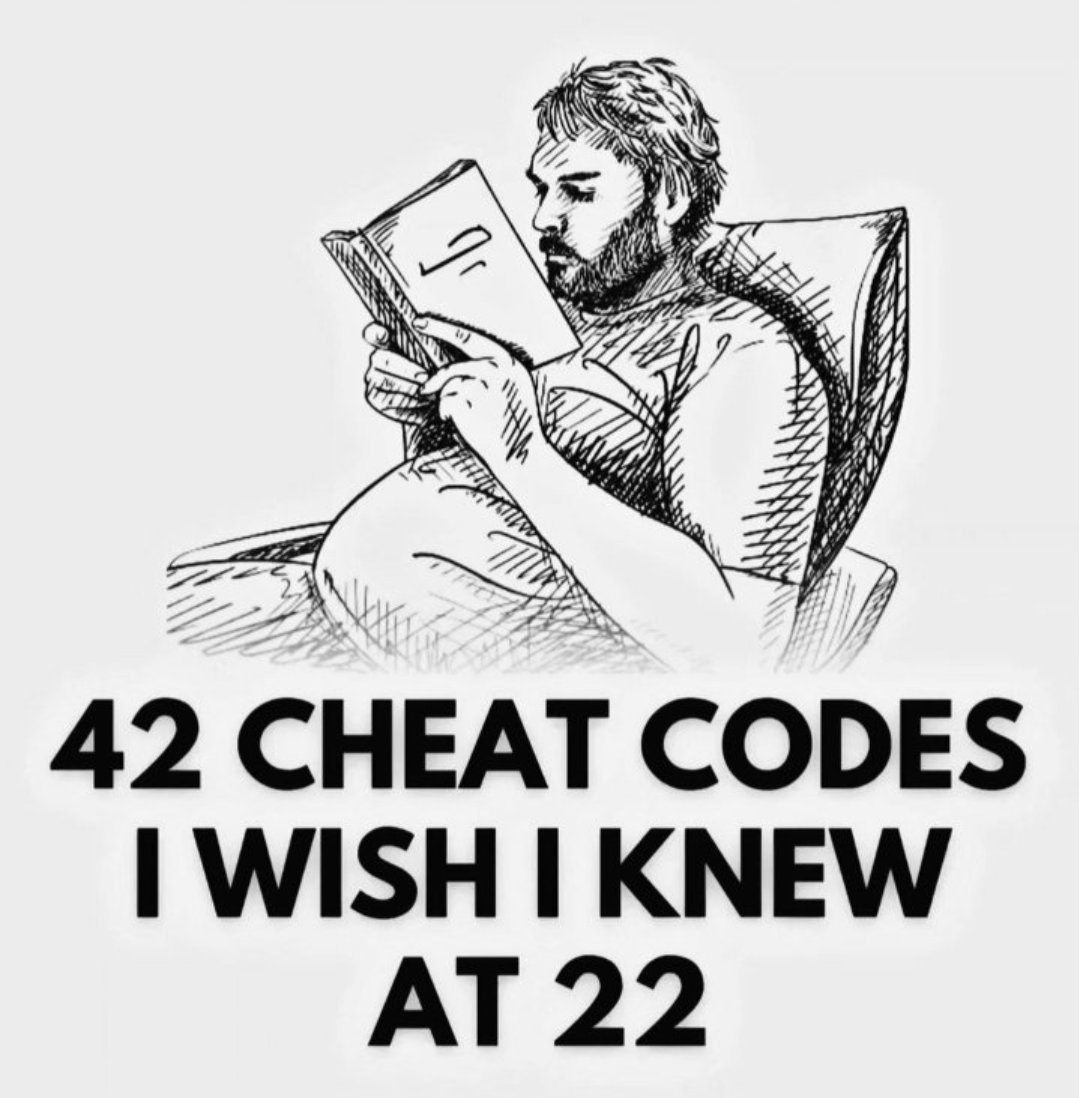
42 Cheat Codes I Wish I knew At 22: // Thread //
Aspireachieve tweet media
English
15
75
374
68.7K
Dangme Royal retweetledi
Men of Purpose
Men of Purpose@Men_Of_Purpose·
Malcolm Gladwell explaining why some people succeed and some don't.
English
0
63
232
13.7K
Dangme Royal retweetledi
True market Leader
True market Leader@TmarketL·
What Secret Societies Teach Rich People
English
0
52
162
9.1K
Dangme Royal retweetledi
Jaynit
Jaynit@jaynitx·
In 2019, MIT professor Patrick Winston gave a legendary 1-hour lecture called “How to Speak.” It has 18M+ views for a reason. His frameworks: • Your ideas are like your children • The 5-minute rule for job talks • Why jokes fail at the start 15 lessons on communication:
English
230
8.6K
40.5K
5.2M