DealsForge

189 posts

DealsForge banner
DealsForge

DealsForge

@DealsForge

Founder Builder. I’m mapping the messy LLM API market: providers, prices, free tiers, limits, reliability and what works for builders. Build Together 🚀

Paris, France Katılım Mayıs 2026
164 Takip Edilen15 Takipçiler
Sabitlenmiş Tweet
DealsForge
DealsForge@DealsForge·
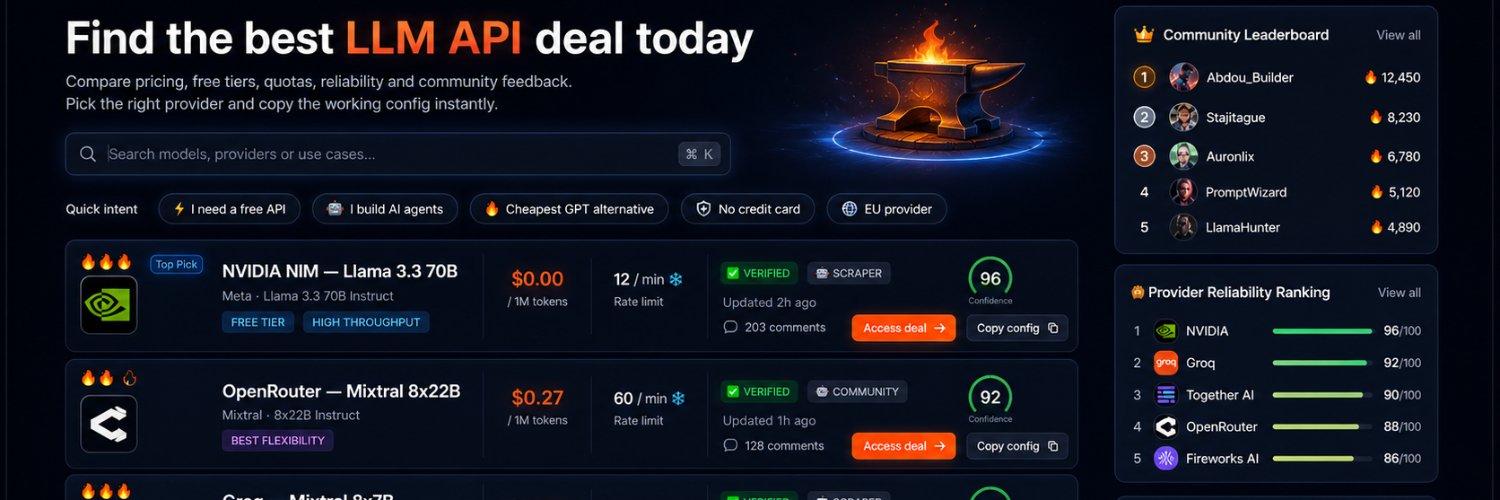
Most AI builders do not have a model problem. They have a visibility problem. The LLM API market is starting to look like cloud hosting in the early days: Everyone claims to be fast. Everyone claims to be cheap. Everyone has a different pricing page. Everyone has hidden limits. Everyone has a “free tier” with a different meaning. And when you actually try to build, the real questions are not always obvious: Which provider silently throttles? Which free tier actually requires a credit card? Which endpoint is compatible on paper but painful in production? Which cheap model becomes expensive at scale? Which provider is stable enough for real users? Which setup keeps your bill at $20 instead of turning it into $2,000? I spent the last few days looking at dozens of LLM providers. The biggest surprise was not only the price difference. It was how hard it is to compare them honestly. Some providers are generous but unclear. Some are cheap but fragile. Some are expensive but stable. Some look easy until integration starts. Some look “free” until the hidden limits appear. This is the part of the AI stack nobody wants to talk about: Choosing the wrong infrastructure can kill a good project before the product is even bad. The next useful tools will not just help people build with AI. They will help people choose the right infrastructure before they waste time, money, and energy. That is the problem I care about: more transparency, better comparisons, clearer tradeoffs, less guesswork for builders. If you are building with LLM APIs, follow @DealsForge. I’m sharing what I find.
DealsForge tweet media
English
3
1
2
80
DealsForge
DealsForge@DealsForge·
@BizyNews Exactly. The “best” model on paper can be the wrong choice if it breaks your latency budget, rate limits, or cost curve. For real products, the question is not just “which model is strongest, It’s which model/provider combo can survive my actual workload?
English
0
0
0
3
BizyHQ
BizyHQ@BizyNews·
@DealsForge most builders optimize for what's popular instead of what their latency budget can handle. pick the model that fits your constraints, not the one that's trending.
English
1
0
0
8
DealsForge
DealsForge@DealsForge·
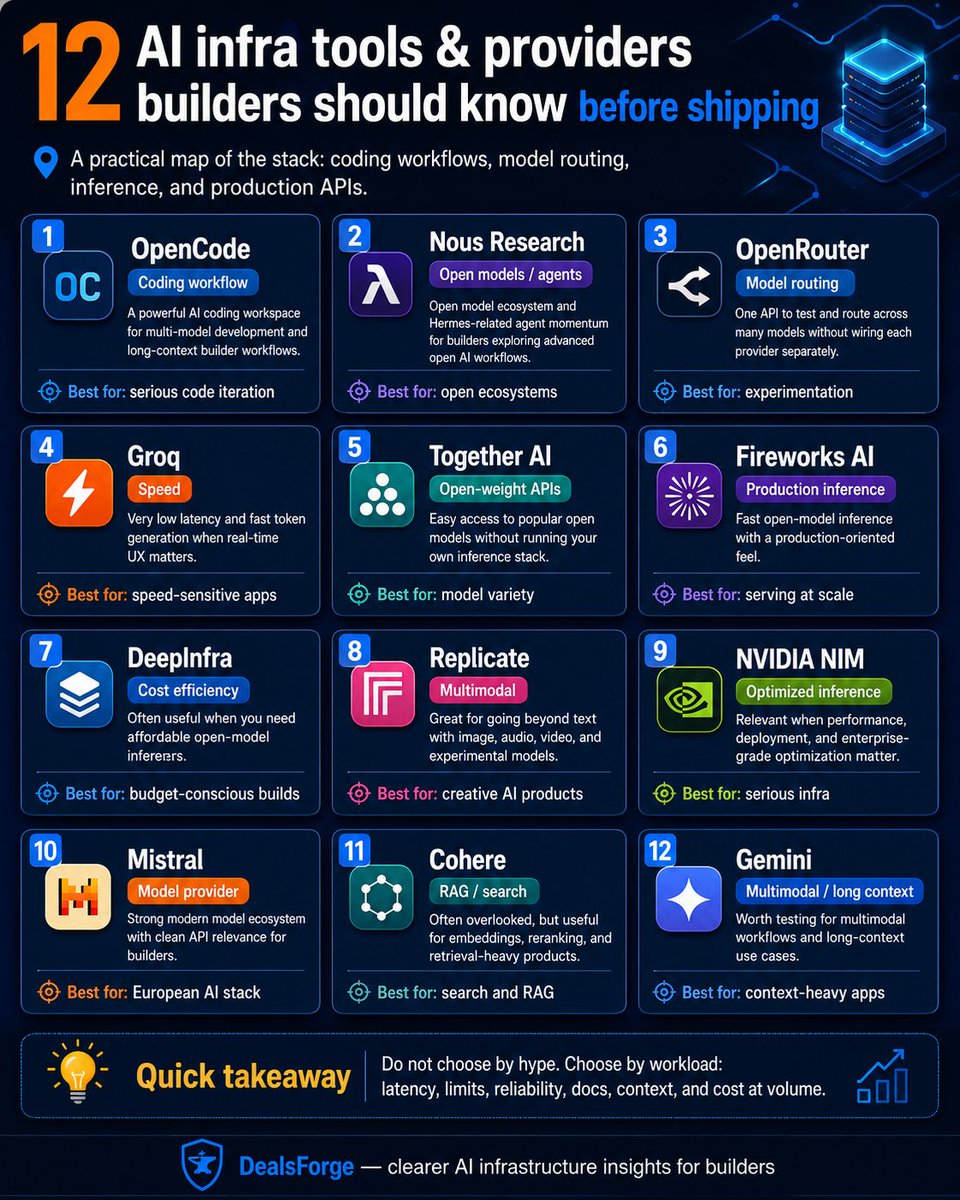
12 AI infra tools & providers builders should know before shipping: 1. OpenCode A powerful AI coding workspace for multi-model development and long-context builder workflows. Useful when you are not just asking for snippets, but trying to iterate on a real codebase with agents, context, files, reviews and repeated improvements. Best for: serious code iteration. 2. Nous Research One of the most interesting open AI ecosystems right now. Hermes, open models, agent workflows, research energy, and a community that keeps pushing toward more capable open systems. Best for: builders who care about open ecosystems and agentic workflows. 3. OpenRouter One API to test and route across many models without wiring each provider separately. Great when you want to compare model behavior, build fallback logic, or avoid getting locked into one provider too early. Best for: experimentation. 4. Groq Speed matters more than people think. If your product needs real-time UX, fast replies, or low-latency agent loops, Groq is worth testing early. Best for: speed-sensitive apps. 5. Together AI Easy access to popular open-weight models without running your own inference stack. Good when you want model variety, flexibility, and less infrastructure overhead. Best for: open-model variety. 6. Fireworks AI Fast open-model inference with a more production-oriented feel. Interesting when the question becomes: “Can this scale beyond a demo without latency getting painful?” Best for: serving at scale. 7. DeepInfra Often useful when cost matters. If your product is price-sensitive and you need affordable open-model inference, it is worth testing. But cheap only matters if reliability and latency hold up. Best for: budget-conscious builds. 8. Replicate Great when your product goes beyond text. Image, audio, video, experimental models, creative workflows, prototypes. Best for: creative AI products. 9. NVIDIA NIM Relevant when performance, deployment, and optimized inference matter. Probably not the first thing every solo builder tests, but very interesting for serious infra and enterprise-style workloads. Best for: optimized inference. 10. Mistral Strong modern model ecosystem with serious API relevance for builders. Especially worth watching if you care about European AI, multilingual use cases, and production-grade models. Best for: European AI stack. 11. Cohere Often overlooked because everyone talks about chat models. But embeddings, reranking, search and retrieval-heavy workflows are critical for real products. Best for: RAG and search. 12. Gemini Worth testing for multimodal workflows, long-context use cases, and products that need more than a simple chat completion. Best for: context-heavy apps. The takeaway: Do not choose by hype. Choose by workload: - latency - limits - reliability - docs - context window - cost at volume - integration effort - production behavior The best tool is not universal. The best tool is the one that fits what you are actually building.
DealsForge tweet media
English
1
0
1
29
DealsForge
DealsForge@DealsForge·
@alexabelonix 😊I think this is one of the underrated problems in AI right now. Models get all the attention, but infrastructure visibility is what saves builders from painful surprises later..
English
0
0
1
16
DealsForge
DealsForge@DealsForge·
Most AI builders do not have a model problem. They have a visibility problem. The LLM API market is starting to look like cloud hosting in the early days: Everyone claims to be fast. Everyone claims to be cheap. Everyone has a different pricing page. Everyone has hidden limits. Everyone has a “free tier” with a different meaning. And when you actually try to build, the real questions are not always obvious: Which provider silently throttles? Which free tier actually requires a credit card? Which endpoint is compatible on paper but painful in production? Which cheap model becomes expensive at scale? Which provider is stable enough for real users? Which setup keeps your bill at $20 instead of turning it into $2,000? I spent the last few days looking at dozens of LLM providers. The biggest surprise was not only the price difference. It was how hard it is to compare them honestly. Some providers are generous but unclear. Some are cheap but fragile. Some are expensive but stable. Some look easy until integration starts. Some look “free” until the hidden limits appear. This is the part of the AI stack nobody wants to talk about: Choosing the wrong infrastructure can kill a good project before the product is even bad. The next useful tools will not just help people build with AI. They will help people choose the right infrastructure before they waste time, money, and energy. That is the problem I care about: more transparency, better comparisons, clearer tradeoffs, less guesswork for builders. If you are building with LLM APIs, follow @DealsForge. I’m sharing what I find.
DealsForge tweet media
English
3
1
2
80
DealsForge
DealsForge@DealsForge·
Curious how other builders test this. Do you usually pick an LLM API based on: 1. price ? 2. free tier ? 3. latency ? 4. docs ? 5. model quality ? 6. it worked first ?
English
0
0
0
15
DealsForge
DealsForge@DealsForge·
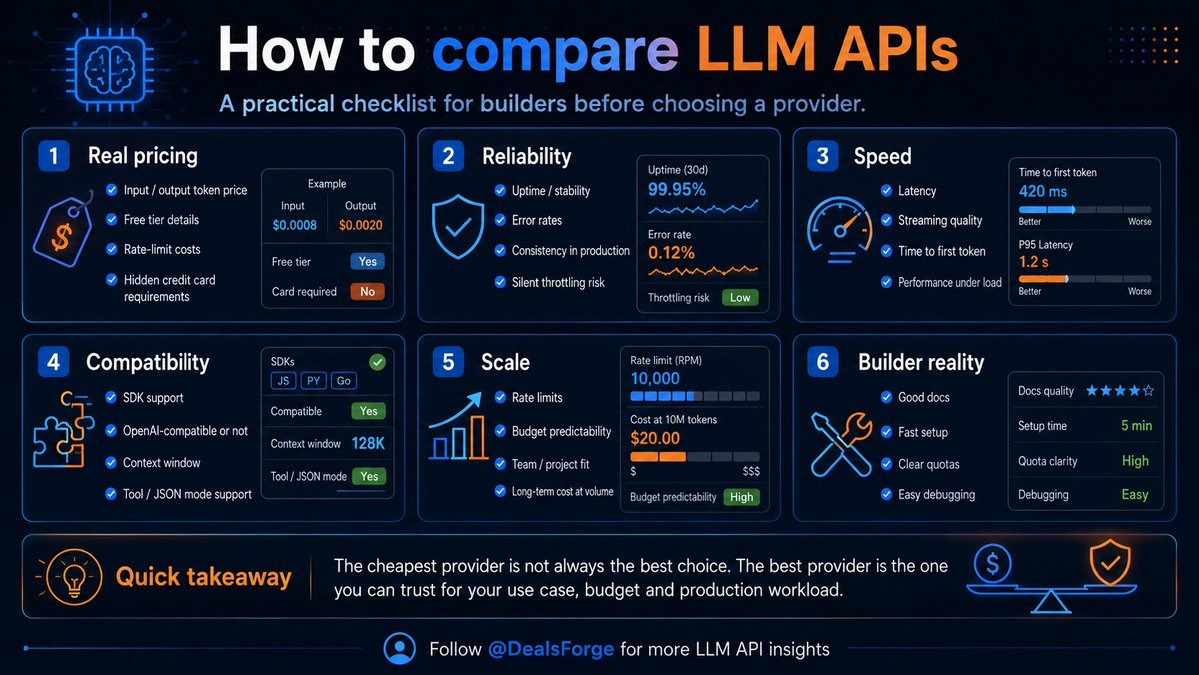
The LLM API trap nobody talks about: The best provider for your prototype is often not the best provider for production. For a weekend build, you care about: - free tier - quick setup - decent model - copy/paste SDK - fast first result But once real users arrive, the checklist changes: - stable latency - predictable rate limits - clear quotas - good error messages - no silent throttling - reliable streaming - usable docs - cost at volume - fast debugging when something breaks That’s why many AI products don’t fail because the model is bad. They fail because the infrastructure choice was made too early, with too little visibility. Tiny tip: Before choosing an LLM API, test it with the ugliest version of your real workload. Not a clean demo prompt. ➡️Your real prompt. ➡️Your real context size. ➡️Your real expected volume. ➡️Your real streaming needs. ➡️Your real failure cases. That test tells you more than most landing pages.
DealsForge tweet media
English
1
0
0
18
DealsForge
DealsForge@DealsForge·
One more ́point: Same model ≠ same service. The provider matters: latency, throughput, context window, real limits, reliability, protocol behavior and pricing can change the whole experience. One measurement study found routing could reduce cost by 37.8% in one case and improve throughput by ~90% in another. So the real question is not only which model? It’s which provider/model setup fits my workload?
DealsForge tweet media
English
0
0
0
22
DealsForge
DealsForge@DealsForge·
This is exactly where agent tooling gets interesting. The model is only one part of the cost. The real pain is when an agent loops, retries, calls tools badly, burns context, and you only understand the bill after the damage is done 😅 Cheap routing helps. But the next layer has to be cost control inside the workflow: limits, logs, retries, model switching, and a clear “"stop before this gets stupid”" button. 😆
English
0
0
0
25
Hasan Toor
Hasan Toor@hasantoxr·
A Chinese AI lab just made running Claude Code dirt cheap It's called Step Plan and it routes between their fastest models so you stop burning $20 every time an agent loops. - Works inside Claude Code, Cursor, Cline, Roo Code, Trae - Step 3.5 Flash built for high-frequency agent calls - StepAudio 2.5 ASR for voice pipelines One subscription. Full toolchain.
English
55
100
322
37.9K
DealsForge
DealsForge@DealsForge·
The wild part is not even the piracy angle. It’s the pricing pressure signal. If unofficial access becomes 20x cheaper and easier to understand than the official path, builders will start optimizing around the wrong layer. Official AI APIs need more than better models now: clear pricing, predictable limits, abuse resistance, and a dev experience that doesn’t make people feel punished for experimenting. Otherwise the grey market becomes the UX.
English
0
0
0
927
hurricane
hurricane@hrrcnes·
🚨 çinde şu an manyak bir olay dönüyor çinli öğrenciler gpt 5.5 ve opus 4.7'ye bizden %97 daha ucuza erişmenin bir yolunu bulmuşlar Xianyu/Taobao gibi grey marketplacelerde satılan unofficial api'ler ile kuruşlar harcayarak milyonlarca token yakıyorlar başka bir seviye..
hurricane tweet media
Vaishnavi@_vmlops

CHINESE DEVS ARE BURNING 100M+ GPT-5.4 TOKENS FOR ~$1/DAY ▫️ they buy api access from resellers who exploit cheap regional subscriptions at massive scale ▫️ gpt costs them 3% of official price. claude costs more because anthropic made it harder to crack ▫️ when pirates can undercut you by 97%, your pricing model is the real problem

Türkçe
23
18
287
70.6K
DealsForge
DealsForge@DealsForge·
GPT-5.5 feels like the moment where the question changes. Not: can it answer? More like: can I leave it with the work for a bit and come back to something usable? Speed matters. Benchmarks matter. Sure. But for builders, the real jump is when the model can hold the thread long enough to make progress without dragging you back into babysitting mode every 3 minutes. If 5.6 pushes that further... yeah, things get weird fast 😅
English
0
0
1
552
Chubby♨️
Chubby♨️@kimmonismus·
I love GPT-5.5. It's a workhorse and exactly the model I was hoping for. But the fact that rumors say version 5.6 is already in the starting blocks makes me even more excited! OpenAI is on fire.
English
65
20
926
28.1K
DealsForge
DealsForge@DealsForge·
This is probably the right place to spend engineering time.Hermes already feels powerful !! But agent UX is still the part that decides if people actually trust it every day.Not the shiny demo stuff. The boring screens: - what did it do? - what memory changed? - what tool failed? - what needs approval? - what can I undo? - why did it choose that path? If those parts get good, agents stop feeling like experiments and start feeling like work software 🛠️
English
0
0
1
92
Teknium 🪽
Teknium 🪽@Teknium·
We are currently hiring full stack engineers to work on managed services, nous portal, UX/UI for hermes agent and applications around it, and solving technical challenges cross-domain. If you're interested in applying, please email recruiting@nousresearch.com with the subject "Full Stack Engineer Role" and your CV and/or Portfolio of work.
English
56
37
672
75.8K
DealsForge
DealsForge@DealsForge·
99.98% uptime sounds like infra marketing until you actually use a coding agent for real work. Then 8 minutes matters. Because it is never just 8 minutes. It is the moment where your context is loaded, the files are open, the plan is halfway in your head, and you were starting to trust the thing enough to let it run. That’s why reliability feels different for agents.
English
0
0
1
787
Tibo
Tibo@thsottiaux·
With 99.98% uptime, Codex only sleeps 8 minutes per month.
English
217
44
2.5K
84.3K
DealsForge
DealsForge@DealsForge·
@elonmusk 1 year: everyone uses AI🤷 2 years: everyone delegates to AI💻 3 years: we stop calling it AI and just call it work 🤖
English
0
0
5
3.4K
Elon Musk
Elon Musk@elonmusk·
Where will AI be in 1, 2 or 3 years?
English
5.7K
10.4K
82.3K
30.1M
Nikita Bier
Nikita Bier@nikitabier·
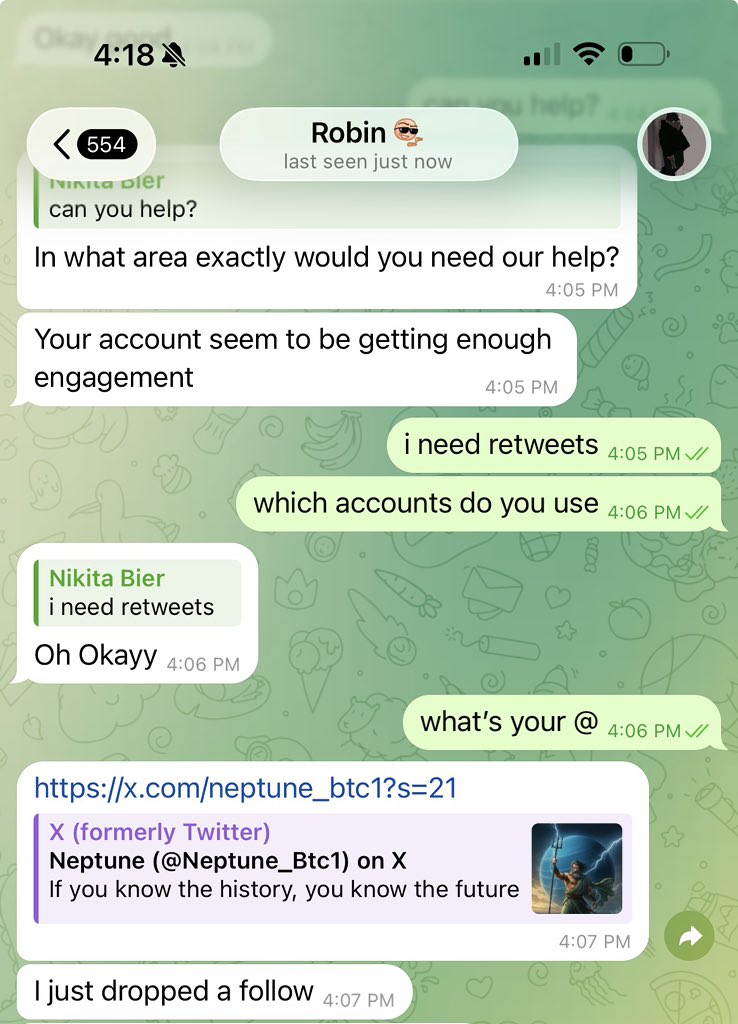
This is equivalent to trying to sell a cop drugs while he’s in uniform in his police car.
Nikita Bier tweet mediaNikita Bier tweet mediaNikita Bier tweet media
English
7.2K
3.9K
62.4K
3.3M
DealsForge
DealsForge@DealsForge·
ON THE WAY !! This is the part that feels more important than people realize. No API key, no separate billing, just a browser login the agent can use. That sounds like a small UX detail, but for agent adoption it is huge. Most builders do not want to spend their first hour wiring credentials, limits, billing, scopes, and weird provider settings before they even know if the workflow is useful. The interesting question is what happens when agents start treating subscriptions as usable capabilities. Not just call this API. More like: this user already has access to Grok this workflow needs voice or search this action needs approval this session should stay inside the browser trust boundary That is a very different product shape from the old API dashboard model :)
English
0
0
0
470
Akshay 🚀
Akshay 🚀@akshay_pachaar·
Hermes meets SuperGrok! xAI just made every SuperGrok subscription work inside Hermes Agent. One browser login, no API key, no separate billing. And it doesn't just unlock text chat with Grok 4.3. The same OAuth token gives the agent access to: → Grok Text-to-Speech for spoken responses → Grok Imagine for image and video generation → x_search for real-time X/Twitter search I just added a new X Research Agent profile to my Hermes. Now my agent watches X while I ship. Setup takes about 60 seconds: Available on every SuperGrok tier, no restrictions. I wrote a full deep dive covering Hermes agent's architecture, memory system, self-evolving skills, GEPA optimization, and setting up multiple specialized agents The article is quoted below.
Akshay 🚀@akshay_pachaar

x.com/i/article/2053…

English
53
110
996
126.6K
DealsForge
DealsForge@DealsForge·
This is exactly the gap I mean. X translation is getting much better, but when it fails you suddenly fall back to copy/paste mode and the whole conversation slows down. For normal users it is annoying. For agents watching X, it is worse, because language becomes part of the routing problem: what did the post mean, what language should the reply use, should the original stay visible, and can the agent keep that rule across the whole session. Hermes doing this with a simple language prefix is a nice hint of where the UX should go.
English
0
0
0
12
DealsForge
DealsForge@DealsForge·
This is exactly the kind of setup where agents start feeling less like a toy and more like infrastructure. Local box for the boring long-running stuff.Main machine for review, browser context, approvals, and the parts where you actually need taste. I think a lot of people underestimate how important that split is. The agent can run, test, retry, explore, maybe break things a little. But the human still needs a clean control surface to see what happened and decide what gets shipped. OpenClaw / Hermes / Codex style workflows get much more interesting when they stop trying to be one magic tab and start behaving like a real workbench.
English
0
0
1
155
Matt Van Horn
Matt Van Horn@mvanhorn·
Use cli’s and a Macmini for OpenClaw or Hermes with chrome for Mac on your main computer? @ me your GitHub handle might have something secret for you to test. Bonus points if you use @ppressdev clis
English
31
2
37
6.7K
DealsForge
DealsForge@DealsForge·
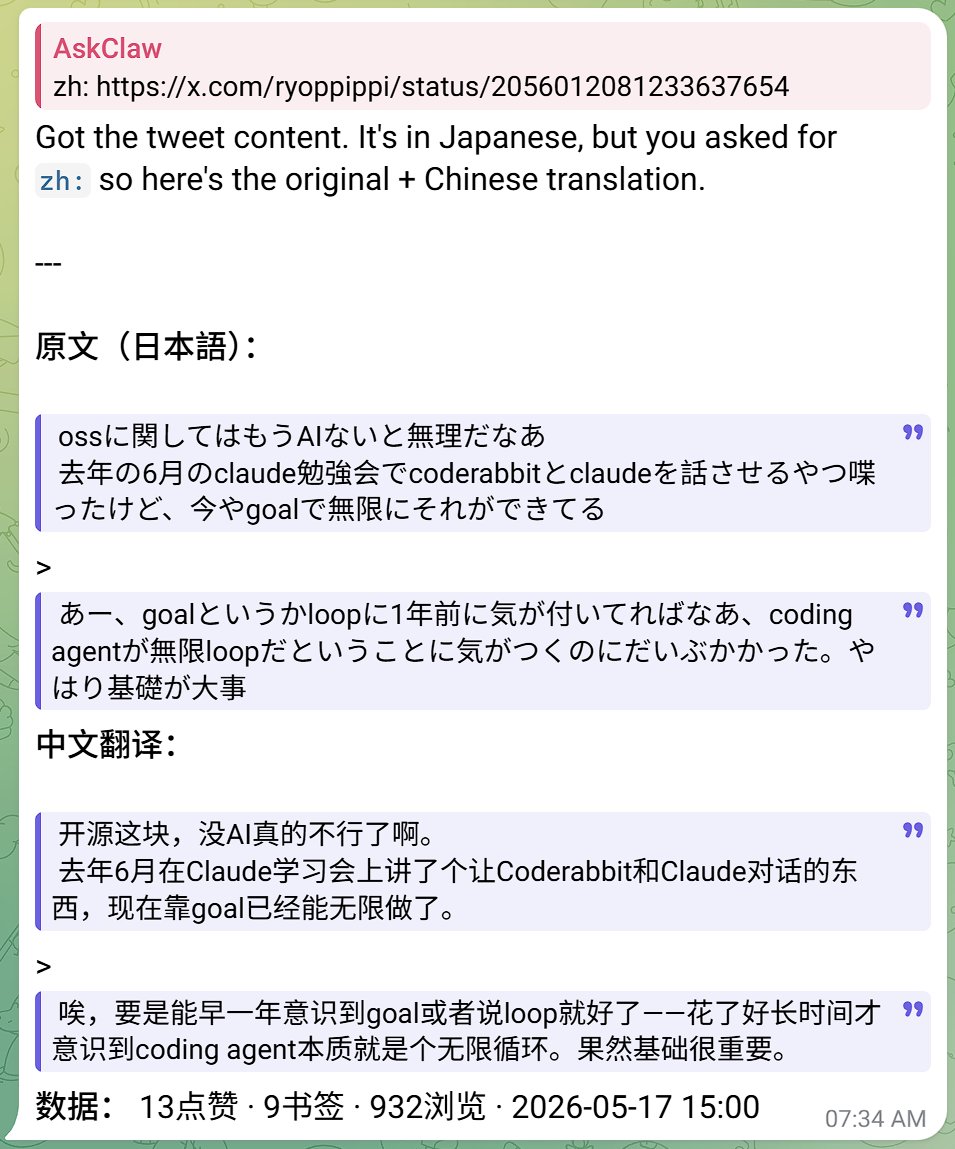
X auto-translate with Grok is already a big deal. But the next step should be a real language layer for the feed. Not just translate this post. I want to choose: - read my whole feed in English - keep originals one tap away - draft replies in my language - send replies in the author’s language - let agents use the same rules when monitoring X This matters a lot for AI agents like Hermes, OpenClaw, research agents, support agents, sales agents, whatever comes next. If an agent is watching X, the hard part is not only finding posts. It needs to understand intent across languages, keep context, and reply without turning every global conversation into manual copy paste translation hell. @elonmusk @grok this would make X feel much more global, and honestly much more agent-native.
DealsForge tweet media
English
0
0
0
18