Designing DeFi

147 posts

Designing DeFi banner
Designing DeFi

Designing DeFi

@Designing_DeFi

Researching what’s happening in DeFi, why it matters, and how to design better systems

New York, NY Katılım Ocak 2026
132 Takip Edilen568 Takipçiler
Designing DeFi retweetledi
Mallesh Pai
Mallesh Pai@malleshpai·
🚨New Paper with @Weiye_Xi , @ciamac and @Qiaoqiao2001 Here’s two different prediction markets priced at ~6.5%: 1. Will the US confirm the existence of Aliens in 2026? 2. *that* Spurs @ Knicks Game 4, ~4th quarter. They suggest that both these events are the same probability, but intuitively these feel very different: the latter (Knicks won!) feels a lot more uncertain. But prediction markets don’t immediately give us a way to quantify it.
Mallesh Pai tweet media
English
4
11
61
6.5K
Designing DeFi
Designing DeFi@Designing_DeFi·
SoK: Market Microstructure for Decentralized Prediction Markets Presented by: @PulpSpy Prediction-market prices depend on the full workflow: market creation, trading, resolution, settlement, and archiving. The process shapes what the price actually means
Designing DeFi tweet media
English
1
2
7
193
Designing DeFi
Designing DeFi@Designing_DeFi·
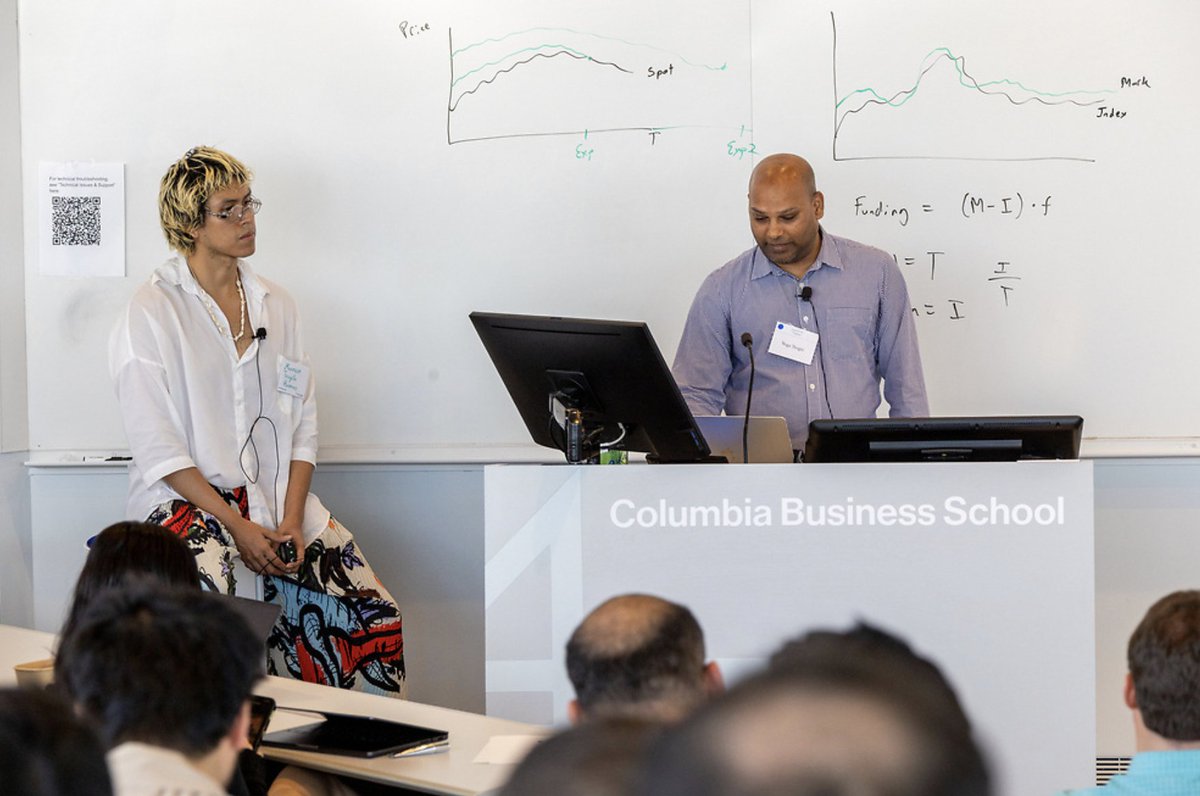
Hyperbolic Funding Rate Mechanisms Presented by: Nihar Shah Perp markets need funding rules that respond to capacity. This talk showed how nonlinear funding can stay mild near balance and push harder as open interest imbalance grows
Designing DeFi tweet media
English
1
0
1
163
Designing DeFi
Designing DeFi@Designing_DeFi·
At D², the AMMs track was about market design beyond swap execution The talks covered how automated pricing rules and market workflows can shape: → Energy coordination → Prediction-market pricing & resolution → Perp open-interest balance Read more: substack.com/home/post/p-20…
Designing DeFi tweet media
English
2
2
23
3.5K
Designing DeFi
Designing DeFi@Designing_DeFi·
There's still more DeFi to design
Designing DeFi tweet media
English
0
1
21
1.5K
Designing DeFi
Designing DeFi@Designing_DeFi·
Autodeleveraging as Online Learning Presented by: @0xnagu & @ConejoCapital Stress events unfold in rounds. This talk looked at how ADL can adapt as prices, liquidations, and solvency needs change
Designing DeFi tweet media
English
1
1
11
631
Designing DeFi
Designing DeFi@Designing_DeFi·
Risk-Based Auto-Deleveraging Presented by: Natascha Hey ADL should reduce the risk that matters. The presentation showed how venues can target dangerous leverage first instead of relying on a simple queue
Designing DeFi tweet media
English
1
0
5
223
Designing DeFi
Designing DeFi@Designing_DeFi·
Under stress, derivatives protocols have to make hard decisions in real time: → How options decay → How leverage is reduced → How ADL is triggered → How losses are allocated → How solvency is restored Full recap of the Perpetual Futures & Derivatives track at D²: substack.com/home/post/p-20…
Designing DeFi tweet media
English
3
4
19
1.5K
Designing DeFi retweetledi
Michele Fabi
Michele Fabi@MF_twit_·
📢 Call for Papers We are organizing DePIN-Energy @ BRAINS 2026: a workshop on Markets for Energy Trading and Decentralized Physical Infrastructures. 📍 Florence, Italy 📅 October 13, 2026 📝 Submission deadline: July 15, 2026 🔗 Submit via EDAS: edas.info/N35433
English
0
2
6
628
Designing DeFi
Designing DeFi@Designing_DeFi·
As DeFi matures, more design questions sit in the microstructure layer: → Transaction ordering → Fee mechanisms → Gas metering → Block building → Geography These infrastructure decisions shape execution quality, congestion, MEV, and credible decentralization
Designing DeFi tweet media
English
1
2
21
1.1K
Designing DeFi
Designing DeFi@Designing_DeFi·
We’re still designing DeFi
English
3
0
10
439
Uniswap Foundation
Uniswap Foundation@UniswapFND·
The second annual OMI-SBS Conference on FinTech & Blockchain Economics is happening June 25–26 at Oxford University Join academics and industry leaders for conversations on the research and ideas shaping the future of financial markets Learn more ↓ sites.google.com/view/omi-sbs-d…
Uniswap Foundation tweet media
English
3
2
13
1.5K
Designing DeFi
Designing DeFi@Designing_DeFi·
Jay designed DeFi
Jay Yu 🐟@0xfishylosopher

Had a ton of fun presenting at @Designing_DeFi my paper "Paper Agents, Paper Gains: An Empirical Study of DeFi Investment Agents", a survey tracking the scope, design, and performance of trading agents from Nov '24 to Nov '25 with @theamyzhao @sui414. Our key findings: > We scraped 1900+ projects on CoinGecko (post-TGE) and Messari (pre-TGE) tagged as AI, filtered out pure infra/non-agent projects, and selected 10 representative agentic projects, incl. Giza, Surf, Numerai, AIXBT, Eliza. > We evaluated their strategy, observability, source of funds, AUM. Most agents don't actually autonomously spot trade - either they provide investment advice or engage in passive yield strategies. Even if they do trade, they don't have great onchain observability and verifiability that an agent is actually signing (vs. a human signer). > We chose to analyze Virtuals + ElizaOS frameworks deeper as these had the highest onchain standardization + observability. Looking at top volume projects built on Virtuals + ElizaOS, we realize that several have $100M+ peak market cap, but extremely high MC-to-AUM ratios, with some peak ratios exceeding 10,000x (compared to 1-3x for DATs). They mostly also trade micro-cap tokens, often holding other agents' tokens. > We then choose 11 Solana projects to analyze onchain PNL for users and agent treasuries (rPNL + uPNL). There seems to a disconnect - treasuries have a net profit of +$34.3M, but users have losses of -$191.7M > Furthermore, there's heavy user PNL inequality, 81.4% of gains are captured by top 1% users, while 62.2% of all users suffer net losses. Agent tokens had 93% peak to trough drawdown vs. Solana only had 54% drawdown. So for the average user buying into these DeFi Investment Agents, things didn't really turn out great. > So where do we go from here? Our findings align with theoretical results abouts the "CoinAlg Bind", which posits a tradeoff between economic fairness and profitability for Collective Investment Algorithms (CoinAlgs). But DeFi trading agents are clearly here to stay, and the space is moving extremely quickly. > In our view, a mature DeFi Investment Agent must satisfy 3 criteria - (1) verifiable autonomy/execution of trades, (2) sustainable profits vs. passive benchmarks, (3) stakeholder alignments, where profits are actually passed back to individual users. While the space is still early, we're really excited about how these DeFi Investment agents can continue to evolve. [FULL PAPER LINK BELOW]

English
1
0
8
840