
Sabitlenmiş Tweet
DestinySeal
1.2K posts


DestinySeal
@DestinySeally
🦭30 - 🎋LoL Head Coach at University of Maryland - 🌊FF14 Boss Enjoyer. -
Eorzea as of late. Katılım Ekim 2020
1.1K Takip Edilen224 Takipçiler
DestinySeal retweetledi

Nikola Jokic shares the journey it takes to become a champion.
"If you wanna be successful, you need a couple years. You need to be bad, then you need to be good, and then when you're good, you need to fail. And then when you fail, you gonna figure it out."
That's the process.
Bad → Good → Fail → Figure it out.
There are no shortcuts.
"Experience is not what happens to you. It's what you're gonna do with what happened to you."
Because the setbacks don't define you. Your response does.
"There is a process that you need to go through. There are steps that you need to fill. There is no shortcuts. It's a journey."
"And I'm glad that I'm part of this journey."
The path to greatness isn't clean. It's messy, painful, and full of failures.
But that is the way. Trust the journey.
(🎥 NBA)
English
DestinySeal retweetledi

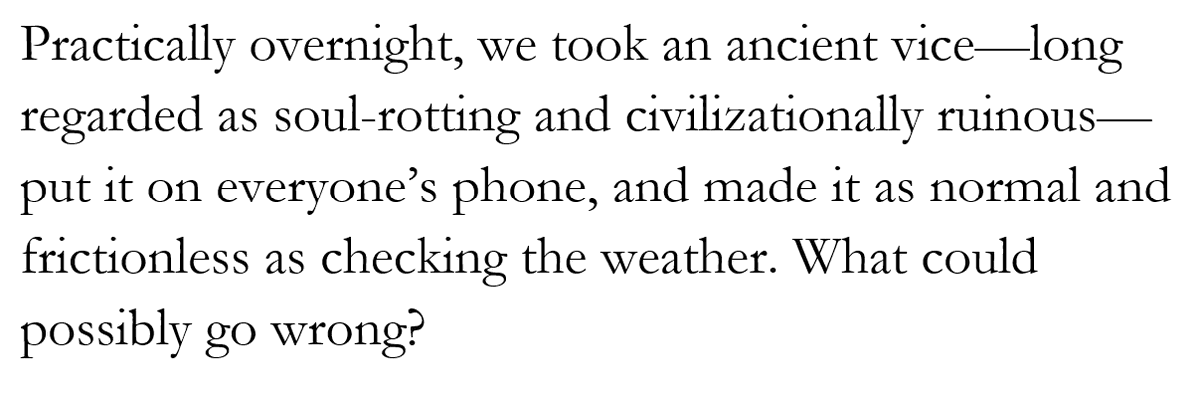
The Atlantic has a sobering, first-person look at the ramifications of legalized online sports betting. Here are a few of the more telling passages.
1/5
English
DestinySeal retweetledi

Humans invented writing to track debts. The world's first writing system, cuneiform, emerged in Mesopotamia around 3200 BC to record who owed what to whom. Clay tokens for accounting date back as far as 8000 BC. Debt isn't some corruption of a golden age. It's so fundamental to human cooperation that we created literacy because of it.
War is even older. At Jebel Sahaba in Sudan, archaeologists found a cemetery dating to 13,000 years ago where half the people buried had been killed by arrows, spears, and clubs. That's thousands of years before the first city, the first farm, or the first written law.
And about that beautiful planet of trees and sunshine: for most of human history, roughly half of all children died before age 15. Researchers who studied 17 hunter-gatherer societies found an average child mortality rate of 49%. Even in Sweden in the 1750s, 40% of children didn't survive to 15. Today globally, it's about 4%. In Japan and Iceland, 0.4%.
The systems the tweet mourns are the same ones that changed those numbers. In 1820, roughly 84% of all humans lived in extreme poverty (per economic historians at the University of Paris). Today it's about 10%. Between 1990 and 2025, roughly 118,000 people escaped extreme poverty every single day.
None of this means that debt or capitalism are without serious flaws. They obviously are. But the "paradise ruined" framing gets the history backwards. The planet was a place where burying your children was normal, and violence was a constant threat. Everything that makes modern life livable was built, imperfectly, by humans figuring out how to cooperate at scale.
le.hl@0xleegenz
I can't believe human were gifted a planet with full of trees, fruit, water, animals and sunshine and then they invented debt, capitalism and war
English
DestinySeal retweetledi

Building up discipline, studying the macro/micro & learning how to stay calm in tense scenarios and react appropriately is genuinely the key to getting better at gaming, rather anything you want to do in life.
cher ➃@SuesMistress
when ur aware ur doing bad in a game but ur hands can’t stop pressing buttons badly
English
DestinySeal retweetledi

fru ask oog: "how you forgive someone who not sorry?"
oog quiet long time.
oog: "you ever carry heavy rock up hill?"
fru: "yeah."
oog: "whole way up. arms burning. legs burning. and rock not even YOUR rock. someone put it in your hand and walk away."
fru: "..."
oog: "forgiveness is not handing rock back to them. they gone. they not taking it. forgiveness is just. putting rock down. on ground. walking away without it."
fru: "so they get away with it."
oog: "they already got away with it fru. question is. you going to carry their rock to your own grave?"
fru look at hands.
long quiet.
fru: "hard to put down."
oog: "hardest thing oog ever do. oog put down slow. over long time. some day oog pick it back up without meaning to. then put down again."
fru: "it get lighter?"
oog: "you get stronger. not same thing. but better thing."
love, oog
English
DestinySeal retweetledi

The Best Valorant Coach of all time took me out to dinner and completely changed how i coach League of Legends
Woohoojin sat across from me and said something i wasn't ready to hear
"Saskio, your coaching is military style. every piece of information you give is correct. your reads are sharp. your game knowledge is there. but you're missing something"
I almost got defensive. I sat there thinking what the fuck could i possibly be missing
"you need to install self belief into your students. not just tell them what to do. make them believe THEY can do it"
and i went quiet
because i realized he wasn't just talking about my coaching
he was talking about ME
i've been so obsessed with being the guy who creates killers that i became cold about it.
mechanical. here's the information. execute it. why aren't you executing it. what's wrong with you.
i sounded like every person who ever made me feel like i wasn't enough
i was coaching the way i was COACHED in life. no warmth. no belief. just expectations and disappointment when they weren't met
Woohoojin looked at me and said the word i never associated with coaching
EMPATHY
not soft. not coddling. not "it's okay you went 0/7"
empathy as in understanding that the coaching client sitting in my discord call has been told he's garbage for 600 games straight
empathy as in recognizing that knowledge without belief is just homework for someone who already thinks they're going to fail the test
empathy as in the difference between "here's what you're doing wrong" and "here's what you're doing wrong and here's why i know you can fix it"
two sentences. same information. completely different person walks away from that conversation
i drove home and couldn't stop thinking about it
tested it immediately. repeat client. been working with him for weeks. iron 4 to bronze 4 in 3 weeks so far.
i changed NOTHING about the game plan
i changed everything about how i made him feel during it
instead of "you need to freeze here" i said "you're already doing this better than last week and now we're going to add the freeze"
instead of "stop dying to ganks" i said "your laning is getting cleaner which means now we can focus on the map awareness piece"
same information. reframed through belief
he messaged me after and said
"that was the best coaching session i've ever had with you"
and it hit me
i wasn't missing game knowledge. i wasn't missing strategy.
i was missing the thing that makes someone actually WANT to improve instead of feeling like they HAVE to
the best valorant coach in the world didn't teach me a new concept
he held a mirror up and showed me the gap i couldn't see in myself
you don't just create killers
you make them believe they were killers all along
Study the Saskio way
English
DestinySeal retweetledi

Every time someone has told me they’re genetically bad at games it always boils down to them being unwilling to practice with intention. Every single time.
IdkTest@IdkTest_06
being genetically bad at games is the worst shit ever cause you keep playing even though you know you never gonna be good
English
DestinySeal retweetledi

You have to accept that, for whatever reason, reality is a kind of game where things are almost never what they appear at first glance and the truth usually seems to be a paradox in which the answer is the exact opposite of what seems to make sense. If you want to win the game you have to be clever and see the solution to your problems in inherent contradictions. It wouldn't be a fun game if anyone could win, after all.
So when it comes to soul crushing loneliness, part of the solution is you have to accept that no matter what you do, you are going to feel soul crushing loneliness. You will feel it until you die. Soul crushing loneliness is just a part of having a consciousness and the responsibility that comes with being a human being that has been given the burden of agency that cannot be given away, stolen, borrowed, or avoided.
When you truly, actually accept this fact, and can hold the knowledge of this loneliness in your heart without it overwhelming all your rationality, is the moment when you'll feel the burden of the soul crushing loneliness lifting enough to begin to cultivate yourself and create positive, soul-enriching relationships with others. The acceptance of this loneliness makes it inconsequential to your movement through life, and thus frees you from it.
Noor@noorrietje
does anyone have a cure to never ending soul crushing loneliness that isnt alcohol or drugs
English
DestinySeal retweetledi

One of the biggest mistakes I see parents make is exposing their children to screens too early.
A 2023 study published in JAMA Pediatrics followed over 7,000 children and found that those with higher screen time at age 1 showed significantly more developmental delays by age 2.
We’re talking language, problem-solving, social skills.
If you’re not yet a parent, hear this clearly.
One of the greatest gifts you can give your future child is limiting screen exposure from day one.
And when I say limit, I don’t mean “reduce it a bit.” I mean don’t normalize it around them.
At that age, your child is studying you.
Watching you. Copying you.
If you’re always on your phone, always pressing something, always staring at a screen, they become curious.
What’s so interesting on that device?
Why does mummy or daddy keep going back to it?
You can’t fight curiosity you’re modeling every day.
You can’t say “don’t touch it” when you’re glued to it.
If you’re serious about protecting your child’s development, treat screens the way you would treat something inappropriate.
You don’t display it casually. You don’t make it accessible. You control the environment.
No TV constantly running in the sitting room.
No phone-as-babysitter.
No background noise from cartoons all day.
The earlier years are foundational.
That brain is wiring itself based on real human interaction.
A child learns to talk because people talk to them.
They pick up emotional cues from faces, tone, eye contact.
They build attention span through boredom, exploration, touch, movement.
When screens replace that, the wiring changes. And it shows up years later in a classroom.
Another study from the National Institutes of Health found that children who spent more than two hours a day on screens had lower scores on thinking and language tests.
Their brain scans actually looked different.
This isn’t opinion.
We’re seeing more speech delays. More attention struggles.
Children who can swipe a screen before they can speak in full sentences. And it’s not mysterious.
When a child’s brain gets used to rapid cuts, bright colors, algorithm-driven stimulation, and instant dopamine hits, then you hand them a book and expect focus… that’s a difficult transition.
You can’t train deep focus on a brain conditioned for constant stimulation.
And then we blame the child.
The truth is, most of it started with the environment.
Yes, there are “educational shows.” Yes, moderation matters.
But nothing replaces direct teaching. Direct conversation. Play. Storytelling. Eye contact. Silence. Boredom.
If you already have kids and screens are already part of the home, adjust gradually. Set new boundaries. It’s not too late for the brain to adapt.
But if you’re yet to become a parent… start with intention.
Create a home where screens are tools, not background noise.
Where interaction beats animation.
Where your child’s brain develops from real life, not pixels.
Your child’s first screen habit is watching yours.
Olúwatósìn Olaseinde@tosinolaseinde
This generation of parents are aggressively protective about screen time
English
DestinySeal retweetledi

such a peaceful scene.. a ts without stress! ahaha awesome

English
DestinySeal retweetledi

”Oh boy another unnecessary reboot/sequel/remake, I don’t eve- WRITTEN BY HUH?”
English
DestinySeal retweetledi

She ate lunch alone for 730 days straight. What this 16-year-old built from that pain now protects millions of kids worldwide.
Seventh grade. Natalie Hampton carried her tray through a packed cafeteria and felt it — that specific, suffocating dread of not knowing where to go.
She'd already learned what happened when you approached the wrong table. The silence. The turned backs. The whispered laughter that followed you all the way to the empty table by the wall.
The one everyone could see.
The one that said: nobody wants her.
For two full years — 730 consecutive lunches — that table was hers. Alone.
The bullying went further than whispers. She was shoved into lockers. Four physical attacks in two weeks. She came home with scratches and bruises. When she finally reported it, school administrators sent her to counseling — to find out what she was doing wrong.
The isolation grew so heavy she was hospitalized for anxiety.
Then ninth grade came. A new school. And almost overnight — everything changed. Students welcomed her. She made friends within weeks. She finally knew what safe felt like.
But she couldn't stop thinking about the kids still sitting at the wall table. Right now. Today.
She remembered what she'd needed most during all those lunches. Not a teacher. Not a pamphlet. Just one person saying: "You can sit with us."
So at 16 — with zero coding experience and "a lot of enthusiasm," as she put it — Natalie built exactly that.
She called it Sit With Us.
The idea was simple and genius: students sign up as "ambassadors," keeping their table open. Other kids privately browse available tables on their phones before ever walking into the cafeteria — and show up knowing they're already welcome.
No public rejection. No moment of judgment. Just a guaranteed seat.
Within 7 days of launching: 10,000 downloads.
Then the world found her. NPR. The Washington Post. CBS News. Messages from Morocco, Australia, the Philippines, France — kids who'd been eating alone for years, finally finding a place to belong.
Sit With Us now operates in 30 countries.
"Even if it helps one person," Natalie said quietly, "it was worth building."
She turned 730 lunches of loneliness into a lifeline for millions.
That's not just survival. That's transformation.

English
DestinySeal retweetledi

There is no Princeton study showing brains emit electromagnetic waves that connect consciousness across 10,000 kilometers. That claim traces back to social media posts that cite no paper, no journal, no DOI, and no named researchers.
What actually exists is the PEAR lab, which ran from 1979 to 2007 studying whether human intention could influence random number generators. Princeton’s own physics department called it an embarrassment to the university. Robert L. Park, a physics professor, said publicly that it embarrassed science and embarrassed Princeton.
The methodology problems were severe. One single test subject participated in 15% of all PEAR trials and was responsible for half the total observed effect. When you remove that person’s data, the “high intention” results drop to barely significant and the “low intention” results fall to pure chance. Two independent German research groups tried to replicate the findings and failed. PEAR itself couldn’t replicate its own results.
The entire statistical framework was flawed. PEAR ran tens of millions of trials, and when your sample size is that enormous, even tiny biases in the equipment produce artificially low p-values that look statistically significant while measuring nothing real. Physicist Massimo Pigliucci laid this out clearly: the machines weren’t perfectly random, and the statistics guaranteed “significant” results from mechanical noise.
What’s actually happening is a content laundering operation. Someone takes a discredited 28-year-old parapsychology program, strips away the criticism, adds fabricated claims about “10,000km brain waves” that appear in zero published research, and stamps “Princeton” on top. The Princeton name does all the heavy lifting. Nobody checks whether the university actually produced the research being described.
The PEAR lab closed in 2007 because its founders retired and its funding dried up after major donors died. The scientific community didn’t fight to save it. Princeton students at the time called it “kind of a joke.” A Nobel Prize-winning molecular biologist at Princeton wouldn’t even comment on the methodology.
This post is getting engagement because it tells people something they want to believe: that consciousness is magical, interconnected, and science is finally proving it. The actual trail leads to a shuttered parapsychology lab, fabricated claims with no source papers, and the same pattern that drives every piece of viral pseudoscience: prestigious institution name + unfalsifiable spiritual claim + zero citations.
RedPilledNurse@RedPilledNurse
Princeton researchers discovered that the human brain emits ultra-low-frequency electromagnetic waves that appear to form part of a global neural network. These signals can subtly influence other people’s brains from as far as 10,000KM away, raising the possibility that human consciousness is interconnected across the planet. This work adds to a growing body of research suggesting that our brains communicate not only through neurons but also through delicate electromagnetic fields. Some studies indicate that these fields may help shape empathy, intuition, and even the way groups synchronize their behavior. Experiments have also hinted that when one person meditates or focuses deeply, nearby or even distant individuals can show slight shifts in their brainwave patterns. The Princeton Engineering Anomalies Research (PEAR) Laboratory has conducted several experiments that show the mind has a subtle capacity to influence the output of devices known as Random Event Generators (REGs). A project that initially started when a student was curious to study the effects of the human mind and intention on the surrounding environment, turned into a rigorous testing lab where Dr. Robert Jahn and his lab assistant spent many hours experimenting to determine whether or not the mind has an effect on our physical world. Jahn and his assistant were able to determine that the human minds interactions with the machines demonstrated a relationship that was not physical in nature. The mind was able to affect and change outcomes of the machine in ways that were beyond standard deviations. In essence, consciousness was having an effect over the physical world. To determine the effects of the mind’s intention on the physical world, they built several machines called a random number generator. The machine would essentially mimic a coin flip and record the results over time. The machine performed 200 flips per second and produced an average mean of 100 as one would expect. Left unattended, the machine would continue to produce results that suggested a 50/50 chance of producing either heads or tails. The interesting results came when human intention started to interact with the machine. What was once a random 50/50 chance of producing heads or tails began to deviate from expectation as the observer began to intend for the numbers to be higher or lower. While the effects of the mind over the machines was not large, it was enough that contemporary physics is unable to explain what exactly is happening. Perhaps this is where the quantum world can shed light? The implications of this research on humanity are fascinating given it could reach into the realms of creating a world of peace, a thriving world and abundance. If intentions and thoughts can impact something the way it has been demonstrated above, why not explore the boundaries of how far this can go?
English
DestinySeal retweetledi

When your sense of self is fragile you become honestly a huge bore to talk to bc in every conversation you’re hoping this person will bolster your self-concept in some way.
Which makes you less attentive, less present, less fun, more self absorbed. The best thing you can do is to stop ruminating on your flaws all the time and think about other things.
English
DestinySeal retweetledi

LoLでSUPキャラをしてみて思ったことなんですけど...。
本当にSUPの方達は凄い方達なんだなと思いました。
どんな事が凄いかと言うと
まず、彼ら彼女達はキルを取ってはいけないんですよ...!
意図的にキルを取らないように配慮してくれてるんです!
体力を倒せるミリのラインで抑える!??
なんかの職人かな?
しかもこれ驚きなのが、レーン戦だけじゃなくて集団戦の時も意識してるときた。
こりゃたまげたぁ...!
僕はブルーロック出身なのでキルしないのは死ぬのと同然に苦しい事なんです。
そんな時彼ら彼女達がキルをした時、SUP達はなんていうか分かりますか!?!?!?
「あー!!キル取っちゃったぁ!!ごめぇぇーん!」
おいおいおいwなんかの冗談か何かかい!?w
あんたらどんだけお人好しなんだい...。
あんたらあれだよ。ゾンビの世界に行った時に真っ先に人の事守って、「君が無事で良かった...!」って言う人達だよ。絶対あれだよ...。
挙句の果てには味方のADCが危ない時、代わりに死んでくれるんです。その時も彼ら、彼女達はきっとこういうんだよ。
「良かったぁ!」
ん?乙骨先輩かな????
待ってくれよ...!でも世の中はこれがワースって言うんだよ。
ゲーム的にはワースだけど...。心的にはNOTワースなんだよ...!
目の前でお母さんが死んでいく姿を見てワース言う奴がいるか...!
そうだよ。いるのがリーグオブレジェンドなんだよ。
なんて世界だ...!
SUP達はこれだけでは飽き足らず、味方が安全に戦えるように視界管理なんて事もしやがるんだ...!
誰か彼らの頑張りに気づいてやってくれ...!
視界管理のついでにMIDロームだぁ!?
【お母さんへ】
体調には気を付けてください。
これ以上働いてしまうと体がボロボロになってしまいそうで心配です。
息子より...。
いつもそうなんだよ。あれはSUPのおかげだった。
誰のおかげでガンクケアができているんだい?
誰のおかげでオブジェクトを安心して取れるんだい?
なぜ今回のオブジェクトファイト、JG同士のスマイトバトルが運ゲーにならなかった?
それはぜぇぇぇっぇぇえぇぇぇー!!!んぶ!!!
SUP様のおかげだよぉ!!!!
ドラゴンピットの裏でSUPたちぃぃ!!!
止めちゃってるんだからぁ!
敵のJGをぉぉぉ!!!!
こおおおれに気づいてあげてぇ!!!
だから彼ら彼女達はさ、ハッキリ言って何してるかって言うとさ。
もうあれ縛りプレイナンダヨ。
キルしちゃいけない、なんか私体硬いから前張らなきゃいけない。
あれリーグオブレジェンドじゃないんよ。
あれ紳士オブレジェンドなんよ。
だから世の中のLoLプレイヤーよ。
SUP達に日々感謝しながらプレイしましょう。
でもね。?ピンを味方に炊くSUPがいたらそいつはダウトだ。
本物のサポートは味方に?ピンなんか炊かねぇ。
まぁ明らか味方がヤバイトロールとかだったら炊くだろうけど。
時と場合による。
でも、基本彼ら彼女達は温厚な存在だ。
最近身を持って感じてここにレポートを残す。
#LoL
日本語
DestinySeal retweetledi
This game is solving a $600B industry’s biggest bottleneck.
The data center industry needs 650,000 workers this year. 58% of operators can’t find qualified talent. Hiring timelines for key roles have doubled from 8 weeks to 4+ months. AWS, Google, and Microsoft are spending $600B+ on GPU and data center infrastructure, but the buildings are useless without people who understand how racks, cooling, power redundancy, and network topology actually work.
The workforce grew 60% from 2016 to 2023 and still can’t keep up. The industry’s official answer? “Partner with universities” and “recruit military veterans.” Both pipelines take years to build and compete with every other sector chasing the same people.
Meanwhile a solo developer built a $20 game where you physically place servers in racks, route Ethernet by hand, watch colored packets reveal your bottlenecks, manage hardware failures, and learn redundancy through consequence. 84% positive reviews on the demo. Releasing March 31.
This tells you everything about how the industry thinks about talent development. Hyperscalers will spend $17M per day on a single data center campus but won’t fund the thing that actually creates intuition for how these systems work: repetition in a low-stakes environment where failure is cheap and feedback is instant.
Kerbal Space Program created more aerospace engineers than any recruitment brochure NASA ever printed. Factorio teaches supply chain optimization better than most MBA programs. The pattern is clear: games that make complex systems tangible produce practitioners, not just awareness.
The talent shortage is the real constraint on data center buildout, and the solution looks like a $20 Steam game, not a $200K university pipeline.
P.M@p_misirov
there is a game called "data center" on steam which let's you build and manage your own data center. this is lowkey genius, the best way to educate people on a new trait. hyperscalers should learn a thing or two from "edutainment".
English
DestinySeal retweetledi

This is a fundamental misunderstanding of what drives phenoms, their motivation, and hard work.
Psychologist Ellen Winner studied this. Prodigies have a “rage to master” that doesn’t come from some adult forcing training. It’s a combo of interest, curiosity, and talent aligning in the form of mastery.
In fact, she and others found that forcing or overcontrolling increased the likelihood that young phenoms burned out or didn’t reach the next level.
It’s hard for folks to understand this who have never experienced it or are outside of the arena. But in my teenage years, I averaged over 80 miles per week for an entire year…and it was all me. My parents and even coaches would have liked me to run less…but I had the rage to master.
And that’s the point. You create an environment that allows people to dabble and find that match. And when the spark is lit, you support it but not by over controlling it.
You dont need a controlling environment to have dedication and resilience. In fact lots of research shows that environment backfires.
Sometimes major talents make it through regardless. But the folks who think that you have to essentially force kids to work hard…well they are wrong. And showing you they’ve never worked with anyone that talented with the rage to master.
You don’t have to listen to me, Wayne Gretzky said the same thing. As did the poster child Tiger Woods. Both said essentially it’s the child’s desire not the adults that matters.
Most folks, like Sarah below, can’t imagine it because they’ve never seen it. But once you work with kids who have the rage to master or teens running 70-100miles per week by choice, you get it. And you see why research shows us that the authoritarian environment backfires for long term development.
The best comparison I can give you is for non-runners they see every run as a chore, something to survive. So they imagine you have to be forced or incentivized to do it. But the experienced runner sees it almost as play. They learn to love even the hardest of workouts and choose to do it.
It’s the same here.
What Alysa’s story tells us is that we need to fundamentally shift our understanding of youth drive and motivation in the public to match what decades of research tells us.
Hard work and joy aren’t opposites. And often the prodigies and phenoms work their butts off because they bring joy to the thing. It’s just dumb adults who squash it out of them…thus why we have such a poor phenom to adult success rate overall.
Let go of outdated ideas.
Sarah Haider 👾@SarahTheHaider
Sorry, I love Alysa’s spirit and joy but this is getting stupid. No amount of “joy” in adulthood makes up for a lack of intense training when young, and no child prefers training to play. If she wasn’t forced when she was young, she would have lost to someone who was.
English
DestinySeal retweetledi
A human consumes about 2,000 calories per day. Over 20 years, that’s roughly 17,000 kWh of total food energy. Training GPT-4 consumed an estimated 50 GWh of electricity. That’s 3,000 humans worth of “training energy” for a single model run.
And GPT-4 is already dead. OpenAI retired GPT-4o from ChatGPT on February 13th. The model that took 50 GWh to train got less than two years of flagship status before replacement. The human you spent 17,000 kWh “training” for 20 years produces economic output for the next 40 to 60 years. The amortization window on GPT-4 was shorter than a car lease.
Now look at what replaced it. GPT-5.2, released December 2025, is OpenAI’s current default. The GPT-5 series consumes an estimated 18 Wh per average query according to the University of Rhode Island’s AI Lab, up to 40 Wh for extended reasoning. That’s 8.6 times more electricity per response than GPT-4. With 2.5 billion queries hitting ChatGPT daily and GPT-5.2 now the default model, the inference math gets staggering fast. Even at a blended average well below 18 Wh, you’re looking at daily electricity consumption that could power over a million American households.
This is what Altman is actually doing. OpenAI hit $13 billion in annual recurring revenue but still isn’t profitable. They need you to think of AI energy consumption as natural and inevitable, the same way you think about feeding a child, because the alternative framing is that they’re burning through enough electricity to rival small countries while racing to build 1-gigawatt Stargate data centers. The food analogy makes the energy costs feel biological and unavoidable instead of what they are: an engineering and business choice that scales with every model generation.
The comparison sounds clever at a fireside chat in India. It falls apart the second you do the arithmetic.
Chief Nerd@TheChiefNerd
🚨 SAM ALTMAN: “People talk about how much energy it takes to train an AI model … But it also takes a lot of energy to train a human. It takes like 20 years of life and all of the food you eat during that time before you get smart.”
English
DestinySeal retweetledi

psychology solved the ai memory problem decades ago. we just haven't been reading the right papers.
your identity isn't something you have. it's something you construct. constantly. from autobiographical memory, emotional experience, and narrative coherence.
Martin Conway's Self-Memory System (2000, 2005) showed that memories aren't stored like video recordings.
they're reconstructed every time you access them, assembled from fragments across different neural systems. and the relationship is bidirectional: your memories constrain who you can plausibly be, but your current self-concept also reshapes how you remember. memory is continuously edited to align with your current goals and self-images. this isn't a bug. it's the architecture.
not all memories contribute equally. Rathbone et al. (2008) showed autobiographical memories cluster disproportionately around ages 10-30, the "reminiscence bump," because that's when your core self-images form.
you don't remember your life randomly. you remember the transitions. the moments you became someone new. Madan (2024) takes it further: combined with Episodic Future Thinking, this means identity isn't just backward-looking. it's predictive. you use who you were to project who you might become. memory doesn't just record the past. it generates the future self.
if memory constructs identity, destroying memory should destroy identity. it does. Clive Wearing, a British musicologist who suffered brain damage in 1985, lost the ability to form new memories. his memory resets every 30 seconds. he writes in his diary: "Now I am truly awake for the first time." crosses it out. writes it again minutes later.
but two things survived: his ability to play piano (procedural memory, stored in cerebellum, not the damaged hippocampus) and his emotional bond with his wife. every time she enters the room, he greets her with overwhelming joy. as if reunited after years. every single time. episodic memory is fragile and localized.
emotional memory is distributed widely and survives damage that obliterates everything else.
Antonio Damasio's Somatic Marker Hypothesis destroyed the Western tradition of separating reason from emotion.
emotions aren't obstacles to rational decisions. they're prerequisites.
when you face a decision, your brain reactivates physiological states from past outcomes of similar decisions. gut reactions. subtle shifts in heart rate. these "somatic markers" bias cognition before conscious deliberation begins.
the Iowa Gambling Task proved it: normal participants develop a "hunch" about dangerous card decks 10-15 trials before conscious awareness catches up. their skin conductance spikes before reaching for a bad deck. the body knows before the mind knows. patients with ventromedial prefrontal cortex damage understand the math perfectly when told. but keep choosing the bad decks anyway. their somatic markers are gone. without the emotional signal, raw reasoning isn't enough.
Overskeid (2020) argues Damasio undersold his own theory: emotions may be the substrate upon which all voluntary action is built.
put the threads together. Conway: memory is organized around self-relevant goals. Damasio: emotion makes memories actionable. Rathbone: memories cluster around identity transitions. Bruner: narrative is the glue.
identity = memories organized by emotional significance, structured around self-images, continuously reconstructed to maintain narrative coherence. now look at ai agent memory and tell me what's missing.
current architectures all fail for the same reason: they treat memory as storage, not identity construction. vector databases (RAG) are flat embedding space with no hierarchy, no emotional weighting, no goal-filtering. past 10k documents, semantic search becomes a coin flip. conversation summaries compress your autobiography into a one-paragraph bio. key-value stores reduce identity to a lookup table. episodic buffers give you a 30-second memory span, which as the Wearing case shows, is enough to operate moment-to-moment but not enough to construct identity.
five principles from psychology that ai memory lacks.
first, hierarchical temporal organization (Conway): human memory narrows by life period, then event type, then specific details. ai memory is flat, every fragment at the same level, brute-force search across everything. fix: interaction epochs, recurring themes, specific exchanges, retrieval descends the hierarchy.
second, goal-relevant filtering (Conway's "working self"): your brain retrieves memories relevant to current goals, not whatever's closest in embedding space. fix: a dynamic representation of current goals and task context that gates retrieval.
third, emotional weighting (Damasio): emotionally significant experiences encode deeper and retrieve faster. ai agents store frustrated conversations with the same weight as routine queries. fix: sentiment-scored metadata on memory nodes that biases future behavior.
fourth, narrative coherence (Bruner): humans organize memories into a story maintaining consistent self across time. ai agents have zero narrative, each interaction exists independently. fix: a narrative layer synthesizing memories into a relational story that influences responses.
fifth, co-emergent self-model (Klein & Nichols): human identity and memory bootstrap each other through a feedback loop. ai agents have no self-model that evolves. fix: not just "what I know about this user" but "who I am in this relationship."
the fundamental problem isn't technical. it's conceptual. we've been modeling agent memory on databases. store, retrieve, done. but human memory is an identity construction system. it builds who you are, weights what matters, forgets what doesn't serve the current self, rewrites the narrative to maintain coherence. the paradigm shift: stop building agent memory as a retrieval system. start building it as an identity system.
every component has engineering analogs that already exist.
hierarchical memory = graph databases with temporal clustering.
emotional weighting = sentiment-scored metadata.
goal-relevant filtering = attention mechanisms conditioned on task state.
narrative coherence = periodic summarization with consistency constraints.
self-model bootstrapping = meta-learning loops on interaction history.
the pieces are there. what's missing is the conceptual framework to assemble them. psychology provides that framework.
the path forward isn't better embeddings or bigger context windows. it's looking inward. Conway showed memory is organized by the self, for the self. Damasio showed emotion is the guidance system. Rathbone showed memories cluster around identity transitions. Bruner showed narrative holds it together.
Klein and Nichols showed self and memory bootstrap each other into existence. if we're serious about building agents with functional memory, we should stop reading database architecture papers and start reading psychology journals.

English