That’s it , A quick overview of this powerful tooling CLI that Is actively into development and adopted by big projects around the world. Show some love on this tool and integrate it into GitHub Actions/CI to slash pipeline times and ship clean code.
Python devs: Meet Ruff the Rust powered linter & formatter blazing through your code at warp speed!
Python tooling is evolving FAST, thanks to Astral (makers of UV, which we geeked out over before). Ruff integrates seamlessly into your workflows – let's dive in.
Built my first CLI Weather Agent 🌦️
Used tool calling to fetch real-time weather data.
Biggest learnings:
• Prompt quality matters more than I thought
• Explored prompting styles: Direct, One-shot, Few-shot & Chain of Thought
• Better prompts = smarter agents
At TUF, we went back to a monolith with the new revamp.
Initially, we chose microservices thinking about scale, clean separation, and future growth.
But reality was different.
- Small team
- more services to manage
- harder debugging
- slower shipping.
- took long to onboard people
So we simplified it
- One codebase.
- Faster changes.
- Easier ownership.
Microservices are great, just not needed for us right now.
Hey
@X Algorithm
I would like to #connect with people who are interested in:
🧑💻 Software Engineering
⚡️JavaScript / Typescript
⚛️ MERN & Next.js
🖥 DevOps
📊 DSA algo
💡 Gen Ai
🪽 Freelancing
#letsconnect#buildinpublic
Messaging & Queuing – SQS, SNS, EventBridge in AWS
Introduction
→ Modern applications rely on asynchronous communication between services to improve scalability, reliability, and performance.
→ AWS provides several managed messaging and event services , Amazon SQS, Amazon SNS, and Amazon EventBridge , to enable decoupled and event-driven architectures.
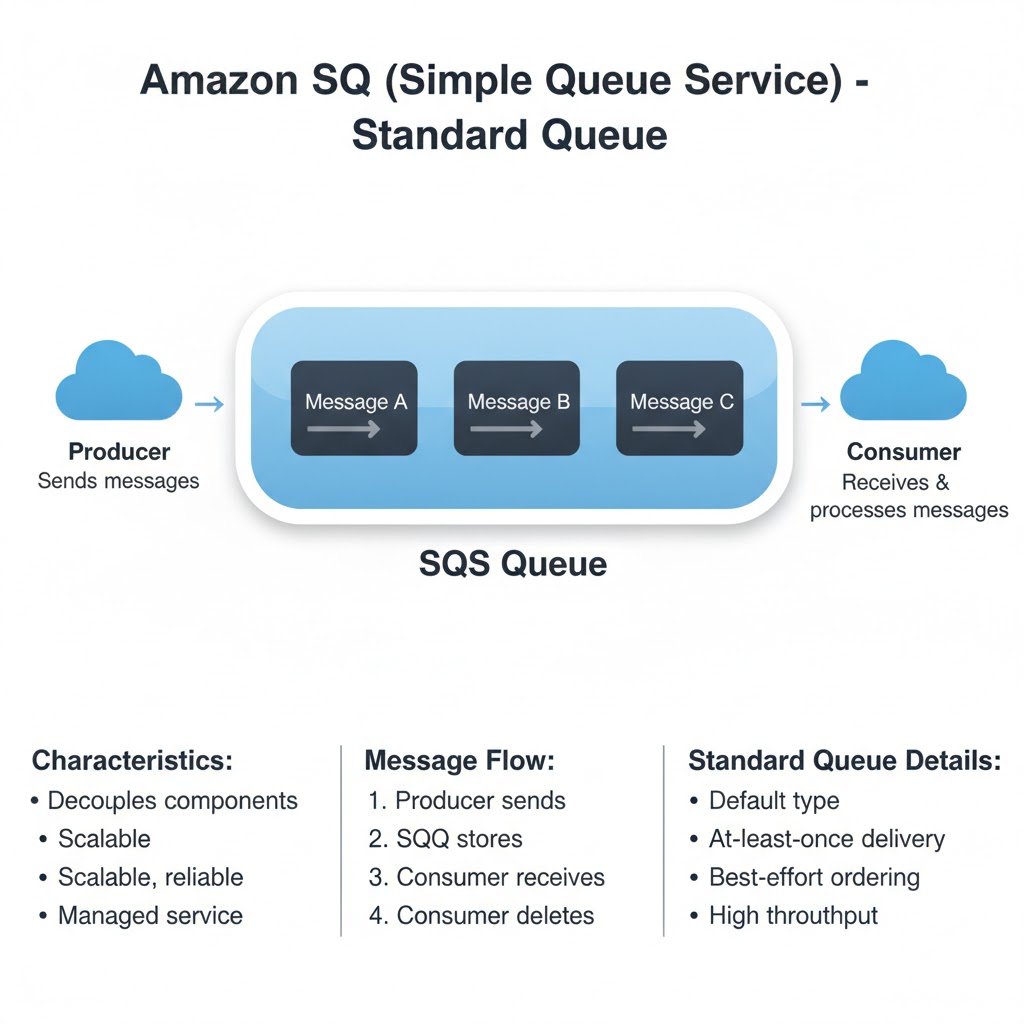
Amazon SQS (Simple Queue Service)
→ Amazon SQS is a fully managed message queuing service that enables decoupling between application components.
→ It stores messages temporarily until they are processed by a consumer.
→ Two types of queues:
→ Standard Queues — provide nearly unlimited throughput with at-least-once delivery.
→ FIFO Queues — ensure messages are processed exactly once and in order.
→ Key Features:
→ Asynchronous communication between microservices.
→ Automatic scaling and durability.
→ Visibility timeouts and dead-letter queues for fault tolerance.
→ Common Use Cases:
→ Decoupling backend services.
→ Task scheduling systems.
→ Processing pipelines (e.g., order processing, video encoding).
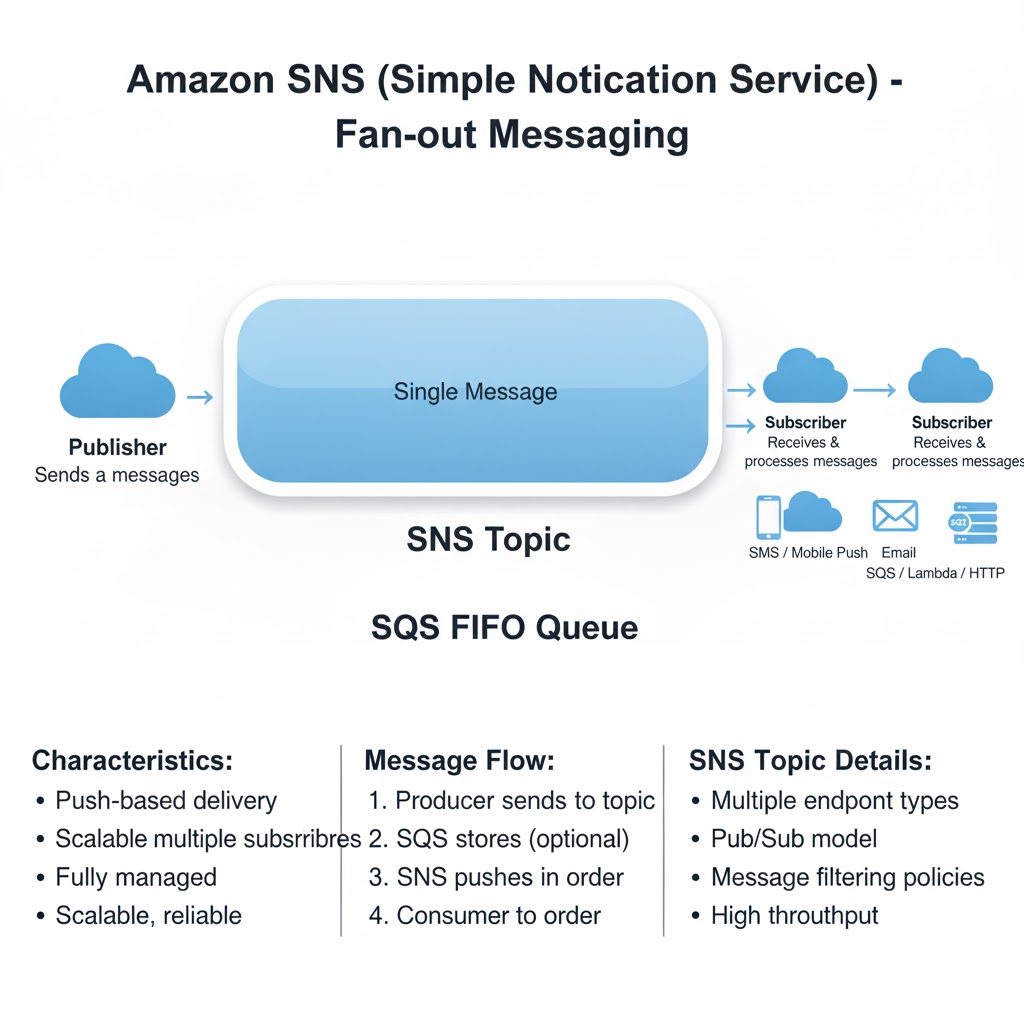
Amazon SNS (Simple Notification Service)
→ Amazon SNS is a fully managed publish/subscribe messaging service.
→ It sends notifications or messages to multiple subscribers simultaneously.
→ Subscribers can be:
→ Email, SMS, HTTP endpoints, AWS Lambda, or SQS queues.
→ Key Features:
→ Push-based delivery instead of polling.
→ Integration with CloudWatch for alerts and system monitoring.
→ Message fan-out — send one message to multiple destinations at once.
→ Common Use Cases:
→ Alerting and notifications.
→ Broadcasting messages to multiple systems.
→ Triggering Lambda functions on specific events.
Amazon EventBridge
→ Amazon EventBridge (formerly CloudWatch Events) is an event bus service for building event-driven architectures.
→ It allows applications to react to events from AWS services, SaaS providers, or custom applications.
→ Key Features:
→ Schema discovery and event transformation.
→ Rule-based routing to specific targets (Lambda, Step Functions, SQS, etc.).
→ Native integration with over 100 AWS services.
→ Common Use Cases:
→ Automating workflows across AWS accounts.
→ Building real-time data pipelines.
→ Connecting external SaaS applications with AWS resources.
Key Differences Explained
→ SQS is for message queuing — ensures reliable message delivery between producers and consumers.
→ SNS is for notifications — broadcasts messages to many subscribers simultaneously.
→ EventBridge is for event routing — connects AWS services and external applications in real time.
→ Together, they form the backbone of decoupled, event-driven architectures in AWS.
Why Messaging & Queuing Matter
→ Improves scalability by allowing asynchronous processing.
→ Increases fault tolerance through message durability and retries.
→ Simplifies complex workflows by decoupling services.
→ Enables event-driven systems that respond instantly to changes.
Our Docker images had 847 vulnerabilities. All from the base image.
We were using ubuntu:latest.
The fix:
- Switched to distroless images
- Reduced image size from 420MB to 28MB
- Vulnerabilities dropped to 3
- Container startup time improved by 60%
Then discovered our CI/CD was pulling images without verification.
Added:
- Image signing with Cosign
- Vulnerability scanning in pipeline
- Admission controller to block unsigned images
Security and performance often align.
Smaller surface area equals fewer problems.