Shane Mason

4.4K posts

Shane Mason banner
Shane Mason

Shane Mason

@DeveloperDude_

Institutionally backed CRE Sponsor with $175mm in completed projects.

Get Deals In Your Inbox 👉🏼 Katılım Mart 2009
770 Takip Edilen3.3K Takipçiler
Sabitlenmiş Tweet
Shane Mason
Shane Mason@DeveloperDude_·
As requested: Underwriting 101 for non-finance folks If you know how to design or build a building, but don’t how to judge whether a project is a good financial investment or a waste of time, read on! 1.The Proforma 2.Underwriting a. Market Study b. Yield Study c. Profitability Metrics d. Sources and Uses 3.Fundraising a. Debt – Local/regional banks vs private lenders b. Equity - Self Funding vs taking on investors Section 1 – The Proforma Below is a simplified proforma for a small development project. Don’t let the numbers scare you – we will break it down section by section, using simple examples. To start, let’s pause and understand the mechanism for value creation in real estate development: Yield on Cost - Cap Rate = the Development Spread (Net Operating Income aka NOI / Cap Rate) - (NOI / Yield on Cost) = Value Created Here’s a simplified example showing the development spread in action– 1.You build a $600k project all cash, lease it up, and clear $60k per year (10% yield) 2.You find a buyer who is willing to pay $1mm for a leased building that clears $60k per year (6% cap) 3.Congratulations, you created $400k of value. (60k NOI / 6% cap rate) - (60k NOI / 10% Yield on Cost) = 1,000,000 - 600,000 = $400,000 For those who haven’t seen these terms before, they are defined below: Stabilized Net Operating Income is the annual net income received from your rentals after deducting vacancy costs and operating expenses. Stabilized Net Operating Income = Rent at full occupancy (aka Gross Potential) – Stabilized Vacancy - Expenses Yield on Cost measures the investment yield of the asset to the developer, or how much annual profit the stabilized project will generate relative to its Total Cost. Yield on Cost = Stabilized Net Operating Income / Total Project Cost Cap Rate measures the investment yield of the asset for the end buyer, or how much annual profit the buyer is receiving relative to their Purchase Price. Cap Rate = Net Operating Income / Purchase Price Was this worth the headache? That ultimately depends on what you and your investors are looking for. But here are a few metrics we use to determine that: Section 2 - Underwriting Underwriting is the process of running the numbers to gauge the profitability of a potential investment and see if it's worth the brain damage and the risk Your goal in underwriting is to identify all of the assumptions necessary to make a profitable project that is worth the brain damage and risk it takes to do it. The first step in underwriting a development project is to calculate the yield on cost and compare it to the cap rate. Calculating Yield on Cost The first step for calculating the yield is defining your rent and occupancy assumptions by commissioning a market study. This report should define the boundaries of your market and assess the rents and occupancy within it. If the market study shows there’s a ton of vacancy, then you may want to skip that project. Once you’ve confirmed the rents and determined you have a reasonable chance at leasing up, the next step is to define how much square footage you can build by commissioning a massing study. This study should determine how much rentable square footage (rsf) you can squeeze out of the site. Generally speaking for infill markets - the more density you can build, the more your property will be worth. Next, get out in the market and talk to people. The fun part about real estate is that it’s a people business – you have to talk to people to learn the market. Here are some things you’ll need to find out to complete your underwriting: 1.Vacancy and expense assumptions for your asset type in your market. 2.Total cost to build (including fees). 3.Cap rates for similar projects With this info in hand, you can finish your underwriting. Multiply rent by total rsf to get gross potential rent, then subtract vacancy and op ex to calculate NOI (Net Operating Income). Divide NOI by Cap Rate to get your projected sales price, and compare to your all in cost. This is your total projected profit. Is it worth your time? That depends – to learn how to answer this question, please read on below. Determining if a project is worth pursuing To determine if a project pencils, you need to consider the following things 1.Who will the investors be (if any) and how long are they comfortable holding the asset for? 2.How long is the holding period? 3.What are the returns? 4.What is the risk? Defining your Hold Period Your business plan can vary dramatically depending on you and your investors goals. Here are the two primary plans: 1.Long term hold – Hold the property for cashflow, enjoy the tax benefits, and ride out long term rent growth. This is best for HNW folks who don’t need their equity back anytime soon. This maximizes total proceeds. 2.Merchant build – Sell the property as soon as it’s leased up (or sooner). You will be selling for a lower price / ft than if you hold it a long time, but you will get your money sooner. Calculating the returns Once you know your goals, here are 3 metrics you can use to gauge the profitability of your project. 1. Cash on Cash: Net Cashflow / Total Investment. This is your actual cash yield from the asset. You can compare this to owning a bond – it’s the actual % return you are earning on your money while it’s tied up in the asset. Depending on your situation, you may be able to include tax benefits in the numerator, further driving cash on cash for your investment. 2. IRR: total cashflows annualized over the hold period. The shorter your hold, the higher your IRR. Shortening hold period drives IRR more than increasing sales proceeds does. Most Real Estate Private Equity Firms derive their compensation from how well they perform on this metric. Most investors want to see 16%+ IRR for development projects, but some huge developers find investors willing to accept as low as 12% for trophy assets. 3. Equity Multiple: Total Distributions (net cashflow + proceeds from sale) / Total Investment. Generally speaking, the longer you hold the larger your multiple will be. Fully leased and seasoned properties generally command a higher price per square foot than newly delivered product because they have less lease up risk. Rents also tend to go up over the hold period, and each $1 of net rent can add $10 or more in sales value. (Remember, NOI / Cap Rate = Sales Price) Most investors want a 1.4 minimum multiple, or else it’s just not worth the brain damage and the risk. You can compare this figure to 10 year treasuries. Most investors want to earn a spread over the treasury (T+ 1% at least) to make development worth the risk. For long term holds, you are focused on maximizing cash on cash return and total multiple. For merchant builds, you are focused on IRR subject to a minimum multiple. Risk analysis Here are some questions I like to ask in order to determine if the returns are worth the risk 1.How much is my total investment? 2.How conservative are my underwriting assumptions? 3.How long will the project take to reach profitability? 4.In a worst case scenario, how bad can the deal get? Be careful when you are underwriting high IRR projects with big budgets and short holds. The total multiple might be low, meaning there’s a risk of asset value being lower than your total cost to build should the market turn on you. Section 3 – Fundraising Once you’ve underwritten a project that appears to meet your team’s goals, the next step is putting together the Sources and Uses. This table summarizes the total project budget as well as the total sources of capital for funding the budget. Sources, AKA total budget: You can put a bracket on these figures by asking for data points from architects, loan brokers, and GCs. Uses, AKA capital stack used to fund the total budget: Generally, development projects are funded using a combination of both debt and equity. A loan broker can provide data points on how much you will be able to borrow to fund your deal. Sources of Debt 1. Local bank / Credit Union – lowest rates but will require you to personally guarantee repayment of the loan (aka recourse). This is typically the best execution available for loans of under $5 million, but they aren’t always open to funding construction costs. 2. Private lenders – high rates and high fees. This is sometimes the only group willing to make small construction loans. Sources of Equity - the example attached proforma assumes you are self-funding. Many sponsors raise Other Peoples Money (OPM) through syndications or joint ventures (JV), which greatly reduces the sponsor’s total capital investment. Structures using OPM could be the topic of their own post, but I will provide a simple comparison of OPM vs self funding below 1. OPM: spread the risk, spread the reward. This requires complicated legal documents and a higher admin/accounting workload than if you fund the deal yourself. 2. Self-Funding: all your money, all your risk, all your reward. Simplest execution, least amount of legal and admin headache. If you liked what you read I’d appreciate if you gave me a follow, retweet, or signed up for my newsletter Follow me @DeveloperDude_ for frequent content on development, deal structures, and running an SMB Sign up for my newsletter for longer pieces like this: masonequitypartners.com/newsletter/ Hope that helped you better understand how to analyze real estate investments. Thank you for reading to the end! @MasterStudent9 @beingjameson @AmandaBuildsUp @SMBfella @k_thos @scarrolsean @sjwpeaceful
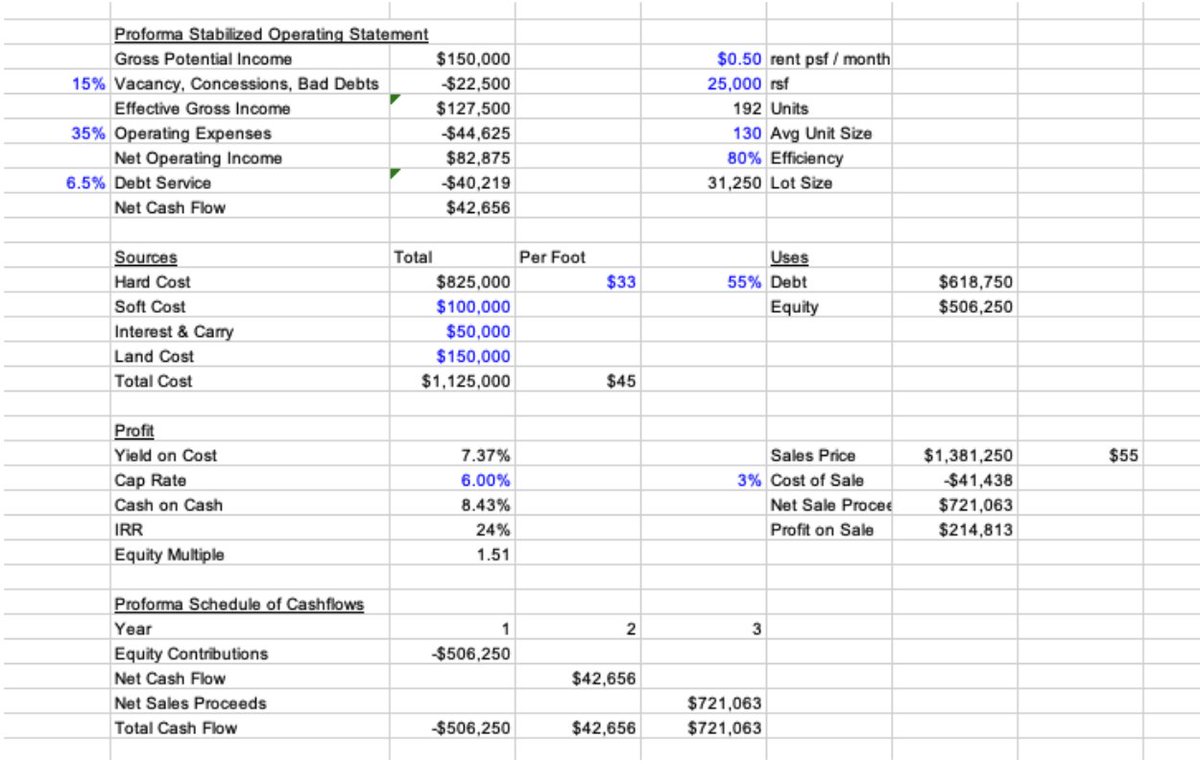
Shane Mason tweet media
English
34
102
1K
353.3K
Shane Mason
Shane Mason@DeveloperDude_·
@LA_Multi_Fam This is clipping out of context In the same interview she says LA needs more market rate housing
English
0
0
1
49
Paul
Paul@LA_Multi_Fam·
I am actually curious what Yimby’s have to say about these Raman ULA statements? One of the main arguments for Raman was that she saw the light with how bad ULA was, and she was going to fight to repeal it?
Justin Gordon@Justin_G0rd0n

Not sure what’s worse, Nithya going on Hasan Piker’s show, or promoting her support of ULA as a housing production measure when it has literally destroyed new development. I have no idea how ANY YIMBY can support her.

English
19
3
51
6.2K
Shane Mason
Shane Mason@DeveloperDude_·
Does you or someone you know need a place to stay in LA for the next 4-6 weeks? I have a 1 br available for $500 / week. DM if interested.
English
0
0
1
246
Brian Armstrong
Brian Armstrong@brian_armstrong·
This is an email I sent earlier today to all employees at Coinbase: Team, Today I’ve made the difficult decision to reduce the size of Coinbase by ~14%. I want to walk you through why we're doing this now, what it means for those affected, and how this positions us for the future. Why now Two forces are converging at the same time. We need to be front footed to respond to both. First, the market. Coinbase is well-capitalized, has diversified revenue streams, and is well-positioned to weather any storm. Crypto is also on the verge of the next wave of adoption, with stablecoins, prediction markets, tokenization, and more taking off. However, our business is still volatile from quarter to quarter. While we've managed through that cyclicality many times before and come out stronger on the other side, we’re currently in a down market and need to adjust our cost structure now so that we emerge from this period leaner, faster, and more efficient for our next phase of growth. Second, AI is changing how we work. Over the past year, I’ve watched engineers use AI to ship in days what used to take a team weeks. Non-technical teams are now shipping production code and many of our workflows are being automated. The pace of what's possible with a small, focused team has changed dramatically, and it's accelerating every day. All of this has led us to an inflection point, not just for Coinbase, but for every company. The biggest risk now is not taking action. We are adjusting early and deliberately to rebuild Coinbase to be lean, fast, and AI-native. We need to return to the speed and focus of our startup founding, with AI at our core. What this means To get there, we are not just reducing headcount and cutting costs, we’re fundamentally changing how we operate: rebuilding Coinbase as an intelligence, with humans around the edge aligning it. What does this mean in practice? - Fewer layers, faster decisions: We are flattening our org structure to 5 layers max below CEO/COO. Layers slow things down and create coordination tax. The future is small, high context teams that can move quickly. Leaders will own much more, with as many as 15+ direct reports. Fewer layers also means a leaner cost structure that is built to perform through all market cycles. - No pure managers: Every leader at Coinbase must also be a strong and active individual contributor. Managers should be like player-coaches, getting their hands dirty alongside their teams. - AI-native pods: We’ll be concentrating around AI-native talent who can manage fleets of agents to drive outsized impact. We’ll also be experimenting with reduced pod sizes, including “one person teams” with engineers, designers, and product managers all in one role. In short: AI is bringing a profound shift in how companies operate, and we’re reshaping Coinbase to lead in this new era. This is a new way of working, and we need to leverage AI across every facet of our jobs. To those who are affected I know there are real people behind these decisions — talented colleagues who have poured themselves into this company and our mission. To those of you who will be leaving: thank you. You’ve helped build Coinbase into what it is today, and I am sincerely grateful for everything you've done. All impacted team members will receive an email to their personal account in the next hour with more information, and an invitation to meet with an HRBP and a senior leader in your organization. Coinbase system access has been removed today. I know this feels sudden and harsh, but it is the only responsible choice given our duty to protect customer information. To those affected, we will be providing a comprehensive package to support you through this transition. US employees will receive a minimum of 16 weeks base pay (plus 2 weeks per year worked), their next equity vest, and 6 months of COBRA. Employees on a work visa will get extra transition support. Those outside of the US will receive similar support, based on local factors and subject to any consultation requirements. Coinbase prides itself on talent density. Our employees are among the most talented people in the world, and I have no doubt that your skills and experience will be highly sought after as you pursue your next chapters. How we move forward To the team that is staying, I know this is a difficult day. We’re saying goodbye to colleagues and friends you've been in the trenches with. But here’s what I want you to know as we move forward together: Over the past 13 years, we have weathered four crypto winters, gone public, and built the most trusted platform in our industry. We’ve made it this far by making hard decisions and by always staying focused on our mission. This time will be no different – nothing has changed about the long term outlook of our company or industry. And most importantly, our mission has never been more important for the world. Increasing economic freedom requires a new financial system, and we’re building it. The Coinbase that emerges from this will be more capable than ever to achieve our mission. Brian
English
5.3K
2.4K
20K
23.5M
Jordan Ross
Jordan Ross@jordan_ross_8F·
The agencies who installed OpenClaw two months ago are running their teams while their founder is on a beach. The problem is most operators don't have time to figure out the install, the security setup, or which workflows actually save time vs which look like time savers. So my team built the operator's playbook. Inside: — 35 ops automations that pay back in week one — The morning brief that replaces the first hour of your day — 11 security fixes the founder won't think to ask about — The client KPI report agent that runs while you sleep — Plus the April 2026 stack: Mission Control, Trust-Meter Kanban, Single Brain Your competitors are sleeping on this. Comment OPERATE and I'll send it
Rohan Paul@rohanpaul_ai

OpenClaw creator Peter Steinberger talks about how China is going all-in for AI agents and OpenClaw. "In China, installing OpenClaw is called raising lobsters. Thousands of people were lining up at the Tencent office in Shenzhen to get their lobster installed. Shenzhen even gives out subsidies for people running businesses on OpenClaw. Now, if you install OpenAIClaw on your work machine (in many other parts of the world), at least with the default settings, you might get fired. And then I met an entrepreneur in China who showed me a spreadsheet. Every employee, every day, one task automated by OpenClaw. If you miss too many days, you're fired. So, fired for using it, fired for not using it." --- From official 'TED' YT channel (link in comment)

English
174
14
161
30.3K
Shane Mason
Shane Mason@DeveloperDude_·
@robbiehendricks Pursuit costs are real! Good on you for not throwing good money after bad.
English
1
0
1
31
Robbie Hendricks
Robbie Hendricks@robbiehendricks·
To be clear, I am not whining here. This is the cost of doing business if you are going to try something new. We have gotten an unbelievable education as a result of this process. And we will be plenty ready to build the next time it makes sense.
English
2
0
17
1.8K
Boring Local SEO
Boring Local SEO@boringlocalseo·
okay let me get this straight. in 2026, if you own a local service business: 1. 47% of your potential customers are now asking an ai model "who should i call" instead of typing "plumber near me" into google. (pew research, march 2026) 2. the ai models aren't pulling from google ads. they're pulling from comparison content, reddit threads, and honest blog posts. your $3k/mo google ads spend contributes ZERO to ai citations. 3. homeadvisor's stock is down 71% over 2 years. angi's restructuring. thumbtack just laid off 23% of staff. the lead-reselling business is imploding in real time. 4. meanwhile chatgpt has 800M weekly users. perplexity just crossed 50M. gemini is the default on every android phone. google ai overview now appears on 87% of local search queries. 5. the local business owners WINNING right now have one thing in common: they wrote honest comparison content. "best X in city" listicles. "real pricing for Y" pages. "when should you use Z vs alternative" guides. 6. the ones LOSING are still buying leads, still running the same google ads they've run since 2018, still thinking "seo" means backlinks and meta descriptions. 7. the gap between these two groups is compounding fast. every week that passes, the ai-cited businesses eat more market share. every week the lead-buyers get worse ROI. this is what's keeping me up at night: most local business owners don't even know this shift is happening. they're going to wake up in 18 months, their homeadvisor leads will cost $120/each (shared with 8 companies), their google ads CPC will have doubled, and a competitor who spent $0 on ads will own every ai recommendation in their city. the worst part is the fix is SIMPLE. one honest listicle. one pricing transparency page. 3-5 helpful reddit comments. track citations at localrank.so. iterate. that's it. that's the whole thing. nobody is doing it because "seo" got a bad reputation in 2020 and most business owners have ptsd from agency promises. but this isn't seo. this is just being honest in public. Comment "LOCALRANK" if you want my LLM citation framework and I'll DM it to you (Must be following)
Boring Local SEO tweet media
English
131
10
222
25K
Jordan Ross
Jordan Ross@jordan_ross_8F·
The agency owners who figure out Hermes in the next 90 days are going to look like geniuses in 2027. The problem is most agency owners don't have time to figure out the install, where to start, or what to actually hand it first. So my team built an 83-page playbook that does it for you. Inside: — The 5 daily prompts that turn it into a second brain — Plain English setup for Mac, Linux, and Android — How to lock it down without torching client data — 8 copy-paste workflows across reporting, outreach, sales, and ops — The cron trick that drops token spend by 90% Your competitors are sleeping on this. Comment HERMES and I'll send it.
GREG ISENBERG@gregisenberg

how to set up hermes agent step by step. built-in memory, 40+ tools, works on your phone, and what to think of hermes vs openclaw: 1. hermes is a personal AI agent that runs in your terminal. think of it like open claw but with built-in memory, 40+ tools out of the box, and 90% cheaper token costs. you install it with one command. 2. the 3 problems with open claw that hermes solves: no memory (you keep repeating yourself), constant gateway restarts, and zero visibility into what you're spending on tokens. 3. hermes remembers everything. every completed task gets saved to memory. it searches through past logs to find solutions. over time it literally gets smarter at your specific workflows. 4. connect it to open router. you see exact costs per model per task. free models rotate weekly. one founder went from $130 every five days on open claw to $10 on hermes. same output. 5. it comes preloaded with skills. apple notes, imessage, find my, browser, web search, image generation, cron jobs. no hunting for plugins. 6. connect it to obsidian so it reads your entire vault. connect it to gstack for your dev environment. create custom skills for your specific workflows. 7. the biggest money saver: have it write code once for recurring tasks. then it runs without burning tokens every time. stop paying an LLM to do the same scrape or report daily. 8. run it on android via telegram. name your agents. talk to them like coworkers. in this episode imran shows you how to set this up. 9. you can run it bare metal, in docker, or serverless on modal. pick your risk level. i begged @imranye to come on @startupideaspod and walk through the full installation live. he made it impossibly clear. if you've heard of Hermes Agent and want the clearest explanation of how to get set up like a pro let me know what you want me to cover on the next ep this is the best personal agent setup video on the internet right now. watch

English
814
91
1.1K
192.2K
Sander Saar
Sander Saar@sandersaar·
Simple: Claude Cowork with Dispatch (control from your phone Claude app, able to use any tools, apps, web, also Claude Code on Mac Mini) Better: Hermes (or Openclaw) with Opus 4.7 & Kimi 2.6 (better memory, skill dev, controls, no limits on scheduled tasks/crons, extendable)
English
1
0
4
2K
John Palmer
John Palmer@johnpalmer·
alright this Mac Mini has been sitting in my desk doing nothing for a month now. if i set it up from scratch today, what agent setup should i go with?
English
24
1
59
23.6K
Shane Mason
Shane Mason@DeveloperDude_·
@gordonliao @MonetSupply Aaves numbers are misleading. My friend and I pulled a lot of usdc out this morning despite it showing 100% utilization. It was dumb luck, only skill was moving fast So if anyone feels trapped, know there’s a way out
English
0
0
0
77
Gordon Liao
Gordon Liao@gordonliao·
Aave's stablecoin lending pools are at 100% utilization for ~3 days. Billions withdrawn. LPs can't exit. Borrow won't budge. This isn't the rsETH hack spreading. It's a governance-set rate ceiling like price control, a market failure coded in Solidity. 🧵 1/
Gordon Liao tweet media
English
11
15
90
33.2K
Shane Mason
Shane Mason@DeveloperDude_·
@gordonliao Thanks for the reply If all the stables are loaned out, how could they repay more than just the loans outstanding? Feels like a lot of stable coin net asset positions are worthless until utilization goes back down
English
0
0
0
26
Gordon Liao
Gordon Liao@gordonliao·
@DeveloperDude_ Liquidation price of the supply asset isn’t the discount though. My read is that there are sufficient eth-linked stakes to cover losses
English
1
0
1
57
Gordon Liao
Gordon Liao@gordonliao·
Btw, this purely personal view that I’m sharing in the spirit of open discussion and debate in DeFi to strengthen the ecosystem. Pls let me know if I’m incorrect in my analysis or want to discuss. Aave and other lending protocols work as intended. In this case, it’s not a run as some have suggested rather it’s a much more innocuous case of possible parameter adjustment needs
Gordon Liao@gordonliao

Aave's stablecoin lending pools are at 100% utilization for ~3 days. Billions withdrawn. LPs can't exit. Borrow won't budge. This isn't the rsETH hack spreading. It's a governance-set rate ceiling like price control, a market failure coded in Solidity. 🧵 1/

English
2
0
12
2.1K
Shane Mason
Shane Mason@DeveloperDude_·
@gordonliao Makes sense. Aave should raise rates to lower debt and increase supply.
English
0
0
1
31
Gordon Liao
Gordon Liao@gordonliao·
A cap on rate, set by committee, enforced by code, producing excess demand and rationed supply — that's the same structure as rent control or any other price control. Same welfare properties. Same failure mode. 3/
Gordon Liao tweet media
English
2
0
4
1.6K
Shane Mason
Shane Mason@DeveloperDude_·
@gordonliao Question for you: Aave says 200mm bad debt There is 2bn USDC supplied at 100% util Borrows against USDC are supposed liquidate at 78% utili Therefore, wouldn't Aave need 2bn / 78% = ~2.5bn in supplies in order to make suppliers whole?
English
0
0
0
54
Gordon Liao
Gordon Liao@gordonliao·
Happy to dig into specific curves or parameter spaces with anyone working on this in the onchain borrow/lend space. The market clearing issue is solved at the mech design and microstructure level. 14/14
Gordon Liao tweet media
English
4
0
1
1K
Umbrella
Umbrella@umbrella_uni·
@gordonliao There is no market failure. Protocol working as intended. You can withdraw hence why pool is dropping
English
2
0
0
688
Robdog 🍾
Robdog 🍾@robdogeth·
17/ Aave bad debt hinges on Kelp's reconciliation path. Under pro-rata socialization, every rsETH takes -16%; Aave's ~$31M leg is absorbed by Umbrella's $50M tranche. Under L2 isolation, mainnet is whole and L2 wrsETH eats ~$280M. Either way, WETH depositors don't wear it.
English
2
0
5
239
Robdog 🍾
Robdog 🍾@robdogeth·
1/ 🧵 $292M of rsETH — was drained from @KelpDAO's @LayerZero_Core bridge in a single forged message. 48 hours later, $13B of DeFi TVL had walked out the door whilst it remains unclear where the losses actually will land. Let's unpack the ecosystem impact.
English
8
6
24
6.4K
Alton Syn
Alton Syn@WorkflowWhisper·
what's in the pdf: → 1-question discovery script → 6 copy-paste workflow prompts → pricing guide by complexity → live demo script (closes 7/10) → 5-min MCP setup comment "CUBAN" to grab it. synta(.)io
English
112
1
28
4.3K
Alton Syn
Alton Syn@WorkflowWhisper·
mark cuban just laid out the exact playbook for making money with AI agents. pick one vertical. learn the flows. become the AI team they never hired. he's right. but he left out the how. i've been doing this for 3 months. here's what it actually looks like: week 1: i called 12 local businesses and asked one question. "what's the most annoying part of your day?" the pool company: "we lose 11 jobs a week because nobody follows up cancellations." the PT clinic: "insurance verification takes 3 hours every morning." the cleaning company: "we quote in 2 days. our competitor quotes in 2 hours." week 2: i built every single one of those workflows. → pool company cancellation recovery - 6 min → PT clinic insurance verification - 11 min → cleaning company instant quote generator - 7 min → dog groomer appointment + waitlist manager - 9 min → pest control follow-up sequence - 4 min average build time: 7.4 minutes. average close rate when you build it live in front of them: 70%. week 3: $10,750 upfront + $1,200/mo recurring. zero proposals. zero decks. zero "let me get back to you." they watched it work. they paid on the spot. cuban said "you don't need a CS degree or VC money." he's right. you need one question, one tool, and the willingness to build it in front of them. i documented the entire framework in a free PDF: → the 1-question discovery script (word for word) → 6 copy-paste workflow prompts by industry → pricing guide (what to charge per workflow type) → the live demo script that closes 7 out of 10 → full MCP setup walkthrough (5 min install) comment "CUBAN" and i'll send it. consultants charge $15K for a discovery workshop. i just gave you the playbook for free. synta(.)io - describe the workflow in plain english. it builds, deploys, and fixes itself. (must be following for DM)
Alton Syn tweet media
English
1.1K
141
1.4K
123.4K
Noah Frydberg | Tiktok Shop For Brands
Nano Banana + Manus + Arcads + OpenClaw = ai content factory. We built a fully automated system that repurposes, localizes, and launches winning TikTok Shop content across hundreds of creator-style accounts. It’s so effective it feels like running Facebook ads in 2008. - CPMs as low as $0.10 - no reliance on paid ads - no ghost creators - no wasted samples - no lost time The $300/monthly tech stack which replaced $50k+ budget: - manus for product research and viral script ideas - cruva for recently viral content ideas from competitors - Arc Ads for images - Arc Ads for video - phone posting network for automated posting Here’s how it works: •Each AI Agent spins up a TikTok Shop–ready creator avatar and profile, built to sell my products through shoppable videos. •Agents are prompted to research the niche, scrape winning TikTok Shop videos, and rebuild them with new hooks, angles, and UGC-style visuals tailored to the brand. Content focus is on the product’s benefits, not fake customer testimonials. •They create and post daily using my tech stack onto the affiliate accounts No touchpoints. No delays. Just shoppable videos going live and GMV compounding every week. Then we use an MPS (Multi-Platform Swarm) approach: once the concept works, we deploy hundreds of AI Agents to flood the niche with variations that all drive back to the Shop and Amazon listing. I’m giving you access to the full stack — the ai workflow, ready to plug into your TikTok Shop today. Comment “Workflow” and I’ll send you everything. (must be connected) PS – Repost for early access to the full TikTok Shop content factory system.
Noah Frydberg | Tiktok Shop For Brands tweet media
English
475
147
1.1K
154K
Shane Mason
Shane Mason@DeveloperDude_·
@JohnJBlatchford 500 units in 11 months? It takes 21 months to build 50 units in Berkeley CA, after all of the necessary permits and entitlements have been obtained
English
0
0
1
61
John Blatchford
John Blatchford@JohnJBlatchford·
People outside of real estate don't realize that construction is already efficient. You can build a stick-frame house in a few weeks. You can build a 500-unit apartment building in less than a year. What takes a long time is everything before construction starts.
Farzad 🇺🇸 🇮🇷@farzyness

I think housing/real estate is going to be a terrible asset for the next 20 years as AI/automation makes building homes insanely easy/efficient. Pair this with a falling birthrate, and the demand for homes relative to supply will massively shrink. NFA.

English
135
233
4.6K
217.6K