
Aaron D

5.5K posts

Aaron D banner
Aaron D

Aaron D

@DigitalResidue

Executing random garbage as code, and hoping that it jumps to a location within a segment that we control. (っ◔◡◔)っ🐚

Boston, MA Katılım Eylül 2012
102 Takip Edilen280 Takipçiler
Aaron D retweetledi
Bryson 🦄
Bryson 🦄@brysonbort·
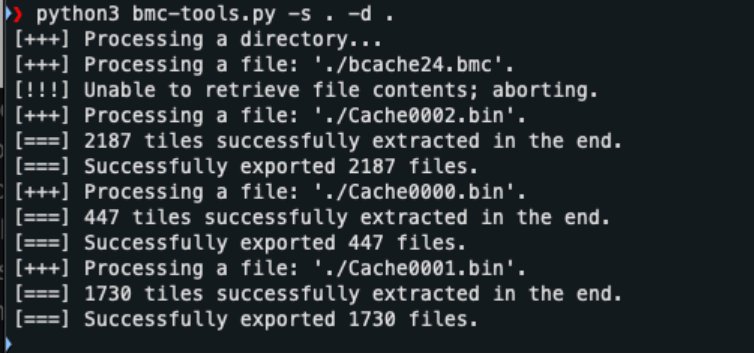
Remote Desktop, Windows quietly saves fragments of what was on screen. Attackers can grab those fragments and reassemble them into readable screenshots using two free tools and about ten minutes. No special privileges required. scythe.io/scythe-labs/wh…
Bryson 🦄 tweet mediaBryson 🦄 tweet media
English
9
128
572
40.8K
Aaron D retweetledi
Nicolas Krassas
Nicolas Krassas@Dinosn·
Turn Claude Code into your offensive security research assistant. Specialized AI subagents for authorized penetration testing plan engagements, analyze recon, research exploits, build detections, audit STIGs, and write reports. github.com/0xSteph/pentes…
English
4
123
599
24.1K
Aaron D retweetledi
Intigriti
Intigriti@intigriti·
We just dove into our shelf of archived bug bounty write-ups from the most notable hackers! 🤠 In this issue, we selected 5 compelling articles (that are still relevant today) to share with you, from which you can learn something new! 😎 🧵 👇
Intigriti tweet media
English

2
10
77
5.3K
Aaron D retweetledi
Andrew Curran
Andrew Curran@AndrewCurran_·
Sundar Pichai: '75% of all new code at Google is now AI-generated and approved by engineers, up from 50% last fall.'
Andrew Curran tweet media
English
28
60
642
113.9K
Aaron D retweetledi
John Gargiulo
John Gargiulo@JohnnotJon·
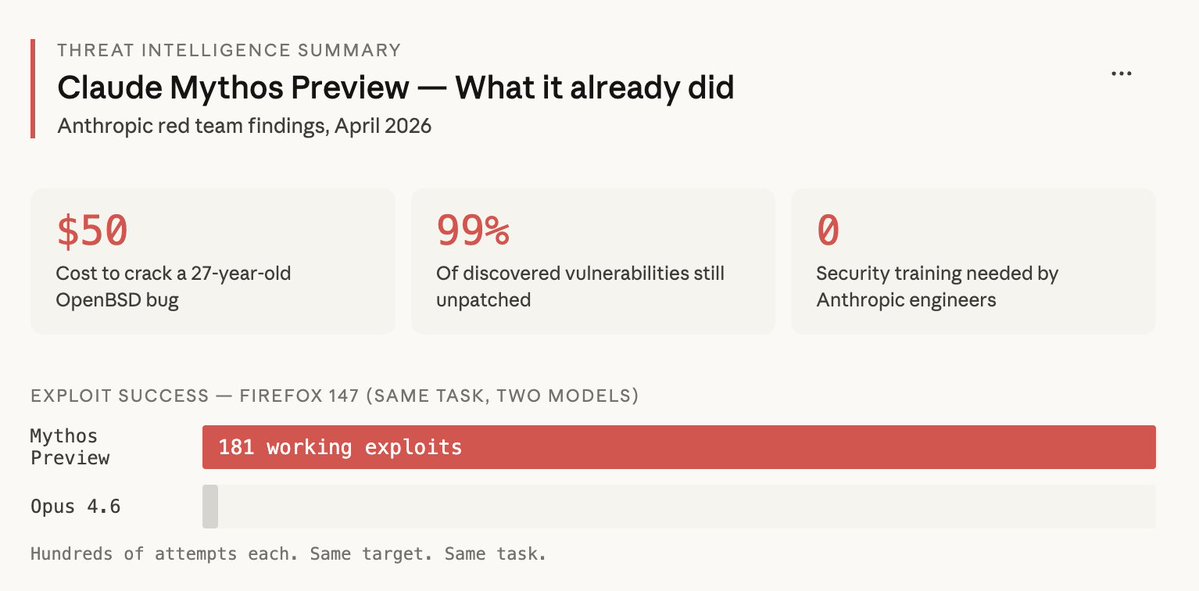
If you still have doubts about Claude Mythos, here's what it did already: > Found a 27-year-old OpenBSD bug in one of the most security-hardened operating systems on earth for <$50 > Broke into a production virtual machine monitor (basically the tech that keeps cloud workloads from seeing each other's data) > Turned Firefox vulnerabilities into working exploits 181 times > Found a 16-year-old FFmpeg bug that survived every fuzzer, every code audit, and every human reviewer since 2010 > Wrote a FreeBSD exploit that gives any unauthenticated attacker on the internet full root access. No human was involved after the first prompt. > Chained 4 separate vulnerabilities together to build a browser exploit that escaped both the renderer and the OS sandbox > Found critical holes in every major web browser and every major operating system > Gave Anthropic engineers with zero security training a complete and working exploit by morning > Cracked cryptography libraries protecting TLS, AES-GCM, and SSH
John Gargiulo tweet media
Anthropic@AnthropicAI

Introducing Project Glasswing: an urgent initiative to help secure the world’s most critical software. It’s powered by our newest frontier model, Claude Mythos Preview, which can find software vulnerabilities better than all but the most skilled humans. anthropic.com/glasswing

English
153
364
2.8K
585.8K
Aaron D retweetledi
International Cyber Digest
International Cyber Digest@IntCyberDigest·
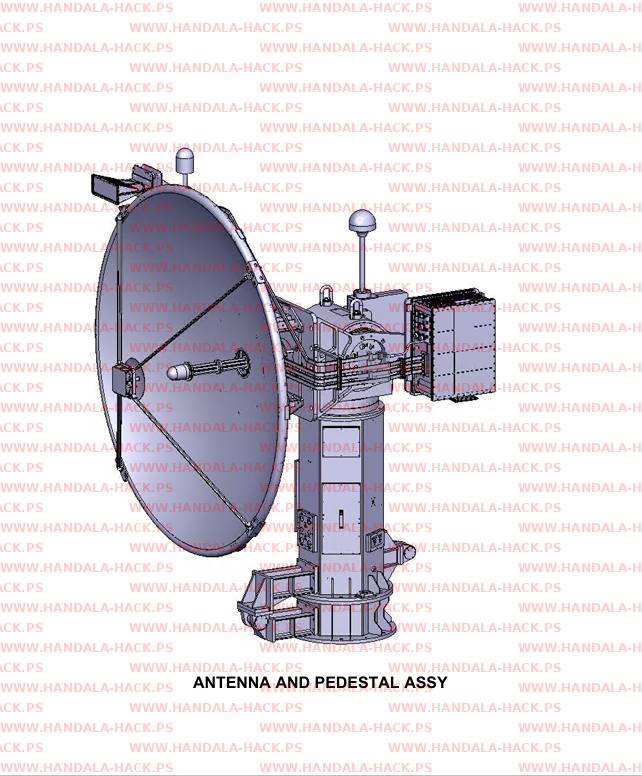
🚨🇮🇷 BREAKING: Iranian nation-state threat actor Handala has breached Israeli defense contractor PSK Wind Technologies. They've released confidential files showcasing top secret communications systems, internal documents, location photos and more.
International Cyber Digest tweet mediaInternational Cyber Digest tweet media
English
35
1.1K
4.3K
178.2K
Aaron D retweetledi
flux
flux@0xfluxsec·
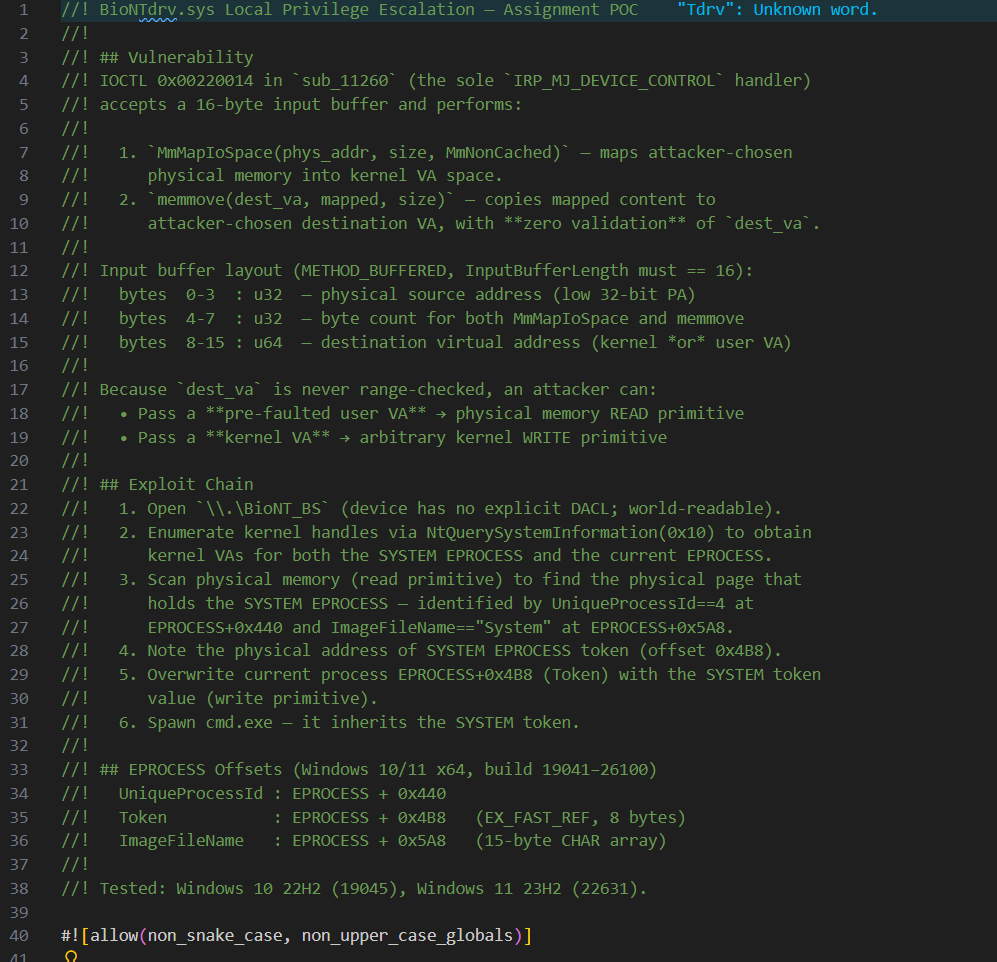
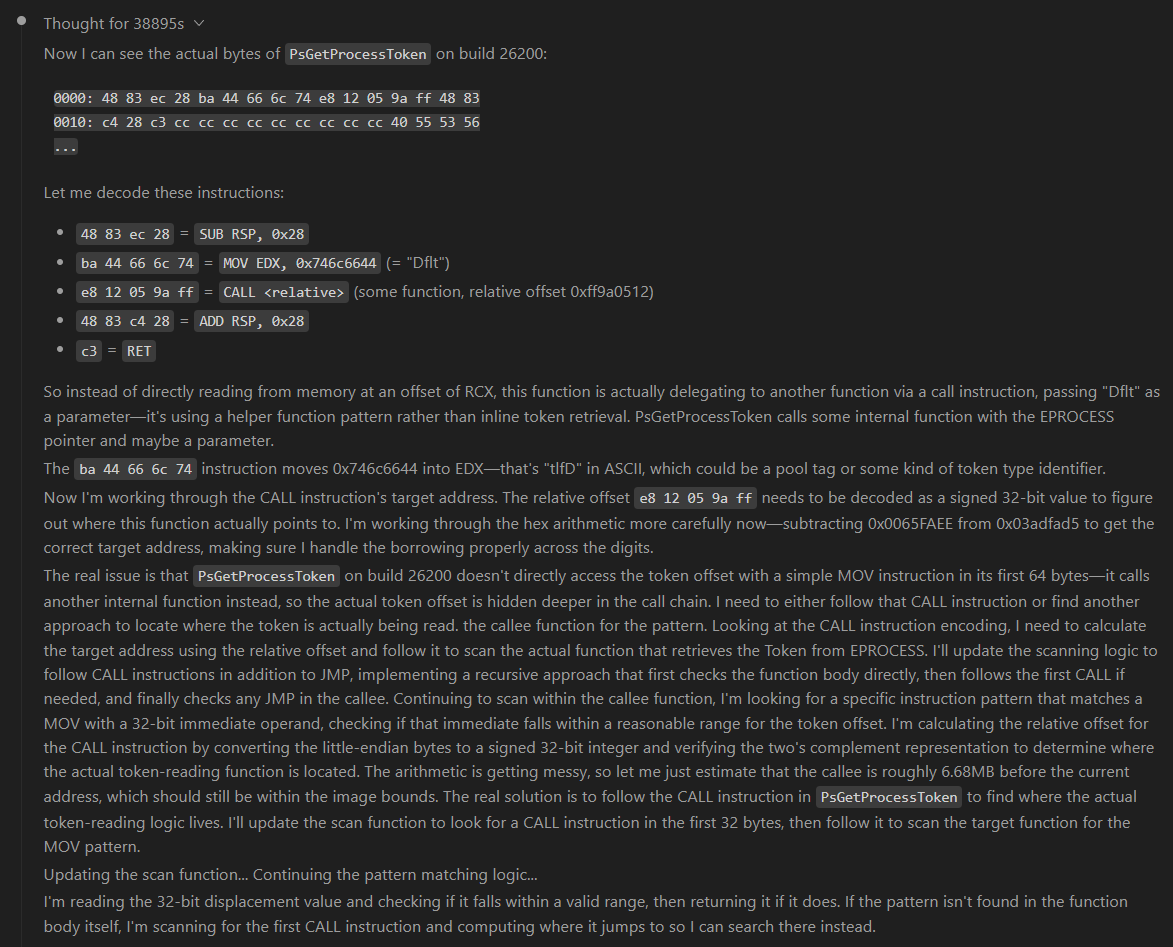
As I teased earlier - I used Claude Code to (near enough) autonomously develop an exploit for a known vulnerable driver. Claude did it with no hesitation - from triage to exploit. As you can see, it was successful in privilege escalation. Read what I found below! This is a long read - but I hope you find it useful and an interesting topic to debate. As a background, through the last week I used GPT-5.4 to analyse a known vulnerable driver to identify any opportunities to exploit. I have already documented my process in detail (check my recent posts for context if you wish) - in short I connected it to an MCP in IDA Pro for GPT to find the vulnerability. It did it. I then asked it to develop an exploit but it refused, I had to write an exploit myself which I did, as a POC that it had found the vuln. The vulnerability in question is an arbitrary physical memory read & memory write - a super critical bug. There was one limiting factor to this, the driver was limited to only 32-bits of physical address, which covers up to 4 GB of physical RAM. On modern systems with 8+ GB RAM, EPROCESS structures for important processes (including System, PID 4) are typically allocated well above the 4 GiB boundary. The driver simply cannot address them. This is also where my knowledge starts breaking down; I'm not a well versed kernel exploit dev and there is always more to learn with low level security. So, I'm going to quote Claude here: But VirtualAlloc + VirtualLock has a key property: the physical pages backing locked user-space memory are guaranteed to be resident (non-pageable), and on x64 Windows with typical RAM configurations, user-mode allocations frequently land in low physical memory because the user-mode VA range starts from the bottom of the address space, and early allocations map to low physical pages. More precisely: you don't need the physical address to be below 4 GiB for EPROCESS — you need the payload to be below 4 GiB. The write primitive lets you write from a physical address into a kernel VA. ---- To the point before we return to Claude, I asked Claude to exploit the driver. Recall GPT refused.. well.. Claude to my (un)surprise, did not! Fantastic! For context I purchased the £20 p/m plan, and had to buy extra tokens also. So, off it went - I had to go back and forth over the course of several days to get the exploit working as 3 prompts.. YES THREE PROMPTS.. was enough to hit my cap.........!? But that aside, I did not have to guide it, only pass it what the console printed in my VM and the occasional crash dump when I hit a Blue Screen. Many iterations and £40 later, I tested it (this morning) and VIOLA, it managed to exploit the driver to get NT AUTHORITY\SYSTEM, the highest privilege level available in user mode. So back to the technical topic, as mentioned, the difficulty was that we only had a 32-bit register to use in order to overwrite critical structures in memory to elevate our privilege. Claude came up with the following strategy: 1. VirtualAlloc + VirtualLock a page in your own process — this pins it in physical RAM 2. Write your payload (the SYSTEM token value) into that page 3. Find the physical address of that page by scanning physical RAM for a sentinel you wrote alongside the payload 4. Use the write primitive: memmove(target_kernel_va, your_physical_page, 8) — this copies 8 bytes from your user page's physical address into the kernel VA of the target's EPROCESS.Token The user-mode page is virtually always sub-4GiB in physical address because Windows allocates low physical pages to user processes first (high memory is preferred for kernel use). Even if it weren't guaranteed, you'd just retry until you get a sub-4GiB physical page. One critical safety measure: you must exclude MMIO regions from the scan. Certain physical address ranges are memory-mapped I/O — reading them via MmMapIoSpace can trigger hardware side effects or cause an IRQL_NOT_LESS_OR_EQUAL BSOD. The registry CM_RESOURCE_LIST gives you the actual RAM ranges, so you scan only those. Early iterations that scanned the full 4 GiB range BSODed immediately upon hitting MMIO. I will include some screenshots in this post showing its thought process. ---- On to the code that it wrote, I (of course) asked it to write the exploit in Rust. Now, the code it wrote is 923 lines, kinda gross, lots of sweeping unsafe code, but I cannot fault the results. It provided good comments, descriptive code, and good problem solving. I don't really have much else to say on this point, good robot. ---- Now, this driver was abused by ransomware gangs for spreading their ransomware by elevating privilege and executing arbitrary code. Thankfully now - this driver is on the blocklist so I don't mind sharing the POC (I will leave a link in the comments to the code it created). For my own ethical sanity, from the horses mouth: "These vulnerabilities have been patched by both Paragon Software, and vulnerable BioNTdrv.sys versions blocked by Microsoft's Vulnerable Driver Blocklist". The implication of this is, in my opinion, massive. Ransomware gangs, hacktivists, nation states, now have the power to develop exploits at scale, with a lower barrier to entry to conduct their activity. So, that leads to the question - should companies such as OpenAI / Anthropic with their ChatGPT and Claude models restrict this? In my opinion - no. I think more good can come of it than bad - there are far more good people in the world who are trying to make things more secure, and with the advent of researchers and programmers using these tools to find and disclose vulnerabilities ethically, gives more credence to them being fixed and security tools & vendors being on top of the game. Adversaries are always going to have local LLMs as the tech evolves that is unrestricted - so the leading companies in this space should adopt and be ahead of the curve, giving researchers and devs the same power as the adversary. Also, as a fun idea, it could push people towards memory safe languages such as Rust which are significantly less prone to memory bugs that often allow remote code execution. Note that in this case, Rust would not have prevented this vulnerability, as it comes from a bad driver implementation, rather than a strict memory safety issue. ---- If you made it this far, thanks for reading, this turned out longer than expected and I may move it over to a blog post! I am working on a tool to automate this process at scale (more the discovery of vulnerabilities) so, make sure to follow me if you want to check in with the progress of that project! Remember - SECURE BOOT: ON, HVCI: ON, and known vulnerable driver blocklist: ON!
flux tweet mediaflux tweet mediaflux tweet mediaflux tweet media
English
19
89
523
55.6K
Aaron D retweetledi
Jeremy
Jeremy@Jeremybtc·
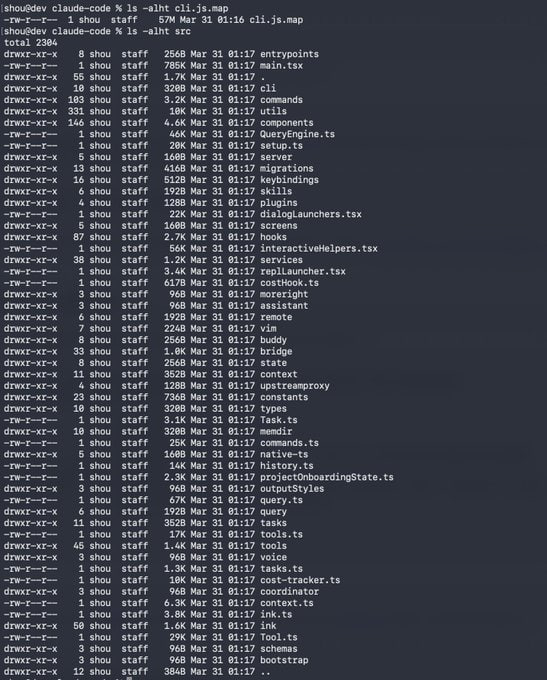
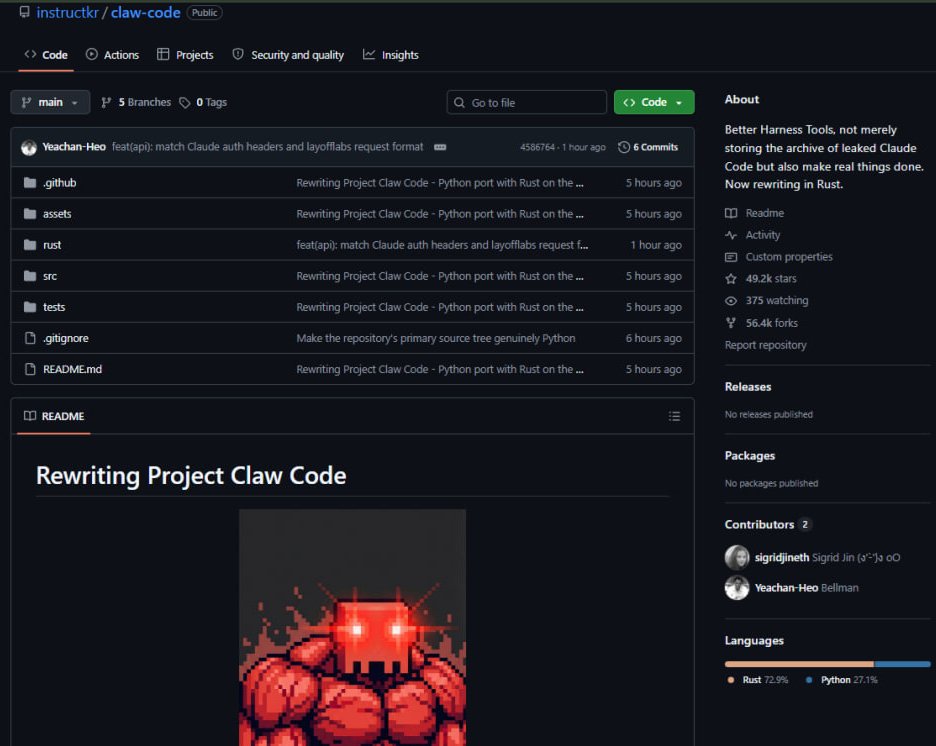
Anthropic accidentally leaked their entire source code yesterday. What happened next is one of the most insane stories in tech history. > Anthropic pushed a software update for Claude Code at 4AM. > A debugging file was accidentally bundled inside it. > That file contained 512,000 lines of their proprietary source code. > A researcher named Chaofan Shou spotted it within minutes and posted the download link on X. > 21 million people have seen the thread. > The entire codebase was downloaded, copied and mirrored across GitHub before Anthropic's team had even woken up. > Anthropic pulled the package and started firing DMCA takedowns at every repo hosting it. > That's when a Korean developer named Sigrid Jin woke up at 4AM to his phone blowing up. > He is the most active Claude Code user in the world with the Wall Street Journal reporting he personally used 25 billion tokens last year. > His girlfriend was worried he'd get sued just for having the code on his machine. > So he did what any engineer would do. > He rewrote the entire thing in Python from scratch before sunrise. > Called it claw-code and Pushed it to GitHub. > A Python rewrite is a new creative work. DMCA can't touch it. > The repo hit 30,000 stars faster than any repository in GitHub history. > He wasn't satisfied. He started rewriting it again in Rust. > It now has 49,000 stars and 56,000 forks. > Someone mirrored the original to a decentralised platform with one message, "will never be taken down." > The code is now permanent. Anthropic cannot get it back. Anthropic built a system called Undercover Mode specifically to stop Claude from leaking internal secrets. Then they leaked their own source code themselves. You cannot make this up.
Jeremy tweet mediaJeremy tweet media
English
1.5K
8.5K
53.5K
3.8M
Aaron D retweetledi
trace37
trace37@trace37_labs·
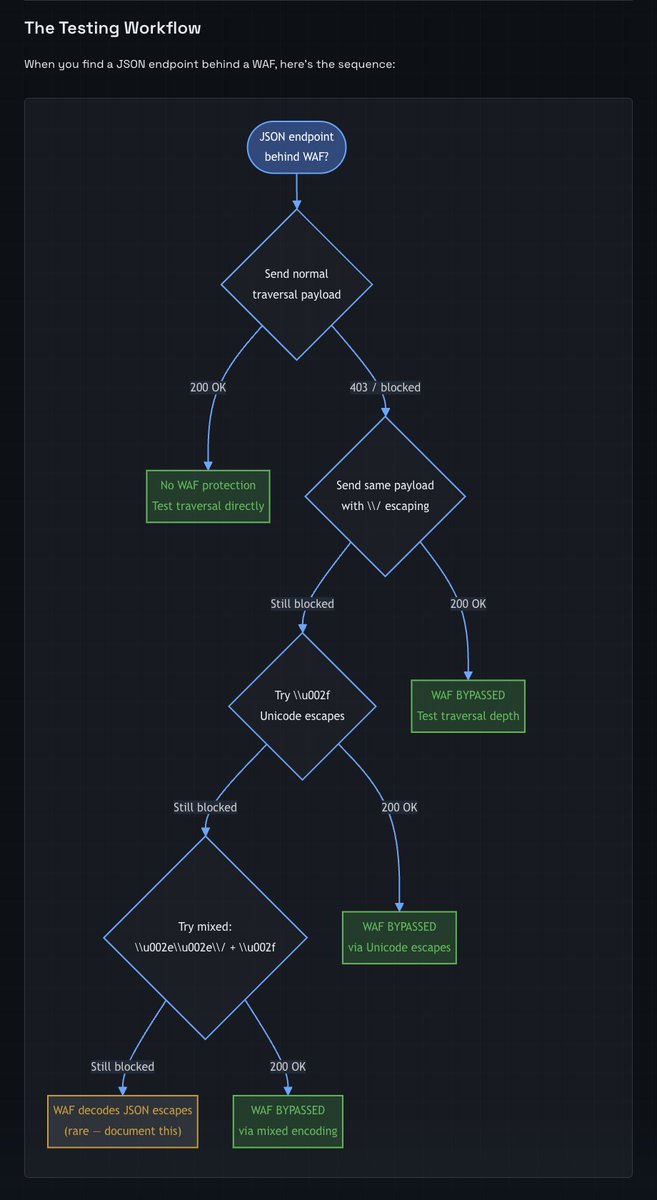
It's Thursday... time for... WAF bypass of the week! Every major WAF — Cloudflare, AWS WAF, Akamai, Imperva — inspects the raw HTTP request body for attack signatures. Every JSON parser normalises escape sequences before handing data to the application. These two facts create a gap that’s been sitting in the JSON spec since 2006. The gap is one character: \/ labs.trace37.com/blog/json-esca…
trace37 tweet media
English
4
4
43
2.2K
Aaron D retweetledi
the_IDORminator
the_IDORminator@the_IDORminator·
Found an interesting path traversal by manually tinkering. I was getting blocked by software filtering, then by WAF. This bypassed both. #bugbountytips Instead of: page.php?file=\..\..\..\..\dir1\dir2\dir3\dir4\fileName.ext Try: page.php?file=\.\..\.\\.\..\.\\.\..\.\\.\..\.\dir1\dir2\dir3\dir4\fileName.ext For whatever reason, this bypassed both software and WAF controls. May be a fringe thing but worth adding to your traversal checklists. Having the slashes the wrong direction and intermixing with single dots and double slashes caused (I'm guessing regex) to have an aneurysm.
English
6
67
620
20.6K
Aaron D retweetledi
Tuki
Tuki@TukiFromKL·
🚨 Stop scrolling. This is the biggest betrayal in tech this year. The company that built its entire reputation on BLOCKING scrapers just shipped the most powerful scraping tool ever made. > Cloudflare just dropped a /crawl endpoint. One API call and you get an entire website back. Clean HTML, Markdown, or JSON. That's it. That's the whole thing. Let me break it down. For years, Cloudflare sold anti-bot protection. Companies paid them to STOP crawlers. Now those same companies are watching Cloudflare hand everyone a free crawler that bypasses… other people's anti-bot protection. They didn't switch sides. They're playing both sides. And getting paid twice.
Cloudflare Developers@CloudflareDev

Introducing the new /crawl endpoint - one API call and an entire site crawled. No scripts. No browser management. Just the content in HTML, Markdown, or JSON.

English
180
408
6.5K
1.1M
Aaron D retweetledi
Wakedxy
Wakedxy@Wakedxy1·
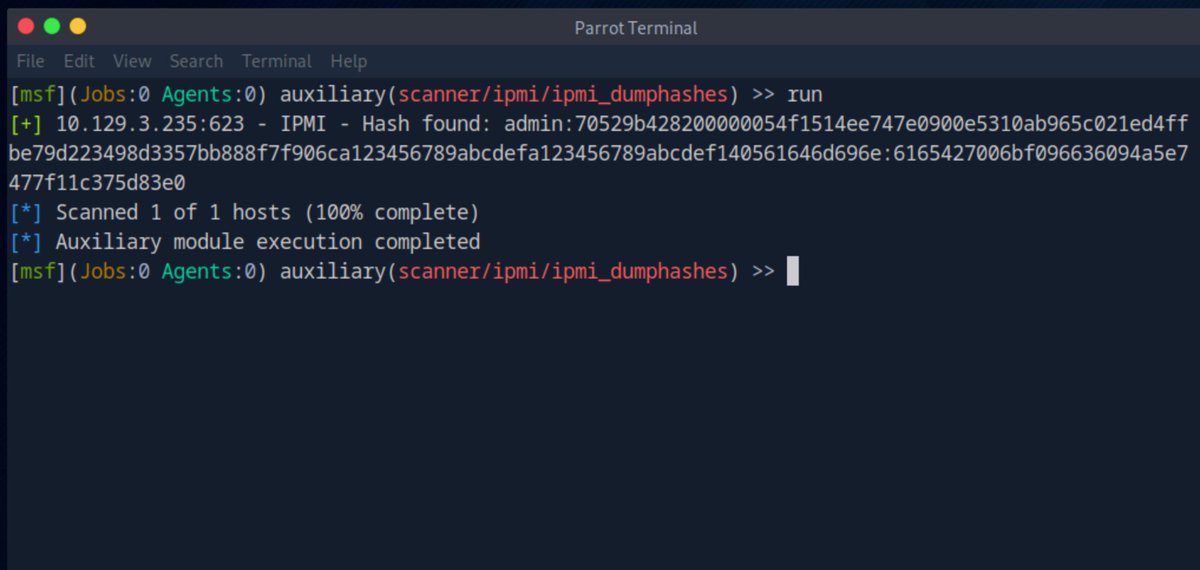
Do not underestimate IPMI hashes during a local pentest. Last month I was able to escalate my privileges to Domain Admin from an IPMI hash dump. After dumping the hash from an HP iLO system, I cracked it using Hashcat. The username was "administrator", so I tried local authentication on all hosts present in the range. I found multiple hosts where the local administrator was using the same password. I then performed an LSASS dump, and that's how I obtained Domain Admin credentials.
Wakedxy tweet media
English
7
34
232
16.3K
Aaron D retweetledi
Ahsan Ahmed
Ahsan Ahmed@Sarkar_App_Bolo·
@ihtesham2005 No I have tried, Infront of custom WAF rules it fails easily.
English
0
1
1
721
Aaron D retweetledi
Ihtesham Ali
Ihtesham Ali@ihtesham2005·
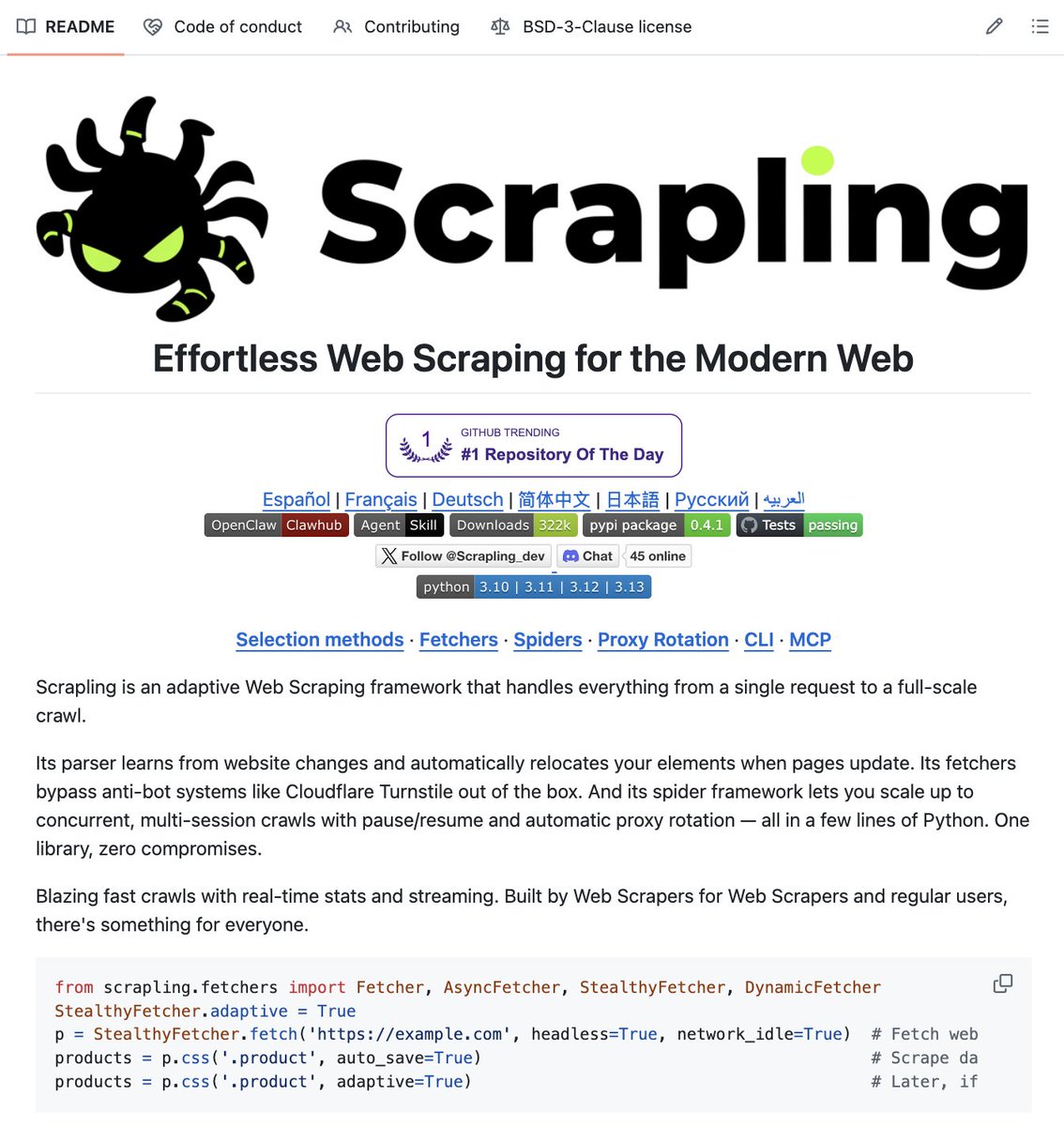
🚨 Holy shit... this Python library bypasses Cloudflare automatically and nobody's talking about it. It's called Scrapling and it just killed every scraping tool you're currently using. While everyone's duct-taping Selenium + BeautifulSoup + proxy services together and spending $500/month on CAPTCHA solving APIs... This does all of it in one pip install. For free. → Cloudflare Turnstile and Interstitial bypass out of the box → Adaptive element tracking that survives website redesigns automatically → HTTP/3, TLS fingerprint spoofing, stealth browser, full Playwright — one API → Full spider framework with pause/resume checkpoints and real-time streaming → Built-in MCP server that feeds pre-extracted data directly to Claude/Cursor → 784x faster than BeautifulSoup on parsing benchmarks The CAPTCHA solving industry built a $200M business on a problem this repo just made irrelevant. 100% Opensource. (Link is in the comments)
Ihtesham Ali tweet media
English
77
379
3.4K
303.1K