

Dimitri van der Linden
70 posts


🧵🧵🧵 Lots of people talking about assortative mating, wherein people choose mates who are similar to themselves on specific traits or overall desirability.
Less well-known is that people who are desirable on one trait (eg intelligence) also tend to be higher on other desirable traits (eg kindness).
Even less well known is that assortative mating CAUSES desirable traits to be correlated in the population over evolutionary time.
🧵Assortative Mating & the Evolution of Desirability Covariation🧵
1/

English
@SteveStuWill That pattern is very often found with outcome variables (e.g., job performance, social succes). The question is why would five presumably independent traits consistently show this specific pattern. The General Factor of Personality (GFP) seems a plausible explanation.
English

“Personality predicts occupational success. Conscientiousness is the strongest predictor... Extraversion, agreeableness, and openness are also positively correlated with occupational success, whereas neuroticism is negatively correlated with it.” stevestewartwilliams.com/p/12-things-ev…
English
@jz_psych @AndrKerber1 Thanks for sharing. Nice study....but, uh..not a single reference to the GFP? :0)
English

Examining the role of personality functioning in a hierarchical taxonomy of psychopathology using two years of ambulatory assessed data (N = 27,173). @AndrKerber1 et al. nature.com/articles/s4139…
English

I don't often share personal news, but this is one I can't keep to myself. I'm absolutely over the moon to announce the birth of my grandson, Hugo Addis Zwaan, earlier today. I can't wait to start this new adventure as a granddad to this already wonderful little person!
English
A recent article on Flow in the Guardian, that also discusses our work on this topic. Together with @Doria59054590 and @ProfABBakker .
theguardian.com/science/articl…
English
@SteveStuWill That seems like a function of the General Factor of Personality, which indeed is correlated with well-being in such a way.
English
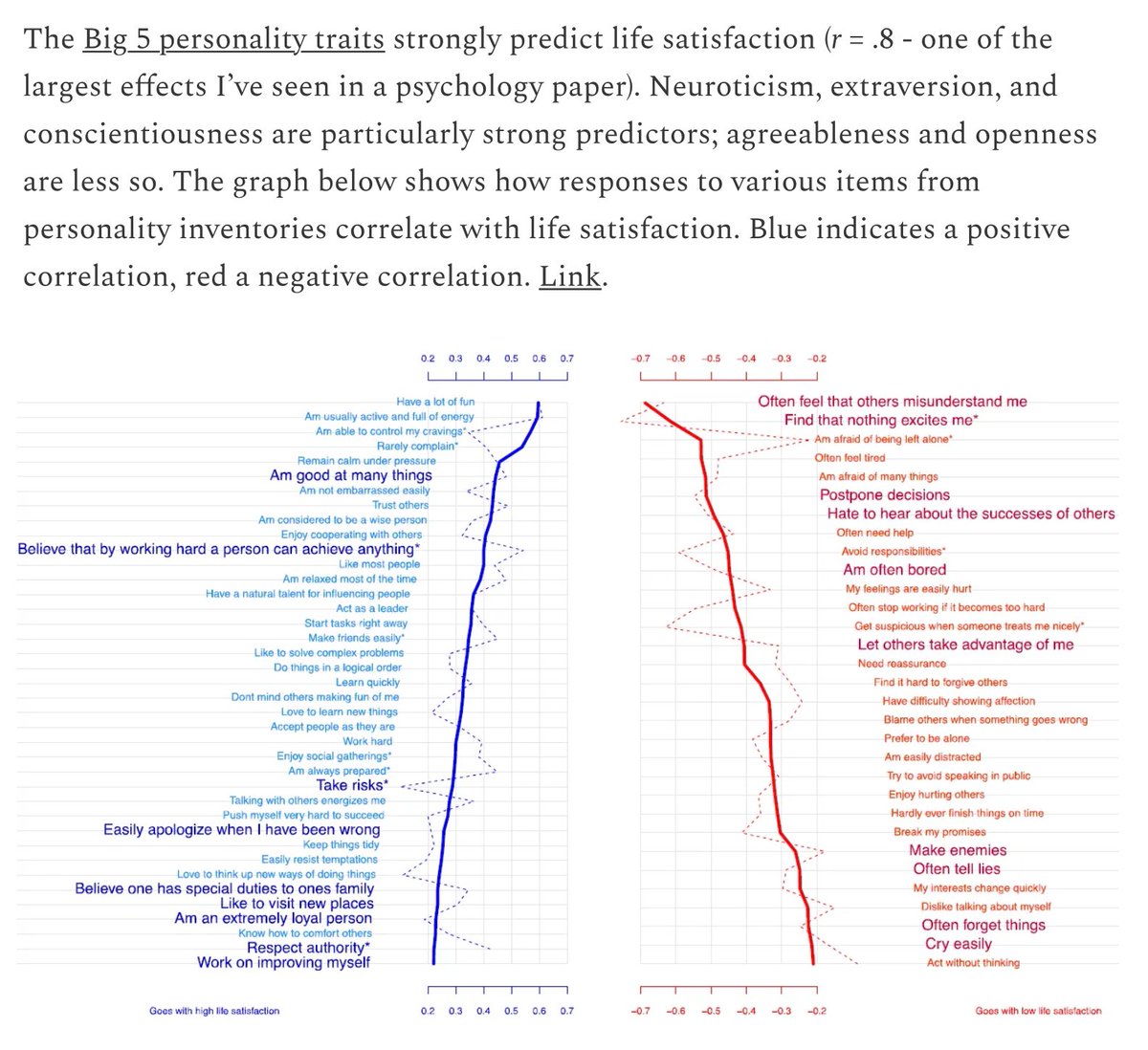
The Big 5 personality traits strongly predict life satisfaction (r = .8 - one of the largest effects I’ve seen in a psychology paper). stevestewartwilliams.com/p/5-new-findin…
English
@DeBie_Hendrik @giladfeldman @ugent I like the idea. It is somewhat a return to the 'old' system in which departments could hire a PhD student every couple of years.
English
@julianetzel @wille_bart Great work! Here is a also paper that provides an additionele way to look at personality and vocational interest:
link.springer.com/article/10.100…
English

🚨 PREPRINT ALERT 🚨
After 4-5 years of work, I am happy to share a preprint of what is my proudest achievement to this day. It entails everything I have learned over the past 10 years and more...
osf.io/preprints/psya…
English
@erikbij Yes, the old literature on fatigue is fantastic. They really did a lot of nice work then.
English
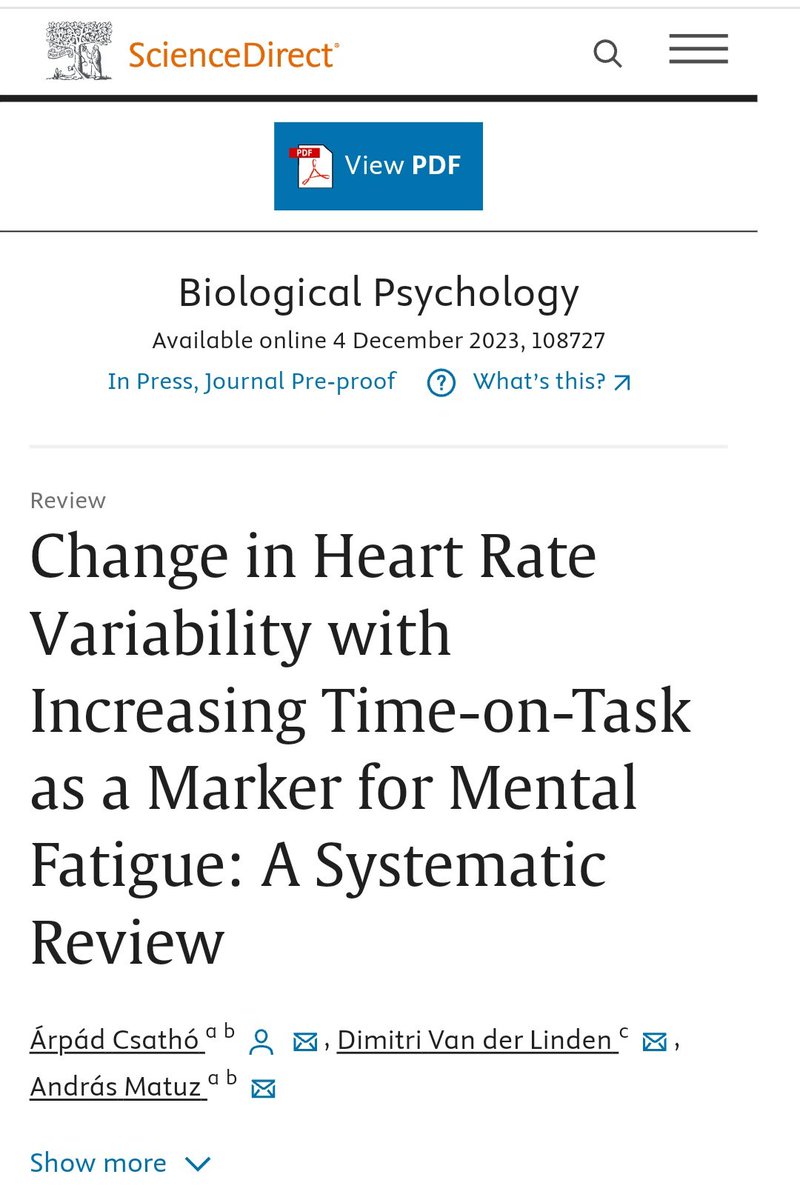
Our review on heart rate variability in mental fatigue is now online in Biological Psychology.
With Arpad Csatho and Andras Matuz.
doi.org/10.1016/j.biop…
English
@SpencrGreenberg Was there a Dunning-Kruger effect?
English

In a study we ran, we asked people if they'd ever taken a commercial/professional IQ test, and if so, if they remembered their score, and if "yes," what their score was. We then measured their IQ ourselves. Guess how accurate or inaccurate their reported numbers were...
🧵
English
@cremieuxrecueil GFP no? Are you sure?
link.springer.com/article/10.100…
English
When someone proposes a new general factor, they should try to see if there's any twin or genomic data available to check if etiological factors match up with the proposed phenotypic model.
For
- GFP: no
- d: no
- p: no
- g: yes!
If causal evidence came first, we'd see fewer!
Eiko Fried@EikoFried
Wrote brief letter explaining why claims in recent World Psychiatry (WP) letter in which authors used bifactor model to "discover existence of d-factor" don't follow. Given this was a letter, WP didn't published my letter. Thoughts on where to send this? psyarxiv.com/47avw
English
@paulg @cremieuxrecueil See this one for the relationship between personality (GFP) and creativity:
#d=gs_qabs&t=1688918153799&u=%23p%3DYppuDo4Jru0J" target="_blank" rel="nofollow noopener">scholar.google.com/scholar?hl=nl&…
English
So much for the concept of the moody creative genius. One of the strongest correlations in this huge study is the *negative* correlation between creativity and "uneven temper." (via @cremieuxrecueil)

English
English
Dimitri van der Linden retweetledi

Very excited to start this project in collaboration with several international experts including Susanne Becker (Düsseldorf), Dimitri van der Linden @Dimitri_329 (Rotterdam), and Nicolas Silvestrini (Geneva)!
English
Dimitri van der Linden retweetledi
Great news 🥳🥂! Our research project exploring the role of effort in the effects of pain on cognitive functioning was funded by @FWOVlaanderen. Looking forward to work on this with a fantastic team of collaborators: @Dimitri_329, Susanne Becker, and Nicolas Silvestrini.
English


Reviewer 2 just reviewed my paper on narcissism as a paper on 'neuroticism'. How's your day going?
English
@gmiller Yes, probably true to a large extent as a very low GFP relates to all kinds of problems. Although the GFP has a broader range as it also includes positive or, at least, social desirable traits.
English

@Dimitri_329 Not sure. To the extent that it looks like there's a GFP, it might be mostly tapping into the p factor (e.g. less adaptive subfactors of neuroticism, Introversion, disagreeableness). Haven't kept up on this debate in a few years though
English
In human intelligence, there's a 'g factor' that captures a lot of the positive correlations across cognitive abilities.
In mental health, there seems to be a 'p factor' that captures a lot of the positive correlations across psychopathologies (mental disorders).
Dr Christian Jarrett 🇺🇦@Psych_Writer
Fascinating, thought-provoking and deeply personal essay by @alexlariley about the p-factor concept - the idea that there is a shared vulnerability underlying many forms of mental illness aeon.co/essays/what-th… For @aeonmag
English