Dindingwe

340 posts

Dindingwe banner
Dindingwe

Dindingwe

@Dindingwe1

Katılım Kasım 2018
66 Takip Edilen47 Takipçiler
johnny.walker92
johnny.walker92@92JohnnyWalker·
@shumbakadzi_zim @wicknellchivayo Wicknell and ED are very clever. Bribe as many people as you can for their silence. Musicians, radio presenters, content creators - anyone you can get your hands on. Steal hundreds of millions, spend a couple thousands bribing All is fair in love and war
English
1
0
1
1.4K
Shumbakadzi👑
Shumbakadzi👑@shumbakadzi_zim·
Sir Wicknell @wicknellchivayo has given $2,000 loan to each of those 30 Capitalk FM workers who were asked to return money by Zimpapers. The loan will be interest free and payable over 10 years with a grace period of 5 years. This means they will only start paying him back in 2031 and their monthly installment will be 33 dollars for 10 years till 2036. Hanzi ma Sir loan yacho has no security required and no loan agreement will be signed. 🤣🤣🙌🏿🙌🏿🙌🏿 Muchabvuma chete #CA3 zvinhu
Shumbakadzi👑 tweet media
English
61
28
206
60.5K
Dindingwe
Dindingwe@Dindingwe1·
@matinyarare Right. U built the Kuda brand, U fought and ended sanctions. Do U even listen to Urself?
English
0
0
0
111
Rutendo Matinyarare
Rutendo Matinyarare@matinyarare·
Temba, I don’t hate Kuda, never have. Kuda has been good to me despite all the broken promises. In turn, I was the one person who built his brand when no one else would. When you were badmouthing him and asking me to reject him, I stood by him. I am the person who started pushing him as a potential future President of the country. I stood by him when I erroneously felt that he was being unfairly attacked by Geza. No one has more videos with higher views than me promoting Kuda; hence today he has become respected and not the disdained criminal he was portrayed to be by others. However, when I disagreed with how the CAB3 process was being pushed and didn’t agree with the cruelty of jailing, beating, and burning of the offices of those opposed to CAB3, and when I aired my view that this attempt to extend President Mnangagwa’s time in office in the manner they were doing, had the potential of ruining what the President, Kuda, and the nation builders were trying to build, Kuda sent threats to me through a mutual friend and got people like you and Kandishaya to attack me by saying I was trying to extort him. That’s Kuda attacking me and not the other way round. How do you say someone you owe money is trying to extort you? What kind of reputation assassination is that? I didn’t understand why he would attack me for merely disagreeing with a bad policy by the President that had the potential of affecting everything they were trying to build. I was just giving constructive advice and not attacking him, but he took it personally and attacked. I merely defended myself, I was vindicated yesterday when you saw Ramaphosa coming to echo exactly the same sentiments I aired—that this policy and the way the President and his advisors were going about things is a potential spark-point. There is still time for Kuda and the President to take uncomfortable advice and do the right thing to ensure their legacy is protect by doing what is right for Zimbabwe. Kuda has done well for himself and the country. He has made money, but that does not make him God to determine who fails and who succeeds. He might be your god and may determine your life, but he is not my God. Our destinies are determined by the God who blessed him, not Kuda. Finally, I saved Zimbabwe from sanctions. I did a greater job than most will ever do for Zimbabwe. The beneficiaries of that are the current President and people like Kuda. How then could I hate either when I have given them such great work? Even you have not done anything close to this for them, and you probably will never do anything at the same level. You have not built a better story around Kuda and Zimbabwe as I have. So how do you say I hate Kuda just because I differ with him on CAB3 and I am defending myself from his attacks? Kuda must learn that constructive criticism is not hatred.
Sabhuku Temba P. Mliswa@TembaMliswa

Do you hear that Sekuru. This man spoke about your kind long ago, success is about work and not focusing on your enemies. You are doing the opposite. You can't hate a man who has engineered his own success through hard work. You can't bring him down especially by throwing flimsy accusations that don't stick. Don King used to say "there is nothing like bad publicity, but what you must never do is say my name wrongly"! I hope you understand that. You are making the man bigger in your frenetic stampede to bring him down. We hold no brief to respond for him but will do so for any leader whose path enemies seek to cross. Focus on your work and stop being petty. Ndizvo tirikuti musaite kunge mukadzi arambwa!

English
9
10
29
17.2K
Dindingwe retweetledi
Murungu Asina Purazi 🔫🚶💣🇿🇼🇿🇦
Kana muroora achiti mwana wangu haha pihwe Zita ra Tezvara or Babamnini moti hahana hunhu, while all she's trying do is to save dzinza rese rive ne turning point 😂 🚶💣💥🔥
Filipino
15
53
210
31.1K
Dindingwe
Dindingwe@Dindingwe1·
@SandileMakeba Sean is Lt Colonel yet, you say ''Same rank of colonel''. Mini started in 1996 and 10 yrs later was Major. Sean in 2010 and made major in 12yrs. As you go higher it is harder to get a promotion which is why it's not everybody who becomes a general.
English
0
0
4
845
Zimbabwean-Xhosa 🇿🇼 🇲🇿
I don't understand how it took 4 years for Sean Mnangagwa to be promoted to Lieutenant Colonel, while Minnie Baloyi had to spend 20 years to reach the same rank of Colonel. Some spend decades in the barracks climbing the ladder, while others seem to have a VIP elevator.
Zimbabwean-Xhosa 🇿🇼 🇲🇿 tweet mediaZimbabwean-Xhosa 🇿🇼 🇲🇿 tweet media
English
41
57
302
27.1K
Dindingwe
Dindingwe@Dindingwe1·
@praisechox What U quoted is not int he constitution and used by propagandists to explain the clause emphatically in way they understand it
English
1
0
0
13
Praise Chekururama
Praise Chekururama@praisechox·
1/2 Prof Moyo, your distinction between "term length" and "term limit" is clever but it's propaganda, that's not what our Constitution says. Section 328(1) defines a term limit provision as ANY provision that "limits the length of time a person may hold office."....
Prof Jonathan Moyo@ProfJNMoyo

Debunking a Persistent and Dangerous Myth: Zimbabwe’s Constitution Contains Only One Presidential Term Limit Provision: In the intense public debate over the Constitution of Zimbabwe (Amendment No. 3) Bill, an utterly false claim is being repeated relentlessly and without a single shred of evidence: that the Constitution contains two separate presidential term limit provisions—sections 91(2) and 95(2)(b). This assertion is not merely incorrect; it is constitutionally impossible. No constitution anywhere in the world has ever created two distinct term limit provisions for the presidency. Section 95(2)(b) is not—and, according to the Constitution’s own crystal-clear definition in section 328(1), read with section 328(7), cannot possibly be—a term limit provision. A genuine presidential term limit provision restricts the total or maximum length of time any individual may hold or occupy the Office of President. Section 95(2)(b) does nothing of the sort. It simply defines the length of each presidential term as five years, running coterminous with the life of Parliament. In straightforward language, section 95(2)(b) regulates the office itself, not the person who holds it, and says absolutely nothing about how many terms or the length of time any one individual may serve. The Constitution of Zimbabwe (2013) contains only one term limit provision: Section 91(2). This clause is unequivocal and ironclad. It prohibits any person from serving more than two terms as President, with the vital safeguard that three or more years in office counts as a full term. It is only this single provision—and this provision alone—that actually limits the total time any individual can occupy the highest office in the land. Nothing illuminates this fundamental distinction more powerfully than comparative constitutional analysis—the gold standard for both public education and responsible policymaking. As the ancient wisdom has it, there is truly nothing new under the sun. A careful examination of proven global practice, vividly illustrated in the attached infographics, reveals three clear and time-tested approaches that nations around the world have taken when designing presidential term rules: Case 1 – Term length only (unlimited re-election permitted) Constitutions in this category have a single provision that simply defines the length of each presidential term, leaving the number of terms entirely open. This constitutional model operated successfully for decades—for example—in Botswana (31 years, 1966–1997), the United States (163 years, 1789–1951), and Zimbabwe itself (23 years, 1987–2013). Case 2 – Two separate provisions Here constitutions have two separate provisions: one that sets the length of each presidential term; and a second, entirely distinct clause that limits the total time any person may serve as President. This is precisely the framework that has—for example—operated in Botswana since 1997, South Africa since 1996, the United States since 1951, and Zimbabwe since 2013. The first infographic displays this clear separation of the two provisions across all the four countries. Case 3 – Combined in one elegant clause Constitutions in this category have a single constitutional provision that seamlessly merges both term limit concepts—defining term length while simultaneously imposing the limit. This approach has—for example— stood the test of time in Argentina (since 1994), Chile (since 1980), France (since 1958), Mexico (since 1917), the Philippines (since 1987), and South Korea (since 1987), as shown in the second infographic. The historical record is especially telling. Botswana introduced its separate term limit provision only after 31 years of independence, the United States after 163 years, and Zimbabwe after more than two decades of operating under a pure term-length provision. South Africa, by contrast, enshrined both provisions, separately, from the very first day of its democratic Constitution in 1996. These facts drive home an irrefutable truth: a provision that merely defines the length of a term has never been—and can never be—a term limit provision. The distinction is not a technicality; it is the bedrock of constitutional integrity. Recognising it clearly ensures that public discourse and debate on constitutional amendments is anchored in facts, logic, and proven international best practice, rather than convenient fiction to advance nefarious political agendas. Zimbabwe and Zimbabweans deserve nothing less!

English
12
7
19
3.7K
Dindingwe retweetledi
Caesar Zvayi 🇿🇼
Caesar Zvayi 🇿🇼@caesarzvayi·
ZVAVANHU . . . "vaMararike, tingati murungu munhu here?" . . . PLEASE RUN IT BACK
Caesar Zvayi 🇿🇼 tweet media
45
9
37
15.3K
Dandaro Online
Dandaro Online@DandaroOnline·
#dandaroupdates Businessman Wicknell Chivayo has pledged US$3.6 million to be distributed equally among Zimbabwe’s 360 legislators, with each MP and Senator set to receive US$10,000 for constituency development projects. Chivayo said the funds, to be handed to the Speaker of Parliament next week, must be used for community initiatives such as boreholes, markets, and sanitation, adding the donation is open to all legislators regardless of political affiliation. Follow Our WhatsApp Channel: whatsapp.com/channel/0029Va…
Dandaro Online tweet media
English
176
35
137
73.2K
Dindingwe
Dindingwe@Dindingwe1·
@hoe_ace @TsikaTinadzo Understandable wangu. U can't respect zvausingaze. Wakakura munhu wese airara naMama achinzi ndi Daddy ka. Zviriko wena
0
0
0
26
Ace Hoe
Ace Hoe@hoe_ace·
@TsikaTinadzo Shona ndeye kumama kana tazogara language ne tsika nemagariro zvese. It took me getting out of zim to see it clearly
English
1
0
3
374
Nyemudzai
Nyemudzai@TsikaTinadzo·
In Shona spirituality, your mother isn't your relative, you don't share a totem. On the surface it reads like pure patriarchy. The spiritual nuance is profound. It presents her as autonomous in your family structure. She has her own ancestral framework separate to yours.
#makeke@Dreadlockd_Diva

@SiboBero @clairenet11 Don't they also say amai mutorwa haisi hama yako

English
5
6
53
8.9K
Dindingwe
Dindingwe@Dindingwe1·
@mthulisi24 @TsikaTinadzo Bodo. Ichi chinyasarande baba. Mudzimu wekwamai haupotere pamwana weMkuwasha wausina ukama naye. Kupamba mwana wevaridzi
Polski
1
0
0
4
mthulisi 🇿🇼🇺🇦
mthulisi 🇿🇼🇺🇦@mthulisi24·
@TsikaTinadzo Surprisingly enough mbuya mai vababa kana kunoteketerwa zita ravo harisiiwi, then mudzimu wekwa mai unogona kutiza kunopotera kumwana wemukwasha esp kana hama dzaamai dzichiurayana
Suomi
1
0
1
265
Dindingwe
Dindingwe@Dindingwe1·
@RichyMachawira @BrianRupiya The process does not institute itself. A particular individual set it up. Are U generally obtuse or U are making an effort?
English
0
0
0
11
Brian T. Rupiya🇿🇼
Brian T. Rupiya🇿🇼@BrianRupiya·
Nelson Chamisa is CCC He owned CCC He presided over the final candidate selection Matsunga Susan &Hwende Charlton,among all,are his endorsements That's why after leaving CCC,he has done nothing Nelso,learn 2accept yo garbage u fostered on the nation Listen🎧 carefully👇
English
50
21
49
19.9K
Dindingwe
Dindingwe@Dindingwe1·
@RichyMachawira @BrianRupiya Doing it alone doesn’t mean personally vetting thousands of applicants; but a process run through proxies (kitchen cabinet) for structures. Sidelining party mechanisms replaces institutional vetting with personalised system where proxies favour loyalty over rigorous evaluation.
English
1
0
0
4
Chawilas.
Chawilas.@RichyMachawira·
@Dindingwe1 @BrianRupiya It doesn't matter that it was confirmed by whoever, the truth remains, not even in Pluto or Mars can one man do vetting to thousands of candidates alone. It's practically impossible, that's where my argument is sir.
English
1
0
0
16
Dindingwe
Dindingwe@Dindingwe1·
@RichyMachawira @BrianRupiya He said it himself, and several of his lieutenants confirmed it. There was no structure or formal body to carry out those tasks, which is why many of us believed him when he claimed to personally vet candidates. Why do you think he was lying?
English
1
0
0
6
Chawilas.
Chawilas.@RichyMachawira·
@Dindingwe1 @BrianRupiya Do you actually believe that narrative kuti he did vetting by himself. More than 300 representatives and more than 1 000 councilors vetted by one person? Varume ka I don't think it's possible. Every process have got it's flaws by kwete kuzoti one person vetted all candidates
English
1
0
0
17
Chawilas.
Chawilas.@RichyMachawira·
@BrianRupiya Politically he was charging his supporters for the work ahead. I don't see anything wrong with what he was saying. Analyze with clear conscience not with biased attitude Mr Brian.
English
2
1
4
196
Dindingwe
Dindingwe@Dindingwe1·
@kennethmtata @ProfJNMoyo There is no perfect system We keep making changes to improve what we have. I think CAB#3 is a force of good but I also think it needs a referendum. Not because that is the constitutional position but because it is politically sound to do so.
English
0
0
1
203
Rev Dr Kenneth Mtata
Rev Dr Kenneth Mtata@kennethmtata·
With respect @ProfJNMoyo, your response shifts the argument rather than answering it. My original point was not that direct election is “superior” because it is common, but that Mr Charamba’s claim—that indirect election is the global norm for executive presidents—is factually incorrect. That remains the case. These are the flaws in your argument 1. You are comparing different systems Your argument relies heavily on the United States and India, but both examples which actually reinforce my point: In the United States, the president is functionally directly elected. The Electoral College —not Congress—serve as a formal intermediary, but the vote is determined by citizens. In India, the president is ceremonial, while executive power lies with a Prime Minister in a parliamentary system. These are not equivalent to Zimbabwe’s system, where the president is both head of state and head of government with full executive authority. 2. The Commonwealth argument is misleading. You cite the Commonwealth of Nations as evidence of a “norm,” but this comparison is structurally flawed: Most Commonwealth countries (e.g. United Kingdom, Canada, Australia) are parliamentary systems, not presidential ones. In these systems, executive power comes from Parliament, not from a separately elected president. Therefore, the Commonwealth does not establish a norm about how executive presidents should be elected—because most of its members do not have executive presidents at all. 3. You are changing the question. The issue is not: “Which system produces better outcomes?” The issue is: What is the global norm for selecting powerful executive presidents? On that question, the comparative evidence is consistent: WHERE A PRESIDENT HOLDS INDEPENDENT EXECUTIVE AUTHORITY, THE DOMINANT MODEL IS DIRECT ELECTION. 4. On instability and African examples It is a serious analytical error to attribute electoral conflict in African countries primarily to direct presidential elections. Countries such as Ghana and Namibia have demonstrated relative electoral stability under direct presidential systems. Conversely, parliamentary systems are not inherently immune to instability. The issue is not the method of election, but: ☆ strength of institutions ☆ rule of law ☆ electoral integrity ☆ political culture Reducing complex political crises to electoral format alone is over-simplification. 5. Zimbabwe’s real constitutional question You correctly highlight Zimbabwe’s history since 1987. But that history points to a deeper issue: ☆ Concentration of power without sufficient checks and balances. Changing from direct to indirect election does not, by itself, resolve this. In fact, in a dominant-party context, it may simply shift power from voters to political elites within Parliament. 6. This core principle remains the central point: ☆ If executive power is concentrated in one office, democratic theory and global practice favour giving citizens a direct say in choosing that office-holder. If Zimbabwe wishes to move toward indirect election, that argument must be made honestly: ☆ It would require restructuring the system itself toward a parliamentary model, not selectively removing the people’s vote while retaining concentrated presidential power. Im view, your argument raises important concerns about stability and political culture. But it does not establish that indirect election is the “global norm” for executive presidencies, nor that it is a simple remedy for Zimbabwe’s challenges. The real choice is not between direct vs indirect election in isolation, but between different constitutional systems altogether. THE PEOPLE KNOW THEIR LEADERS!!
Prof Jonathan Moyo@ProfJNMoyo

With all due respect, @kennethmtata, your rejoinder misses the central point by a wide margin. Yes, direct election of executive presidents is indeed common across Africa, Latin America, and parts of Asia. But this is no recommendation. Popularity is not proof of excellency or superiority. It does not make the system more democratic, nor does it represent the purest application of universal adult suffrage [“one man one vote”] or the truest reflection of the people’s will. Far from it. Two compelling examples should give you pause: the oldest continuous democracy in the world, the United States, indirectly elects its president — a leader often regarded as one of the most powerful on earth. Likewise, the largest democracy on earth, India, selects its head of government through parliamentary processes. But it's best to set global examples aside. Zimbabwe must stop measuring itself against the troubled models of unstable regimes and dictatorships in Africa, Latin America and Asia. Instead, it should learn from its own past to shape a better future, while looking to the distinguished company it longs to rejoin: the Commonwealth of Nations. The Commonwealth has 56 sovereign member states. Of these, 34 nations — 61% — elect their head of the executive indirectly, through mature parliamentary systems where prime ministers or executive presidents rise from parliamentary majorities or party-list mandates. Only 20 (36%) rely on direct presidential elections, while just two (3%) are absolute monarchies with no elections whatsoever. Among the 34 countries with indirect systems, four are proudly African and Sadc member states: Botswana, Lesotho, Mauritius, and South Africa — three of which are shining examples of stability and democratic maturity on our continent and from our region. By contrast, 16 of the 20 direct-election countries are African: Cameroon, Gabon, Gambia, Ghana, Kenya, Malawi, Mozambique, Namibia, Nigeria, Rwanda, Seychelles, Sierra Leone, Tanzania, Togo, Uganda, and Zambia. Almost all of these 16 were born from one-man rule, one-party states — a legacy that locked in the high-stakes direct presidential election model. The results speak for themselves, and they are sobering. These 16 African Commonwealth nations have been repeatedly scarred by severe, violent, and chronically recurring election disputes. This is no coincidence. Direct presidential elections dramatically inflate the stakes in environments marked by fragile institutions, ethnic and regional divisions, deep polarisation, and sometimes foreign meddling. Zimbabwe, though still not back in the Commonwealth, has suffered exactly the same fate. This is the clear and undeniable reality: indirect election of the head of the executive is the settled norm across the Commonwealth — the very community Zimbabwe is striving to re-enter. An overwhelming 80–85% of the Commonwealth’s 2.6 billion people live under such systems, powered above all by India’s 1.4 billion citizens in its parliamentary republic, together with major nations like the UK, Canada, Australia, Bangladesh, and Pakistan. Only a small minority lives in Commonwealth countries with directly elected presidents. Your claim that Zimbabwe’s powerful executive presidency — operating under a full presidential system — demands direct election to secure democratic legitimacy is not only puzzling; it is flatly contradicted by the evidence and is therefore empirically false. From the very moment Zimbabwe’s executive presidency model was first enshrined in our Constitution in 1987— declaring that “the President takes precedence over all other persons” — it has delivered exactly the opposite of legitimacy: a never-ending cycle of bitterly disputed direct presidential elections, toxic ethnic mobilisation, and polarising politics that have locked the country into a perpetual election mode. The empirical record is overwhelming, unambiguous, indisputable and painful: direct election of the president has not worked for Zimbabwe and there are no signs that it will work. It is time to face these hard truths with courage and clarity, without being blinded by political expediency or the ephemeral and false politics of “good guys” in the echo chamber versus the stigmatised “bad guys” in office. Zimbabwe deserves better than a system that has too often divided and destabilised the nation. And Zimbabweans deserve institutions that deliver genuine, rational and legal legitimacy, scaffolded by the authentic will of the people with lasting peace and development. The Commonwealth’s proven norm and path — rooted in representative democracy, parliamentary accountability and indirect leadership selection — offers that wiser, more stable future in the national interest!

English
10
20
53
13.2K
TellZim News
TellZim News@TellZimbabwe·
Justice, Legal and Parliamentary Affairs Portfolio Committee Chairperson Edson Zvobgo Jnr has argued that the proposal in Constitutional Amendment Bill #3 calling for the President to be elected by Parliament was not foreign to Zimbabwe. He noted that similar systems are used to elect presidents in countries such as South Africa, Botswana, and the United Kingdom. Zvobgo Jnr challenged the double standard, saying it is acceptable when practiced by neighboring nations but criticized when Zimbabwe seeks to adopt the same approach. He was speaking at a press discussion held at Chevron Hotel yesterday (April 11), organised by the @MAZ_Zim Media Alliance of Zimbabwe in partnership with TellZim News. @ZUJOfficial @MoJLPA @DeptCommsZW @edmnangagwa @vamaunga @PKuzipa @zhrc365
English
46
5
17
16.3K
Dindingwe
Dindingwe@Dindingwe1·
@chakazt @ZiFMStereoNews ...and the health careers U claim take home $3K a month 'overseas' are owning houses? A shame X does not have the equivalent of skinning goats for those whose IQ is at the level of a door knob
English
1
0
0
30
チャカズ
チャカズ@chakazt·
@Dindingwe1 @ZiFMStereoNews Musanyebere kudzungaira bamunin. Can anyone dream of owning a house on these salaries? With my single digit IQ at least I know kuti neZanu hakuna kuri kuendwa ba
English
1
0
0
36
ZiFM Stereo News
ZiFM Stereo News@ZiFMStereoNews·
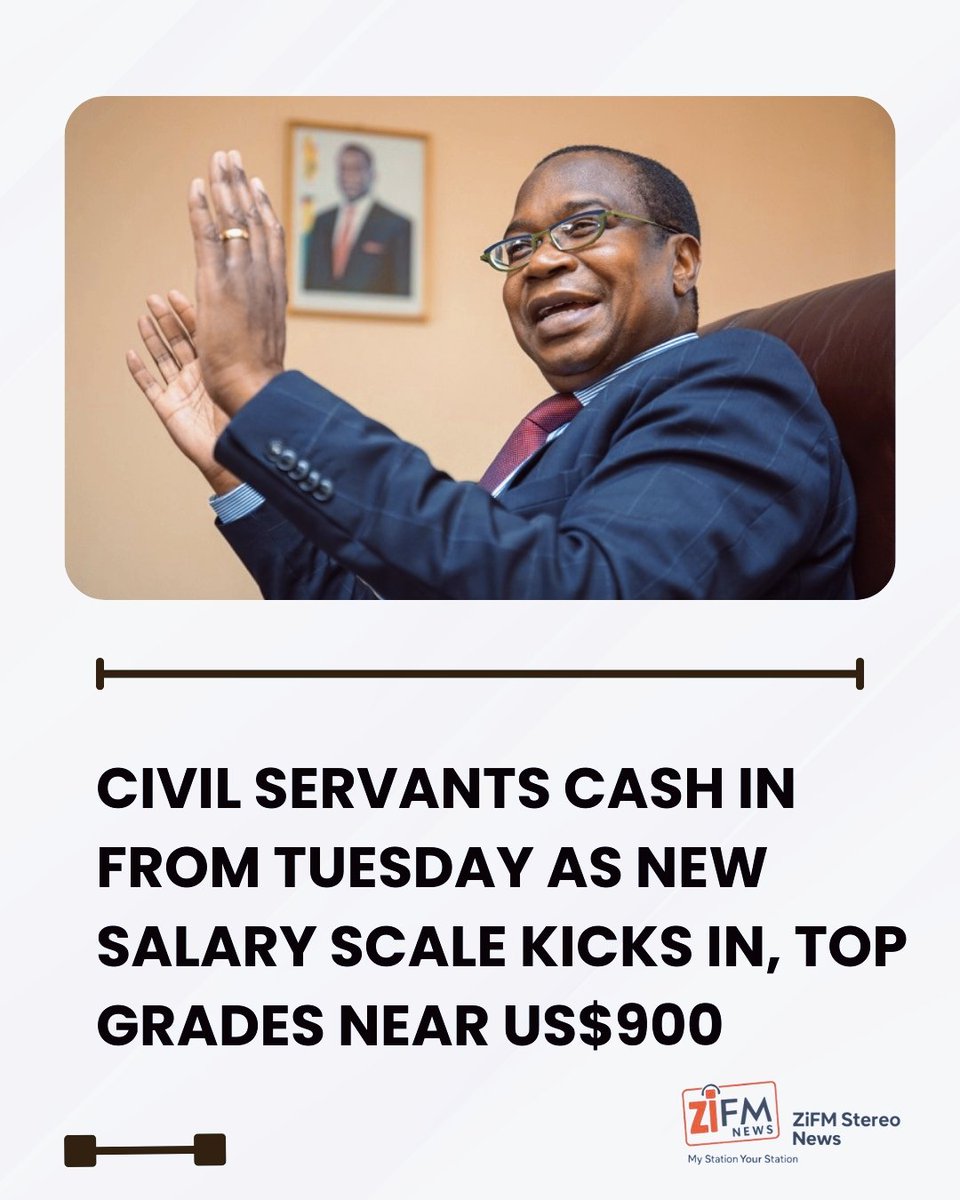
NEWS | Civil servants cash in from Tuesday as new salary scale kicks in, top grades near US$900 - HARARE –Civil servants are waking up to heavier pay packets from Tuesday, with uniformed forces first to receive the newly reviewed salaries under a sweeping government overhaul that instantly shifts earnings across the public service. The figures are turning heads, entry-level A3 workers now pulling in US$370 to US$375, B-grade salaries jumping up to US$435, while mid-tier C band climbs to US$536. At the top, senior D grades are now closing in on US$900, peaking at US$897. The payments arrive alongside ongoing economic measures, including efforts to strengthen the Zimbabwe Gold (ZiG) and existing support packages such as vehicle schemes and housing initiatives. Authorities say the review is driven by a job evaluation framework designed to match salaries with qualifications, skills, and responsibility, resetting the pay structure across all levels in one decisive rollout. – Sunday Mail — ZiFM Stereo News continues to provide dependable, fact-based reporting from Zimbabwe and beyond. Our newsroom remains committed to accuracy, objectivity, and timely updates, ensuring the public is informed with verified and relevant news as it happens. Follow the ZiFM Stereo News WhatsApp Channel: whatsapp.com/channel/0029Vb…
ZiFM Stereo News tweet media
English
62
14
84
76.4K
Dindingwe
Dindingwe@Dindingwe1·
@chakazt @ZiFMStereoNews There is rent and transport just as overseas, but it is a small fraction of what is paid there. Which is why salaries are lower in Zimbabwe. Ordinarily, I would not bother to explain, but I understand when something as simple as binary confuses a single-digit IQ individual
English
1
0
0
44