

0xSorcerer
17.8K posts

0xSorcerer
@DoDa1151
weaving codes & coins | nft spellcaster | conjuring alpha on-chain | magic of defi
Katılım Mayıs 2013
371 Takip Edilen334 Takipçiler



full roadmap
you just follow the signal trail.
Andreessen Horowitz has been quietly bull-posting privacy again, and yeah, they’re tied to @0xMiden .
that combo alone is worth pausing on.
here’s my thinking
privacy cycles don’t show up randomly. they show up when infra is finally ready.
compute gets faster, proofs get cheaper, and suddenly all the ideas that felt “too early” start clicking into place.
if that thesis holds, a long campaign isn’t a downside
it’s a filter.
four months means fewer tourists, more builders, more people actually paying attention instead of chasing quick points.
worst case? you spend time learning a serious stack.
best case? you’re early to a privacy layer that institutions and infra funds already care about.
not saying it’s guaranteed. nothing is.
but when capital, narrative, and timing line up even loosely, it’s usually worth taking the shot.
sometimes the real edge is just committing before it’s popular.

English
@hinkal_protocol @n_koreli This is huge for DeFi privacy
ZK + stealth addresses on EVM is the future
English

We cracked on-chain privacy... ⛓️💥
Multiple users. One address. Zero information leakage.
Our CTO, @n_koreli, presented the Hinkal wallet architecture at Devcon Argentina - Ethereum's flagship developer conference, breaking down the full Hinkal wallet architecture: ZK proofs, stealth addresses, and UTXO pools on EVM.
Enterprise-grade privacy that works seamlessly with any DeFi protocol.
"This is a normal transaction in Hinkal" - That's the point. Privacy by default.
🎙️ Watch him walk you through the magic:
English

MASSIVE BURN ALERT!
1,027,640 $DINO (that's 0.1% of total supply) just got scooped up and PERMANENTLY BURNED! 100% transparent transaction:
solscan.io/tx/4HpKtTAEX6n… don’t just talk — we deliver.
Since launch, we’ve torched ~143 MILLION $DINO — meaning 14.3% of total supply is gone forever! Supply keeps shrinking → upward price pressure keeps building.
The $DINO deflation engine is running at full throttle! If you’re still holding $DINO, you already know what time it is...
Dinosol@DinosolMeme
💵 Another 1,027,640 $DINO (0.1% of Total supply) was bought and burned. Proof here: solscan.io/tx/4HpKtTAEX6n… Consistency is the key. We have already burned ~143m $DINO (14.3%) since launch
English

Excited to launch Earn alongside early partners Upshift and Sentora.
@upshift_fi brings institutional-grade vault infrastructure. @SentoraHQ curates strategies for our BTC and stablecoin vaults.
Earn is embedded into the Tria account so funds stay liquid and ready for everyday use.
Upshift@upshift_fi
Let the people Earn. Upshift is the Earn provider for @useTria, a crypto neobank with the lowest fees across 150+ countries. Put your BTC and USDC to work.
English


@rabp2012 @SentientAGI fingerprint capacity at 24k is wild
will be there
English

okay, so here’s the sauce: @SentientAGI is wiring open-source AI to on-chain incentives
oml 1.0 fingerprints let you tag 24,576 keys inside a model, so builders can prove provenance, route agent payments, and keep usage loyal. pair it with ROMA multi-agent control and you get ai that plans, checks, and fixes long-horizon tasks on the GRID. open, verifiable, monetizable #Web3
ama with sandeep today 10am pt. drop your sharpest questions and come learn how creators actually get paid see you in discord

English

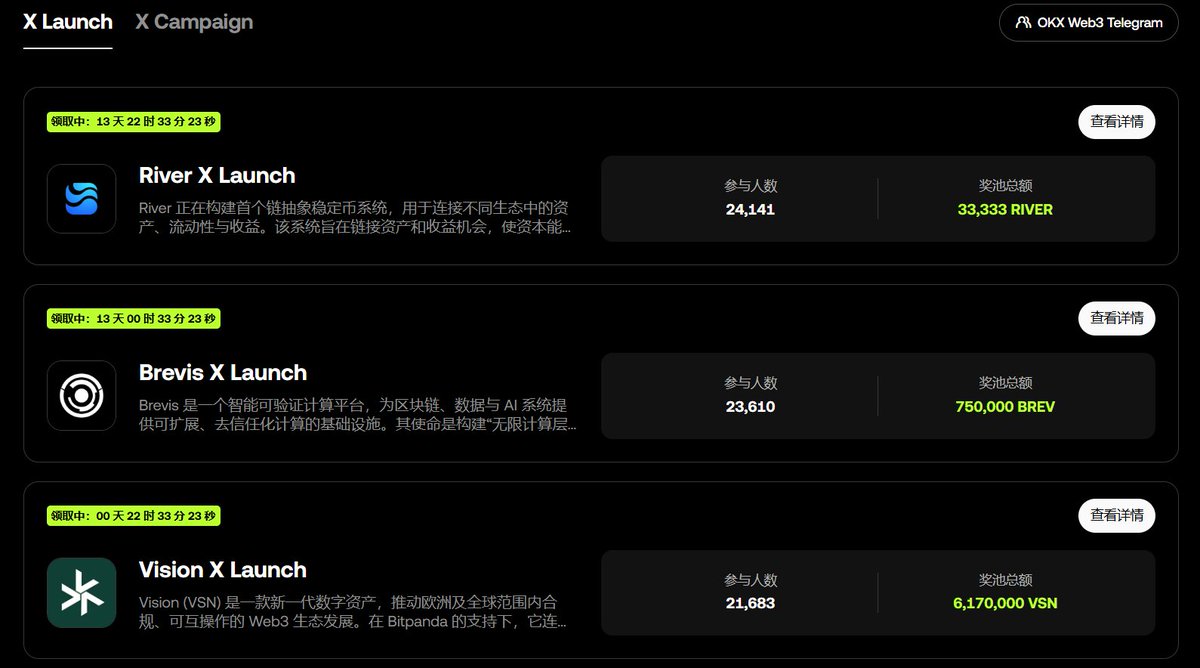
兄弟们,OKX Boost @okxchinese 记得去领取奖励
web3.okx.com/ul/6EfLNiH?ref…
无颜 (❖,❖) | MemeMax⚡️@WY_mask
太猛了, $RIVER 一周 830% 的涨幅,最高价格 $25 全网交易量 30 亿美金,交易量仅次 BTC、ETH;超过 DOGE、SOL coinglass.com Binance 上 24 小时交易量最高达 17 亿美金 t.me/theblockbeats/… River @RiverdotInc TGE后还获得了来自由 Arthur Hayes @CryptoHayes 创立的 @MaelstromFund 的战略投资,准备构建第一个链抽象稳定币系统,这项战略投资将支持该系统的持续发展及其在数字资产领域的扩展。 官方现在还有2个活动可以参与 1️⃣预测 $River 在1月 15日时的价格,最接近的20名用户每人获得101个 $River ,活动1/12截止。 要求:推特发布有关 $River 有关内容并写出你预测的价格,并 @RiverdotInc 和 @River4FUN 🔗填表链接:docs.google.com/forms/d/e/1FAI… 2️⃣ 创作者活动中前100名每人可获得 20.26u
中文

Took the @0xSoulProtocol incentivized testnet for a spin earned seeds, linked my accounts across Arbitrum and Avalanche, and for the first time my collateral actually felt borderless
Deposited on Aave on ETH, borrowed on Compound on Optimism, all under one Controller using LayerZero. No redeposits, no bridge drama, seeds convert to $SO at TGE, capital moves where rates are better. UX has rough edges but the efficiency gains are real
Who else is tired of juggling chains and ready for omnichain borrowing #DeFi #Omnichain

English

Vibe coded a copy trader bot for the 15-minute markets on @Polymarket.
2x my bankroll in one day.
The setup is very simple.
Watched two traders and copied their trades if specific parameters were met.
Stack:
> Claude Code + Cursor
> Polymarket API
Let me know if you want a further breakdown on how to build one.

English

코인 과세 환경이 바뀌면, @KaitoAI 보상도 바뀌어야 합니다
최근 가상자산 과세 관련 정부 지침이 정리되면서
단순히 “얼마를 벌었는가”보다
어떤 방식으로 취득했는가도 중요해지고 있습니다.
이 흐름 속에서
Kaito 리워드 구조 역시 재검토가 필요하다고 생각합니다.
제가 제안하고 싶은 방향은 명확합니다.
토큰 에어드랍이 아니라
커뮤니티 세일 참여 권리입니다.
--------
에어드랍 vs 커뮤니티 세일, 과세 구조의 차이
에어드랍은 구조적으로
무상 취득으로 해석될 여지가 큽니다.
한국에서도 상담 사례를 보면
상장된 코인을 에어드랍으로 받은 경우
취득 시점 과세 이슈가 발생할 수 있다는 해석이 반복됩니다.
반면 커뮤니티 세일은 다릅니다.
- 유상 취득
- 취득가 명확
- 과세는 매도 시점의 차익 기준
즉,
에어드랍은
받는 순간 세금 리스크가 생길 수 있지만,
커뮤니티 세일은
실제로 이익을 실현했을 때만 과세가 논의됩니다.
이 차이는
단순한 세율 문제가 아니라
참여자 경험 자체를 바꿉니다.
--------
Zama 커뮤니티 세일이 보여준 가능성
이 논의를 현실로 보여준 사례가
바로 Zama입니다.
Zama는 커뮤니티 보상을
무료 에어드랍이 아니라
OG NFT 홀더 대상 커뮤니티 세일 권한으로 설계했습니다.
여기서 핵심은
“살 수 있었다”가 아닙니다.
Zama 커뮤니티 세일은
퍼블릭 세일(옥션) 플로어 가격을 기준으로 설계되었습니다.
이는 곧,
- VC 라운드에서 암묵적으로 형성되는 고 FDV 기대치가 아니라
- 퍼블릭 시장에서 책정되는 가격 기준으로 참여
즉,
VC보다 훨씬 낮은 가격대에서, 실질적으로 낮은 FDV로 포지션을 잡을 수 있는 구조였습니다.
커뮤니티 입장에서는
“VC와 같은 가격”이 아니라
VC보다 훨씬 보수적인 밸류에이션에서 참여한 셈입니다.
이건 단순 할인도, 단순 에어드랍도 아닙니다.
- 커뮤니티에게는 낮은 FDV 진입 기회
- 프로젝트에게는 장기 홀더 유도와 공정한 분배
양쪽 모두에 정렬된 구조입니다.
--------
이 구조가 프로젝트에도 유리한 이유
커뮤니티 세일은
참여자에게만 좋은 구조가 아닙니다.
프로젝트 입장에서 보면,
- 무료 토큰 배포 → 즉시 매도 리스크 큼
- 유상 취득 → 보유 확률 상승
이라는 차이가 분명합니다.
또한,
에어드랍은 항상
“누가 더 많이 받았는가”라는 논쟁으로 이어지지만,
커뮤니티 세일은
“누가, 어떤 조건으로 참여했는가”가 명확합니다.
Zama는 이 방식을 통해
에어드랍 농사꾼이 아닌
초기 서포터를 실질적인 초기 투자자 포지션으로 끌어올렸습니다.
--------
한국과 미국 과세 관점에서 봐도 자연스러운 방향
한국에서는
에어드랍이 무상 취득으로 해석될 경우
취득 시점 과세 리스크가 계속 논의됩니다.
미국 역시
에어드랍을 소득으로 보는 해석이 존재해
수령 시점 과세 논쟁이 반복돼 왔습니다.
반면 커뮤니티 세일은
- 매입가 명확
- 처분 시점 과세
라는 전통적 자산 과세 구조에 훨씬 가깝습니다.
그래서 이 방식은
한국·미국뿐 아니라
여러 국가에서 점점 선호되는 추세적인 설계로 보입니다.
--------
그래서 Kaito에 왜 어울리는가
Kaito는 이미
- 기여 데이터를 수집하고
- 랭킹과 기준을 만들며
- 프로젝트와 유저를 연결하는
런치패드 구조를 갖고 있습니다.
실제로
야핑 + 런치패드 방식은
모멘텀, 팔콘, 바운드리스 등에서
이미 여러 차례 실험되었습니다.
여기에
리워드를 에어드랍이 아닌
커뮤니티 세일 권한으로 전환한다면,
Kaito 보상은
단순 보상이 아니라
검증된 기여자를 위한 초기 참여 트랙이 됩니다.
--------
Kaito 리워드는
무료 토큰을 나눠주는 시스템이 아니라,
기여를 통해
VC보다 낮은 가격, 실질적으로 낮은 FDV에서
프로젝트에 참여할 수 있는 권리를 주는 시스템으로 진화해야 할 시점입니다.
Zama는 이미 그 가능성을 보여줬습니다.
Kaito가 그 방식을 표준으로 만들 차례라고 생각합니다.
BAEK_PRO🌊@baekpro
If Crypto Taxation Is Changing, @KaitoAI Rewards Must Change Too As government guidelines around crypto taxation become clearer, the key question is no longer simply “how much did you earn?” but rather “how did you acquire it?” In this context, I believe Kaito’s reward structure also needs to be reconsidered. The direction I want to propose is straightforward. Not token airdrops, but community sale participation rights. Airdrops vs. Community Sales: The Tax Structure Difference Airdrops are structurally close to uncompensated acquisition. In Korea, recent tax consultations repeatedly suggest that receiving listed tokens via airdrops may trigger taxation at the time of receipt. Community sales are fundamentally different. - Paid acquisition - A clearly defined cost basis - Taxation based on capital gains at the time of sale In other words, airdrops can introduce tax risk the moment tokens are received, while community sales are typically taxed only when actual profit is realized. This difference is not just about tax rates. It meaningfully changes the user experience of participation. Why Zama’s Community Sale Matters A real-world example that demonstrates this shift clearly is @zama . Zama designed its community rewards not as free airdrops, but as community sale rights for OG NFT holders. The key point is not simply that participants were able to buy tokens. A Meaningfully Lower Entry FDV vs. Market Expectations Zama’s community sale pricing was based on the public auction floor price. This means participants were not buying at the inflated FDV often implied by VC rounds, but instead entered at prices discovered by the public market. As a result, the community was able to take positions at significantly lower prices and a genuinely lower FDV than VCs. From the community’s perspective, this was not “VC pricing,” but participation at a far more conservative valuation. This was neither a simple discount nor a conventional airdrop. For the community: access at a lower FDV For the project: long-term holder alignment and fair distribution The incentives were aligned on both sides. Why This Structure Also Benefits Projects Community sales are not only advantageous for participants. From a project’s perspective: - Free token distribution → high immediate sell pressure - Paid acquisition → higher likelihood of long-term holding The difference is material. Airdrops often lead to disputes about “who received more,” while community sales make it clear who participated, under what conditions, and at what cost. Zama used this structure to elevate early supporters from airdrop recipients to genuine early-stage stakeholders. A Natural Fit from a Korean and U.S. Tax Perspective In Korea, airdrops interpreted as uncompensated acquisition continue to raise concerns around taxation at receipt. In the U.S., there is also precedent for treating airdrops as taxable income, leading to recurring disputes over timing and valuation. Community sales, by contrast, align closely with traditional asset taxation frameworks: - Clear purchase price - Taxation at the point of disposal For this reason, this approach is increasingly favored not only in Korea and the U.S., but across many jurisdictions as a broader trend. Why This Makes Sense for Kaito Kaito already has the necessary infrastructure. It collects contribution data It ranks and scores participants It connects projects and users through a launchpad-like structure In practice, the “yapping + launchpad” model has already been tested through projects such as Momentum, Falcon, and Boundless. If rewards were shifted from airdrops to community sale participation rights, Kaito rewards would evolve from simple payouts into a curated early-access track for verified contributors. One-Sentence Summary Kaito rewards should evolve from distributing free tokens to granting contributors the right to participate in projects at meaningfully lower prices and genuinely lower FDVs than VCs. Zama has already demonstrated that this is possible. Now, it may be time for Kaito to turn this approach into a standard.
한국어

< 이렇게 내리 꽂아버리면 TGE는 다시 연기 될 수도... >
작년 말 하락장 때문에 @Kindred_AI TGE 일정이 딜레이 됐었죠.
상승 추세로 전환한 줄 알았으나 본진이 또 털리고 있네요.
이렇게 되면 팀에서 추진 중인 Kaito badge 시스템이 도입되며 자연스레 TGE 일정이 밀릴 수 있을 것 같습니다.
사실 팀에서도 가장 좋은 시기에 TGE를 진행해서 제대로 된 밸류를 인정받고 싶을 겁니다.
하지만 5개월 이상 달려온 야퍼들은 현재 지칠대로 지치기도 했고, 급작스레 변경된 카이토 시스템으로 인해 대거 강제 이탈 되었습니다.
팀에서 초기부터 헌신해온 유저들을 이대로 이탈하게 놔둘 것인지는 진심으로 고민해봤으면 좋겠습니다.
그들은 적어도 감정 지능이 탑재된 AI 동반자 제품이 완전히 출시된 상태도 아님에도 불구하고 팀만을 신뢰하며 지금까지 달려왔거든요.
서로가 윈윈할 수 있는 전략으로 진행해주셨으면 합니다.

Searchfi@searchfi_eth
< 아쉽게도 100 yaps 기준은 변동될 것 같지는 않네요 > @Kindred_AI 디스코드를 쭉 둘러보니 파운더와 유저들간의 대화가 오갔는데 요약 해드릴게요. - Kaito에서 시빌과 봇을 걸러내기 위해 실제 기여자를 우선시 하기 위해 이러한 조치를 취했다 함 - Max는 캠페인 초반부터 봇들에 대한 불만이 많았기에 Kaito가 이러한 조치를 취한 것을 긍정적으로 보고 있다고 함과 동시에 균형을 위해 기준 설정의 추가 조정 필요성 언급 - 유저들이 수개월 간의 노력을 어필하자, 그는 Kaito가 yaps 수치만 측정하는 것이 아닌, 평판/온체인 사용 등 여러 요소가 반영되는 구조라고 함 - 향후 Klara, SATO NFT 보유자 등을 반영할 수 있는 배지 시스템을 도입할 계획 - 프로젝트 별 기준을 낮추길 원한다는 유저 의견에 기준을 낮추면 봇들에 대한 불만이 가중될 수 있어 기준이 다소 높더라도 봇을 쳐내는게 합리적이라 함 👉 결론적으로 뱃지 시스템이 현실적인 보완책으로, 이번 주나 다음 주에 Kaito와 콜을 잡고 뱃지 시스템을 구체화할 예정이라고 합니다. 아쉽게도 자체 리더 보드나 기준치 100 yaps에 대한 변경은 없을 것 같습니다 ㅠㅠ 참고로 오늘 카이토에서도 19시경 올린 트윗에서 당분간은 이 업데이트를 감수해야 한다고 밝혔습니다. 일단 임계치 없는 프로젝트와 얍스 파밍을 위해 방향 선회들을 하셔야 할 것 같습니다. 최대한 서포트 해볼게요!! 모두 화이팅입니다. 💪
한국어
@forknet_io this agg layer setup sounds like the real deal for seamless multi-chain plays
instant fills + unified liquidity? count me in for 2026feels like easy cook
English

AggLayer connects isolated ecosystems, turning them into one massive liquidity pool.
Trade perps with depth from multiple chains, think instant fills, no latency drags.
Bridge once, then vault assets for effortless yields, or flip into Reactor pools for high APY action.
No more jumping between apps; everything's unified, low-fee, and high-throughput.
@NeurochainAI adds that decentralized efficiency layer, ensuring your trades are smart and secure.
Whether you're a yield hunter or perp master, this setup lets you spot opportunities anywhere and execute seamlessly.
Make 2026 your breakthrough year, join the revolution.
forknet.io

English

Legend @jgonzalezferrer is back in Korea 🇰🇷
Another big IRL coming up @billions_ntwk , see you there sooon 🩵
GIF
Limu_mbm_@Limu_mbm_
Happy New Year Fam🩵 2026 is going to be full of gBillions @billions_ntwk 🦸🏻♀️
English

This image infuriates me. Just waterboard the motherboard. Great idea. 😂
JNS@_devJNS
I just cleaned my PC.. what should I do next?
English
@Blqck_champ try reseating the cooler + fresh thermal paste
usually fixes stubborn heat issues quick
English



Top 3 things to know about @OpenGradient 🩵👇🏻
OpenGradient focuses on cryptographically proving where AI outputs come from, which model generated them, and how they were produced.
It provides a verifiability layer for AI models and inference, making it possible to detect fake, manipulated, or untrusted outputs.
Positioned at the intersection of Web3 and AI, OpenGradient supports a trustless AI vision by enabling transparent, auditable standards for developers and platforms.

LeywinG@0xleywing
Spot simply means price right now. No futures, no options, no narratives just the asset trading at its current market value. Spot forecasting is about one thing: trying to anticipate where that price goes next, whether minutes ahead or months out, using data, ML, and AI. This becomes powerful in DeFi. Spot forecasts aren’t just for trading bots. They can drive smarter vault strategies, dynamic exposure management, and more adaptive yield aggregation. Instead of static allocations, protocols can rebalance based on expected relative performance across pairs like ETH/USDT or SOL/ETH, reducing downside risk and improving capital efficiency. @OpenGradient takes this further by making spot forecasting verifiable and composable. Their example SUI/USDT models (30-minute and 6-hour) show how OHLC data can be transformed, filtered, and optimized using transparent ML pipelines all runnable on decentralized infrastructure. The real unlock is integration. Protocols like DoubleUp already use OpenGradient’s spot forecasts to power AI-driven prediction markets, proving these models aren’t theoretical they’re live. Spot forecasting isn’t about perfect predictions. It’s about better decision-making. And OpenGradient is building the rails to make that trustless, onchain, and usable.
English

English