Kaushik Talukdar

467 posts

Kaushik Talukdar

Kaushik Talukdar

@DocKaush

Lecturer and researcher in health, physical activity and sports

Auckland Katılım Ekim 2015
198 Takip Edilen125 Takipçiler
Sabitlenmiş Tweet
Kaushik Talukdar
Kaushik Talukdar@DocKaush·
Now that all my chapters from my PhD have been published, I would like to share some insights about this journey, provide background and relevant details from each chapter that I think will be useful for practitioners and researchers working with young female athletes #research
English

1
0
4
0
Kaushik Talukdar
Kaushik Talukdar@DocKaush·
@theliverdoc that said with time being a constraint i would rather have more people doing some resistance training rather than mindlessly chasing steps after a certain point.
English
0
0
0
13
Kaushik Talukdar
Kaushik Talukdar@DocKaush·
@theliverdoc Btw 10k steps was a japanese marketing strategy but several studies have been done to follow it up. Upper limit doesn’t have empirical evidence to support across population.
English
1
0
1
17
TheLiverDoc™
TheLiverDoc™@theliverdoc·
Steps. 10k steps is a myth. Here is what matters. Minimal “benefit” zone: ~4,000 steps/day is already better than very low activity. If someone is very sedentary (<2,000 steps), even small increases matter. Realistic healthy target: ~8,000 steps/day maximum low risk of dying (from all causes) and reduced disease-risk benefit. ~8,000-10,000+ steps/day may give additional benefit (especially for healthy people), but with diminishing returns. So cap at 8k when it comes to healthy steps. You can go higher, but the benefits have a ceiling effect. For liver-specific health: Aiming for ~8,000 steps/day or above is ideal. But even jumping from low to ~5,000 can confer meaningful reductions in risk of fatty liver or progression.
English
89
197
2.1K
210.9K
Kaushik Talukdar
Kaushik Talukdar@DocKaush·
@WSWayland Debating over gym based stuff for sprinting is of very little importance unfortunately
English
0
0
0
10
Kaushik Talukdar
Kaushik Talukdar@DocKaush·
@WSWayland Sprinting is better for sprinting, rest all we do in gym is assisting. Context matters, for an individual who needs to be exposed in long muscle length for the hamstring, single leg RDL is good for someone who needs isolation for the gluteal hip thrust/raise variation can help.
English
2
0
0
131
Coach Wayland | Performance Expert | Craftsman
RDLs vs Hip Thrusts for Sprint Performance. Good Questions from a mentee asking why RDL's are (in my opinion) better for sprint performance than hip thrusts. Despite EMG Showing more glute max on hip thrusts. Answer; EMG does'nt tell the whole story. RDLs are more effective for developing explosive sprinting power because they emphasize the hip extensors and hamstrings in a lengthened position, fostering thestretch reflex crucial for rapid muscle fiber recruitment. Hip thrusts primarily train the glutes in a shortened position, with peak muscle activation at the top of the movement, which is less directly transferable to the dynamic, powerful hip extension needed for the first strides of a sprint Why RDLs benefit sprinting 🟩Targets the Stretch Reflex: In an RDL, the glutes and hamstrings are significantly lengthened under load, promoting a powerful stretch reflex that leads to more explosive contractions when returning to the standing position. A fully triphasic movement that can be overloaded thusly. 🟩Develops Explosiveness: By strengthening the posterior chain (glutes and hamstrings) in this lengthened, loaded state, RDLs improve the ability to generate hip torque force and speed out of relevant positions which are essential for sprinting. 🟩Enhances Full-Body Strength: RDLs are a compound exercise that also engages the entire posterior chain, contributing to overall power and stability, which are beneficial for the dynamic movements of sprinting and changing direction. Orientation matters so standing up extending the hip against vertical forces challenges the posterior chain in a corresponding fashion, rather than laying supine. Why Hip Thrusts are less directly beneficial for sprinting 🟥Focuses on Shortened Positions: Hip thrusts emphasize glute activation when the muscles are in a shortened position, leading to a strong contraction at the peak of the movement. This type of activation is not the primary need during the initial phase of a sprint. 🟥Limited Range of Motion for Sprint Power: The range of motion for hip thrusts, particularly the significant stretch, is less pronounced than in an RDL, which limits the development of the stretch reflex that helps with explosive power. 🟥More of an Isolation Exercise: While effective for glute growth, hip thrusts isolate the gluteal muscles more than RDLs and are less effective at developing the dynamic, whole-body power needed for sprinting.
English
3
6
84
11.9K
Kaushik Talukdar
Kaushik Talukdar@DocKaush·
@GregLehman I also feel hip dominant vs knee dominant is a very generalised way of looking not acknowledging movement variability, so any exercise can be both hip and knee dominant depending how it is executed
English
0
0
0
19
Kaushik Talukdar
Kaushik Talukdar@DocKaush·
@GregLehman I think the only thing you get more is with grip involved a lot of upper body at play too. However, I don’t think any lift would have generalised athletic transfer as such, it would depend on the task - sprinting vs. jumping etc. lot of the so called transfer is debatable
English
1
0
0
81
Greg Lehman
Greg Lehman@GregLehman·
If you are squatting heavy what benefits in terms of athleticism, strength etc do you get from deadlifts. Do they provide a lot more value? Especially if your squat is very hip dominant
English
22
1
6
9.5K
Kaushik Talukdar
Kaushik Talukdar@DocKaush·
@mboyle1959 Coach is no trap bar deadlift for adults new in your space? Would like to know why ?
English
2
0
1
541
Michael Boyle
Michael Boyle@mboyle1959·
Our athletes hang clean, bench press and trap bar deadlift. Our adults dont Olympic lift, dont straight bar bench press and dont trap bar deadlift. Its all about knowing your audience.
English
19
3
163
37.9K
Kaushik Talukdar
Kaushik Talukdar@DocKaush·
@pbasilstrength Specific athletes with good lever to trunk ratio who are into contact sports (back squat being traditional norm/test) like to back squat in my experience
English
1
0
1
63
Pat Basil
Pat Basil@pbasilstrength·
“Athletes don’t like to Back Squat” This is utterly false I tested it I took them out for some teams and made the Trap Bar my main bilateral lift Several complained and wanted Back Squats back in They do value the stimulus, even if it s harder Lesson learned
English
5
0
21
7.7K
Kaushik Talukdar
Kaushik Talukdar@DocKaush·
@hjluks Thanks for the post, any specific characteristics that prevention programs should have ?
English
0
0
0
58
Howard Luks MD
Howard Luks MD@hjluks·
Orthopedic Truths #4 The ACL: The ACL is important for some people to remain active. Others tolerate its loss very well. ACL tears are too common in sports. ACL tear prevention programs exist... they work, yet community/ school sports don't utilize them. ACL tears are more common in athletes participating in the same sport year-round. ACL surgery, despite years of research and practice, remains an imperfect solution to a complex problem. Do all ACL tears require surgery? No But yours might. Your child should probably have it. It's the secondary injuries we worry about. What about adults? Many do fine without ACL surgery. Some don't. But it often pays to wait and see. Everyone's knee feels unstable initially. Very often, that stability improves with time and physical therapy. Therefore, for adults, you might want to wait before booking that surgery date. Why is the surgery an imperfect solution? Because the native ACL isn't a straight, single-diameter structure, but our reconstruction is. Secondary injuries can include meniscus tears and cartilage injuries. Those will increase the risk of developing arthritis. The history of reconstruction is wild... and somewhat circular. Back in the 80's and 90's we argued about which graft worked well. We still have those arguments. Now, we added the quad tendon graft to the argument. Would I take hamstrings from a sprinting athlete... no, not really. Am I a quad enthusiast? Not yet. When the MOON group announces their data, then I might. But it took 20 years for that to come out for hamstrings vs BTB. BTB remains the gold standard... and will for a while. But we tried Goretex. We tried other things, too. Those didn't end well. Oh. We have this scope thing. Let’s keep reconstruction via one tunnel. Evolution be damned. The ACL has had the same femoral footprint (attachment) for millions of years. But heck. Let’s put that tunnel here. It worked for some... but many failed. We tried to repair them, but they failed. We developed tools to place the ACL where nature intended it. But going too distal seemed to increase the risk of re-rupture, too. Now we cheat a little back up the wall on the lateral condyle. We tried reconstructing both bundles—certainly, that would work better. I tried them, too, but that didn't work. Fixation... we need screws. The metal screw worked very well. It was predictable and easy to remove. Oh.. I hate seeing screws on the x-ray. Let’s use these awesome bioscrews. Wow…, I haven’t seen a cyst that big before 😩 Sadly... those screws dissolved the bone around the graft, too. Then, we devised some wild, stupid ways to secure the graft that make revision surgery challenging. Thankfully, most of those are gone now. Along the way, we thought we would save our patient's tissue by using cadaveric tissue or allograft. There were disease-spreading issues early on. But that got better. Oops... they fail very often in kids. We don't use them in kids anymore. We can use them in adults. (But your own tissue is better.) Hey... It's been 30 years, so let's repair them again. That still didn't work. Hey... let's put this little sponge in the repair. Okay... That might work... the jury is still out on this. "ACL tears never heal without surgery." But it appears that they do! Enter the cross-brace protocol. It's annoying for the patient. It doesn't pay the surgeon as well. But it appears to work. For some. The jury is still out. More research is needed. But... ACL tears can heal. Rehab. “I let my patients return to sports in 6 mos”. 🙄. Just don't! Don’t mess with the biology of healing. Kids should wait 12-24 mos to return to sports. I don't think that most parents understand the recurrent tear rate. Most kids I see out there are not properly/fully rehabilitated after surgery. It's hard when our lovely insurance companies approve 8 PT visits for an ACL patient. Multinational/well-researched protocols exist for the rehab of an ACL athlete. But they're not used often. Ah... this messy little ligament has generated reams of "research" over the years. Much of it is nonsense, but some solid data exists. The controversies around how to manage these athletes persist. I would have thought we would have been further along, but here we are. Stay tuned... I imagine we are still having the same conversations in 20 years. Ask your school to implement ACL tear prevention programs.
English
79
164
932
228.2K
Michael Boyle
Michael Boyle@mboyle1959·
I think what our older clients call “balance” is really unilateral hip and ankle strength / function. When clients say “my balance is bad” what they mean is they can’t stand on one foot/ leg. 🤔
English
19
3
150
20.9K
Kaushik Talukdar
Kaushik Talukdar@DocKaush·
@StrengthDebates Can we say Strength training in the gym is anatomy, need and competency specific and less sports specific ?
English
0
0
0
61
Official Strength Debates
Official Strength Debates@StrengthDebates·
Unless the sport is weight lifting or powerlifting Everything in the weight room is general There aren’t any specific strength exercises for each sport Just strength exercises 💪🏼
English
13
29
243
28.3K
Kaushik Talukdar
Kaushik Talukdar@DocKaush·
@CoachKevinCarr Relying on training may not be enough. I think at population level free living physical activity (FLPA) and non-exercise activity thermogenesis (NEAT) key, thoughts ?
English
1
0
1
1K
Kevin Carr
Kevin Carr@CoachKevinCarr·
Zone 2 training is valuable but the problem for the average gym-goer is time availability. The #1 cited reason for not exercising is “lack of perceived time” It’s common to hear coaches recommend 150-300 minutes per week of continuous aerobic work. 😳 The average person in the US goes to the gym 2x per week. Less than 23% of people currently meet the minimum aerobic exercise guidelines of 150-300 minutes of moderate-intensity or 75-150 minutes of vigorous intensity. This presents a huge mismatch between the prescription and the average person who most needs our help to get healthier. If we also think power and strength training is valuable, starting with interval training presents a time-efficient way to improve aerobic health for the average gym-goer. It’s a much more sensible approach for most people to start with interval based conditioning in addition to strength training to maximize the benefit they get from their time commitment to exercise. We know that we can see similar improvements in VO2, Insulin Sensitivity and Mitochondrial Content when comparing 30 min/week of HIIT training when compared to 150 min/week of of continuous work done at 70% MHR. That’s a 5x difference in time commitment! ➡️ pubmed.ncbi.nlm.nih.gov/27115137/ If we can build a balanced program that checks all the boxes ➡️ Mobility/Power/Strength/HIIT that can be done in 60 minutes/2x per week we can make huge improvements in in overall health and hopefully open the door for behavior change that leads to increased volume and frequency of exercise. With time, hopefully we can encourage clients to participate in low-intensity aerobic work on their days outside of their time with a coach via walking, cycling, elliptical etc etc. It’s obvious that more is better, 4+/week exercisers have significant changes in ventricular compliance and life expectancy not seen in those training 2-3 days per week but Rome wasn’t built in a day. Training is like farming and behavior change is hard. Start with something accessible to the average person and use the positive impact to create long term changes in their activity levels.
Krakow, Poland 🇵🇱 English
8
11
90
28.9K
Kaushik Talukdar
Kaushik Talukdar@DocKaush·
@pbasilstrength @AndreaPintore5 Yes, there are many ways to be explosive without relying on oly lifts. I feel it becomes the old hammer and nail analogy for many who cannot see beyond oly lifts. Just a note I am not against oly lifts - context matters.
English
1
0
1
66
Pat Basil
Pat Basil@pbasilstrength·
@AndreaPintore5 Nope, I chose my words carefully “Kinda sorta” isn’t me
English
2
0
0
402
Pat Basil
Pat Basil@pbasilstrength·
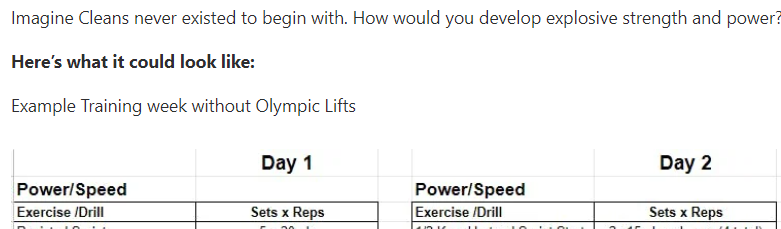
Cleans won’t make you explosive I took them out 5 years ago and our program has only gotten better Here's a FREE guide on why and how to train Power without Cleans With a sample week you can use To get it: 1 Retweet this 2. Reply “POWER” below I’ll DM it to you Must follow
Pat Basil tweet media
English
194
118
83
56.5K
Kaushik Talukdar
Kaushik Talukdar@DocKaush·
@ThisThat14456 It might be better if her bowling action doesn’t remind you of anyone, bowlers who make it to higher level have their own unique style, I must say she has a very smooth run up and jump- best wishes
English
0
0
0
17
This Is Vani
This Is Vani@ThisThat14456·
Seeing this girl, which bowler's action does she remember?
English
3.5K
579
6K
1.8M