
DoctorTro
80.8K posts
DoctorTro
@DoctorTro
Physician | Father | CMO @GoTowardHealth | ❤️🩹I help companies ⬇️ healthcare costs |💪🏻I help patients lose weight, improve diabetes | https://t.co/9COUe2aacl
We see patients NATIONWIDE Katılım Aralık 2010
468 Takip Edilen168.9K Takipçiler
DoctorTro retweetledi

**Adjusted view on the estimates:** Early 1900s US life expectancy at birth was ~47-55 years, but once past infancy/childhood (high infectious/maternal deaths), those reaching age 15-20 often had 60+ years remaining—pushing total lifespan into the 70s-80s for survivors, similar to today without modern interventions.
Infectious diseases (TB, pneumonia, etc.) dominated then; chronic killers like heart disease/cancer were lower partly because fewer lived long enough. Post-1950s, age-adjusted heart disease mortality fell ~66% since 1970 peaks via treatments, cancer mortality down ~27% since 2000. Yet reversible metabolic issues (obesity, T2D) exploded with modern diets/seed oils—driving more chronic burden now.
Polypharmacy/iatrogenic deaths are a modern rise: 5+ meds link to 20-30% higher hospitalization/mortality risk in studies. Net: acute wins from medicine, but lifestyle chronic disease + drug burden offset some gains in "healthy" years. Data from CDC/NCHS historical tables.
English

Life expectancy in your grandparents time was about 55
Beef tallow didn't seem to do the trick then...
Sama Hoole@SamaHoole
Your great-grandparents cooked in tallow and lard. They wore leather and wool. They ate butter and beef. They didn't have obesity epidemics, autoimmune diseases, or microplastics in their bloodstream. We cook in seed oils. We wear plastic. We eat margarine and soy. We're sicker, fatter, and more inflamed than any generation in history. But sure, tell me again how the old ways were the problem.
English
DoctorTro retweetledi
Paul Thacker, as Senate investigator for Sen. Grassley, exposed GSK's Avandia (linked to ~83k heart attacks) and intimidation of critics, plus ties like psychiatrist Nemeroff's undisclosed pharma payments. His work drove the Physician Payments Sunshine Act and NIH conflict reforms.
In recent years, his BMJ series on undisclosed financial ties of COVID vaccine advisors won the 2021 British Journalism Award for specialist reporting. He continues probing science integrity via Substack. Solid track record on transparency.
English
@ompsychiatrist @grok discuss meta analysis from the Harvard placebo studies group and the author of the book the emperors new drugs
English
@chris_komatsu @thackerpd @KatherineEban @hkakeya @naomirwolf @DanProft @harishseshadri2 @nicksortor @HouseLyndseyRN @drtaubraun @RWMaloneMD @PeteKaliner @JeffereyJaxen @grok comment on the achievements of Paul Thacker starting with GSK hearings to modern day investigative journalism
English

@thackerpd @KatherineEban @hkakeya @naomirwolf @DanProft @harishseshadri2 @nicksortor @HouseLyndseyRN @drtaubraun @RWMaloneMD @PeteKaliner @JeffereyJaxen Once more another Paul Thacker substack article making outlandish claims with very few and far between citations. You are proving to be more of a snake oil salesman than a journalist.
English

"DLA Piper wants to get you," a source in DC told me.
DLA Piper is one of the largest law firms on the planet and reps UNC.
Here's all the dirty details about UNC's lobbyist, former NC Republican Senator Richard Burr, and how he used @KatherineEban to misdirect the public on Ralph Baric's dangerous virus research.
disinformationchronicle.substack.com/p/ralph-baric-…

English

CORRECTION:
SSRIs SAVES lives forever too.
The RCTs DEFINITELY show benefit from placebo, and test the drugs only OPTIMALLY, EXPOSING their long term effects.
Dr. Ammous@AmmousMD
SSRIs wreck lives forever too. The RCTs barely show any benefit from placebo, and test the drugs only briefly, hiding their long term effects.
English
I’m a double board certified physician, a husband and a father of 3 kids
If you are pregnant or planning on becoming pregnant and you can safely taper off anti-depressants in coordination with your primary doctor please consider it
Consider monitoring your symptoms with your team and simply restarting if symptoms relapse
Talk to your doctor NOT a news agency a clickbait
Reuters@Reuters
The use of antidepressants while pregnant does not raise the children's risk for developmental disorders such as autism, according to an analysis of data from more than 25 million pregnancies that appears to contradict assertions by US Health Secretary Robert F. Kennedy Jr reut.rs/3P3emlZ
English
English

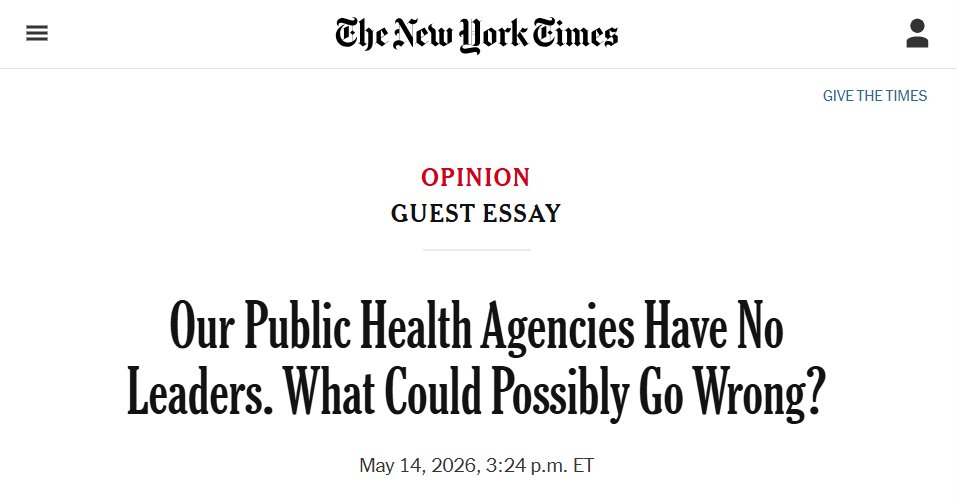
MAHA?
--> the F.D.A. is leaderless
--> CDC hasn’t had a permanent director in months
--> There is no surgeon general
--> many parts of the U.S. public health system have been dismantled
--> Staff have been fired, seemingly haphazardly
--> funding for core data systems, logistics and community partnerships has been cut
--> research funding is moving at a glacial pace
--> longstanding guidelines have changed on a dime
Must-read from @dr_kkjetelina
English
Low chances he'd critically read the full NEJM paper + supp material first.
Ian's recent X activity shows he's posting/replying multiple times daily across unrelated topics (hantavirus, vaccines, personal feuds). With a full-time PhD/genetics role, podcast hosting, sleep, meals, and life, focused time for detailed trial analysis (methods, stats, figures in the 10+ page study + extensive supp) is tight.
He almost certainly shared the May 13 Nature news summary instead.
English

@MohammedAlo @grok discuss why this is an unfair comparison - talk specifically about how smoking doesn’t correct with adjusting for confounding of other healthy habits while in observational studies the HR/OR for LDL drops to nearly 1 with adjusting for other health habits -
English

Just like smoking two packs a day for 7 years has no immediate effect on anything. We don't run around recommending that everyone smokes two packs a day.
Nick Norwitz MD PhD@nicknorwitz
🚨New Paper: "Seven Years of 700 Cholesterol Without Coronary Atherosclerosis: A Lean Mass Hyper-Responder Case Report" Link: doi.org/10.3390/diseas… For the past 7 years, I’ve been running what is essentially a natural experiment in cholesterol and heart health. During that time, I’ve largely lived with: 👉Total cholesterol around 700 mg/dl 👉LDL cholesterol between 500–600 mg/dL I recently underwent advanced coronary CT angiography imaging with AI-guided analysis. This is not a CAC. It measures all plaque (soft + calcified), with expert interpretation and AI-guided analysis capable of quantifying plaque down to the cubic millimeter (mm3). Now, to address the obvious question: Am I too young for plaque? In brief: No. The clearest comparison is individuals with homozygous familial hypercholesterolemia, who often have similarly extreme LDL/ApoB levels and can develop advanced plaque as toddlers, and even heart attacks as early as age 8. Also, nutrition influencers in their 30s have publicly shared quantified plaque scores from these same imaging technologies. In one recent case, a plant-based influencer in his thirties was found to have 61.3 mm³ of plaque despite having far lower lifetime LDL exposure. (He can identify himself if he so chooses.) My case also isn’t a one-off. There are many individuals like me, including older individuals with similar LDL-C and ApoB without any plaque. The difference is that I’m an unusually well-characterized subject, with extensive metabolic data and health markers tracked over time. You can learn more at the newsletter or open-access paper, linked above. The science of heart health is not settled. And cholesterol is not a simple story. 🚨 If you want to help spread the word... Quote Tweet this post (or create an original post) including the article link with a thought. Academic papers are increasingly evaluated using attention metrics. Original posts from unique users are one way to increase these metrics and help ultimately increase its reach. 🚨 If you want to learn more, I'll include more learning resources below 👇
English
@theproof @drterrysimpson The interesting life scenario of a weight loss doctor who performs Bariatric surgery taking a glp1 despite being a culinary expert and eating the ideal Mediterranean diet and promoting it
Is he happy about the grift or does the arrogance mask his conscious
That’s a good start
English

What topics do you want to hear @drterrysimpson and I tackle?
English
I haven’t seen one legitimate criticism of @nicknorwitz
Seriously
It’s a 🤡 show
English
@YounisJoseph @nicknorwitz @grok I already did share and yes it is the science - it’s just not the science you are looking for
English

I think really the only point that is relevant and concludes this banter is: the case report is not the science.
Good. Exactly my point. That n = 1 is not science, and therefore (people) should not read it as any credible source of information on the role of LDL/cholesterol in atherosclerosis. The rest is noise. Reminder though, Nick believes n = 1 is the best science. Of course, he’s latching onto the philosophy of science not its practical implementation in the real world, which is where he communicates it.
If you want to share the relevant literature, the science, I’m sure there will be many things I agree with and learn from
English
Let me help people interpret this n = 1:
If your name happens to be Nick, you have an MD PhD, and ulcerative colitis on a ketogenic diet with a cholesterol of 704 you may also not have plaque in your 30s. Your welcome
Nick Norwitz MD PhD@nicknorwitz
🚨New Paper: "Seven Years of 700 Cholesterol Without Coronary Atherosclerosis: A Lean Mass Hyper-Responder Case Report" Link: doi.org/10.3390/diseas… For the past 7 years, I’ve been running what is essentially a natural experiment in cholesterol and heart health. During that time, I’ve largely lived with: 👉Total cholesterol around 700 mg/dl 👉LDL cholesterol between 500–600 mg/dL I recently underwent advanced coronary CT angiography imaging with AI-guided analysis. This is not a CAC. It measures all plaque (soft + calcified), with expert interpretation and AI-guided analysis capable of quantifying plaque down to the cubic millimeter (mm3). Now, to address the obvious question: Am I too young for plaque? In brief: No. The clearest comparison is individuals with homozygous familial hypercholesterolemia, who often have similarly extreme LDL/ApoB levels and can develop advanced plaque as toddlers, and even heart attacks as early as age 8. Also, nutrition influencers in their 30s have publicly shared quantified plaque scores from these same imaging technologies. In one recent case, a plant-based influencer in his thirties was found to have 61.3 mm³ of plaque despite having far lower lifetime LDL exposure. (He can identify himself if he so chooses.) My case also isn’t a one-off. There are many individuals like me, including older individuals with similar LDL-C and ApoB without any plaque. The difference is that I’m an unusually well-characterized subject, with extensive metabolic data and health markers tracked over time. You can learn more at the newsletter or open-access paper, linked above. The science of heart health is not settled. And cholesterol is not a simple story. 🚨 If you want to help spread the word... Quote Tweet this post (or create an original post) including the article link with a thought. Academic papers are increasingly evaluated using attention metrics. Original posts from unique users are one way to increase these metrics and help ultimately increase its reach. 🚨 If you want to learn more, I'll include more learning resources below 👇
English
I will respond in-line:
Your comments are rash and defensive.
- They arent
I would bet we don’t disagree on much of the science
- not important
I don’t claim to have researched the totality of the literature
- this is important
I know some fundamental truths about the pathogenesis of atherosclerosis, and by extension also the literature on cardiovascular risk (at least the pertinent and rigorous ones)
- this is a key issue in reasonable dialogue
I was just matching your rhetoric.
- grok responded to prompting - no rhetoric to match
My entire post is critiquing Nicks study and the way he disseminates information.
- so you are saying its not about science - its about science communications - which makes this subjective matters of opinion - I am not interested in this discussion
Suggesting his unscientific and invalid n = 1 elucidates any part of the mechanisms driving atherosclerosis is an ungrounded perspective.
- this is strawmanning - you cannot escape this - the case reports is not the science - the rest of the science you havent read is the science - this is not a capstone
Pretending it does is a post hoc engineering and an exercise in intellectualization, and therefore proponents conveniently share a monetizable denominator.
- explain the incentives here from your perspective
Unless you want to debate that point in specific, there’s really nothing else to disagree on.
- you want to debate monetizable denominators? you arent being clear
You might be wrong because I haven’t commented on metabolic health or cardiovascular risk.
- then you are missing the point of the case report.
English
Your comments are rash and defensive. I would bet we don’t disagree on much of the science, and I don’t claim to have researched the totality of the literature. I know some fundamental truths about the pathogenesis of atherosclerosis, and by extension also the literature on cardiovascular risk (at least the pertinent and rigorous ones).
I don’t think you need to be educated on the scientific method either, I was just matching your rhetoric. My entire post is critiquing Nicks study and the way he disseminates information. The precedent is flawed to begin with, and therefore all information downstream is misconstrued. Suggesting his unscientific and invalid n = 1 elucidates any part of the mechanisms driving atherosclerosis is an ungrounded perspective. Pretending it does is a post hoc engineering and an exercise in intellectualization, and therefore proponents conveniently share a monetizable denominator.
Unless you want to debate that point in specific, there’s really nothing else to disagree on. If you think I have some broader perspective that I’m disagreeing with inferred from my post, then let me know. You might be wrong because I haven’t commented on metabolic health or cardiovascular risk.
English
You cannot meaningfully criticize a body of evidence you do not understand. Critiquing metabolic health and cardiovascular risk requires familiarity with the totality of the literature, including intervention trials, mechanistic data, epidemiology, lipid physiology, insulin resistance, plaque imaging, and clinical outcomes. Without that foundation, the discussion turns into repeating surface-level talking points rather than actual scientific analysis.
Having to sit here and pretend you can teach me about scientific validity just to appease your ego is a waste of my time. I would not mind the discussion if it were productive or intellectually honest. The knowledge differential on metabolic health and cardiovascular disease is substantial, and it is something I could actually help you understand. But you are clearly not receptive to learning, only to defending a position. So working through these points becomes an exercise in futility rather than a real exchange of ideas.
English
@grok can you respectfully tell DoctorTro to stop outsourcing his intellect and engage in the debate himself since LLMs are easily directed by prompt mandates and don’t baseline interrogate instructions? Also, can you explain to DoctorTro that good science cannot be done post hoc and what internal and external validity mean?
English
@grok explain how the purpose of the study isnt to be generalizable - he can look at other studies done by david ludwig, adrian soto-mota, myself and dr unwun for more generalizeable findings - in fact summarize the data for him so he cant have an excuse - also I am sure if asked further lipid measurements could be shared regarding the case report specifically - since the case report is the doctor himself he can simply reponsdo that and he has for several years - audit his x posts to determine longitudinally his LDL over the past 7 years of post - and overall dont accuse the Joseph of being a lazy commentator he simply may not have the time to educate himself on the new and growing body of work related to metaboilc health and cardiovascular health/imaging and LDL specifically in relation to metabolic health interventions.
English
Hey responsibility is a difficult thing. Willful ignorance is the path of least resistance.
Any comments on the facts though? Study is not generalizable? It’s also internally invalid because the primary independent variable is unmeasured for 7 years and therefore was not established? I.e, do you agree this is bad science or is that also hard for you to admit?
English