Dongqi Fu

78 posts

Dongqi Fu banner
Dongqi Fu

Dongqi Fu

@DongqiFu_UIUC

Sr. Research Scientist at @AIatMeta, Assoc. Editor at @TheOfficialACM

Katılım Ocak 2017
631 Takip Edilen1.1K Takipçiler
Dongqi Fu retweetledi

Akshay 🚀
Akshay 🚀@akshay_pachaar·
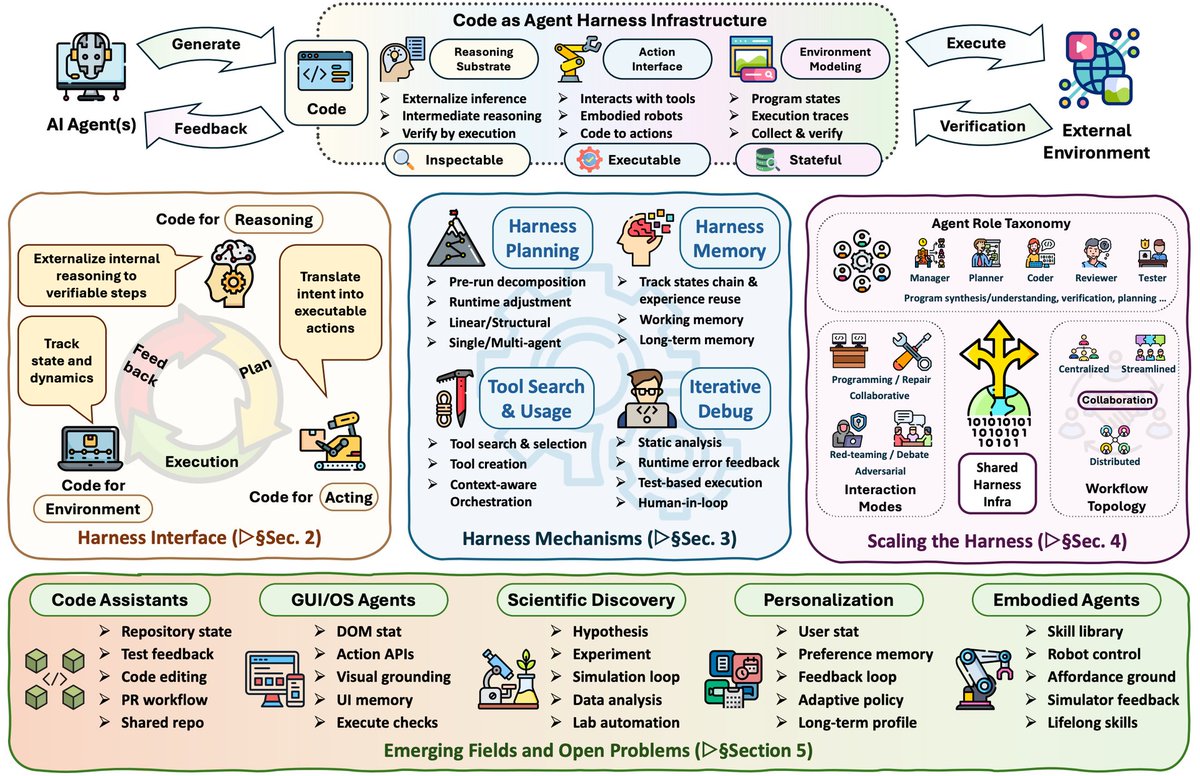
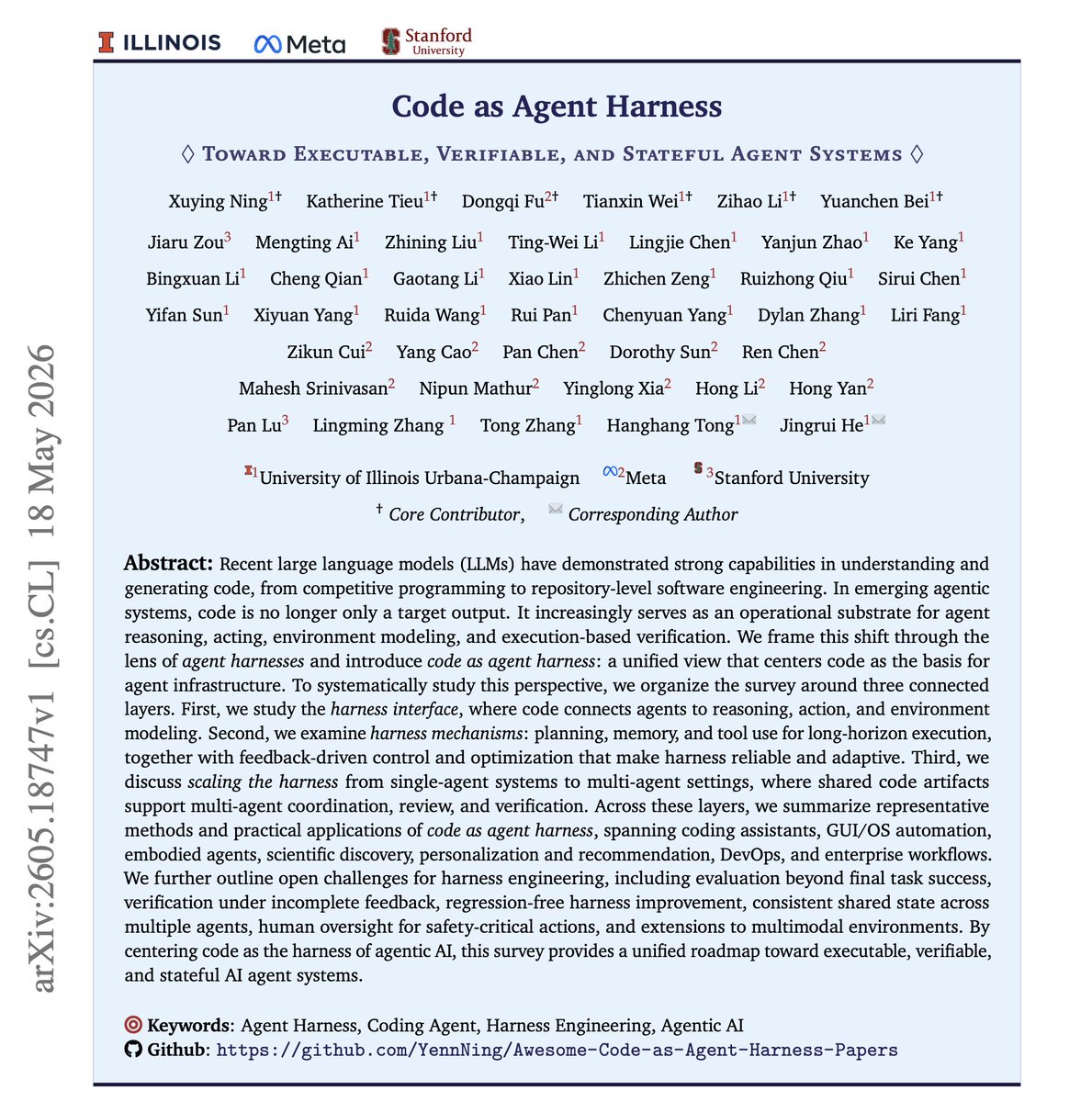
code as agent harness. a 102-page survey from Stanford, Meta, and UIUC on agent harnesses. the paper argues that code is no longer just the thing agents produce. it’s the medium through which they reason, act, and represent their environment. it calls this “code as agent harness” and covers three layers: code as the interface between agents and their tasks; the mechanisms that keep agents reliable over long-horizon execution (planning, memory, tool use, verification); and how multi-agent systems coordinate through shared code artifacts. core findings: the paper introduces “evolution agents” that treat the harness itself as the optimization target. they collect telemetry, diagnose failures, propose infrastructure changes, and promote only mutations that pass regression. the harness improves itself. in multi-agent systems, topology complexity inversely correlates with infrastructure quality. teams with better shared state use simpler coordination. teams without it build increasingly elaborate workarounds. finally, the paper concludes that future agent systems need four properties: - executable - inspectable - stateful - governed read more: arxiv.org/abs/2605.18747 i also published this deep dive (article) on agent harness engineering, covering the orchestration loop, tools, memory, context management, and everything else that transforms a stateless LLM into a capable agent. the article is quoted below.
Akshay 🚀 tweet media
Akshay 🚀@akshay_pachaar

x.com/i/article/2040…

English
40
111
749
123.1K
Dongqi Fu retweetledi
DailyPapers
DailyPapers@HuggingPapers·
Code as Agent Harness A comprehensive survey on how code serves as the executable substrate for AI agents—spanning harness interfaces, memory mechanisms, and multi-agent scaling across software engineering, robotics, and scientific discovery.
DailyPapers tweet media
English
4
20
41
2.1K
Dongqi Fu retweetledi
AK
AK@_akhaliq·
Code as Agent Harness
AK tweet media
English
4
10
55
43.3K
Dongqi Fu
Dongqi Fu@DongqiFu_UIUC·
Tianxin Wei@wei_tianxin

🚀Code as Agent Harness: A survey work from UIUC, Stanford, and Meta. 📄arxiv.org/abs/2605.18747 Code is no longer just the output of AI. It is becoming the executable, inspectable, and stateful substrate through which AI agents reason, act, verify, remember, and self-correct over long horizons. In our new survey, we examine this shift through the lens of Code as Agent Harness, focusing on how code serves as: • 🧠 Harness Interface: coding for reasoning, acting, and environment modeling • ⚙️ Harness Mechanisms: planning, memory, tool use, feedback, and optimization • 🤝 Multi-Agent Harnesses: collaboration through shared code, tests, and execution traces We review applications spanning: 💻 Coding Agents 🖥️ GUI/OS Agents 🤖 Embodied Agents 🔬 Scientific Discovery 🏢 Enterprise Workflows If you find this survey helpful, feel free to explore our resource collection below. 🤗 Hugging Face Daily: huggingface.co/papers/2605.18… 💻 GitHub: github.com/YennNing/Aweso… 🌍 Website: code-as-harness.github.io/code-as-harnes… Feedback, suggestions, and community contributions are warmly welcome! #AI #Agents #LLM #Coding #AgenticAI #SoftwareEngineering

ZXX
0
0
1
168
Dongqi Fu retweetledi
Tianxin Wei
Tianxin Wei@wei_tianxin·
🚀Code as Agent Harness: A survey work from UIUC, Stanford, and Meta. 📄arxiv.org/abs/2605.18747 Code is no longer just the output of AI. It is becoming the executable, inspectable, and stateful substrate through which AI agents reason, act, verify, remember, and self-correct over long horizons. In our new survey, we examine this shift through the lens of Code as Agent Harness, focusing on how code serves as: • 🧠 Harness Interface: coding for reasoning, acting, and environment modeling • ⚙️ Harness Mechanisms: planning, memory, tool use, feedback, and optimization • 🤝 Multi-Agent Harnesses: collaboration through shared code, tests, and execution traces We review applications spanning: 💻 Coding Agents 🖥️ GUI/OS Agents 🤖 Embodied Agents 🔬 Scientific Discovery 🏢 Enterprise Workflows If you find this survey helpful, feel free to explore our resource collection below. 🤗 Hugging Face Daily: huggingface.co/papers/2605.18… 💻 GitHub: github.com/YennNing/Aweso… 🌍 Website: code-as-harness.github.io/code-as-harnes… Feedback, suggestions, and community contributions are warmly welcome! #AI #Agents #LLM #Coding #AgenticAI #SoftwareEngineering
Tianxin Wei tweet media
English
10
19
44
4.3K
Dongqi Fu retweetledi
elvis
elvis@omarsar0·
// Code as Agent Harness // 100+ page report on all things related to agent harnesses. (bookmark it) In particular, the survey summarizes methods and applications of code as agent harness. This paper makes a strong case that code-as-harness might be the key to moving us towards a broader science harness engineering. Is code all you need? Maybe. Regardless, the paper argues that future systems must have the following four properties: executable, inspectable, stateful, and governed. Paper: arxiv.org/abs/2605.18747 Learn to build effective AI agents in our academy: academy.dair.ai
elvis tweet media
English
33
153
805
79.7K
Jiaru "Rubin" Zou
Jiaru "Rubin" Zou@Jiaru_Zou·
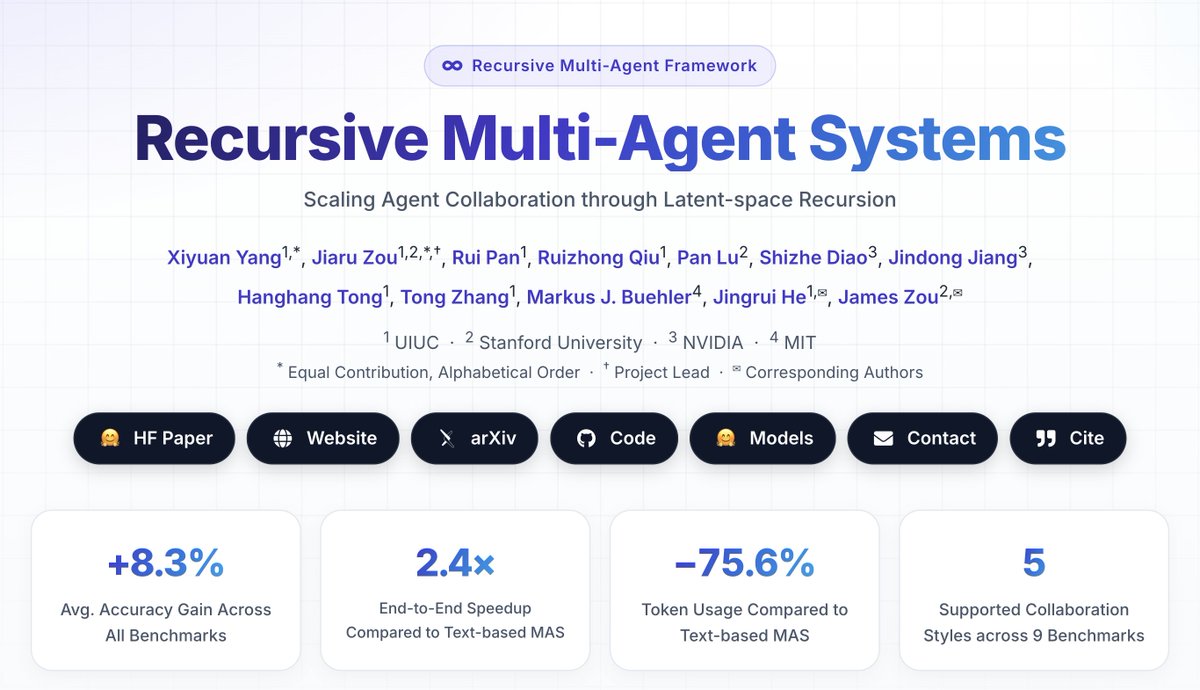
🔥Can Agent Collaboration itself be scaled through recursion? 🚀In #RecursiveMAS, we introduce a new learning framework that casts the entire multi-agent system as a unified latent-space recursion, unlocking a powerful scaling axis for AI teams' collaboration. 🌐 Website: recursivemas.github.io 🤗 Paper: huggingface.co/papers/2604.25… RecursiveMAS unlocks a new scaling paradigm shift for agentic AI👇 Not just bigger models, not just more agents, but deeper connected collaboration. ✨ Key Features - 🔁 System-level latent recursion for MAS - 🔗 Lightweight Connector to Link Heterogeneous Agents - ⚙️ Inner-outer loop recursive learning for whole-system co-optimization - 🧩 Plug-and-play across all common MAS styles - ⚡ Super Efficiency for Inference 📊 The Results Across 9 benchmarks in math, science, medicine, search, and code generation, RecursiveMAS achieves: 🏆 +8.3% average accuracy improvement ⚡ 1.2×–2.4× end-to-end inference speedup 🪙 34.6%–75.6% token usage reduction Try it yourself! 🌐 Project: recursivemas.github.io 💻Code: github.com/RecursiveMAS/R… 🤗 HF Models&Collections: huggingface.co/RecursiveMAS 📄 Paper: arxiv.org/abs/2604.25917 #AgenticAI #MAS #RecursiveLearning #Agents
Jiaru "Rubin" Zou tweet mediaJiaru "Rubin" Zou tweet media
English
4
22
118
27.7K
Dongqi Fu retweetledi
Yueqi Song
Yueqi Song@yueqi_song·
Excited to be at #ICLR2026 next week, where I will be presenting our work Agent Data Protocol (arxiv.org/abs/2510.24702). I will ba giving an oral presentation in Oral Session 4D on Apr 24. Feel free to send a DM / email to me if you want to chat! :)
English
1
17
84
7.7K
Dongqi Fu retweetledi
DailyPapers
DailyPapers@HuggingPapers·
ReMix: Reinforcement routing for mixtures of LoRAs A new approach to prevent routing weight collapse in Mixture-of-LoRAs models using non-learnable routing weights and the RLOO gradient estimator, ensuring all active LoRAs contribute equally to boost expressive power.
DailyPapers tweet media
English
2
13
58
8.5K
Dongqi Fu retweetledi
Xinyi Zhou
Xinyi Zhou@XinyiZhouXZ·
#WSDM2026 Doctoral Consortium is just around the corner 🚀 Check out our amazing participants and the exciting talks ahead ⬇️. Stop by if you’re interested! @tommantonela89
Xinyi Zhou tweet media
English
0
4
11
1K
Dongqi Fu
Dongqi Fu@DongqiFu_UIUC·
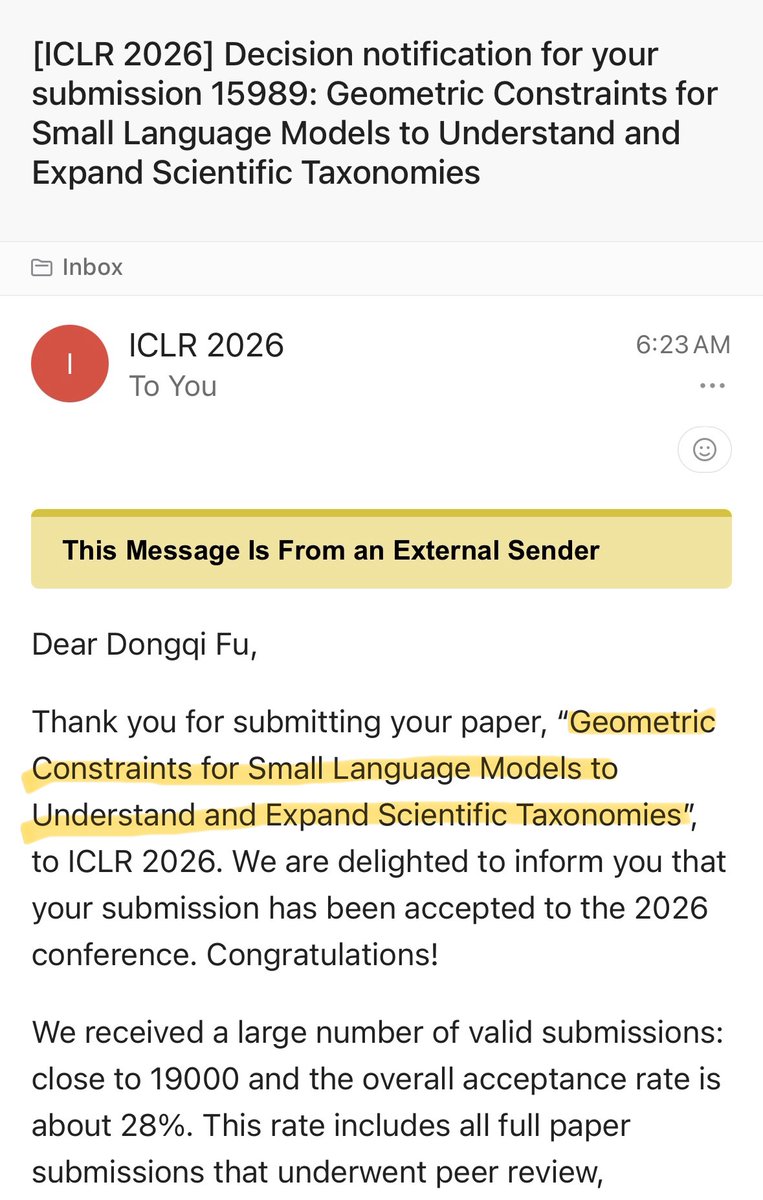
🎉7 Papers Recently Accepted: 4 at #ICLR 2026, 1 at #WSDM 2026 (Industry), 1 at #EDBT 2026 (Industry), and 1 at #EACL 2026 (Findings) Covering: 𝐂𝐨𝐧𝐭𝐞𝐱𝐭 𝐆𝐫𝐚𝐩𝐡, 𝐌𝐋𝐋𝐌 𝐑𝐞𝐚𝐬𝐨𝐧𝐢𝐧𝐠, 𝐆𝐞𝐨𝐦𝐞𝐭𝐫𝐲 𝐰𝐢𝐭𝐡 𝐋𝐋𝐌𝐬, 𝐇𝐢𝐞𝐫𝐚𝐫𝐜𝐡𝐢𝐜𝐚𝐥 𝐑𝐞𝐭𝐫𝐢𝐞𝐯𝐚𝐥
Dongqi Fu tweet mediaDongqi Fu tweet mediaDongqi Fu tweet mediaDongqi Fu tweet media
English
2
0
3
491
Dongqi Fu retweetledi
elvis
elvis@omarsar0·
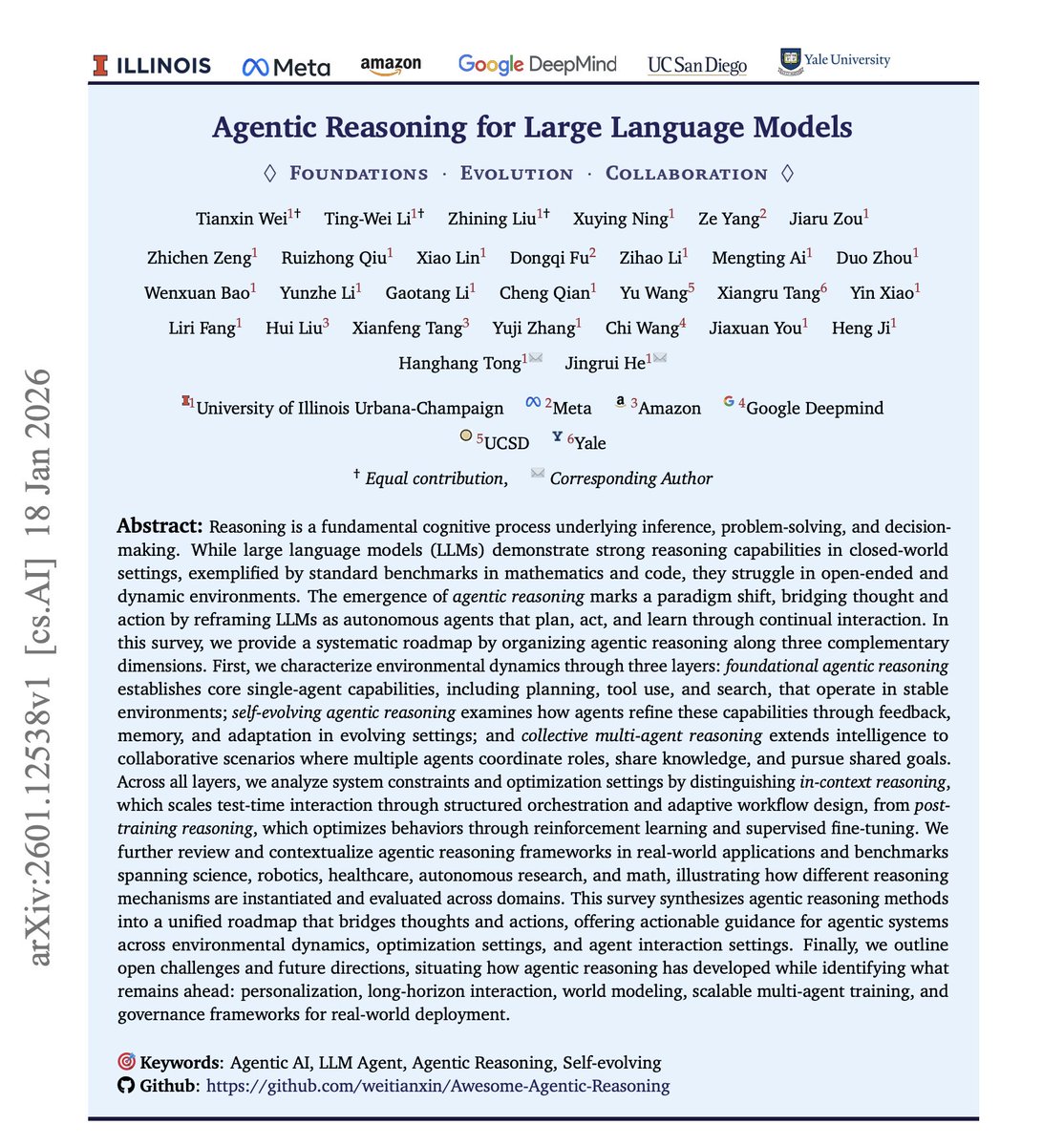
Impressive survey on agentic reasoning for LLMs. (bookmarks this one) 135+ pages! Why does it matter? LLMs reason well in closed-world settings, but they struggle in open-ended, dynamic environments where information evolves. The missing piece is action. This is because static reasoning without interaction cannot adapt, learn, or improve from feedback. This new survey systematizes the paradigm of Agentic Reasoning, where LLMs are reframed as autonomous agents that plan, act, and learn through continual interaction with their environment. It provides a unified roadmap that bridges thoughts and actions, offering actionable guidance for building agentic systems across environmental dynamics and optimization settings. The framework organizes agentic reasoning along three complementary dimensions: 1. Foundational Agentic Reasoning: Core single-agent capabilities including planning, tool use, and search. Agents decompose goals, invoke external tools, and verify results through executable actions. This is the bedrock. 2. Self-Evolving Agentic Reasoning: How agents improve through feedback, memory, and adaptation. Rather than following fixed reasoning paths, agents develop mechanisms for reflection, critique, and memory-driven learning. Reflexion, RL-for-memory, and continual adaptation link reasoning with learning. 3. Collective Multi-Agent Reasoning: Scaling intelligence from isolated solvers to collaborative ecosystems. Multiple agents coordinate through role assignment, communication protocols, and shared memory. Debate, disagreement resolution, and consistency through multi-turn interactions. Across all layers, the survey distinguishes two optimization modes: in-context reasoning (scaling inference-time compute through orchestration and search without parameter updates) and post-training reasoning (internalizing strategies via RL and fine-tuning). The survey covers applications spanning math exploration, scientific discovery, embodied robotics, healthcare, and autonomous web research. It also reviews the benchmark landscape for evaluating agentic capabilities. I have been looking closely at this area of research, and here are some of the open challenges that remain: personalization, long-horizon interaction, world modeling, scalable multi-agent training, and governance frameworks for real-world deployment. Paper: arxiv.org/abs/2601.12538 Learn to build effective AI agents in our academy: dair-ai.thinkific.com
elvis tweet media
English
16
117
554
43.7K