Leonid Sirota

10.4K posts

Leonid Sirota banner
Leonid Sirota

Leonid Sirota

@DoubleAspect

Legal academic, Associate Professor @UniRDG_Law. Mostly public law, dabble in jurisprudence; blogger, also mostly on (Canadian) public law.
Reading, England Katılım Kasım 2012
269 Takip Edilen2.7K Takipçiler
Sabitlenmiş Tweet
Leonid Sirota
Leonid Sirota@DoubleAspect·
Хай живе вільна Україна!
Українська
2
2
18
0
Leonid Sirota retweetledi
Phil Magness
Phil Magness@PhilWMagness·
Maybe Marx wasn't a real Marxist after all ;-)
Phil Magness tweet media
English
9
44
374
7.4K
Leonid Sirota retweetledi
Henrick Johansson
Henrick Johansson@compliantvc·
A trolley is about to hit 5 people laying on the track You can redirect the car, but the other track has not yet reached regulatory approval or completed its 1 year environmental testing period, so operating a train car on it is a violation of transit regulations What do you do?
Henrick Johansson tweet media
English
552
693
8.5K
547.3K
Leonid Sirota
Leonid Sirota@DoubleAspect·
My latest for JOTWELL is a review of a forthcoming article by Lewis Graham on the use of the interpretive powers under s 3 of the Human Rights Act 1998 by UK courts: conlaw.jotwell.com/doctrine-by-th…
English
0
4
7
944
Leonid Sirota retweetledi
The Alex Nowrasteh
The Alex Nowrasteh@AlexNowrasteh·
Nationalists are the reason why people have a low opinion of nationalism. A reader didn't like our case against nationalism. He wrote an email that shows @IlyaSomin & I correctly described nationalism and the motivations of the nationalists themselves. nationalaffairs.com/publications/d…
The Alex Nowrasteh tweet media
English
2
13
37
2.3K
Leonid Sirota
Leonid Sirota@DoubleAspect·
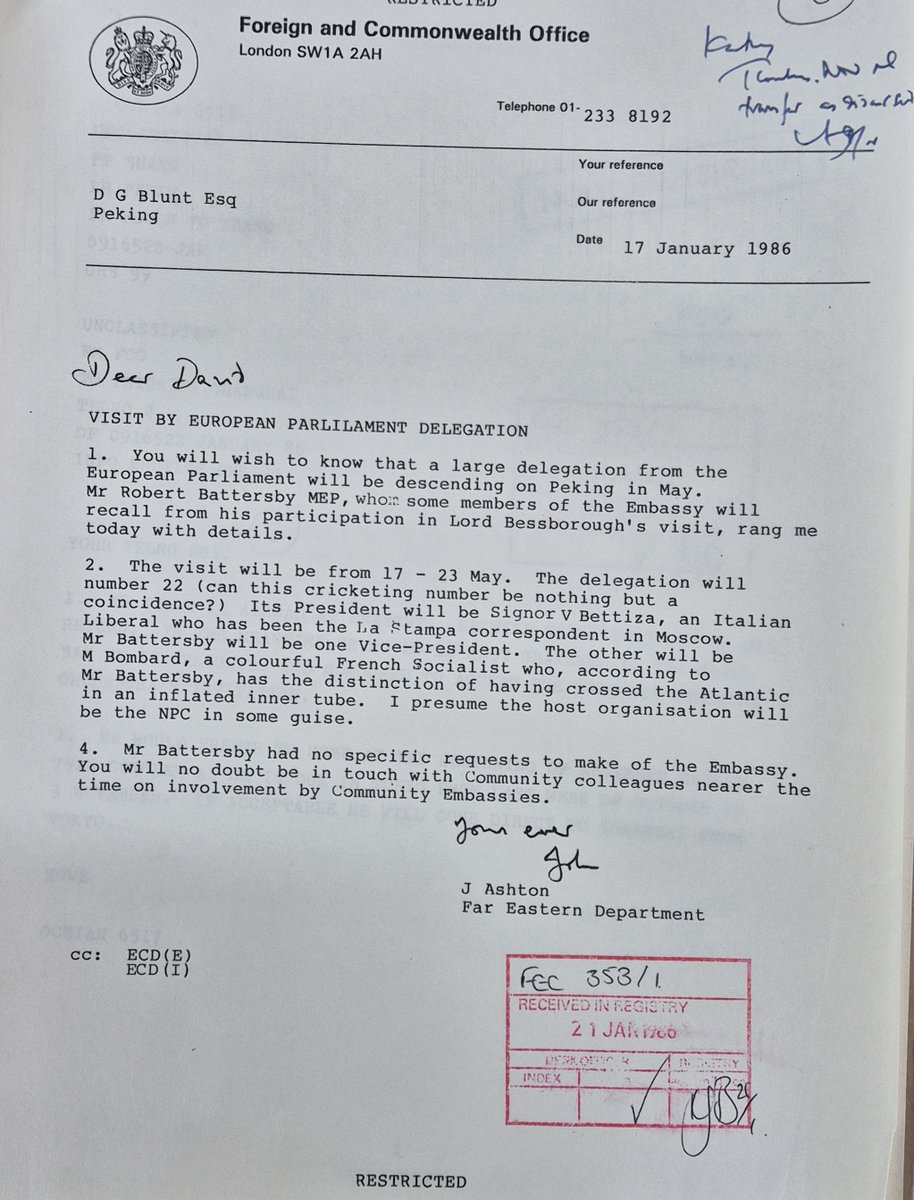
@exPremiers It wasn't quite an inflated inner tube... but it was a remarkable story.
Leonid Sirota tweet media
English
1
0
1
85
Peter Just
Peter Just@exPremiers·
✍️🏻 'A colourful French socialist who...has the distinction of having crossed the Atlantic in an inflated inner tube.' 📘 When I get round to writing, 'In search of Former Prime Ministers: tales from research and retail', it's going to filled with gems such as this find today.
Peter Just tweet media
Peter Just@exPremiers

🔍 Another day at The National Archives in pursuit of life after Downing Street and to do initial research for an exciting new Margaret Thatcher - non-life after Downing Street - project about which I look forward to sharing more soon.

English
3
1
5
2.9K
Leonid Sirota retweetledi
Phil Magness
Phil Magness@PhilWMagness·
One of the most notable failures of the leftwing pundit and academic commentariat scene over the 15 years is how they completely misdiagnosed the dynamics of what was happening on the American right. They dreamt up fantastical conspiracy theories about the history of "neoliberalism" and "market fundamentalism," both pejorative caricatures. And they focused their energies on attempting to show how all of their own political grievances, which were mostly economic in nature, traced back to Mises, Hayek, Friedman, and/or Buckley. In the process, the left punditry almost entirely missed the emergence of the Postliberal right, which also shares their own animosity toward Mises, Hayek, Friedman, and Buckley. When Deneen's book appeared in print, they joined Obama in soft praise for its "provocative" thesis. When JD Vance burst onto the scene with Hillbilly Elegy, they accepted him as a respectable and perceptive critic of alleged free market "excesses" from the right (and only really soured on him when he became a Trumpist cultural warrior). They barely even noticed Adrian Vermeule's rehabilitation of Nazi theorist Carl Schmitt, save to also afford it intellectual respectability since (a) he was a Harvard elite who coauthored with progressives and (b) there was also a progressive strain of Schmittian rehabilitation in this same period. The left-pundits of this era also spilled barrels of ink trying to prove that Pat Buchanan's cultural crankery transmitted to the present day via the late-life political alliances of Murray Rothbard. In reality, Rothbard was simply trying to latch himself onto Buchanan, whose movement predated and was much larger than the paleolibertarian scene. And now that Buchananite movement has grafted itself into Trumpism as well, without any discernible influence of Rothbard whatsoever. The result is that the left-pundit class of the 2010s now struggles to comprehend the divisions on the right, even though the evidence is all around them. They can't process how much Buckley's Fusionism is despised by the Postliberal & Buchananite crowds that migrated into Trumpism. They can't comprehend how Postliberals like Deneen, Vermeule, and Pappin embrace anti-capitalist economic narratives that are not far removed from their own positions. They don't understand how the same Postliberals have adopted their own narratives and pejorative screeds about "neoliberalism" and "market fundamentalism." All they can do is repeat the same old tropes of the 2010s "neoliberalism studies" genre, and hope that by repeating the name "Trump" enough they can somehow make it stick to a Postliberal intellectual scene that, just like the far left, also views what it calls "neoliberalism" as its primary enemy.
John Ganz@lionel_trolling

All false again

English
17
51
351
106.5K
Leonid Sirota retweetledi
Orin Kerr
Orin Kerr@OrinKerr·
Niche tweet, but there's a lot of discussion of "viewpoint diversity" in academic hiring, and what it means, and whether it's an affirmative good. In law schools, at least, I think it's a good thing and important. I thought I would say what I think viewpoint diversity is, and why I think it's good and important in academia—focused, at least for now, on scholarship. (As I said, it's a niche tweet—feel free to skip.) I'll start with an observation. One of the things you realize when you start law school is that legal argument is a cultural practice and a language, not a science governed purely by logic. As a result, whether a particular legal argument is deemed persuasive often depends on the legal culture that the judge who is to be persuaded is steeped in, and how the lawyer has framed the issue in light of that legal culture. There are some parts of the legal culture that are broadly shared by essentially all lawyers. But the legal culture splinters, too. On a lot of topics, there is no one prevailing legal culture, but rather two or more different legal cultures. To pick an accessible example, you may have one group that sees a close reading of text as the important part and policy and purpose as sideshows, while another group sees policy and purpose as the focus while the details of text are side shows. Often, these different legal cultures emerge organically from different political or ideological perspectives, which themselves change over time. It's human nature, I think. People are naturally enthusiastic about the modes of legal thinking that tend to deliver results they like. Over time, they gravitate to modes of thinking that have tended to lead to those results. People won't see themselves as result-oriented in coming to those views. Rather, they will just notice (being insightful people) that certain modes of thinking usually lead to pretty inherently attractive outcomes, and the principled arguments for those modes of thinking will be more present in their minds than the principled arguments against them. Attitudes towards the different schools of thought tend to follow. Every approach has its principled arguments for and against—no approach is perfect. But people will naturally focus on the principled arguments in favor of viewpoints that lead to results they see as fundamentally heartwarming, positive, or great. And on the flip side, they will naturally focus on the the principled arguments against viewpoints that tend to lead to results they see as fundamentally troubling or terrible. What does this have to do with viewpoint diversity in academic hiring? A lot, I think. First, when it comes to evaluating the merit of scholarship during the hiring process, professors naturally tend to put a thumb on the scale of work within their subcultures. Scholarship speaking from within their legal subculture will resonate with them more than scholarship speaking from a different subculture. It's enough of a difference that, if they're not paying attention to the dynamic, what they casually perceive as just trying to hire the best people will often mean trying to hire the best people among those within their particular legal subculture. As I see it, the importance of "viewpoint diversity" starts with just being aware of this limit to our own perceptions and the need to overcome our own biases. In law, at least, you tend to hire the best people only when you're aware that good ideas don't only come from the particular legal subculture that you personally live in, and that you need to try to step outside yourself to see that people with other views and assumptions have good ideas, too. So that's the start, and it's basically just about overcoming our own biases as we try to measure merit. The next part of it is the belief, based on experience, that a clash of ideas tends to sharpen them. Scholarly ideas are like a muscle. They need to be stressed to become strong. I can't be sure if I'm right unless I encounter someone who disagrees with me and who challenges me, and who forces me either to defend my view or change it. Ideally, the challenge is not just on a minor point, like how best to express an idea, but on a more fundamental issue like whether the basic premises of the argument are right or wrong. A big benefit of viewpoint diversity is that it tends make that clash of ideas a lot more likely. If everyone basically thinks the same way, there are less likely to challenge basic premises. They won't think of basic critiques as readily, and they won''t be as willing to raise them, as those outside their subcultures would be. So to make your own work stronger, it's far more valuable to get feedback from those who don't share your basic premises than those who do. Having viewpoint diversity on a faculty creates an environment that makes it more likely to strengthen scholarship among those in the majority group. This second value of viewpoint diversity doesn't have an obvious normative "to do" in response. Different people will have different senses of what it should lead to. Maybe it simply emphasizes the importance of the de-biasing discussed above. And it doesn't mean just (roughly) left and right, or left and center, or political ideology: Different subcultures can be different methodologies, PhD disciplines, and different subject areas, too. But I think that clash of ideas based on different views of the law is a key way to improve legal scholarship, and that having viewpoint diversity makes that clash more likely to happen. There are other benefits to viewpoint diversity, I think. I haven't addressed those to students in class, who get to learn different worldviews in their courses that can help them persuade judges from different worldviews, too. But this tweet was long enough.
English
3
11
71
17.9K
Leonid Sirota retweetledi
Phil Magness
Phil Magness@PhilWMagness·
Academia postures as a meritocratic institution, but if you've spent any time there you've likely encountered what I refer to as the Sneer Club. The Sneer Club consists of people with thin CVs and little scholarly achievement who nonetheless claim high status in academia through their elite connections. Mistaking this status for personal accomplishment, they then sneer at any research finding by non-elites that challenges their own priors. Sneer Club types see no obligation to rebut that work, nor even establish themselves as experts on a subject before weighing in. They think their status alone is sufficient. That status almost always comes from a peripheral accomplishment that borrows on the reputation of others. Often, it means they studied at an Ivy League program and parlayed a PhD from Harvard, Princeton, or Yale into a string of postdocs, fellowships, and faculty roles despite never doing anything of note in their claimed area of expertise. Other times it means they did their dissertation under a famous scholar, who then called in nepotistic favors to get them a job. And then there are those who combine the two: students of a famous scholar at an elite department, who rely upon that affiliation as their main mechanism of career advancement. You can almost always tell a Sneer Club type by looking at their CV. It will feature a list of fancy degrees and/or the name of fancy advisors, and a string of prestigious postdoc or fellowship appointments. They're often on the decadal dissertation plan as well, having taken an inordinately long period of time to finish a graduate degree that most people complete in half that time. What you won't find on a Sneer Club resume is anything remotely resembling scholarly research achievement. Some will list a "Big Book Project" that's been pending since grad school and that somehow always has a completion date around 8 years out from now. Others will list low grade political op-eds in Jacobin, the New Left Review, Current Affairs, or, for right wing Sneer Club members, American Affairs. If you're lucky, you might see a book review or a minor article in a C-list journal with 3 citations. But everything else about their research output screams mediocrity. That doesn't stop the Sneer Club types from weighing into subjects beyond their competencies. Quite the contrary - they have prestige degrees or a famous advisor, and that's more than sufficient to pass judgment. Furthermore, if you have actual scholarly achievement in an area where they don't, they'll dismiss it on gratuitous grounds. They'll invent a conspiracy theory that explains how you got through peer review, or they'll baselessly claim your work is tainted by undisclosed "dark money." In short, they'll trade sneers as a replacement for substance. The deleterious effect of this pattern includes a sustained decline in the reputation of higher education, because few things are more off-putting to the public than entitled elites.
English
13
14
164
19.7K
Charles Reding
Charles Reding@CharlesReding67·
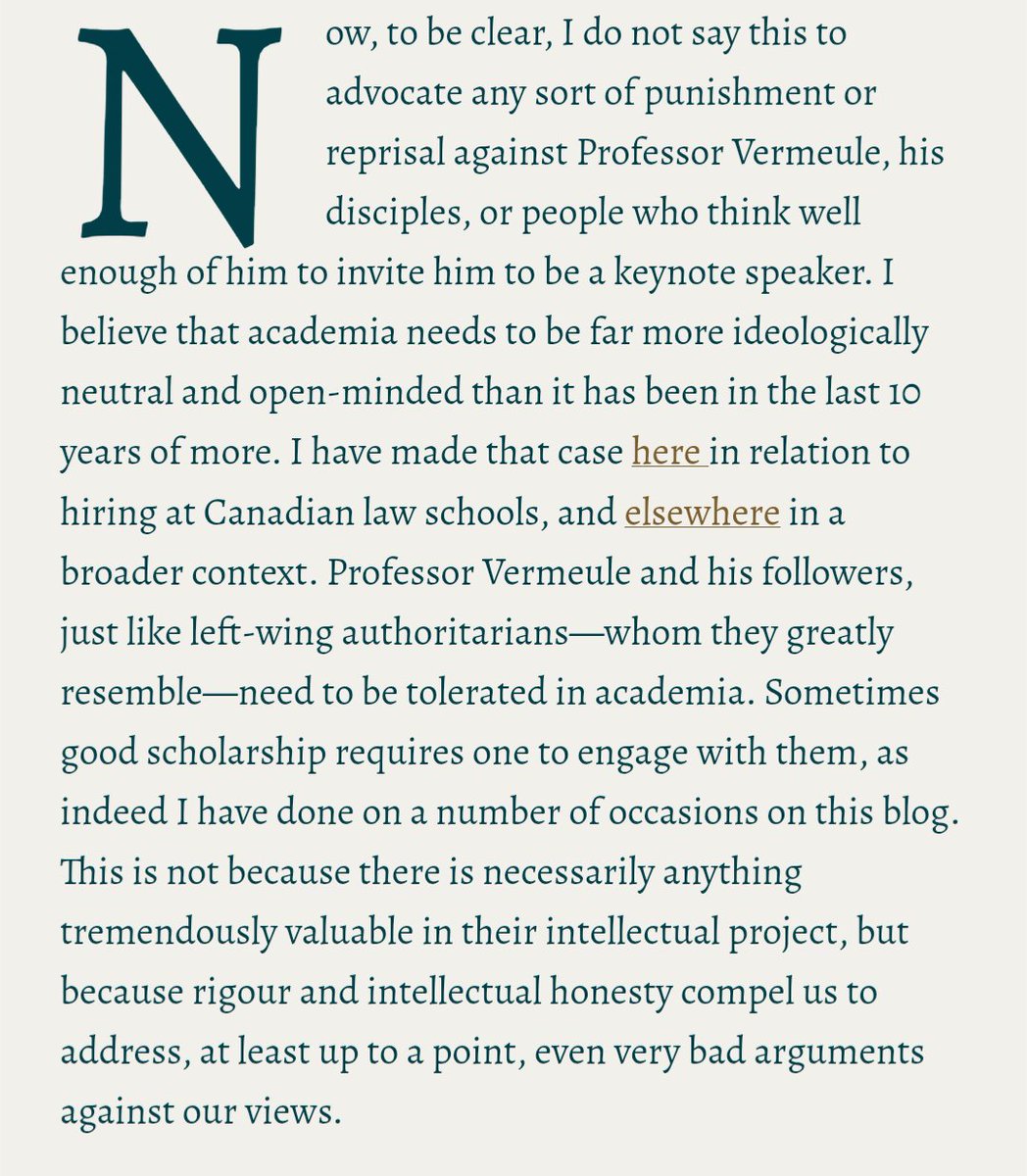
@DoubleAspect @kvallier @philippilk You frame him as not worth engaging with except to refute "even very bad arguments against our views" - on this question you are actually to the left of Elana Kagan
Charles Reding tweet mediaCharles Reding tweet media
English
1
0
4
90
Leonid Sirota
Leonid Sirota@DoubleAspect·
@CharlesReding67 @kvallier @philippilk Worth noting, too, that Vermeule had blocked me here before I had written this or any other direct criticism. So it's pretty rich to hold up my criticism of him as a default on the duty of scholarly engagement.
English
1
0
0
51
Leonid Sirota
Leonid Sirota@DoubleAspect·
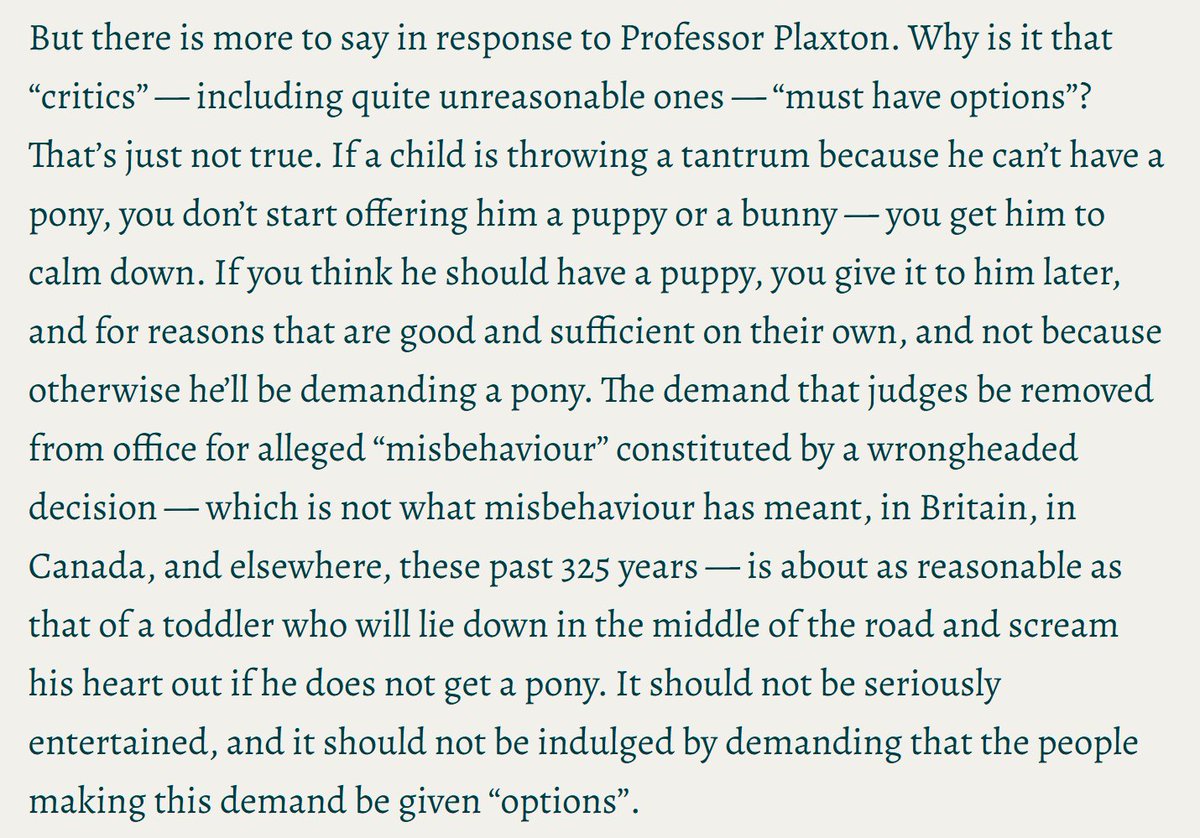
New post: if you care about the Rule of Law, you need to work to make the Supreme Court of Canada care too — not give populists "options" for blowing it up. Link below.
Leonid Sirota tweet media
English
2
2
5
1.5K
Leonid Sirota
Leonid Sirota@DoubleAspect·
New post: attempts to defend the Supreme Court's inconsistency on account that it is not as bad as it seems do not succeed, and this matters — not just for the sake of theoretical purity. Link below.
Leonid Sirota tweet media
English
1
0
1
697
Leonid Sirota
Leonid Sirota@DoubleAspect·
ICYMI: Perhaps the Supreme Court's comments on constitutional interpretation in Alford are just noise. But the thing is, so is everything it says on the topic. doubleaspect.blog/2026/05/06/the…
English
0
0
0
430