Draupnir

27 posts

Draupnir banner
Draupnir

Draupnir

@DraupnirAlpha

Katılım Mayıs 2026
60 Takip Edilen85 Takipçiler
Draupnir
Draupnir@DraupnirAlpha·
You buy every dip in $HLIT with both hands
English
0
0
0
205
Finn Stockinger
Finn Stockinger@FinnStockinger·
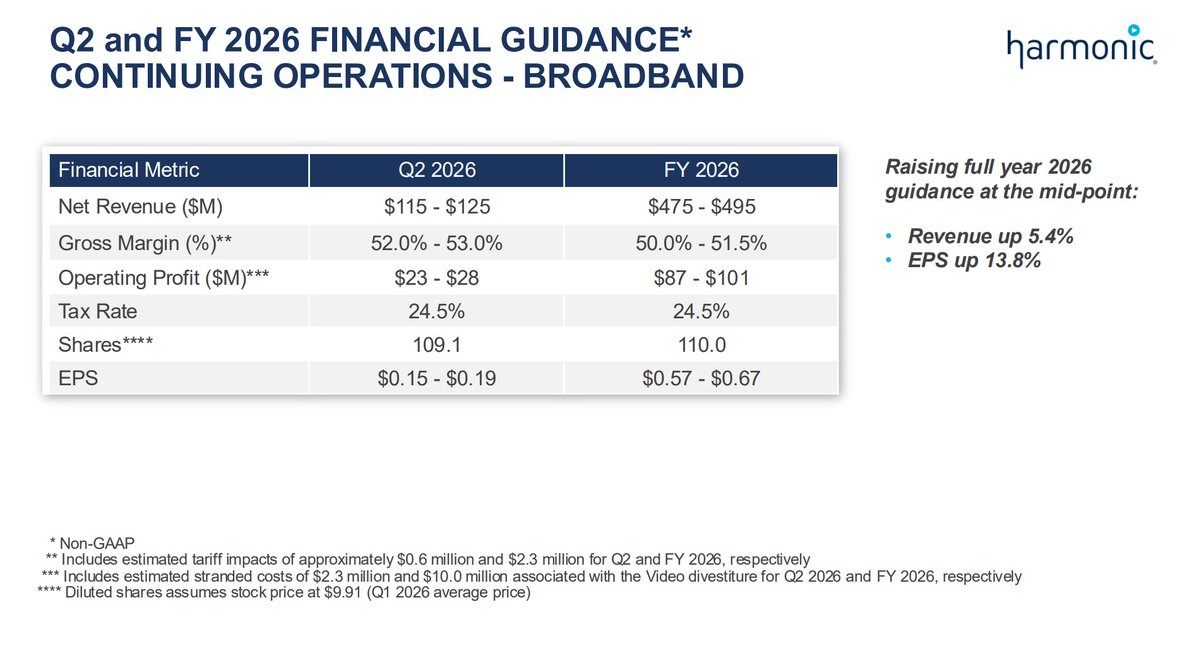
$HLIT I’ve been watching this company for two weeks (since their solid earnings report). It has been getting a lot of attention lately, and while I might not be the most original here, I really like what I see. But investing isn't about being original; it's about making money. I haven't bought any shares today, but I am strongly considering it. First of all, big congratulations to @KawzInvests, @CKCapitalxx , and @michaelsikand for pulling this Cinderella out of the shadows and onto the main stage. Excellent fundamental eye. Here is a little secret - I currently work in the ICT industry, so I see this market from the inside. I recently found out that the first smaller tier operator in my country has started deploying Harmonic’s solutions. The market giants haven't made the move yet - yet, because given current technical realities, they simply have no other choice. This means one thing: we are still incredibly early. @KawzInvests has written extensively about the adoption wave in the US, but I am looking at this from Europe. This is a massive market where infrastructure challenges are often significantly worse due to extreme population density and decades-old urban layouts. So not only US, but whole world is global TAM. Here is my view of $HILT story 1⃣The Infrastructure War: Squeezing HFC and xPONTo understand the investment thesis for $HLIT, you have to look underground at the physical and financial constraints of global broadband delivery: ➡️HFC (Hybrid Coaxial-Fiber): This is the dominant legacy footprint owned by cable giants. Historically, it’s an operational nightmare - prone to RF signal attenuation, "ingress noise" (interference leaking into old copper lines), and dependent on a delicate cascade of physical, power-hungry analog amplifiers that fail during seasonal temperature swings. ➡️xPON (Pure Fiber-to-the-Home): Regarded as the long-term endgame, but operators face immense deployment bottlenecks. Tearing up dense European cities to lay new fiber to every single doorstep requires unimaginable capital expenditures (CAPEX) and years of bureaucratic permitting. Furthermore, xPON relies on shared bandwidth architecture; as data traffic explodes, existing optical lines experience severe split-ratio congestion at the central offices. ⬇️Where Harmonic steps in: Their cOS platform (virtualized CMTS) completely digitizes the hardware architecture, commanding an absolute monopoly in the virtualized core. The software platform now powers 150 customers globally, serving 45.7 million connected devices. For HFC cable operators, cOS replaces failure-prone analog headends with centralized software and simple, dumb optical nodes. By upgrading to the DOCSIS 4.0 standard via software, operators achieve multi-gigabit symmetric speeds over their already deployed and fully depreciated coaxial assets. But here is the critical expansion: Harmonic is now a fiber play as well. For xPON networks, Harmonic’s cloud-native virtual OLT solutions allow fiber providers to decentralize and virtualize their optical routing. Instead of building massive, expensive new hardware aggregation hubs to solve fiber congestion, operators use Harmonic's software to dynamically allocate and optimize bandwidth across existing fiber strands. Whether it is cable or fiber, Harmonic acts like DSP (Digital Signal Processing) did for telephone wires decades ago - it squeezes unprecedented life and efficiency out of an existing medium. Paying Harmonic for software is a pure financial play for infrastructure giants to extract maximum ROI from historical CAPEX. 2⃣Business Model and TAM Expansion Harmonic does not target your local neighborhood ISP. Their sales model exclusively targets large-scale Tier-1 infrastructure operators managing millions of subscribers. They monetize this via a highly predictable Hardware-Enabled Software hybrid model: ➡️The Initial Hook: They sell physical optical nodes and hardened appliances to the operators. The gross margins on these are lower due to hardware manufacturing and global chip costs. ➡️The High-Margin SaaS Core: To run those nodes, operators must purchase ongoing subscription licenses for the cOS software core, billed per active connected customer modem. This drives a highly recurring, high-margin revenue stream. ➡️The Addressable Market: The market for core virtualized cable infrastructure is scaling toward $1 Billion by 2030. Concurrently, by utilizing the cOS ecosystem to aggressively break into the pure fiber access market (Remote OLT), Harmonic is tapping into an additional global fiber TAM of over $2.5 Billion. As an agile new entrant in pure fiber, Harmonic already saw fiber products represent over 14% of its appliance and integration revenue over the past year. 3⃣Dissecting the Financial Reality The latest financial statements validate the immense operating leverage of this software-centric pivot: ➡️The Strategic Corporate Cleansing: On March 20, 2026, Harmonic formally executed a definitive Asset Purchase Agreement to sell its legacy, low-margin Video business to MediaKind for $145 million in cash. The transaction is on track to close during this current quarter (Q2 2026). The Video segment has already been moved to "discontinued operations," leaving HLIT as a pure-play broadband tech stock. ➡️Top-Line Surge: Pure Broadband revenue from continuing operations rose an impressive 43% year-over-year to $121.7 million (beating management’s own guidance range of $100M–$105M). ➡️Guidance Hiked & Backlog Up: Backed by accelerating commercial traction, management officially raised full-year broadband revenue guidance to $475M–$495M. Total broadband backlog and deferred revenue grew 87% YoY to a record $582.1 million, with 60% contractually obligated to convert to revenue within the next 12 months. ➡️De-risking Customer Concentration: Bears always point out HLIT's historical reliance on Comcast. However, the latest data reveals a massive structural shift: HLIT’s "Rest-of-Market" (non-top 2 clients) segment grew an explosive 78% YoY, now accounting for 42% of total revenue, driven directly by international Tier-1 rollouts - particularly across dense European footprints. ➡️The Margin Counter-Weight: To remain completely objective, watch the near-term margins. While Broadband non-GAAP gross margins were strong at 54% in Q1, full-year non-GAAP guidance sits at 50%–51.5% due to a temporary $6 million macro headwind from elevated global memory component costs (RAM/Flash) used in initial product hardware ramps. The Summary👇 Thanks to my background in the ICT sector, I can see that the modernizing wave hitting Europe is just the tip of the iceberg. When the Video divestiture closes this quarter, Harmonic will enter H2 as a debt-free, cash-rich pure-play broadband machine with absolute market dominance. As Wall Street permanently shifts its valuation models from low-multiple telecom hardware to high-multiple enterprise software metrics, a major structural re-rating is highly likely. I really consider to join to this party tomorrow.
Finn Stockinger tweet mediaFinn Stockinger tweet mediaFinn Stockinger tweet mediaFinn Stockinger tweet media
KawzInvests 🦑@KawzInvests

$HLIT (~$1.65B) controls more than 95% of the software that every major US cable company needs to upgrade their network for the AI era. Every time you stream, video call, or ask an AI app a question, that data runs through a cable line owned by Comcast, Charter, or Cox. Upstream traffic is now growing 21.7% a year and the old cable standard cannot keep up. The fix is called DOCSIS 4.0. It takes cable from 1 Gbps to 10 Gbps with much faster upload speeds. Every Tier-1 operator is being forced to upgrade or lose subscribers to fiber. There is only one company that sells the software to run those upgraded networks at scale. HLIT. Comcast, Charter, Cox, and Altice all run its cOS platform. 150 customers and 45.7M cable modems live on it today. Charter alone has committed $5.5B to this upgrade through 2027. Every single node they deploy requires an HLIT license. Q1 revenue grew 43% YoY and beat the top of guidance by 16%. Backlog hit $582M, up 87% YoY and 1.2x full year revenue guidance. The biggest cable upgrade cycle in history is already booked. The chips and the lasers get all the attention. The toll booth between AI demand and your living room is hiding in plain sight. Full deep dive in the comments. $HLIT $CMCSA $CHTR $CALX

English
15
14
146
22.4K
Draupnir
Draupnir@DraupnirAlpha·
Interesting article, one big point to mention: Cox was already using Vecima's DOCSIS 4.0-capable DAA nodes — the distributed access hardware — before the vCMTS selection. Cox didn't switch from HLIT to Vecima. Cox was never an HLIT customer. They were a Vecima DAA hardware customer who then logically selected Vecima's complementary vCMTS software to run on top of their existing Vecima hardware infrastructure. The Cox/Vecima relationship was built bottom-up from the DAA hardware layer. Cox chose Vecima's vCMTS because they already had Vecima RPDs deployed - switching to cOS would have meant running HLIT software on top of Vecima hardware, which creates integration complexity. They chose the vertically integrated Vecima stack. That's not a statement about cOS quality. That's a statement about switching costs working in Vecima's favor within the Cox footprint.
English
1
0
1
66
Draupnir
Draupnir@DraupnirAlpha·
$IQE $IQEPF vs LandMark The market is paying 118x revenue for a Taiwan-based CPO epiwafer supplier with no defense relationships and 3 patents. It's paying 6x revenue for a UK/US-based CPO epiwafer supplier with 15-year Raytheon qualification, BAE Gold Tier status, Lumentum and MACOM LTAs, Point72 and Artisan on the register, explicit government supply chain protection, and a £45M strategic anchor investment. The gap between those two valuations is the IQE opportunity in one number....
English
4
1
13
1.5K
peony abdul
peony abdul@peonyKingOF·
if market closes up, probably gonna pick up a couple more boxes of tempura chicken nuggets from sam's club tonight
English
4
0
23
2.6K
Draupnir
Draupnir@DraupnirAlpha·
@kevinxu Kevin's just find out swing trading works better when you dont pick dogshit stocks
English
3
0
14
3.1K
Kevin Xu
Kevin Xu@kevinxu·
let's just say there's a reason i had to rush all in $HLIT on friday my instinct told me
Kevin Xu tweet media
Kevin Xu@kevinxu

NEW TRADE: ALL IN $HLIT. Currently -2% lower than my own entry btw. They make broadband software for companies like Comcast, Charter, etc. I spent 2 hours researching the ticker here on 𝕏 and think it could be a good one. THESIS: Huge pull-forward demand to future-proof for an agentic AI world. Similar to $NOK but for broadband networks. Citrini shouted it out yesterday after hours x.com/citrini/status… which caused the +15% jump Agentic AI usage patterns will look quite different than previous networking demands (mostly one-way like video). So there's a huge push to modernize quickly. Their CableOS software is the easiest way to do it. The company is legit: - 98% market share - Revenue is up 87% YoY, 43% QoQ - 52% gross margins - Guidance raised to $475M - $495M - $43M in stock repurchases - Lots of insider, hedge fund, and robinhood buying - Stock price peaked at $157.50 back in 2000 🤯 They also sold their legacy low growth video business to focus on the high-margin software. Good focus. Catalyst is... price momentum honestly. Similar to $BAND over the last few weeks. Crossing fingers its the start of a multi-day run. I hate chasing. NGL I broke this rule here. Had to listen to my gut. Also worth experimenting with my own rules. Different markets demand different rules and not chasing this year has left me missing several good plays. We'll see how good my gut still is. My doctor says its healthy. --- As a reminder: this is my challenge account where I restarted with $35k to go all-in swing trading 1 stock at a time to $10M again. Now at $61k. As always, please do your own research with your own independent thinking and risk tolerance and decide your own buys and sells. (sorry for the delay, was dealing with a power outage and had to run to a cafe)

English
59
9
262
87.4K
John Galt
John Galt@AtlasShrug1·
2 things: 1. That won’t be the best hedge when the market blows up. Most ppl here have never seen a recession or a real bear market. If you buy the top especially in tech, it can take 10-15 yrs just to get back to even. $CSCO was the $NVDA of the 1990s and it finally made a new ATH 36 years later. 2. Anyone who thinks writing pieces on substack is career will be doubly f’d. Bc when these stocks go out of favor, both their portfolios and “careers” if u can call it that will be decimated simultaneously.
English
2
0
17
906
Luc
Luc@investingluc·
If you are worried about AI blowing up your job/life, the single best hedge is to simply own assets. Do whatever you can to get more skin in the game. If you make $100K at your 9-5, invest as much of that as possible. Get exposure. Future belongs to owners, not workers.
English
45
24
342
23.7K
leki ⚔️
leki ⚔️@mkfilko·
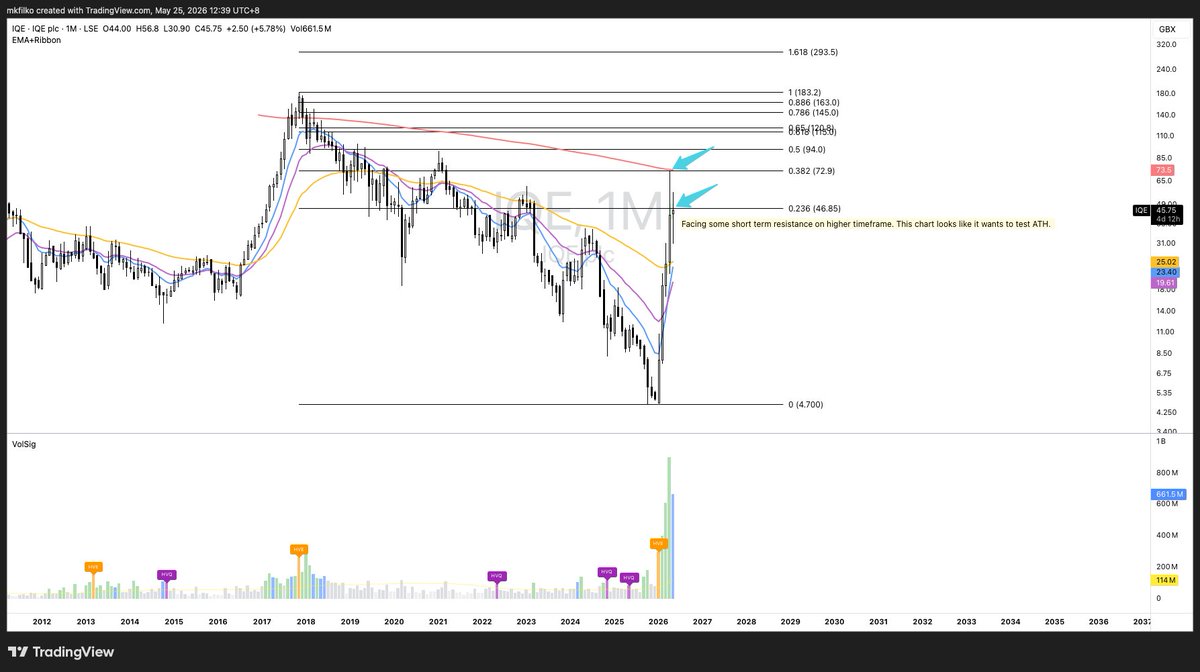
$IQE.L $IQEF $IQE @DraupnirAlpha has written a concise and comprehensive view on $IQE here, wanted to do a deep dive but I think he more than covers it. Fundamentally, this company is definitely going to be an important one to watch for in time to come. Please give him a follow, underrated af account, he showed me that $SHMD was worth a second look. Let me give a second perspective through TA. You don't want to miss this: On the monthly chart, the 0.236 Fibs and 0.386 Fibs were perfect resistance levels in the past 2 months, with the latter coinciding beautifully with the 200EMA (Red). I have marked it using cyan arrows. So we have to watch for these levels moving forward, but just seems like price is consolidating here after the initial run it had from 4p. On the daily chart, the EMA bullish stack is in place, with 10/20/50EMA all on top of each other. We are currently just right below the 0.236 level, and my custom volume indicator printed a HVQ candle (purple), the last time it printed, we rallied 200% to the 0.382 Fib level of 73p. We just printed the same thing a couple of days back, you know what that means? Another case of fundamentals matching up with technicals. I'm going long $IQE as soon as the UK stock exchange opens again tomorrow. Looks like it is done printing a bottom here.
leki ⚔️ tweet medialeki ⚔️ tweet media
Draupnir@DraupnirAlpha

Here's a new take on a popular name that I haven't seen touched on AT ALL on X so far. First, some background: $IQE / $IQEPF is a compound semiconductor wafer supplier. £448M market cap. $IQE makes advanced epitaxial wafers. The foundational material that makes semiconductors function at extreme frequencies and precision. Without IQE's wafers, the chips powering modern defense, photonics and AI infrastructure don't exist. Here's what nobody is connecting. $IQE is embedded inside every major U.S. defense prime. Let me emphasize this again. $IQE is a SOLE (not SINGLE) SOURCE vendor to all the Prime Aerospace and Defense companies in the United States. They CANNOT use LandMark as it is a supply chain risk. 🔹 RAYTHEON ($RTX) 15+ year direct partnership. Greensboro NC facility officially qualified for IR photodetector epiwafers powering advanced ISR systems. Multiple Premier Supplier Excellence and EPIC awards. Embedded. Qualified. Awarded. Not transactional. 🔹 BAE SYSTEMS GOLD TIER supplier to BAE Electronic Systems. The highest classification BAE awards. BAE builds defense, aerospace and security technology directly for the U.S. DoD. One of the most demanding qualification processes in defense. IQE passed it at the top level. 🔹 LOCKHEED + NORTHROP IQE's InP and GaAs wafers flow into Lockheed and Northrop platforms via $MACOM and Qorvo - integrated into RF and photonic systems inside the most advanced U.S. defense platforms in existence. Every major U.S. defense prime. One supplier. Indium Phosphide is not a commodity. It's a controlled, high-precision material. There are almost no qualified alternative suppliers at IQE's level. Qualification cycles take years. The moat is structural. The U.S. government knows this. The InP executive order was about defense supply chain security, protecting allied-nation suppliers of critical compound semiconductors. IQE's Welsh and U.S. fabs sit squarely inside that framework. Explicit government policy support for IQE's core business. $MACOM didn't just sign LTAs with IQE. They invested £45M directly - a 10% market cap injection from a company that needs IQE's InP supply to exist. Supply chain insurance dressed as equity. Debt repaid. Capex funded. Capacity redirecting to high-margin photonics. 🔹 $LITE (Lumentum) - flagship customer, LTA locked in. Lumentum is critical to the NVIDIA optical interconnect buildout. NVIDIA's photonics push flows through Lumentum. Lumentum's supply chain flows through IQE. Direct line from IQE wafers to the most important AI infrastructure buildout on the planet. The smart money noticed. 🔹 Point72 - Form 8.3 under UK Takeover Code. Steve Cohen's fund disclosed. 🔹 Artisan Partners — 12.99%. Multi-year conviction. 🔹 Lombard Odier — 200-year-old Swiss private bank. 🔹 T. Rowe Price — long duration institutional money. The Point72 Form 8.3 matters. Filed under Rule 8.3 of the UK Takeover Code — required during offer periods or takeover speculation. Point72 isn't just holding. They're disclosing under takeover rules. Someone knows something. The full picture: → Every major U.S. defense prime. One supplier. → InP executive order protection → $MACOM £45M strategic anchor → $LITE LTA → Point72. Artisan. Lombard Odier. T. Rowe. → £448M market cap This doesn't trade here once the market figures it out. The catalyst is Thursday. $IQE FY2025 results May 28. Defense positioning. MACOM investment. Photonics ramp. All formally presented post-fundraise for the first time. Thursday is the moment. $IQE $RTX $MACOM $LITE $MTSI

English
5
1
36
13.9K
Draupnir
Draupnir@DraupnirAlpha·
Here's a new take on a popular name that I haven't seen touched on AT ALL on X so far. First, some background: $IQE / $IQEPF is a compound semiconductor wafer supplier. £448M market cap. $IQE makes advanced epitaxial wafers. The foundational material that makes semiconductors function at extreme frequencies and precision. Without IQE's wafers, the chips powering modern defense, photonics and AI infrastructure don't exist. Here's what nobody is connecting. $IQE is embedded inside every major U.S. defense prime. Let me emphasize this again. $IQE is a SOLE (not SINGLE) SOURCE vendor to all the Prime Aerospace and Defense companies in the United States. They CANNOT use LandMark as it is a supply chain risk. 🔹 RAYTHEON ($RTX) 15+ year direct partnership. Greensboro NC facility officially qualified for IR photodetector epiwafers powering advanced ISR systems. Multiple Premier Supplier Excellence and EPIC awards. Embedded. Qualified. Awarded. Not transactional. 🔹 BAE SYSTEMS GOLD TIER supplier to BAE Electronic Systems. The highest classification BAE awards. BAE builds defense, aerospace and security technology directly for the U.S. DoD. One of the most demanding qualification processes in defense. IQE passed it at the top level. 🔹 LOCKHEED + NORTHROP IQE's InP and GaAs wafers flow into Lockheed and Northrop platforms via $MACOM and Qorvo - integrated into RF and photonic systems inside the most advanced U.S. defense platforms in existence. Every major U.S. defense prime. One supplier. Indium Phosphide is not a commodity. It's a controlled, high-precision material. There are almost no qualified alternative suppliers at IQE's level. Qualification cycles take years. The moat is structural. The U.S. government knows this. The InP executive order was about defense supply chain security, protecting allied-nation suppliers of critical compound semiconductors. IQE's Welsh and U.S. fabs sit squarely inside that framework. Explicit government policy support for IQE's core business. $MACOM didn't just sign LTAs with IQE. They invested £45M directly - a 10% market cap injection from a company that needs IQE's InP supply to exist. Supply chain insurance dressed as equity. Debt repaid. Capex funded. Capacity redirecting to high-margin photonics. 🔹 $LITE (Lumentum) - flagship customer, LTA locked in. Lumentum is critical to the NVIDIA optical interconnect buildout. NVIDIA's photonics push flows through Lumentum. Lumentum's supply chain flows through IQE. Direct line from IQE wafers to the most important AI infrastructure buildout on the planet. The smart money noticed. 🔹 Point72 - Form 8.3 under UK Takeover Code. Steve Cohen's fund disclosed. 🔹 Artisan Partners — 12.99%. Multi-year conviction. 🔹 Lombard Odier — 200-year-old Swiss private bank. 🔹 T. Rowe Price — long duration institutional money. The Point72 Form 8.3 matters. Filed under Rule 8.3 of the UK Takeover Code — required during offer periods or takeover speculation. Point72 isn't just holding. They're disclosing under takeover rules. Someone knows something. The full picture: → Every major U.S. defense prime. One supplier. → InP executive order protection → $MACOM £45M strategic anchor → $LITE LTA → Point72. Artisan. Lombard Odier. T. Rowe. → £448M market cap This doesn't trade here once the market figures it out. The catalyst is Thursday. $IQE FY2025 results May 28. Defense positioning. MACOM investment. Photonics ramp. All formally presented post-fundraise for the first time. Thursday is the moment. $IQE $RTX $MACOM $LITE $MTSI
English
3
1
16
7.8K
Draupnir
Draupnir@DraupnirAlpha·
@jasonschips Nobody ever mentions the impending dilution with $SIVE x.com/i/status/20566…
Draupnir@DraupnirAlpha

This one might be unpopular, but here goes: 🧵 $SIVE has run 1,200% in under a year. Management called the April raise "only 2.5% dilution." Here's why that framing is misleading — and what the filings actually show: 1. The 2.5% figure comes from Sivers' own April 16 press release (MFN.se). What they didn't headline: the denominator already includes ~41M shares of warrants, options and convertibles that don't show up in the basic share count. The 2.5% is technically accurate. The framing is not. 2. Do the math yourself: 8.62M new shares ÷ 2.5% = ~345M fully diluted shares. Basic count post-raise: ~304M. That 41M gap is real latent dilution sitting above the stock right now. Source: Sivers April 16 directed issue press release. 3. It gets worse. At the June 15 AGM (source: Sivers AGM notice, sivers-semiconductors.com), management is asking shareholders to authorize: → 7M new stock options (P11 program) → Power to issue 15% MORE shares (~46M) with NO further shareholder vote needed 4. Key dates the bulls aren't pricing in: 📅 June 15 — AGM. 15% blank-check authorization vote. 📅 Mid-July — 90-day insider lock-up expires. Board members, CEO, CFO free to sell. (Source: April 16 press release) 📅 Mid-October — 180-day company lock-up expires. New issuance open season. 5. Also confirmed in the AGM notice: a USD $12M convertible loan from Bootstrap Europe at 10.85% interest, maturing Dec 2029. At ~55 SEK/share it's deeply in the money. Conversion = more shares, no vote required. 6. Meanwhile (source: EFN.se, May 18): → Largest shareholder Achilles Capital: 18.2M shares in March → 0 today → CTO sold 42M SEK of stock outside FI disclosure requirements → Three board members leaving simultaneously → Foreign ownership jumped from 15% → 48%, primarily retail via custodian accounts 7. The fully diluted P/S at ~55 SEK: ~70x. Revenue 2025: SEK 307M (restated). Net loss: SEK 223M (also restated wider, source: Sivers 2025 annual report). Don't get me wrong, the CPO/InP thesis certainly seems to be real. However, the current price embeds perfect execution on a pre-revenue photonics ramp while insiders exit and the cap table expands. Read the filings. As always, NFA/DYOR.

English
1
0
0
533
Jason's Chips
Jason's Chips@jasonschips·
" $SIVE can reach $80b because $LITE is $80b" has to be the dumbest and most dangerous investment thesis ever. People will lose their savings listening to all this misinformation. It's sad and needs to stop (I am starting an anti $SIVE crusade). 1. $SIVE is not a bottleneck (despite it being the poster child of the photonics bottleneck craze). A bottleneck, by definition, must be the company that constrains the production of a massive downstream industry. To constrain production, you must both own hard physical assets and hold a dominant market share position. Sivers has neither. Sivers is a fabless design company that relies on WIN for Foundry services, and with revenues of ~$30 million, they hold near zero market share in the massive datacom laser industry. 2. Supply chain analysis is misleading. In semiconductors (or any industry producing a durable manufactured good) switching costs are near zero while process power, cornered resources, and scale dominate. Therefore, "who has a superior product" is far more important than "who supplies what to whom." CPO external light sources require quality lasers meeting noise (linewidth and RIN) and power (400mW+) specs. $SIVE lasers are far inferior to that of larger peers like $LITE. 3. $SIVE valuation is comically detached from reality. On NTM metrics, $LITE trades at 14x EV/Revenue and 32x EV/EBITDA while $SIVE trades at 50x and 650x (!!) those same metrics. As a permanent AI infra bull, I fully agree that consensus is too conservative; however, they are not off by two orders of magnitude. The misinformation needs to stop. Let's help actually help retail understand what they own.
Cyberpunk Sense 👑@napoleon21st

To be honest I do believe $SIVE can reach 80b market cap. It's in an exploding market and its peers have done it.... So what prevents them?

English
105
29
431
331.8K
Draupnir
Draupnir@DraupnirAlpha·
@JonkooTrades why does nobody mention the dilution overhang with SIVE? x.com/i/status/20566…
Draupnir@DraupnirAlpha

This one might be unpopular, but here goes: 🧵 $SIVE has run 1,200% in under a year. Management called the April raise "only 2.5% dilution." Here's why that framing is misleading — and what the filings actually show: 1. The 2.5% figure comes from Sivers' own April 16 press release (MFN.se). What they didn't headline: the denominator already includes ~41M shares of warrants, options and convertibles that don't show up in the basic share count. The 2.5% is technically accurate. The framing is not. 2. Do the math yourself: 8.62M new shares ÷ 2.5% = ~345M fully diluted shares. Basic count post-raise: ~304M. That 41M gap is real latent dilution sitting above the stock right now. Source: Sivers April 16 directed issue press release. 3. It gets worse. At the June 15 AGM (source: Sivers AGM notice, sivers-semiconductors.com), management is asking shareholders to authorize: → 7M new stock options (P11 program) → Power to issue 15% MORE shares (~46M) with NO further shareholder vote needed 4. Key dates the bulls aren't pricing in: 📅 June 15 — AGM. 15% blank-check authorization vote. 📅 Mid-July — 90-day insider lock-up expires. Board members, CEO, CFO free to sell. (Source: April 16 press release) 📅 Mid-October — 180-day company lock-up expires. New issuance open season. 5. Also confirmed in the AGM notice: a USD $12M convertible loan from Bootstrap Europe at 10.85% interest, maturing Dec 2029. At ~55 SEK/share it's deeply in the money. Conversion = more shares, no vote required. 6. Meanwhile (source: EFN.se, May 18): → Largest shareholder Achilles Capital: 18.2M shares in March → 0 today → CTO sold 42M SEK of stock outside FI disclosure requirements → Three board members leaving simultaneously → Foreign ownership jumped from 15% → 48%, primarily retail via custodian accounts 7. The fully diluted P/S at ~55 SEK: ~70x. Revenue 2025: SEK 307M (restated). Net loss: SEK 223M (also restated wider, source: Sivers 2025 annual report). Don't get me wrong, the CPO/InP thesis certainly seems to be real. However, the current price embeds perfect execution on a pre-revenue photonics ramp while insiders exit and the cap table expands. Read the filings. As always, NFA/DYOR.

English
0
0
0
63
The Trend Sage
The Trend Sage@JonkooTrades·
The customer list - $SIVE / $SIVEF This is the part that turns the chokepoint story from theory into reality. These are not speculation. Every one of these is either publicly disclosed by Sivers, by the counterparty, or strongly implied by industry insiders piecing together supply chain BOMs. • Ayar Labs - Sivers supplies the laser arrays for Ayar's SuperNova™ ELS module, which feeds the TeraPHY™ optical I/O chiplet. Ayar just closed a $500M Series E at ~$4B valuation. Investors include Nvidia, AMD, Intel, and MediaTek. MediaTek alone put in $90M. • $POET - POET Technologies - strategic partnership for ELS modules. POET is the long-time supplier to Celestial AI, which Marvell just acquired for $3.25B plus $2.25B in earn-outs. Marvell's CEO publicly guided $500M annual run-rate by end of FY28 and $1B by end of FY29 from Celestial. • O-Net Technologies - already inside Nvidia's existing pluggable supply chain. Sivers signed an OEM deal where O-Net integrates Sivers DFB laser arrays into ELSFP optical modules. • Enablence $ENA.NE + Jabil $JBL - ELS module mass production partners. • Aeva $AEVA - the unnamed strategic LiDAR customer that's ramping volume in Q4 2026. Aeva was just selected for Nvidia DRIVE Hyperion, targeting 2028 start of production. Sivers disclosed $53–138M cumulative revenue from this single customer over the program lifecycle. • ALL.SPACE - the only SATCOM provider in the world capable of simultaneously holding multi-band links across LEO, MEO, and GEO orbits. They just hit TRL 6 with the U.S. Army and are building a 2 million square foot manufacturing facility in Alabama. Each ALL.SPACE terminal contains roughly 1,800 Sivers chips, with ~$9,000 of Sivers content per terminal. • Tier-1 telecom OEM (widely believed to be Nokia $NOK) - Gen 3 mmWave beamforming chip in co-development. Gen 1 and Gen 2 launching end of 2026. • Northrop Grumman $NOC , Raytheon $RTX, BAE Systems $BA. , Ericsson $ERIC - CHIPS Act consortium. $11M initial award, extensions expected. • Apple $AAPL - unconfirmed but widely reported as a customer for optical biosensing chips since 2018. Tied to the long-rumored non-invasive glucose monitoring project. This is not a story stock with one slide deck and a press release. These are real, multi-year integrations with multi-billion-dollar counterparties. The market has not finished pricing this in.
The Trend Sage@JonkooTrades

Where does $SIVE sit in the AI supply chain? This is the part most people miss. Sivers doesn't sell directly to Nvidia or Amazon. They sit upstream of the companies that sit upstream of those hyperscalers. The chain looks like this: Sivers ships InP CW-DFB laser arrays → to companies like POET, Ayar Labs, O-Net, and Enablence, which package those lasers into External Light Source (ELS) modules → those ELS modules feed optical engines built by Celestial AI (just bought by Marvell), Ayar's TeraPHY chiplet, and Lightmatter's Passage → those optical engines plug into ASICs designed and packaged by Marvell, Broadcom, and Alchip → which become AWS Trainium, MSFT Maia, META MTAI, Google TPU, and Nvidia Rubin clusters Four layers up the chain from the GPU. That's why nobody saw them. And that's exactly why they matter. The laser is the input that nothing else in the stack works without. You can swap optical engine vendors. You can swap packaging vendors. You cannot swap the laser source without a 2–3 year requalification cycle that nobody has time for in a 2027–2028 ramp window. That is what supply chain analysts call a chokepoint. @aleabitoreddit calls it "the kingmaker for CPO." The structural position is real. The only debate is whether Sivers specifically captures the volume, or whether Lumentum and Coherent eat the share from above. More on that later. $NVDA $META $MSFT $AMZN $GOOG $AVGO $LITE $COHR $MRVL $POET

English
2
2
19
6.3K
Draupnir
Draupnir@DraupnirAlpha·
1) The ALL.SPACE SATCOM terminal revenue assumes Army deployment and commercial expansion both materialize. 2) The $53–138M LiDAR figure is 10-year cumulative from one customer. $9.5M/year is already baked into consensus expectations for a company targeting 25–30% CAGR. 3) The CPO TAM capture of 10% assumes Sivers wins against Intel, II-VI/Coherent, and others who are also targeting that market with significantly more capital.
English
0
0
1
27
The Trend Sage
The Trend Sage@JonkooTrades·
$SIVE - Due Diligence completed 1/ x.com/JonkooTrades/s… 2/ x.com/JonkooTrades/s… 3/ x.com/JonkooTrades/s… 4/ x.com/JonkooTrades/s… 5/ x.com/JonkooTrades/s… Let me know what you think!
The Trend Sage@JonkooTrades

The $LITE comp - $SIVE / $SIVEF Lumentum was a sleepy optical components supplier for a decade. Trading at 1–2x EV/sales. Nobody cared. Then the AI buildout started, and the EML laser - the specific component Lumentum was the dominant supplier of became the non-substitutable bottleneck for current-generation 800G and 1.6T optical transceivers. Nvidia secured all the EML capacity it could before everyone else figured out it was a chokepoint. Lumentum went from ~$3B market cap to $50B in eighteen months. A 15–20x re-rating. Nvidia followed up with a direct $2B equity investment to lock down capacity. Same playbook with $COHR ($2B) and $MRVL ($2B). Three $2B checks written to control the optical layer of the AI stack. $SIVE is the same trade. One node upstream. One generation earlier. $LITE = EML lasers = current-gen pluggable transceivers (the bottleneck of today). $SIVE = CW-DFB laser arrays = next-gen co-packaged optics (the bottleneck of 2027–2028). This is exactly what @aleabitoreddit called out when he started building his position. His words: "$SIVE sits in the silicon photonics CW DFB laser bottleneck of the next gen photonic architectures spearheaded by $NVDA. This is compared to how $COHR / $LITE EML lasers are the current optical transceiver bottleneck." The critical asymmetry: Nvidia has paid $2B EACH into $LITE, $COHR, and $MRVL to lock down current-gen optical capacity. They haven't done it yet with Sivers. The pattern says they will - or someone else will get there first. Marvell could take a 10–20% stake in Sivers for ~$300M and effectively secure their billion-dollar CPO program supply chain. Broadcom could acquire the entire company for what amounts to a rounding error against their $1T+ market cap. The trade isn't "buy at $130M before anyone notices" - that window closed in March when this thing did 20x in twelve months. The trade now is whether the next leg is another 3–5x as CPO volume materializes, plus the embedded acquisition optionality.

English
2
3
31
21.1K
Draupnir
Draupnir@DraupnirAlpha·
@mkfilko Solid & consistent list of bangers!
English
1
0
1
174
leki ⚔️
leki ⚔️@mkfilko·
How did I know my best calls were going to run before they did? $BRUN $DGXX $SIVE $LPK $NBIS $LPTH $HIVE $EOS.AX If you scroll my profile, you would think I like to do TA. But actually I love doing fundamental analysis as well. I enjoy finding gems and digging through the company just as much as I enjoy the TA. That work takes weeks, and I'm super selective, that's why I don't spam tickers continuously. But when I do put out a thesis, you can bet that I have done the homework. Here is my framework: Question zero: enabler or beneficiary? Before anything else. Does this company build the foundation of the AI buildout, or just use AI to improve a service? Enablers are examples like semis, memory, neoclouds, photonics. The picks and shovels. Beneficiaries are fintech, SaaS, healthcare. Enablers capture the most value right now because they can't be skipped. Demand is outstripping supply. The odds of picking a winner are higher. Beneficiaries fight in crowded markets, and at worst AI eats them. See the recent SaaS bloodbath. Pick enablers to be included in your portfolio want enablers. 1. Leadership. Everything about a company stems from the top, the culture, the finances, the engineering, the technology, the customer relations etc. > Does the founder have experience that actually maps to this company, or a resume from an unrelated field? > How long has the CEO been in the seat? > Is it founder led? > Do they own real stock, and are they buying in the open market or quietly selling? > Any history of missing their own guidance, related party deals, or restatements? And if so, why? Unproven at this scale is fine if the credentials fit and their own money is on the line. Documented dishonesty is an instant fail. 2. Revenue Quality. > Is it recurring, or a one time lump that won't repeat? > Is it spread across many customers, or does one whale carry the whole number and could walk tomorrow? > Where does it come from geographically? One country, or many? Heavy China exposure is a different risk than a diversified base across the US, Europe and Asia. > Does the cash flowing in match the revenue being booked, or is the growth living on paper? 3. Revenue Growth. This is crucial for finding 10 baggers > Is there a credible inflection coming, or just a steady trailing rate? > Is the capex already in the ground to support it? If not there are dilution risks. > Is the customer pipeline named, or hand waved? > Is there any guidance on revenue growth given by management? A flat company with a real inflection ahead beats a steady grower with nothing coming. 4. Moat. The edge that protects them. Extremely important to find winners in the long run as well. > Is it an artificial moat, the Lululemon or Nike kind, built on brand and marketing that a competitor can erode with enough spend? Or is it something only this company can do? > Switching costs, multi year qualification cycles, patents, sole supplier status? > Has anyone with money and reputation on the line validated it? A named hyperscaler, a platform leader, a strategic investor on the board? > External validators are hard evidence, not narrative. Counterparties don't sign off on weak operators. 5. Asymmetry. Risk to reward at today's price. Most people get this backwards. It is not "the stock has run, I missed it." It's "does the upside still pay me for the downside." > What's my floor? Cash on the balance sheet, trust value, book value? > If the bear case hits, how far do I actually fall? > If the thesis works, where does it go? > Does the probability weighted upside still beat the downside by a wide margin? A stock that has 5x'd and still pays you 2 to 1 is more asymmetric than one that has done nothing and pays you 1.3 to 1. There are many ways to value a company, for me, the best way to value growth stocks is looking at their forward earnings/revenues and comparing it to peers. This is what I did with $BRUN to determine it was undervalued. Find your style. 6. Conviction Gap. The space between what I can prove today and what the next catalysts will prove. > What is genuinely unknown right now? > Which way does the existing evidence lean? > What specific event would convert the unknown into fact? When does that event happen? A wide gap with evidence pointing the right way is the whole game. It means the market is pricing in uncertainty I have a reasoned view on. Thin analyst coverage isn't a red flag here. It's the opportunity. I write the bear case out in full and pick at it before I ever post. If I can't convince myself first, I won't try to convince you. To summarise 0. AI Enabler over beneficiary. 1. Leadership I trust. 2. Real revenue. 3. Forward growth. 4. A moat only they can build/is hard to replicate. 5. Asymmetry that pays me. 6. A gap with a catalyst to close it. You can take these 6 criteria to come up with a composite score to decide whether you want to decide to invest in the company or not. 7. How I integrate TA into all of this. The fundamentals tell me what to buy. The technicals tell me when. The best setup is when both line up. Great fundamentals with a broken chart just means you bag hold while you wait, sometimes for years even! See $PATH. Arguably the right company, sadly the wrong tape. And this is huge opportunity cost. So once a name clears my framework, I check the chart for confluence. > Is the stock breaking out of a downtrend or a long consolidation? > Are the EMAs stacked bullish, shorter over longer, all sloping up? > Is there real volume driving the move, or is it drifting on nothing? Each one on its own may be noise, but stacked together, they can be a signal. That confluence is the difference between catching the entry and riding the wave, or being early and bleeding. Conclusion I recently caught $HIVE, $EOS.AX and $LPTH using the fundamental and technical combination as laid out above, you can search my profile. It takes a lot of hard work and patience to find names like this. It's definitely an arduous but certainly rewarding process. I typically don't share the full thesis as the engagement on them are typically lower, but an example of full theses are my articles on $BRUN and $SEYE.ST. I really appreciate you taking the time to read this. I hope it inspires you to do your own fundamental analysis. These are just guidelines, and the actual research can go much deeper than this, but I think this is sufficient to give you a headstart! If you have any questions, please feel free to reach out. Thanks once again :) - Leki 🐵
English
22
20
211
45.5K
Draupnir
Draupnir@DraupnirAlpha·
On the moat haircut: The Cox/Vecima and Liberty Global/CommScope wins are the right comps to cite, but they're also instructive about where the risk actually sits. Both are tier-1 / large European operators with enough engineering resources and negotiating leverage to run multi-vendor architectures. The "rest of market" operators — regional MSOs, smaller telcos — almost certainly lack that capacity. The 78% YoY growth in that segment and its crossing 50% of Q1 bookings is arguably the most structurally important datapoint in the last print, precisely because it reframes the TAM away from the accounts most vulnerable to competitive displacement. On Charter specifically: The multi-vendor signal is real, but worth being precise about the mechanism. Vecima having the RPD business there is a footprint play, not a vCMTS displacement — RPDs are the distributed access nodes, not the virtualized core. The question is whether Charter's multi-vendor posture eventually extends to cOS-equivalent workloads or stays at the access layer. If it stays at the RPD/access layer, Harmonic's software economics there remain largely intact.
English
0
0
0
63
The Trend Sage
The Trend Sage@JonkooTrades·
Solid thesis here, there is just a few things worth layering on for anyone underwriting this: The moat is real but not "95%." Harmonic had ~98% of vCMTS revenue in 2023, but the cracks are worth naming: Cox went with Vecima last year, and CommScope just won the Liberty Global European footprint (VodafoneZiggo, Sunrise, Telenet). Charter has explicitly signaled it wants multi-vendor - Harmonic is the anchor but Vecima already has the RPD business there. The good news for the thesis: smaller "rest of market" operators are where the real volume sits going forward, and Q1 rest-of-market bookings were 50%+ of total Q1 bookings and grew 78% YoY. That diversification away from Comcast concentration is the actual de-risking story. The intelligence layer is the part most people miss. Beacon, Pathfinder, and Amply launched this quarter, these are AI-powered ops tools that sit on top of cOS. Early Beacon deployments reduced customer support calls 30%+. This is how a vCMTS license business becomes a recurring per-subscriber software platform. Margin profile changes meaningfully if that lands. Backlog math is even better than stated. $582M backlog + deferred is up 87% YoY, but the more important number: cOS now serves 45.7M cable modems across 150 customers, up from 35.3M and 136 customers two quarters ago. Modems-per-customer is climbing as existing customers expand. That's the SaaS-like dynamic showing up in the unit economics. Post-Q1, Jefferies went $10→$15, Rosenblatt $16→$20, Needham $17→$18, Northland $14→$15. Just a sidenote, but the 3.5x forward revenue argument assumes the software multiple expansion thesis lands. If Charter's multi-vendor strategy proves out and Vecima/CommScope chip away another 10-15 points of share over the upgrade cycle, you get the revenue but not the multiple. The bull case requires share holding through the ramp, not just the ramp itself. Still long for a bit. Just worth knowing what you actually own.
The Trend Sage tweet media
CK Capital@CKCapitalxx

I want to give everyone the full breakdown on $HLIT because this is one of the most compelling setups I have come across in a long time. Harmonic spent 35 years building broadband expertise and just completed a full transformation from a hardware company into a pure play broadband software platform. The video business just sold to MediaKind for $145 million. What remains is one of the most defensible software moats in the market. The product is called cOS. And here is why it matters. Every cable operator in the world runs physical CMTS hardware. Massive proprietary boxes costing hundreds of thousands of dollars per node that have to be physically replaced every few years. Truck rolls. Technicians. Capital expenditure that never ends. The economics for operators are brutal. cOS virtualizes the entire cable access network in software. Buy the platform once. Run it on standard cloud hardware. No proprietary boxes. No replacement cycles. Software updates deploy remotely. Capacity scales with a license not a truck roll. Once an operator converts the switching costs are enormous. You do not rip out the software layer running your entire broadband network. That is why cOS commands greater than 95% market share in virtualized CCAP deployments. Every major US cable operator is already a customer. Now here is the catalyst that makes this a must own right now. DOCSIS 4.0. The largest infrastructure upgrade in cable history. AT&T fiber now passes 28 million plus homes. Frontier is aggressively overbuilding. T-Mobile fixed wireless is accelerating. Every month Charter or Comcast delays DOCSIS 4.0 they lose broadband subscribers to fiber offering symmetric gigabit at comparable prices. This upgrade is not optional. It is a survival imperative. Charter committed $5.5 billion to DOCSIS 4.0 upgrades with full network completion in 2027. Comcast mid ramp targeting 5 Gbps symmetric by 2026. Cox committed multi gig to 65% of its footprint by 2028. Every single one of those deployments requires a Harmonic cOS license. Mandatory decade long capex cycle. $HLIT is the only production grade platform in the market. There is no alternative. And AI is pulling the cycle forward faster than anyone expected. Consumer AI proliferation is driving upstream bandwidth demand at 20% annually per Harmonic’s own operator data. That rate makes mid split upgrades insufficient within 18 months. DOCSIS 4.0 becomes mandatory ahead of schedule and $HLIT revenue comes with it. Q1 confirmed the ramp is here. Revenue $121.7 million. Up 43% year over year. Beat the top of guidance by 16%. Largest quarterly beat in company history. Operating profit up 115% year over year. Backlog at $582 million up 87% year over year. That is 1.2x full year revenue guidance already sitting on the books before a single new order is added. Full year guidance raised to $475 to $495 million. Free cash flow estimated at $110 to $130 million for the year. Gross margins running at 52% today and expanding as the software mix grows. Pure play broadband software companies with 50% plus gross margins trade at 4 to 6x EV/Revenue. $HLIT currently trades at 3.5x forward revenue. The re rate has not happened yet.
English
2
1
18
4.1K
Draupnir
Draupnir@DraupnirAlpha·
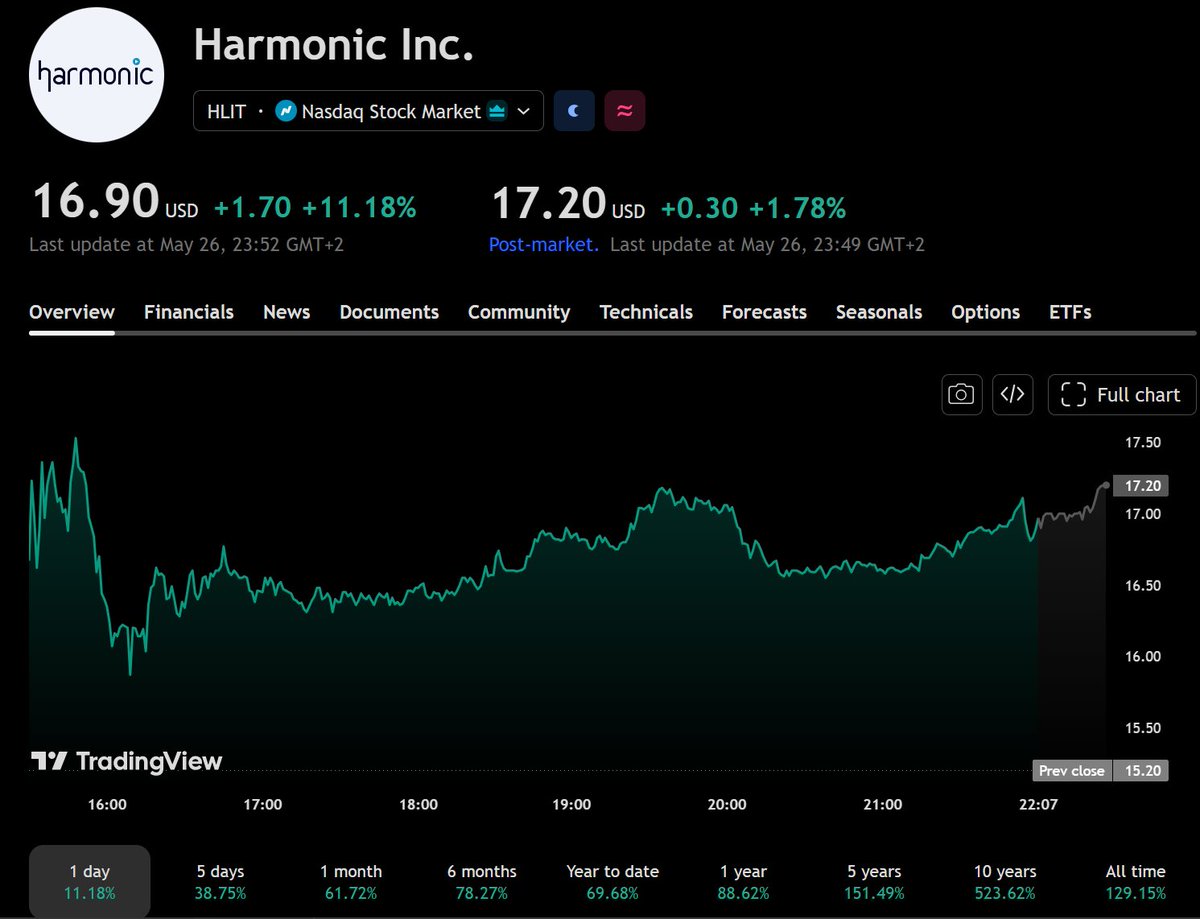
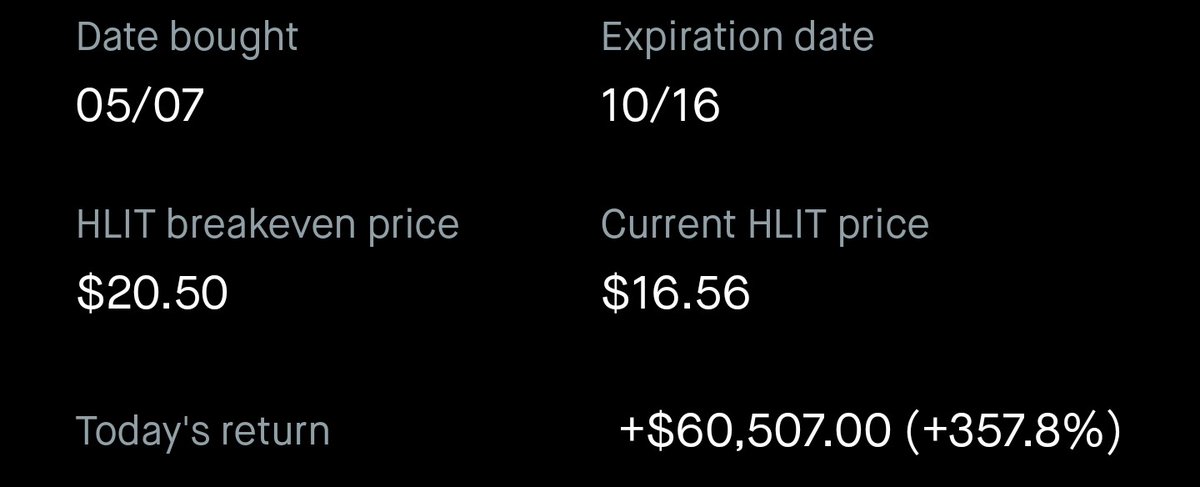
Actually had this thread drafted before the Citrini tweet, check the date when I bought the calls to confirm: $HLIT just reported Q1 2026. The thesis isn't just intact — it's accelerating. Here's why this is one of the most underappreciated AI infrastructure plays in the market: 1. THE SETUP Broadband companies have been left behind by AI. Their 30-year-old cable networks can't handle the data loads modern AI generates. Comcast and Charter confirmed at GTC 2026 they're deploying $NVDA RTX 6000 Blackwell GPUs directly into neighborhood hubs — but you can't plug a 2026 GPU into 1990s cable infrastructure. Harmonic has a virtual monopoly on vCMTS — the software that modernizes cable networks without rebuilding physical infrastructure. Same concept as what $NOK is doing for cell towers with anyRAN. 2. Q1 2026 RESULTS → Broadband revenue: $121.7M — up 43% YoY → Rest-of-Market revenue: +78% YoY (now 42% of total) → Backlog + deferred revenue: $582.1M — up 87% YoY → 60% of that backlog converts within 12 months = ~$349M locked in for 2026 → Beat the high end of guidance. Raised full-year outlook to $475-495M. → Repurchased 4.2M shares for $43M in a single quarter — management buying their own stock aggressively 3. THE MATH $1.2B market cap. $582M backlog. 60% converting in 12 months. Full year guidance raised to ~$485M midpoint. You're paying ~2.5x forward revenue for a company growing broadband 43% YoY with 55% gross margins on a pure-play SaaS model — after they just sold the legacy video drag. 4. THE CATALYSTS STACKING UP 🔹 $22B combined Comcast + Charter capex cycle — 2026 most aggressive year 🔹 FCC "Delete, Delete, Delete" mandate freeing up maintenance capex from copper 🔹 $42B BEAD grants requiring fast deployment — software wins over physical builds 🔹 Rest-of-World now 41% of revenue and growing fastest (+78%) — customer concentration risk resolving in real time 🔹 Video business sale on track to close Q2 — pure-play SaaS re-rating incoming 5. WHAT CHANGED THIS QUARTER Rest-of-Market bookings exceeded 50% of total Q1 bookings. That's the inflection. HLIT is no longer a Comcast/Charter story — it's becoming the global standard for broadband virtualization. International operators watching Comcast and Charter lead are now following. 6. THE RISK Customer concentration was the bear case. It's actively resolving. The remaining risk is execution on DOCSIS 4.0 rollout timing and whether the video sale closes clean in Q2. At $1.2B market cap with $582M in backlog, 43% revenue growth, and management buying back $43M of stock in one quarter — the market hasn't caught up yet. NFA/DYOR
Draupnir tweet media
English
4
1
6
1.5K
John Galt
John Galt@AtlasShrug1·
Whenever this one ends, be it next month or next year, what comes next is a lost decade for the Nasdaq and you know that. This secular bull is now 17 years old going on 18, and these typically last 15-20 years which you also know. This isnt guesswork, it has to happen unless you believe that equities as an asset class no longer return 10.5% or so on avg over the long term. I see no reason to believe that would change. Therefore, it is simple math that if you have 10-15 yrs of 20% type returns, u gonna have a decade or close to zero to average that out. I’m not that good at math but even Josh Brown could figure that out.
English
3
0
2
425