@Zuby_Tech ah where are those good times when people played games directly and not platforms, it was so long ago
English
Flex Meter
47 posts









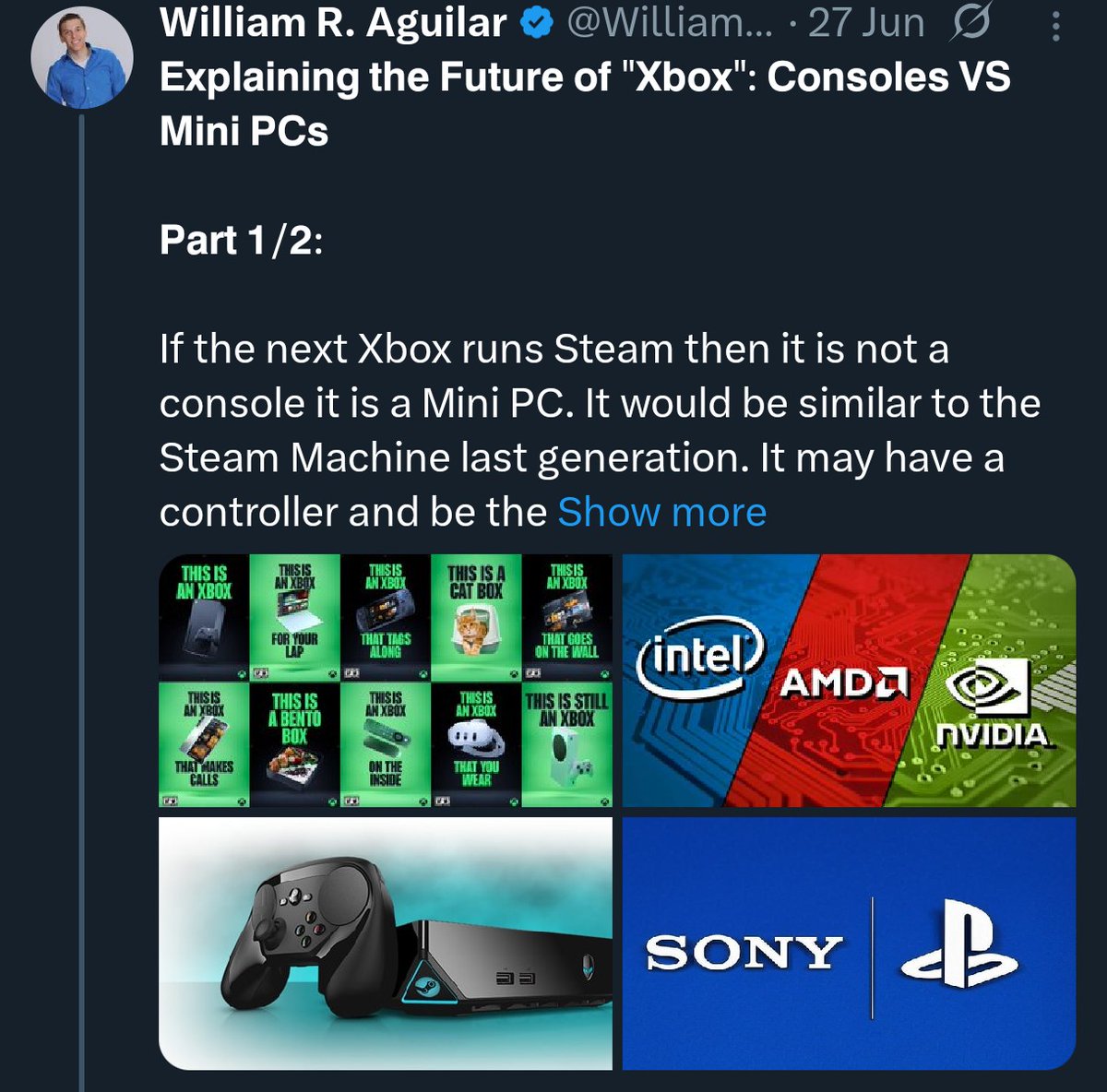
𝗘𝘅𝗽𝗹𝗮𝗶𝗻𝗶𝗻𝗴 𝘁𝗵𝗲 𝗙𝘂𝘁𝘂𝗿𝗲 𝗼𝗳 "𝗫𝗯𝗼𝘅": 𝗖𝗼𝗻𝘀𝗼𝗹𝗲𝘀 𝗩𝗦 𝗠𝗶𝗻𝗶 𝗣𝗖𝘀 𝗣𝗮𝗿𝘁 𝟭/𝟮: If the next Xbox runs Steam then it is not a console it is a Mini PC. It would be similar to the Steam Machine last generation. It may have a controller and be the size of a console but the distinct difference between a console and a mini PC is that a Mini PC isn't running a unique SKU for a game, it's running the PC version of a game which means that SKU Version of the game does not have the possibility to be as optimized as a unique console version because the game still has to be made to run on a vast variance of different computers that each could have 1000s of different parts from multiple different competing companies. Developers could still optimize the PC SKU Version of a game to run "well" on a Xbox branded Mini PC but they will not be able to optimize to that specific set of hardware as deeply as they could when coding to the metal to get the absolute maximum amount of performance out of a dedicated high end consumer level console like the upcoming PlayStation 6. This is why games from Naughty Dog like Uncharted, Last of Us, and Intergalactic look like they are almost a full console generation ahead of everything else. Developers with skill and dedication can push the limits of performance and fidelity of games on console hardware, beyond what is expected to be possible, because they only have to take into account one specific preset of parts that are already designed to work together at a deeper level than parts that could be swapped in and out on a PC. This applies to ALL of the millions of PlayStation Consoles sold that generation. To be clear, assuming the specs perform similarly, the PC version of a game could be better optimized than a Console Version but the difference is that there is a deeper level of possible optimization, for developers, on a Console SKU than on a PC SKU, due to the vast variance of different possible parts on PC. This is not theoretical it's axiomatic. It's a law of physics. Let's take, for example, only two of the multiple different possible parts that could be in a PC designed to run the same SKU PC Version of a game - the CPU and GPU: AMD, Intel, & Nvidia CPUs and GPUs that are rated to be roughly similar to each other, in power, will not perform the same PC Version of a game at the exact same level of performance because they each have unique, proprietary, patented technology and techniques to do similar things in different ways. For example, FSR and DLSS are similar but they don't achieve the goal the same way and they both have different strengths and weaknesses, due to their unique designs. Even if you turn these features off, the three companies design their chips differently. Additionally, while you can pair an AMD CPU to work with an Nvidia GPU they won't work together as well as pairing a CPU & GPU from the same company. If you built 6 different computers, that are roughly rated to be similar in power, where 3 of them have a CPU & GPU from the same of each of the three companies (AMD with AMD) and 3 of them that mixed parts between the companies (Intel with AMD) these 6 computers will not run the same PC Version of a game at the same level of performance and fidelity. With a Locked Framerate, the 6 computers might all perform at a locked 30FPS at 4K, from start to finish, but if you unlock that framerate one of those PCs may be at 33fps then jump to 36 then drop to 31 and fluctuate wildly. The 2nd PC may stick to 35fps with an occasional drop to 32. Another PC may perform close to 40fps but then at random places it drops down further than any of the other PCs to 30fps and stays there for 15min in sections that the others never drop that low on before going back up to 37fps. This is because Intel, AMD, and Nvidia have completely unique, proprietary, and nuanced differences. 𝗣𝗮𝗿𝘁 𝟮: ⤵️