Phillip Dube retweetledi
• Zimbabweans are very clear, it’s an absolute no to 2030
• An unequivocal no to CAB3 .
• Zimbabwe belongs to Zimbabweans not an individual.
#WeNeedNewLeadersNow
#ZanupfMustGo
English
Phillip Dube
7.1K posts

@DubePH
I am about nation building, and I'm very passionate about my people. #NgekeSguqe
It turns out that it was not editorial fiction, my brother. Nelson Chamisa did actually give the interview to the Daily News, which recorded it. After I and many others challenged the Daily News, it has now released part of the recording and says it will soon upload the full interview. Ironically, the Daily News actually published only the milder comments from him in the original story. It now turns out that he went much further and directly attacked people by name. In this audio, you can hear him criticising Jameson Timba for leading people against Constitutional Amendment Bill Number 3. This is why transparency matters in both journalism and politics. When there is a dispute over what was said, evidence must speak for itself. Now the serious question that anybody opposed to the violation of the Constitution is asking is this: why is Nelson Chamisa attacking people who are fighting against Constitutional Amendment Bill Number 3? And why did he go onto his timeline two days ago and claim that the Daily News story was fiction and that he never said those things, when the audio now shows that he actually said far more than what was originally published? The emerging evidence now raises serious credibility and political questions. If he disagreed with those opposing Constitutional Amendment Bill Number 3, he had every right to say so openly. But denying the interview entirely, only for recorded audio to emerge later, is what is now deepening public concern and confusion. In politics, credibility matters. Once leaders begin denying things that are later proven to be true, people naturally begin questioning what else they may not be telling the public honestly.
🔹Two weeks ago, the Ford Rangers for the Varakashi were released. Goto and his crew shared theirs, Goto took a Fortuner, while Nkata, Watungwa, Moses, Maria, and Joseph all got Rangers. Meanwhile, Jones and his team got absolutely NOTHING! Today, they’re off to China, while the rest of VARAKASHI vanobauma pano vatichinyaudza were only given iPhone 17s! Bvumai kumiswa musati mapera zvekwa Mwari! 🙄🚗📱 #Varakashi #FordRanger #iPhone17

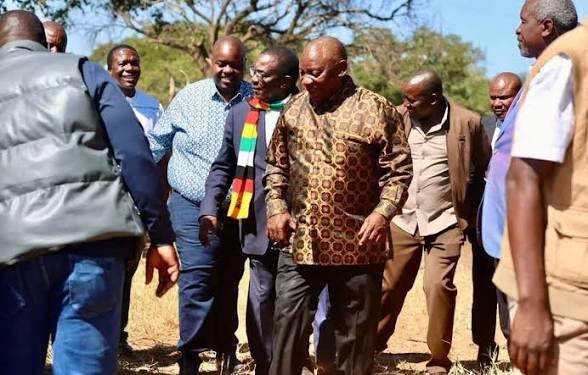
This afternoon, His Excellency President Emmerson Dambudzo Mnangagwa and His Excellency President Cyril Ramaphosa arrived at Pricabe Farm in Kwekwe District for a joint tour of the thriving agricultural enterprise. The visit underscores the deepening agricultural and economic ties between Zimbabwe and South Africa, and highlights the role of private sector investment in national food security. Pricabe Farm has become a model of modern, commercial farming in the Midlands. With diversified operations spanning horticulture, livestock, and mechanized crop production, the farm exemplifies how private initiative can complement government’s agricultural transformation agenda under Vision 2030. Food security anchor: By producing high-yield crops and quality livestock, Pricabe contributes directly to Zimbabwe’s goal of a self-sufficient food basket, reducing import dependence Job creation engine: The farm employs hundreds of locals from Kwekwe and surrounding areas, providing skills transfer and sustainable livelihoods for youth and women Technology transfer: Pricabe showcases modern irrigation, precision farming, and value-addition techniques that can be replicated across the country, raising agricultural productivity Regional cooperation: The Presidents’ joint tour signals cross-border collaboration in agriculture, trade, and investment, strengthening SADC integration and shared prosperity President Mnangagwa has consistently championed Nyika inovakwa nevene vayo, and Pricabe Farm stands as a practical embodiment of that philosophy. President Ramaphosa’s presence further cements the spirit of Pan-African solidarity and economic partnership. The tour is expected to open new avenues for bilateral investment and knowledge exchange as both leaders seek to unlock Africa’s agricultural potential @wicknellchivayo
ZIFA’s leadership has steadied the ship. It has set a clear course. And most importantly, it has begun to restore belief – in the institution, in the process, and in the future of Zimbabwean football. zifa.co.zw/zifa-exco-live…

@mawarirej I read your thread twice. Once for the substance, once for the sleight of hand. Let me show you what you actually did. Cde Chinamasa asked a narrow, specific question: where in the pre-independence record of NDP, ANC, ZAPU, ZANU, ZIPRA or ZANLA did the liberation movements debate how the President was to be elected, directly by the people, or by Parliament? That is a question about mechanism. About the electoral architecture for the head of state. You answered a different question. You quoted passages about voting for the National Assembly, abolishing the colonial parliamentary system, and referenda on major policy issues. None of that is what Chinamasa asked. Voting for MPs is not voting for a President. Abolishing reserved white seats is not specifying a presidential election method. Referenda on major policy is not a mechanism for choosing a head of state. Read your own attachment. Page 22 of Mwenje No. 2 says every citizen shall have the right to vote for "members of the National Assembly and all other state institutions." That language is deliberately broad and deliberately silent on the presidency. The document does not say the President shall be elected directly. It does not say the President shall be elected by Parliament. It does not specify the mechanism at all. You had to interpolate, "surely the office of the President is one of the most important parts of... ALL OTHER STATE INSTITUTIONS." That word "surely" is doing all the work. It is you reading something into the document that the document itself does not say. Which is exactly Chinamasa's point. Here's the part of liberation history you skipped: the Lancaster House Constitution of 1980 created a President elected by Parliament. Cde Mugabe, the founding father of this Republic, ZANU's own commander, was elected by Parliament, not by the people, from 1980 until the 1987 amendments. If the liberation movements had committed to direct presidential election as a non-negotiable, settled principle, explain to us why the men and women who fought that war accepted and operated a parliamentary-elected presidency for the first seven years of independence. Either the founding cadres betrayed the liberation programme on day one, or, more honestly, Chinamasa is right that the mechanism was never a settled question. Then there is the personal anecdote. You tell us your father took you to ZANU night meetings in Mkoba as a five-year-old, that you read liberation literature as soon as you could read English, that you have kept some of the books. That is meant to manufacture credentials. Forgive us if we apply some scepticism. A man who, in March, denied owning a BMW that he physically drives, a vehicle whose provenance the family of a deceased estate has been chasing him over, now wants us to credit his memory of being five years old in 1977 as bedrock historical authority. We will read the documents. We are not obliged to take your autobiography on trust. And the closing flourish about "Party bosses" imposing candidates is the most self-incriminating line in your thread. That is precisely what your faction is attempting. The Baloyi household does not exist to defend the Constitution. It exists to defend a Party boss's path to a candidacy he has not earned through any popular test, by manufacturing a referendum demand that the Constitution itself does not require. Section 95(2)(b) is not a term-limit provision under section 328(1). The Attorney-General's list of fifteen genuine term-limit provisions does not include it. The Mupungu judgment supports that distinction. The constitutional argument is on Cde Chinamasa's side. That is why you are reaching back to 1973 for a document that does not say what you need it to say. Cde Chinamasa asked a real question. You did not answer it. Try again, and this time, find us the page in Mwenje, or in any pre-independence ZANU, ZAPU, NDP, ZIPRA or ZANLA record, that specifies how the President of independent Zimbabwe was to be elected. #CA3
#CAB3 increases the President’s control over: - elections - courts - Parliament - prosecutors - traditional leaders Makes our Parliament undemocratic Takes away our right to vote for the President & gives it to that undemocratic Parliament Deprives us of a say in a referendum
Dr. Tagwirei shamed individuals who speak ill of President ED Mnangagwa. He stated that President ED Mnangagwa is the one who proclaims blessings upon this country. Romans 13:1 – “Let every soul be subject unto the higher powers. For there is no power but of God: the powers that be are ordained of God ".

After attending a Human Rights meeting, I’m deeply concerned about Bill No. 3 in Zimbabwe. This is not reform—it’s control. Our rights matter. #Zimbabwe #SpeakOut”

The man who put Coventry City on the African map..