Dustin Ashe ✝️ Mary Respector
3.3K posts

Dustin Ashe ✝️ Mary Respector
@DustinAshWrites
Catholicism is the ONLY cure for the decay of western civilization. The Antichrist spirit is AntiCatholic. Mary is the Mother of God.


Catholic aggression! Why do so many Catholics behave so aggressively online? Why are they so militant against anything that challenges their world view? Why aren’t these popular influencers especially Catholic organizations calling out Candace Owens and others for their UnChristian-like behavior?


The Biblical Case for the Pope : The most famous passage supporting the papacy is Matthew 16:16-19 but I think most people do not realize how much it says. Let's start with reviewing the text. "Simon Peter answered, “You are the Messiah, the Son of the living God.” Jesus replied, “Blessed are you, Simon son of Jonah, for this was not revealed to you by flesh and blood, but by my Father in heaven. And I tell you that you are Peter, and on this rock I will build my church, and the gates of Hades will not overcome it. I will give you the keys of the kingdom of heaven; whatever you bind on earth will be bound in heaven, and whatever you loose on earth will be loosed in heaven.” Here we have Jesus renaming Simon to Rock (Petros in Greek) and telling him that he will build his church on him that the gates of hell will not overcome. But then Jesus begins a ceremony. I call it a ceremony because it appears that Jesus is following a ceremonial formula for ordaining the Vicar (representative) of a King. Jesus, who regularly quoted from Isaiah (over 20 times), closely follows the formula in Isaiah 22:20-22. Consider: “In that day I will summon my servant, Eliakim son of Hilkiah… I will place on his shoulder the key to the house of David; what he opens no one can shut, and what he shuts no one can open." The parallels are striking. A key is given. Peter/Eliakim is then given the power to bind/shut or loose/open. The similarity of the phrasing and the tendency of Christ to quote from the prophet Isaiah make it seem HIGHLY unlikely that this is coincidental. Jesus is nearly quoting the Prophet Isaiah on purpose. What is he getting at? To understand, let’s look at who Eliakim was. He was the Vicar of King Hezekiah. And we see his role in 2 Kings 18:18. In that passage, the Assyrian Commander calls for King Hezekiah. But instead of the King going out, Eliakim is sent to speak on his behalf. Eliakim was the vicar, the representative and the spokesperson for King Hezekiah. With that in mind, let's get back to the ceremony that Jesus performed on St Peter in Matt 16:16-19. Jesus (a king) was performing a ceremony of a Vicar and the Vicar's role (as seen in 2 Kings) is to speak on behalf of the King. He is making Peter his Vicar. There are other proofs in the bible. Jesus promised that Peter would be the one to strengthen the brothers (Luke 22:31-32). In John 21:10-14 Peter hauled in the fish (a symbol for the faithful) by himself when all the disciples together couldn't do it (v6) and the text says the net did not tear (the greek for tear is schism). And throughout the book of Acts you see Peter acting as Pope. In Acts 5, it is Peter (not the other apostles) who sits in judgement of Ananias and Sapphira. In Acts 15, at the first council only Peter speaks during the deliberations and when James wraps up the discussion he quotes one person: Peter. We see St Paul say that when completed his period of contemplation, he went to Peter first (Galatians 1:18). And the list of the apostles changes in order quite a bit throughout the New Testament but it always starts with St. Peter (and ends with Judas) - the others change in order. In many cases, it just says “Peter and the others.” Peter is clearly given a unique role of leadership, vicarship of Christ, and spokesman for the Christian movement. But did he pass it on? Is it possible that Peter was indeed given a special role but that ended with Peter? The answer to this is no. The offices off the apostles were passed on. We know this both from the bible and from history. Consider Acts 1:12-26. In that passage, Judas (one of the twelve apostles) has died an ignominious death and Peter (acting as the leader of the Apostles) says that “it is necessary to choose” someone to take his office (v 20-21). The word for office here is “episkopēn” which is the Greek word for bishopfrik. And then Matthias is chosen to replace Judas “in this ministry and apostleship” (v25) and that he “was numbered with the eleven apostles.” (v26) Here we have an apostle dying and a successor being chosen. How in the world is this not apostolic succession? And, relevant to the topic of Peter, it explicitly states that Matthias would take the office (bishopfrik) of Judas. This is a handing down of an ecclesial office. And lest people think this is a one off situation with Judas, there is another very interesting account from St Clement of Rome writing in 90AD. He writes, “Our apostles knew through our Lord Jesus Christ that there would be strife for the office of bishop. For this reason, therefore, having received perfect foreknowledge, they appointed those who have already been mentioned and afterwards added the further provision that, if they should die, other approved men should succeed to their ministry” (Letter to the Corinthians 42:4–5, 44:1–3) In short, the papacy is clearly a biblical office instituted by Christ.

Genghis Khan isn't King, Mr. Netanyahu. Christ is King.


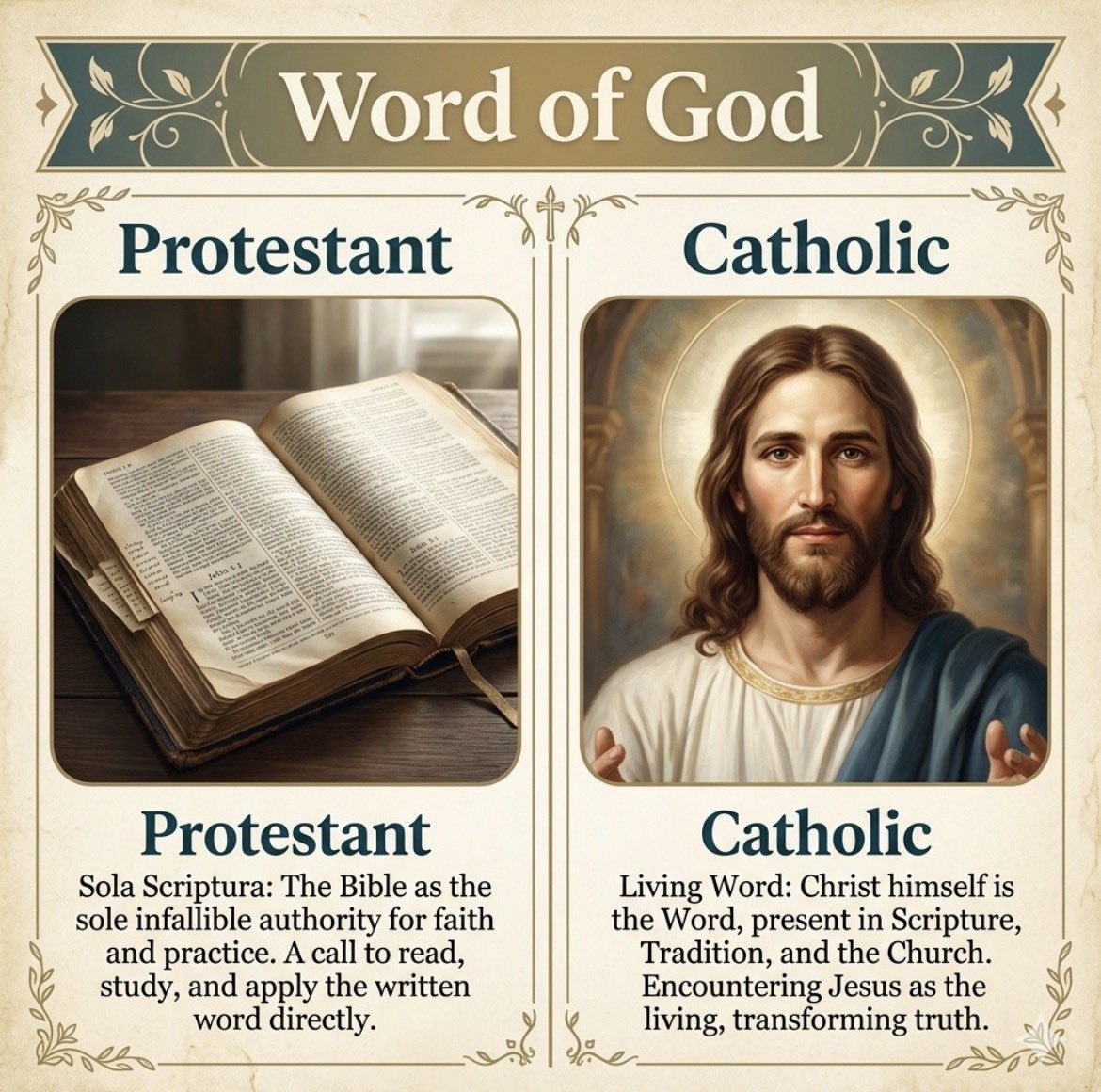
Roman Catholics claim an infallible church, but in practice what they defend is a selective and shifting infallibility. The problem is not hard to see. There are councils the Roman Church now rejects or downplays, such as the iconoclast council of Hieria in 754, which opposed the use of images, and then later councils that reversed course. Both cannot be protected from error. At some point, the church was wrong, and Rome decides after the fact which moments count and which do not. That is not a consistent doctrine of infallibility. That is a retrospective sorting of history. The same tension appears in the Western Schism from 1378 to 1417, when there were two and then three rival popes, each with supporters, each claiming legitimacy, and each excommunicating the others. The church did not speak with one clear, indefectible voice. It fractured, and it took decades and a council to sort out the mess. During that time, who exactly was the infallible head of the church. The system offers no clean answer. It simply moves past the problem once a winner is declared. There are also moments when popes themselves resisted ideas later defined as dogma. In the fourteenth century, during disputes over poverty, the Franciscans pushed arguments that would bind a pope to prior papal statements. Pope John XXII rejected those claims and opposed the line of reasoning that would later be used to support papal infallibility. Take another example. Pope Honorius I was condemned by the Third Council of Constantinople for supporting the Monothelite heresy. A pope was formally rebuked as a heretic by a council later recognized as authoritative. Or consider the Council of Constance in the fifteenth century, which asserted that a general council held authority over the pope. Rome later rejected that principle. So was the church speaking infallibly when it elevated the council over the pope, or when it later denied it. Both positions have been held. Both cannot be infallible. Then there is the case of Pope Sixtus V and his official edition of the Latin Vulgate in 1590. He proudly proclaimed to have produced an infallible translation. Yet within his own lifetime, it was found to contain numerous errors. Within a short time, it was withdrawn and replaced under Pope Clement VIII with a corrected version. Oops. And this raises a deeper problem. Can the church produce an infallible list of all the infallible things it has ever said. It cannot. What Rome actually has is a selective catalog, identified after the fact, under highly technical conditions that seem to change with the wind. That is not how an inherent property works of infallibility works. Even beyond that, popes have contradicted one another in teaching and policy. Councils have been called, corrected, and sometimes effectively reversed. Rome maintains the appearance of consistency by narrowing the definition of infallibility to rare, highly technical conditions, then declaring that only those moments count. Everything else is allowed to be mistaken, revised, or abandoned. That approach protects the claim while conceding the reality that the church, in its actual history, has erred. Once that is admitted, then we aren't dealing with infallibility any more. An authority that can be wrong in many of its official acts, reversed by later decisions, and divided against itself in times of crisis does not carry the marks of something that is incapable of error by nature. The historical record shows a church that can speak truly at times and err at others. That is exactly what one would expect from a fallible institution, not an infallible one. Holy Scripture is infallible because it is the word of God. It is the only infallible authority on earth.


This is fake: flags on the left & right are folded exactly the same way. It's the same flag duplicated. Contrast between lectern & flags shows they are entirely separate elements, not in the same room. The left lapel on the jacket has disappeared again.