EAC | Jumuiya

308 posts

EAC | Jumuiya banner
EAC | Jumuiya

EAC | Jumuiya

@EACIntergration

My vision is to forge a vibrant, unified East African Community State, harmonizing 51 dynamic communities, each thriving under empowered local governance, drivi

Arusha, Tanzania Katılım Mayıs 2025
48 Takip Edilen15 Takipçiler
Sabitlenmiş Tweet
EAC | Jumuiya
EAC | Jumuiya@EACIntergration·
Wishes will be carried over. The tide of time, people's dreams... Those things can't be stopped. As long as people search for the meaning of freedom, those things will see no end.
English
0
0
1
109
EAC | Jumuiya retweetledi
TheLegion!
TheLegion!@Ephantus_Mwas·
Pale homabay county tulikua tunafanya kazi unapata mgonjwa anagasp unaenda kutafuta oxygen unapata cynliders ni mbili ward mzima , inabidi unawatch mgonjwa akipass
Filipino
71
1.8K
4.4K
128K
EAC | Jumuiya retweetledi
Dr. Strange
Dr. Strange@Imonaar·
Na mjue nurses wakianza kuongea we will have to disband the country. We have a dysfunctional public healthcare system. The dysfunction has been worsened with SHA.
English
48
2.8K
6.6K
69.1K
EAC | Jumuiya retweetledi
Dr Branice Munyasa
Dr Branice Munyasa@Branicemercy·
This young man used his last coins to board a matatu to the airport and won us Gold. Let’s show him some love . May he know we appreciate him 🙏.his hard work is not in vain . If you see this please send him something to appreciate him 🙏
Dr Branice Munyasa tweet media
Kevin Kiarie Ruhiu@KelvinuhK

@Kibet_bull +254758514315

English
11
1.2K
5.2K
116.6K
EAC | Jumuiya retweetledi
Jackson
Jackson@Jacksonsrule·
Billionaires don’t have bank accounts like you and me. They have art collections,Yachts,Mansions,Stocks. None of it gets taxed until they sell it. So they just never sell it. They borrow against it instead. Live off the loans. Pay almost nothing. Then when they die, their kids inherit it all tax-free. The wealth never gets taxed, It just gets passed down. And we wonder why the gap keeps getting wider.
໊smolaraa@kesikesiluv

Hit me with the harshest reality truth.

English
1.4K
29.6K
189.4K
11.4M
EAC | Jumuiya retweetledi
Nelson Amenya
Nelson Amenya@amenya_nelson·
Posting about that ugly suswa unfinished road when the timeline is flooded with beautiful pictures of Ethiopia’s transformation is peak stupidity IMO 😂😂 hawana hata situational awareness.
English
24
773
3K
43.3K
EAC | Jumuiya retweetledi
Don Teya
Don Teya@TeyaKev·
Jirani have 5 minutes to recreate this photo.
Don Teya tweet media
English
93
2K
14.1K
236.2K
EAC | Jumuiya retweetledi
OCTOPIZZO
OCTOPIZZO@OCTOPIZZO·
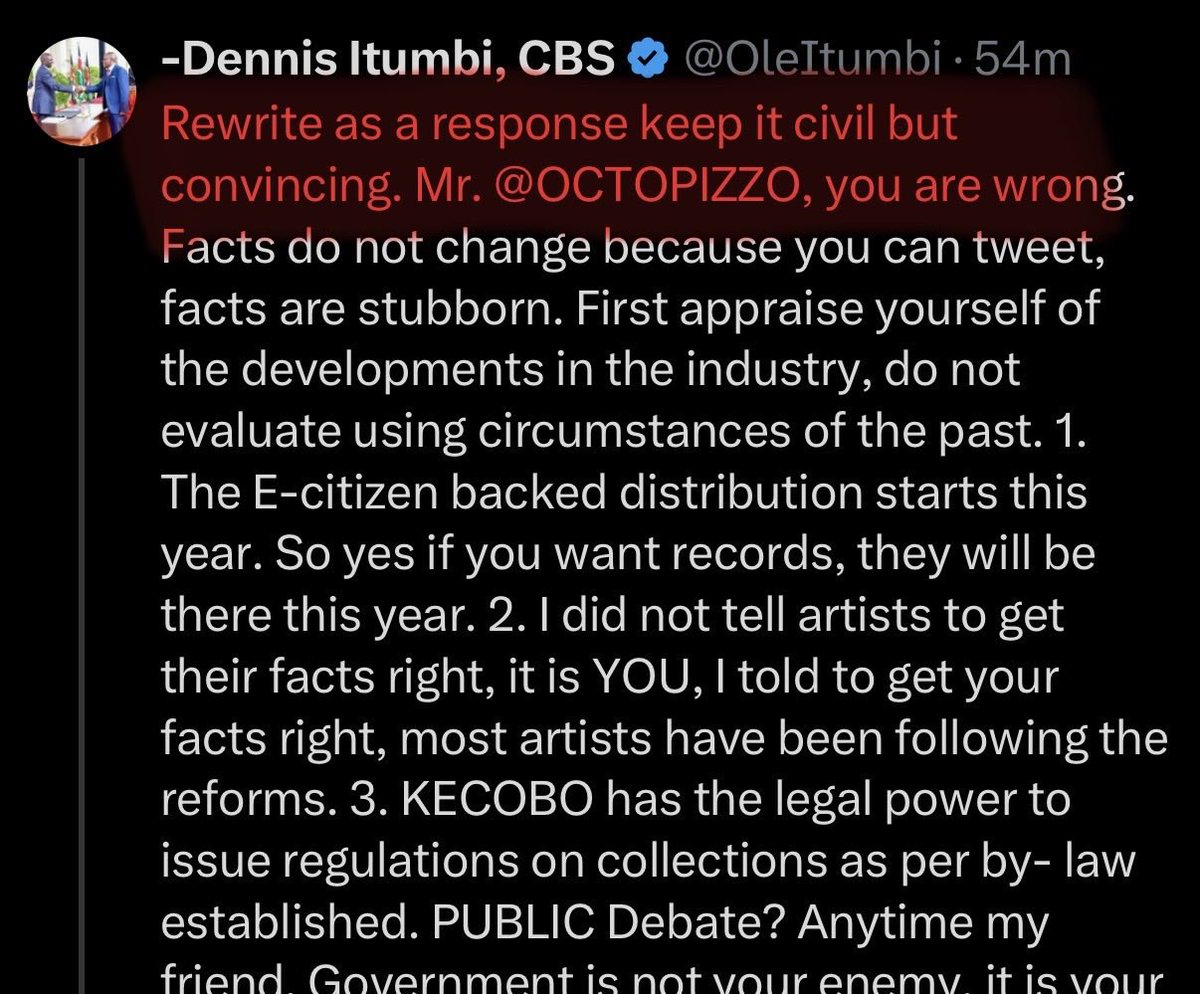
Mzee @OleItumbi Stop misleading artists. You claim CMOs are “fixed” and paying 70% via eCitizen since when? Show ONE verifiable list of artists paid. Most haven’t seen a cent. Why is the government handling private royalties? Under the Copyright Act (Kenya), that money belongs to artists not the State. How did funds move to eCitizen without artists’ consent? CMOs are not our right keepers. They don’t represent all artists only those who mandate them. No closed-door meetings. Call a public forum JKLive. Bring audited reports, legal backing, and proof of payment. Facts. Not PR.
-Dennis Itumbi, CBS@OleItumbi

Mr. @OCTOPIZZO, please get your Facts right. First on CMOs we have fixed the issue and we dis not need to change the law, just implement it. Collections are now being done via Ecitizen. The CMOs get 30% and the musician 70%. Secondly, MCSK is no longer alive licenced CMO. There is a new Copyright laws and it is about to come for Public participation. There is much that has been done and much awaits, but President @WilliamsRuto is leading the way in protecting artists. The issue at hand happened in 2019 and the President in this meeting took charge to ensure the 30 artists access justice. I am willing to engage you on FACTS, kuja ofisi and raise the issues, I show you the progress and we agree on what remains and we do it. @eddiebutita is doing the little he can, he is aligned to FACTS and SOLUTIONS. Join him and let is contribute to solving.

English
77
1K
2.8K
212.6K
EAC | Jumuiya retweetledi
Mihr Thakar
Mihr Thakar@MihrThakar·
The following countries should be merged with Kenya to become a super country: 1. South Sudan 2. Burundi They have been struggling for decades. Time to exchange talent and build them to their full potential.
English
72
53
456
22.6K
EAC | Jumuiya retweetledi
OCTOPIZZO
OCTOPIZZO@OCTOPIZZO·
Acha kutupima @eddiebutita This matter cannot be reduced to personalities or proximity to power it is, at its core, a question of policy, law, and institutional reform. For over a decade, kwanza kwanzia 2010 stakeholders in the music industry (artists, producers ) have consistently raised concerns around copyright protection, enforcement, and fair remuneration. These are not new issues, nimepiga hadi msee wa MCSK na Kiti huko bomas ju ya pesa yetu and and nothing has been resolved nor will be resolved through commentary alone, nor by deflecting responsibility outward. They require deliberate legislative review, strengthened regulatory frameworks, and the political will to implement and enforce meaningful change. Na ulisema earlier this is not political. WELL IT IS! It is also important to recognize that intellectual property is a technical field. Effective engagement demands not only passion for the arts, but a clear understanding of the legal, commercial, and creative ecosystems that govern it. Advocacy must therefore be grounded in expertise, not merely access or association. & you are not an expert nor are you an artist. Where rights have been contractually assigned particularly in international markets those transactions carry legal consequences that cannot simply be reversed through public pressure. The focus, instead, should be on ensuring that artists are properly advised, protected, and empowered at the point of negotiation, so that such outcomes are not repeated. Domestically, there must be urgent attention given to the governance and accountability of collective management organizations such as Music Copyright Society of Kenya and Kenya Association of Music Producers etc . These bodies exist to safeguard creators’ rights, yet persistent concerns about their transparency, distribution, and oversight continue to undermine trust within the industry for year! Sijawai kuona ukiongea junya MCSK. Reform here is not optional, it is essential. Equally, the industry must confront its own internal standards. The increasing reliance on derivative or unoriginal production practices raises legitimate challenges in copyright identification, monitoring, and enforcement. Ma artists na producers wana downloads riddims online na wanataka ku monitor, Intellectual property systems are designed to protect originality; when that foundation is diluted, enforcement becomes inherently more complex. If there is genuine commitment to progress anzeni na MCSK. Am uchoree hizi sideshow na sanitizer syndrome.
English
42
702
2.7K
103.8K
EAC | Jumuiya retweetledi
Cyprian, Is Nyakundi
Cyprian, Is Nyakundi@C_NyaKundiH·
They tried to do a deal without involving mkubwa. That is the story.... it is not about "fighting corruption"
English
185
2.3K
10.3K
219.9K
EAC | Jumuiya retweetledi
Aakash Gupta
Aakash Gupta@aakashgupta·
A city on the Moon will cost somewhere between $100B and $500B, require thousands of Starship flights, and demand a decade of nonstop construction in a place where the temperature swings 400°C between day and night, the dust cuts through metal seals like sandpaper, and a single cracked habitat window means everyone inside is dead in about 90 seconds. Musk just announced SpaceX is doing it anyway. Here’s the actual engineering path. You build at the south pole. Specifically the rims and floors of craters like Shackleton and Cabeus, where temperatures in permanent shadow drop below -230°C. NASA estimates 600 million metric tons of water ice are buried in these craters under about 40 cm of dry regolith. That water becomes your oxygen supply, your drinking water, your radiation shielding, and 78% of your rocket propellant by mass. The crater rims get near-continuous sunlight for solar power. You build where the resources are. Getting there is where it gets wild. Every Starship lunar mission requires 10-15 tanker flights to fill 1,200 tons of propellant in Earth orbit before the ship can even leave. One cargo delivery to the lunar surface burns through roughly 12 Starship launches. Starship V3 lands 100 metric tons per trip. The Moon is 2 days away with launch windows every 10 days. Mars gets one window every 26 months with a 6-month flight. That 13x iteration advantage is why Musk pivoted. The first 20-30 landings are all cargo. No humans. You’re sending solar arrays for the crater rims targeting 100+ kW continuous, nuclear fission reactors for the 14-day lunar night, ISRU rigs that mine ice from regolith and electrolyze it into hydrogen and oxygen, pressurized hab modules, and autonomous rovers that 3D-print structures from lunar soil using concentrated solar heat. Each landed Starship also stays as a permanent building. 50 meters tall, 9 meters wide, 1,100 cubic meters of pressurized volume. The ISS has 916 cubic meters and took 13 years to assemble. Three Starships on the surface already exceed that. The economics flip the moment you start producing oxygen on the Moon. You stop shipping 78% of your propellant from Earth. Tanker flights per mission drop from 15 to about 4. Every ton produced locally frees up mass budget on the next inbound Starship for more construction equipment, food systems, and mining hardware. The base starts building the base. That’s what “self-growing” means. Compound logistics where each delivery makes the next delivery cheaper. 2027: first uncrewed Starship lunar landing. SpaceX told investors March 2027. 2028-2030: cargo buildup, 30-50 deliveries, all robotic, ISRU prototypes go operational. 2030-2032: first crews arrive, probably 6-12 people, 6-month rotations, running equipment maintenance and scaling propellant production. 2033-2035: permanent population hits 50-100, propellant depot goes up in low lunar orbit so arriving ships refuel before descent. 2035 onward: population grows past 100, agricultural modules come online, the base becomes partially self-sustaining. The unsolved problems are real. Lunar dust is electrostatically charged and sharp as broken glass. It shreds seals, clogs machinery, and embeds in lung tissue. Nobody has a long-duration fix. Radiation on the surface runs 200x Earth’s dose. Regolith shelters and water shielding help but add enormous construction overhead. The 14-day night drops temperatures to -173°C and kills all solar power, and the only flight-ready nuclear reactors produce 1-10 kW, far below what a growing base demands. What years of 1/6 gravity do to human bone density and cardiovascular systems is completely unknown. SpaceX is valued at a trillion dollars and just told investors the Moon comes first. They’re betting that proving lunar logistics at commercial cadence builds the playbook for Mars. The Moon is a 2-day test lab with a 12-day resupply cycle. Mars is a 6-month voyage with a 2.5-year wait if anything breaks. It makes sense.
Elon Musk@elonmusk

For those unaware, SpaceX has already shifted focus to building a self-growing city on the Moon, as we can potentially achieve that in less than 10 years, whereas Mars would take 20+ years. The mission of SpaceX remains the same: extend consciousness and life as we know it to the stars. It is only possible to travel to Mars when the planets align every 26 months (six month trip time), whereas we can launch to the Moon every 10 days (2 day trip time). This means we can iterate much faster to complete a Moon city than a Mars city. That said, SpaceX will also strive to build a Mars city and begin doing so in about 5 to 7 years, but the overriding priority is securing the future of civilization and the Moon is faster.

English
1.1K
947
8.2K
1.7M
UmarAi
UmarAi@Umar__786Ai·
99.9% will fail..!! Tell me the number that is bigger than this..??
UmarAi tweet media
English
25.8K
295
2.4K
3M
EAC | Jumuiya retweetledi
Chelzard PK
Chelzard PK@PinonKhaemba·
@Kenyans @jumuiya needs patriots who will dissolve these colonial states & create a federal government for Eastern Africa as part of unification & defeating invisible colonial borders imposed on us.
English
0
1
4
1.4K
EAC | Jumuiya
EAC | Jumuiya@EACIntergration·
Inherited will, the flow of the times, and the dreams of the people cannot be stopped. As long as humanity continues to yearn for freedom, these forces will never disappear.
English
0
0
0
3
EAC | Jumuiya
EAC | Jumuiya@EACIntergration·
What is preventing the US from attacking any African nation and Kidnapping their leaders? Corrupt and coerced leaders? Venezuela is proof peace is just myth.
EAC | Jumuiya tweet media
English
0
0
0
43
EAC | Jumuiya retweetledi
イェン ダニエル
イェン ダニエル@Danhier_BaPPA·
How Do People Become a Nation? A Case Study of South Sudan In the words of Gellner (1964), “Nationalism invents nations where they do not exist.” The communities of South Sudan have long existed in a state of peoplehood with little shared sense of nationhood. In the Nilotic way of life, loyalty traditionally flows from the family unit to the clan and tribe, with the nation occupying the lowest rung of affiliation. This feature continues to prevail in independent South Sudan, even fifteen years after independence. The liberation movements - Anya Anya (1955-1972) and later the SPLM/A (1983-2005) - offered a moment of reprieve, as Southerners sought to move from peoplehood to nationhood through a shared struggle. That struggle eventually earned us our flag, a powerful symbol of nationalism. Yet, the collective gains of the liberation era proved difficult to sustain. Our common history of struggle gradually shifted from a unifying narrative of nationhood to one centered on tribal identities, with Nuer, Dinka, and Equatorian communities each claiming credit for the milestone of independence. For example, Elder Lewis Anei Madut Kuendit, during the launch of his book on Dinka history and lecture on the cultural laws of the Dinka people at Victoria University (Melbourne) on February 1, 2016, remarked: “Dinka cultural strength was able to establish an army (SPLA) and a sovereign nation that forestalled Islamic and Arabic expansionism in Africa.” While this statement may hold some truth, it reflects tribal pride rather than the spirit of nationhood (flowing from older generations to younger generations). Unfortunately, elder Lewis is not alone in this approach; many Nuer and Equatorian scholars also write from the perspective of tribal affiliation, further fragmenting the national narrative. Nation-building, however, requires deliberate actions that transcend cultural divisions. It demands thoughtful leadership, equitable allocation of national resources, the promotion of common languages, and investments in security, education, and economic development. Most importantly, it requires (the leadership) giving people reasons to interact and connect across tribal lines - through trade, intermarriage, and shared relationships. Equally, it means providing citizens with something worth protecting: their livelihoods, welfare, and dignity. Without this, violence and fragmentation, so central to our history, will continue to undermine the dream of a united South Sudan.
English
3
10
27
1.1K