Sabitlenmiş Tweet
Adam Sheldrick
231 posts

Adam Sheldrick
@ECSM_Research
Independent researcher developing ECSM: testing whether gravity, redshift, structure & light emerge from finite-response dynamics.
Tamworth, England Katılım Nisan 2026
371 Takip Edilen63 Takipçiler

New ECSM paper published:
Neutral Closure, Weak SU(2)L, and Higgs-Like Branch Locking in ECSM
This paper asks whether the triadic matter-branching structure can provide a route toward chiral weak coupling.
Recent ECSM work proposed:
Q_loc → (Q₊, Q₀, Q₋)_loc
where:
Q₊ / Q₋ provide polarity or mirror imbalance
Q₀ provides neutral closure
The new bridge asks:
Could weak SU(2)L describe the effective symmetry of closure-active triadic matter states?
In this interpretation:
left-handed states = closure-active orientations
right-handed states = branch-locked singlets
The weak interaction becomes local charged-neutral branch conversion:
Q₀ ↔ Q_ch
And the Higgs-like scalar is reinterpreted as a medium-locking order parameter:
H_SM → Φ_lock(Q,χ)
with mass as response-locking energy:
m_f c² ↔ E_lock^(f)
This does not claim to derive the full electroweak theory, Higgs mass, Yukawa couplings, or neutrino oscillations.
It is a structural bridge:
triadic matter branching → neutral closure → weak-like doublet → Higgs-like branch locking
Paper:
doi.org/10.5281/zenodo…
English

New ECSM paper published:
Two-Branch versus Three-Channel Closure Splitting in ECSM
This is the notebook-backed follow-up to the triadic matter-branching paper.
The question was simple:
If a saturated localised excitation splits, is a two-branch mirror split enough?
Or does a neutral closure channel become favoured at high load?
Tested channels:
P → A + B
versus
P → A + B + C₀
where C₀ is neutral under the charge-like projection, but can carry closure, helicity, phase, or response-load bookkeeping.
The scan gives three ordered regimes:
L < 1.32
parent remains stable
1.32 < L < 3.56
two-branch mirror split is favoured
L > 3.56
three-channel closure split is favoured
So the neutral branch is not favoured trivially.
It appears only when closure/helicity demand exceeds the capacity of the two-branch split.
That supports the ECSM claim:
two branches = polarity
three branches = polarity + closure
This does not derive neutrinos or the Standard Model.
It establishes a narrower structural result:
in a finite-response matter-genesis model, a neutral closure channel can become dynamically necessary at high saturation load.
Paper:
doi.org/10.5281/zenodo…
Github:
github.com/asheldrick-res…
English

New ECSM paper published:
From UV Saturation to Triadic Matter Branching in ECSM
This paper fills a missing step in the matter-sector chain.
Previous ECSM work had:
finite response → UV saturation → localisation
and later:
three-component bipolar matter structure
But the missing question was:
why should a saturated localised excitation resolve into three internal branches at all?
The proposed answer:
A two-branch split gives polarity, handedness, or mirror imbalance.
But polarity alone is not closure.
For a stable matter-like excitation, ECSM requires:
Q₊ = excitation / excess branch
Q₋ = compensating mirror branch
Q₀ = neutral closure branch
So the chain becomes:
coherent propagation → UV saturation → Q_loc → (Q₊, Q₀, Q₋)_loc
In short:
Bipolarity gives the split.
The neutral branch gives closure.
This paper is theoretical and structural only. It does not derive the Standard Model or identify Q₀ as a neutrino.
It sets up the next test: whether a neutral closure channel becomes dynamically favoured when two-branch splitting is no longer enough.
Paper:
doi.org/10.5281/zenodo…
English

In ECSM, gravity happens because matter creates a local response burden in the medium. The medium then reorganises into the lowest stress coherent configuration it can maintain. Other matter follows that response gradient because it is the path of least reconfiguration cost. A crude analogy would be how bubbles or defects on a surface can migrate toward each other, not because they are magically attracting, but because the surface tension/stress field is being reduced by the configuration. In GR we describe this as curved spacetime. In ECSM, curved spacetime is the effective geometry of medium stress relief.
English

New ECSM paper published.
V14 moves the electron-like packet sequence from bound shells and anisotropic splitting into transition structure.
Starting from the V12/V13 response-well bound shell hierarchy, the notebook generates 32 bound modes and applies a simple dipole-like transition rule:
Δl = +1
Δm = 0, ±1
internal state conserved
Result:
54 allowed transitions
3 transition families
l0 → l1
l1 → l2
l2 → l3
In the isotropic case, each transition family collapses to a single spectral gap.
With anisotropy, the same allowed families broaden into multiplet-like gap distributions.
A chi-deformation scan preserves the allowed transition count and family count while shifting the mean gap.
25 / 25 criteria passed.
This is not a full derivation of atomic spectroscopy. It is a controlled bridge showing that ECSM bound shells can support selection-rule-like transitions, anisotropic spectral gaps, and determinant/exclusion stability in the same scaffold.
Paper:
doi.org/10.5281/zenodo…
Github:
github.com/asheldrick-res…
English

New ECSM paper uploaded:
Controlled Anisotropic Fine-Structure-Like Splitting of ECSM Electron-Like Bound Shells
V12 showed that a finite response-well eigenproblem can generate shell-like bound states with the familiar capacity structure:
2, 6, 10, 14
closures: 2, 8, 18, 32
V13 asks the next question:
Can those bound shells split under controlled anisotropy without destroying the filling/exclusion structure?
Result:
24 / 24 criteria passed.
The model recovers the V12 shell hierarchy at zero anisotropy, then produces fine-structure-like sublevel splitting when anisotropy is introduced.
It preserves:
• shell capacity
• determinant filling
• duplicate exclusion
• closure sequence
• chi-deformed stability
This is not claimed as a full derivation of atomic fine structure. It is a controlled bridge showing that ECSM bound shells can host stable anisotropic sublevel splitting.
Paper:
doi.org/10.5281/zenodo…
English

Beta = 1 does not mean self-sustaining though. It just means plasma pressure and magnetic pressure are roughly comparable. That still leaves the main question unanswered.. what maintains the magnetic field, replaces radiative/thermal losses, prevents diffusion/recombination, and keeps the structure confined over time? A beta value describes pressure balance. It is not an energy source.
English

@ECSM_Research @AshtonForbes Ashton has explained they’re self-sustaining due to beta=1 magnetic fields
English

This is what they use to make the plasma orbs. I'm sure now it's a fusion reactor.
There can be a device inside because they figured out low temperature fusion.
The hastelloy screens can handle plasma and are setup to cause spin and act as a magnetic mirror.
And the guy who sent me this disappeared.
I'm either gonna disappear or I'm gonna expose this.
Ashton Forbes@AshtonForbes
This is a fusion reactor schematic @TMBSPACESHIPS hand drew, for me. "Ion Pumpy thing for Ashton!"
English

Published the next ECSM electron-like packet paper.
V12 moves the shell-structure test from a counted degeneracy argument to an explicit response-well bound-state spectrum.
A finite-difference response-centre eigenproblem produces bound modes which recover:
orbital ladder: 1, 3, 5, 7
capacity ladder: 2, 6, 10, 14
closure sequence: 2, 8, 18, 32
Duplicate filling collapses, valid closure filling survives, and the chi-deformed scan preserves the hierarchy while shifting the bound-state energy span.
This is not a claim to have derived the full periodic table. It is a reproducible bridge showing how shell-like structure can emerge from finite-response ECSM bound modes rather than being inserted as a postulate.
doi.org/10.5281/zenodo…
English

Published V11:
Emergent Shell-Like Filling Hierarchy of Electron-Like ECSM Response Packets
This extends the ECSM electron-like packet sequence from many-mode filling into generated shell-like hierarchy.
Result:
V11 passes 21/21 criteria.
The notebook detects:
• orbital degeneracy ladder: 1, 3, 5, 7
• capacity ladder: 2, 6, 10, 14
• closure sequence: 2, 8, 18, 32
• duplicate occupancy collapses the determinant
• same-group two-internal filling remains allowed
• closure overflow by duplicate occupancy is forbidden
• χ-deformation preserves the hierarchy while shifting the energy span
This is not claimed as a full derivation of atomic structure or the periodic table.
It is a reproducible bridge showing that ECSM electron-like response-centre modes can generate a shell-like degeneracy and closure hierarchy under a finite-response stability ansatz.
DOI:
doi.org/10.5281/zenodo…
Github:
github.com/asheldrick-res…
English

Published V10:
Many-Mode Fermion-Like Filling and Shell-Capacity Structure of Electron-Like ECSM Response Packets
This extends the ECSM electron-like packet sequence from two-packet antisymmetry into finite many-mode filling.
Result:
V10 passes 22/22 criteria.
The notebook shows:
• duplicate occupancy collapses the determinant to zero
• same-shell orthogonal internal states remain allowed
• separated same-internal states remain allowed
• all finite modes can be filled once
• overflow by duplicate occupancy is forbidden
• common unitary evolution preserves the filled determinant
• χ-deformed evolution preserves filling while changing transport
This is not claimed as a derivation of the periodic table, full many-body QFT, or the spin-statistics theorem.
It is a reproducible bridge showing that the ECSM electron-like packet scaffold can support finite fermion-like filling, duplicate exclusion, and shell-capacity proxy behaviour.
DOI:
doi.org/10.5281/zenodo…
English

Yes that is a fair objection, and it would be true if I stopped at there is a deeper medium. The difference is that ECSM is not meant to be just an interpretation of the same maths. It has to earn its place by doing work deriving coherent limit physics, predicting where that limit fails, and giving measurable threshold behaviour. So the medium is not the claim by itself. The claim is finite response, coherence limits, saturation, stable excitations, and testable departures when response time and drive time become comparable. If those structures do not produce quantitative predictions, then yes, it is just metaphysics. If they do, then it becomes physics. These arent just arbitrary assumptions either, the mechanism is based on actual superfluid and condensed matter physics, which surprisingly recovers a lot of phenomena without many assumptions.
English

@ECSM_Research @PhysInHistory But that really doesn't sound more well defined nor less meta-physical than any of those 11 interpretations laid out above.
English

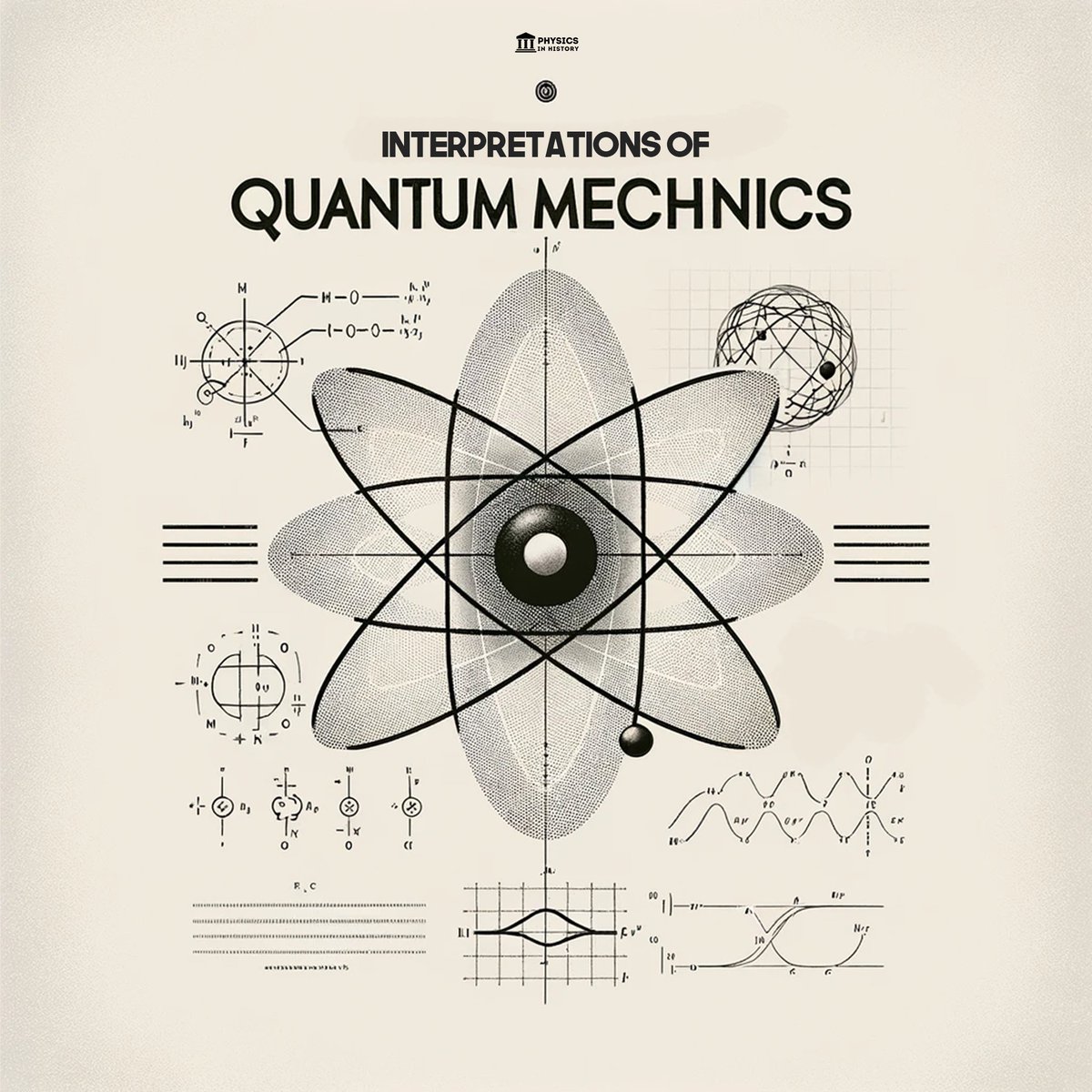
11 different interpretations of Quantum mechanics explained in brief ✍️
1. Copenhagen Interpretation: The "standard" interpretation where quantum systems exist in superpositions until measured, at which point they "collapse" to a definite state.
2. Many-Worlds Interpretation (MWI): Every quantum event spawns countless parallel universes, with each possible outcome actually occurring in a different universe.
3. De Broglie-Bohm (Pilot Wave) Theory: Quantum systems are guided by "pilot waves" that determine their behavior, implying that particles have definite positions at all times.
4. Objective Collapse Theories: Quantum systems spontaneously collapse to definite states over time, without requiring a measurement.
5. Quantum Bayesianism (QBism): Quantum states are subjective beliefs about the outcomes of experiments, emphasizing a Bayesian approach to probability.
6. Relational Quantum Mechanics: The properties of a quantum system are relative to the observer and do not exist absolutely.
7. Transactional Interpretation: Quantum events involve a time-symmetric exchange of "offer waves" and "confirmation waves" between source and detector.
8. Ensemble Interpretation: Quantum mechanics only applies to ensembles of systems, not individual systems, emphasizing statistical outcomes.
9. Consistent Histories: Focuses on establishing a consistent framework to discuss sequences or "histories" of quantum events over time.
10. Quantum Logic: Proposes a modification of classical logic to account for quantum phenomena.
11. Participatory Anthropic Principle (PAP): Observers play a role in bringing the universe into existence through quantum processes.
None of these interpretations alter the core mathematical formalism of quantum mechanics, but they provide different perspectives on what's "really" happening beneath the calculations. The debate over which interpretation, if any, correctly describes nature is ongoing and remains one of the central philosophical questions in the foundations of quantum theory.

English

Published V9:
Fermion-Like Antisymmetry and Exclusion of Electron-Like ECSM Response Packets
This extends the ECSM electron-like packet sequence into a minimal exclusion-sector test.
Result:
V9 passes 21/21 criteria.
The notebook shows:
• identical packet states antisymmetrise to zero
• separated same-internal states remain allowed
• same-position orthogonal internal states remain allowed
• exchange gives the required minus sign
• one-particle marginals normalise correctly
• unitary and χ-deformed propagation preserve antisymmetry
This is not a derivation of full fermionic QFT or Fermi–Dirac thermodynamics.
It is a minimal bridge showing that the ECSM electron-like packet scaffold can support fermion-like antisymmetry and Pauli-like identical-state exclusion.
DOI:
doi.org/10.5281/zenodo…
English

Published V8c:
Gauge-Covariant Phase Coupling of an Electron-Like ECSM Response Packet
This extends the ECSM electron-like packet sequence into a minimal gauge-sector test.
Key result:
branch conservation is recovered when positive/negative branch projection is defined covariantly using the same shifted Hamiltonian used for evolution.
V8c passes 20/20 criteria:
• norm preserved
• branch weights conserved
• signed A_eff response
• local phase imprint without runaway leakage
• χ-deformed gauge-coupled transport
This is not full electrodynamics or QED, but it is a working gauge-covariant bridge for the ECSM packet programme.
DOI:
doi.org/10.5281/zenodo…
English

I’ve been pondering this myself and actually written a paper on this exact idea. I propose that physical law may not be arbitrary rules imposed from nowhere, but the surviving stable relationships left after unstable possibilities fail to persist. Not exactly like biological selection, but similar, a stability selection.
A law survives if it remains coherent, closed under its own operation, perturbatively stable and able to preserve the conditions that allow it to exist. That, to me, is a more satisfying starting point than saying fields just exist and stopping there.
An infinite 3-dimensional universe with infinite possible behaviours, and reality may be what survived the process of stabilisation.
English

So many TOEs that hit my replies or my DMs start out with the idea that reality emerges from a dimension or structures that sit below the poverty line for reality. Ive spent a little time reading some of these but every time they fail to describe what the initial "thing" is. Some start with waves, some start with geometry, some are built on Lattice, Foam, or Aether and build up from there.
They all force you to accept that there is something magic about the universe we cannot see, or we cannot measure. I feel like takes dark matter and reallocates the problem somewhere else. Instead of making it an open question, it makes it a fundamental property of the universe that "Feels better" because now being unexplained "piece", its an unexplained fundamental.
I can't help but feel like that's wrong. To get to reality you have to start with something that is real. Reality accumulates until you can see it, otherwise all we we doing is wrapping up "God" in some pretty scientific equations and asking me to have faith that its there. Even QM says "Particles are excitations in underlying fields". Fields of what?
What is space made out of that you think concentrates into something when you poke it?
English

Yes, by deeper medium I mean a more fundamental underlying physical substrate, not a mystical substance or ether. The idea is that particles, fields, spacetime geometry and quantum states may be emergent stable behaviours of that substrate, in the same way waves are real but not separate from the medium supporting them. ECSM (my theory) asks whether the quantum formalism is possibly the coherent limit description of that deeper finite response structure.
English

Published V7 of the ECSM electron-like packet programme.
Response-Potential Dynamics of an Electron-Like ECSM Packet
This step moves from free Dirac-like propagation to weak external response coupling.
Result:
15/15 criteria passed.
The packet preserves:
• q_eff ≃ -1 scaffold
• alpha/beta closure
• norm
• branch weights
• controlled negative-branch leakage
A weak response potential changes the packet trajectory with force/acceleration sign agreement, while χ-deformed dynamics changes transport without breaking conservation.
This does not claim the physical electron is derived yet.
It shows something narrower:
an electron-like ECSM Dirac packet can undergo response-potential dynamics while conserving branch structure.
DOI:
doi.org/10.5281/zenodo…
Notebook:
github.com/asheldrick-res…
English

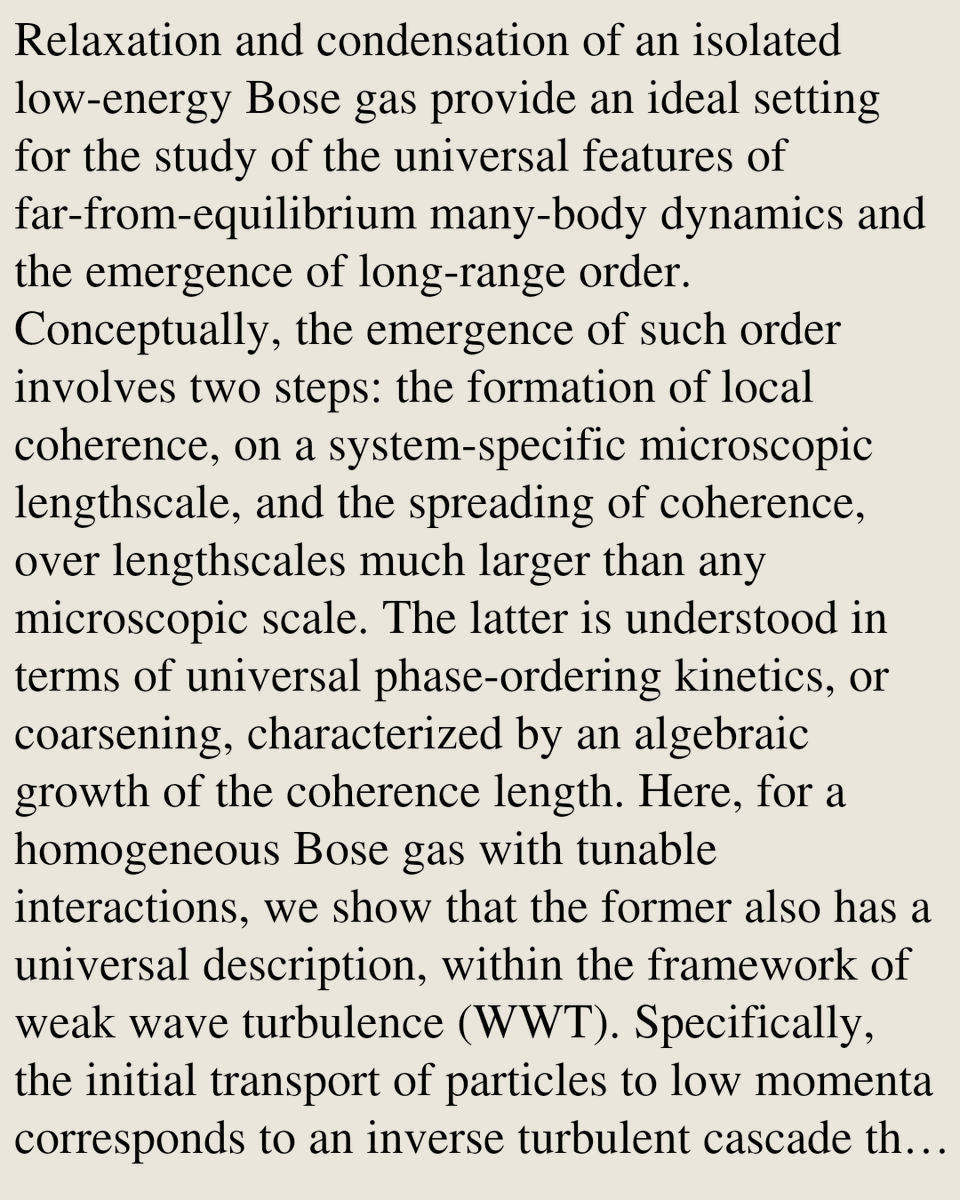
This is a great paper... The staged structure is what stands out to me, incoherent far-from-equilibrium state, inverse turbulent transport toward low momenta, local coherence formation, then long-range order via coarsening.
That is exactly the kind of physical route from disorder to coherent structure that is worth paying attention to.
English

Weak wave turbulence as a precursor to universal coarsening in a homogeneous Bose gas
Simon M. Fischer, Martin Gazo, Sebastian J. Morris, …
arxiv.org/abs/2605.22906 [𝚌𝚘𝚗𝚍-𝚖𝚊𝚝.𝚚𝚞𝚊𝚗𝚝-𝚐𝚊𝚜 𝚌𝚘𝚗𝚍-𝚖𝚊𝚝.𝚜𝚝𝚊𝚝-𝚖𝚎𝚌𝚑 𝚙𝚑𝚢𝚜𝚒𝚌𝚜.𝚊𝚝𝚘𝚖-𝚙𝚑 𝚚𝚞𝚊𝚗𝚝-𝚙𝚑]

English

This is exactly the kind of real physics ECSM is built around.
Far-from-equilibrium medium → weak-wave turbulent transport → local coherence → spreading long-range order.
Not magic. Not abstract extra dimensions. A physical system reorganising through finite interaction, coherence formation, and universal coarsening. That sequence matters because it shows how ordered structure can emerge dynamically rather than being imposed from the start.
Quantum Gases Papers@QuantumGases
Weak wave turbulence as a precursor to universal coarsening in a homogeneous Bose gas Simon M. Fischer, Martin Gazo, Sebastian J. Morris, … arxiv.org/abs/2605.22906 [𝚌𝚘𝚗𝚍-𝚖𝚊𝚝.𝚚𝚞𝚊𝚗𝚝-𝚐𝚊𝚜 𝚌𝚘𝚗𝚍-𝚖𝚊𝚝.𝚜𝚝𝚊𝚝-𝚖𝚎𝚌𝚑 𝚙𝚑𝚢𝚜𝚒𝚌𝚜.𝚊𝚝𝚘𝚖-𝚙𝚑 𝚚𝚞𝚊𝚗𝚝-𝚙𝚑]
English

Published the next ECSM electron-like packet result:
Dirac-Like Propagation of an Electron-Like Response Packet in ECSM
This is the V6b test in the sequence:
occupancy closure → q_eff ≃ −1 packet
→ internal SU(2)
→ Clifford/Dirac closure
→ dynamical Dirac-like propagation
The key point is not “ECSM has derived the electron.”
The claim is narrower:
a minimal ECSM electron-like response packet can host dynamically stable Dirac-like spectral propagation.
The V6b test passes all 14 criteria, including norm conservation, suppressed negative-branch leakage, response-deformed conservation, and positive/negative energy symmetry.
DOI:
doi.org/10.5281/zenodo…
English