

Eric Claussen
970 posts

Eric Claussen
@EClaussen
Founder of Platonic Path Author of Ascesis: The Handbook of Platonic Practice. https://t.co/8svlPE0shP
Montana Katılım Mayıs 2025
160 Takip Edilen615 Takipçiler

@Tweetophon @unimaticus @TibetanGnome @PunishedAbammon @Aarvoll_ Thanks for the talk. Good to hear a well-thought-out position that challenges Platonism. I think you have some valid points, but I'm not quite sold on your perspective. However, it has given me some things to think about. Thanks again, looking forward to a future chat.
English

Eric, thank you for engaging in good faith. It was an interesting discussion, but I agree that we're just retreading the same ground. I think your talk of potential is a red herring, because ultimately we have (a) a reality that is complete and subsumes past, present, and future, and (b) everything of reality is what it is. So the only question is, is there a thursday. Ie: are the events, such as a sea battle on thursday, in the timeline of reality.
If not, ok. If so, ok. But whichever we pick, reality is what it is, so we honour the presence of the events we do concede, and we must not seek to posit and introduce others "that are not" from "beyond reality". So yes, the future must be "fully actualised", for reality is "fully actualised": reality is complete and contains the future (whatever that may be) and it cannot be other than it is (for there only is what there is, and it is what it is).
Anyway, thank you for the discussion, happy to discuss one of the other critiques another day, or revisit this one if you have some new point, but I remain certain in my opinion. 👍
English
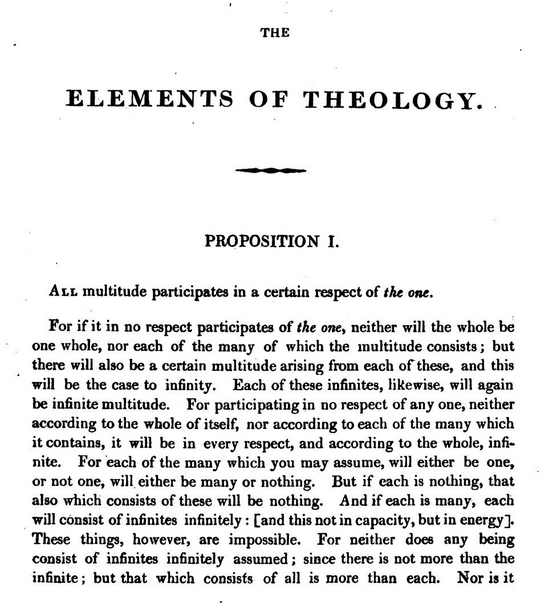
If one considers Proclus' "the one" and "participation" to be nonsense/meaningless, what are they to do with The Elements of Theology? Should they just shelve it until encountering a NeoPlatonist who makes sense? (don't hold your breath)
How about a new proposition 1: "what-is".
English
You’re treating ‘real’ and ‘actual’ as identical, and that’s the mistake. I’ve never denied actuality. I’ve said that reality includes both actualities and potentialities as distinct modes of being.
So there’s no contradiction: the past is actual, the future is real but not yet actual.
Your argument only works if you assume that everything real must already be actual. That’s not a consequence of identity. It’s an extra premise you haven’t justified.
From ‘potential is not actual,’ it does not follow that ‘potential is not real.’ That’s your assumption.
If potentiality is real, then reality can be complete even if the future is not fully actualized. So your dilemma collapses.
I feel like we're going in circles at this point, and you're not addressing what I'm saying.
English
But now you contradict your earlier admission: potential is not identical/synonymous with actual! And, you slip back into limited, presentist language - "must already be" - despite admitting that reality contains past present and future!
On the first point, in particular: you admitted potential is not actual/they are not the same. So if there is only potentials, you cannot say reality has actuals. For the potential is not the actual by your own admission (they are not the same). And so you cannot admit the actual full stop, for you have said it is not in reality. For if it is in reality, then it is what it is.
How do you break this? This is an iron clad refutation of platonism on this issue. Talking about potential is 100% irrelevant, you must decide whether actual is or is not of reality, and there cant be prevarication over it being in the future because reality contains the future (and hence its events!!!)
English
Your dilemma depends on equating completeness with full determinacy. I reject that.
A complete reality need not be a finished list of actual events. It can include both actualities and real potentialities. Nothing is ‘missing’ from reality if what exists are genuine potentials rather than already actualized outcomes.
So Thursday is real, but not yet fully determinate. Its events are not ‘missing’ from reality; they exist as potentials grounded in present causes, not as completed facts.
You only get your dilemma if you assume that everything real must already be actual. That’s exactly the point in dispute. Without that assumption, there’s no contradiction and no fatalism.
English
Why do you say, "defined Thursday as already determined", as if that could be a point of contention? As if "right now" matters for this discussion?
See above, you conceded that reality is not limited to past, present, or future. It contains all of that, because it lacks nothing.
So you must admit that if there ever is a thursday, reality contains thursday. And you admit that identity applies, so it is what it is.
Another angle: you say that thursday "includes indeterminacy, not a completed list of events." You are making reality incomplete, because you admit that thursday is part of reality, which itself is complete.
So if thursday is incomplete, where are the missing events? If they are in reality, rhen thursday is complete, for the events are of thursday. If the events are not in reality, then reality is incomplete, for you name events and do not concede they are or reality. Clearly reality must have a completed list of events, or else it is incomplete, for it would lack the events that aren't on the list.
So you are stuck on these horns of completeness and identity. Platonism is either fatalistic or else refuted as nonsense.
English
You’re still building fatalism into your definition.
If by ‘actual Thursday’ you mean a fully determinate set of events, then fatalism follows. But that’s because you’ve defined Thursday as already determined.
The question is precisely whether Thursday is actual in that way right now. That’s what’s in dispute.
What I'm saying is Thursday is real as a future time, but its contents are not yet actual. They exist as genuine potentials grounded in present causes. So it is what it is but what it is includes indeterminacy, not a completed list of events.
So identity doesn’t give you fatalism. You only get fatalism by assuming that the future is already fully actualized.
You need to prove that first, otherwise your argument isn't valid.
English
Great, so then we need not mention "potential thursday". I dont know what you mean by that title.
Returning to thursday, which I suppose we will now call "actual thursday", do you agree that it is 100% real and that the events contained within are what they are?
If so, the case for fatalism is agreed! For the question regarding the sea battle admits of a definite answer: it either is or is not among the events of "actual thursday", and we know that "actual thursday" is there to speak of and that it is definite/what it is, for reality is complete (thus does not lack actual thursday, and we have previously discarded the attempt to limit "reality" to only past, present, or future), and everything is what it is (so those events are those events, where they are as they are).
So platonists are either fatalists in this sense or otherewise demonstrably mistaken/confused.
English
@Tweetophon @unimaticus @TibetanGnome @PunishedAbammon @Aarvoll_ Of course not. I am not identical to 80 year old me in every respect. I may be the same person but not the same age or the same experiences.
Potential Thursday is not the same as actual Thursday but both are Thursday in different respects.
English
@EClaussen @unimaticus @TibetanGnome @PunishedAbammon @Aarvoll_ I'm not smuggling anything in. We're apparently both in agreement about identity, thursday is thursday. So answer this: is "potential thursday" identical to "actual thursday"? Ie: is potential identical to, or synonymous with, actual?
English
I don’t deny identity at all. Of course, Thursday is Thursday (A = A). But that doesn’t imply that Thursday already has a fixed, determinate content.
You’re smuggling that in. You’re treating ‘Thursday’ as if it already includes a fully specified set of events. That’s exactly what needs to be argued, not assumed.
Thursday is a real future event whose content is grounded in present potentials. It is what it is, but what it is includes indeterminacy.
So identity doesn’t give you fatalism. You only get fatalism if you assume that all future contingents are already determinate and true. Why should that be taken to be so?
English
Great, you have confirmed that reality does contain the past and the future. So the first horn is secure: reality is complete, and whatever we're discussing (thursday) is necessarily of it/real.
Now you have shifted to challenge the other horn: identity. Do you deny identity? Specifically, do you agree that whatever we refer to, it is what it is?
If yes, will you agree that Thursday is what Thursday is? In which case, its content is its content, and the question of whether there is a sea battle has its unwavering answer there. Thus, fatalism.
If no, what are you saying about thursday? That it is what it is not? In which case, do you admit that you arent talking about thursday at all, or anything really, as you can't identify anything? Or what is your position(?) after denying identity?
English
Reality does contain the past and the future. That much I can agree with. But that doesn't mean the future is predetermined. That's my point.
So the sea battle example is part of reality as an undetermined potential.
The whole includes all potential and actual states, but only one is actual at any given moment.
English
Completeness does entail that it contains all past and future states, just as it contains everything. The qualifier of "right now" is inappropriate, you're equivocating re: "reality" and "reality limited to a given moment and excluding others."
If you answer the question I put forward, it is clear enough. Does reality lack anything? If the answer is no, then Thursday is "of reality". If the answer is yes, the question is what does it lack (does it lack thursday?) and ultimately we need to acknowledge that you have rescinded your agreement that reality is complete.
English
Completeness doesn't entail that it contains all past and future states right now. When the future happens, it will happen in reality; the past, too, happened in reality, but that doesn't mean that those have to exist now in some deterministic way.
The argument just doesn't follow.
You have to first prove that change cannot happen.
English
Remember, I'm not asking a question about personal knowledge. I suspect there are many details about today that we don't know, too.
Rather, I am pointing at what necessarily follows from the two horns of my argument: completeness and identity. The platonist apparently accepts both horns, so he is stuck with the necessary conclusion: if we say there is Thursday then it is of reality and it is what it is.
So, do you accept this, or do you wish to deny some previous agreement?
If you wish to deny that reality is complete, I would ask you: what was the appropriate term for what we spoke of at the beginning of the conversation? Here you are mentioning "reality" and an apparently separate "thursday", so what subsumes both as a complete whole?
Or, are you happy to say that reality is complete, and thus Thursday is of reality, but... it is not what it is? Do you instead deny identity?
It doesnt matter if I appear to be rejecting a platonic claim about change. All that matters is that we've agreed to reality and now we have to consider the necessary ramifications. Given completeness and identity, platonists should speak accordingly or admit that their position fails.
English
Reality is complete in the sense that it contains the whole, but that doesn't mean it includes all that it ever was or will be in regard to the physical world, because this world is in flux and change. A snow globe is complete in itself, but that doesn't mean the parts within it don't move and change position. I can't say where the parts will be tomorrow.
The only certain aspect of reality in regard to time is now. We can remember the past, but the past is no longer here, and tomorrow has not come yet.
It seems you're suggesting that change is impossible. I think you would need to prove that first for your argument to hold.
English
Well, by way of background, I think our acceptance of reality involves certain necessary inferences, and that these inferences constitute the nature of reality. In order for us to speak coherently/communicate something meaningful, our words must conform to reality.
Now, there are two details that are especially important regarding tomorrow (thursday). First, reality is complete, and second, reality is what it is (identity).
So, if i ask a neoplatonist whether there is a sea battle on Thursday, what will he say? He could say he doesnt know, which is fair enough, but the question is really: whether or not there is a sea battle on Thursday, does the neoplatonist agree that reality is complete and therefore it subsumes Thursday (if we accept that after today/wednesday there is thursday), and also that Thursday is Thursday and thus everything about Thursday is also what it is, and therefore the answer is fated/what it is, and that "indeterminacy" is incoherent when applied existentially rather than as an expression of personal ignorance?
English
@Tweetophon @unimaticus @TibetanGnome @PunishedAbammon @Aarvoll_ I agree there is some affirmative presence there, even if it isn't any particular thing. But yes, I think we can agree that being and non-being are equal.
I'm not sure I understand the idea about fate and the reality of tomorrow. Perhaps you could explain the issue?
English
I'm not sure if youre really agreeing with me, because you both say that non-being is real but also call it the "absence of something". When we say absence, I think we mean that something else is not present, or that it is not something else. But all the same, in pointing at it or granting it any significance, it has its affirmative presence. Or else we go back to my earlier objection that we should just delete the meaningless term and deny there is a mixture.
But if I am reading to much into it, and you do happily affirm there is something called being, and something called non-being, and existentially they are equals, I think im happy to move onto another criticism like fate/the status of tomorrow. Because just as I thought that platonists deny the completion of reality & its flat/non-gradated existential nature, so I think platonists deny that tomorrow is real. But we can also pick a different criticism instead, I named a few, or maybe we need to dig further down into this issue of being and nonbeing.
English
@Tweetophon @unimaticus @TibetanGnome @PunishedAbammon @Aarvoll_ I am referring to the absence of something which is a phenomenal aspect of reality. Every thing is the substance of what it is demarcated by what it is not.
So yes, Reality subsumes Being, non-being, and whatever else we find essential to reality.
English
But non-being is something, correct? For if you aren't referring to anything by the term, then we would drop the term and just have being, and then you'd have to tell me what being is to be mixed with to form the mixture.
So to what I said earlier, whatever non-being is, whatever significance the term offers, to that extent it is absolutely real. Just like being and anything else we might mention is absolutely real. So reality subsumes something called being, something called non-being, and whatever else we might mention, agreed?
English
I wouldn't say it is like tin and copper. I would use the analogy of matter to space. Keep in mind that this uses the physical world to talk about metaphysics, but the analogy should hold.
All things are composed of matter (Being) and space (non-being). But, all things cannot be composed of Being alone; it would be like the universe was composed of pure matter and no space. It would just be a continuous infinity of pure matter. It's the mixture of matter (Being) with the not-matter of space (non-being) that allows for the multiplicity and differentiation of things we see.
So non-being isn't one of the things like tin or copper. It's the space, or emptiness, between, so to speak, that allows things to differ from one another.
English
Ok, so we have our perfectly complete reality 👍
I'm not sure I understand your gradation of being, though. You said that it's a gradation of mixture. So I suppose it is not only a gradation of being, but a "mixture of being and non-being", the two things you mentioned. So are you saying that certain entities can consist of more or less non-being, more or less being? Being and non-being both being real, like tin and copper? I don't have any concern about that, so long as we maintain that being, non-being, and anything else we mention is all real/subsumed by reality. And thus everything is what it is, whatever it is and however it all hangs together.
English
I think I generally agree with the first point that things of reality are flatly things of reality. And again, more real and less real are used to speak of Being.
We can say reality is the complete whole. Within that reality is Being and not-Being. The gradations are defined by the mixture. More Being is higher than less Being in terms of gradation.
English
So, two issues:
If you will link ontology to a platonic definition of "being", rather than to the broader existential point, that is fine. I am trying to confirm that you agree reality is existentially flat - literally everything is real ("of reality") and absolutely so, and it would indicate confusion if one said that something is "more real" or "less real" in regards to the fact that it is of reality. Do you agree?
Secondly, you repeated yourself, "Being within that while does have gradation", but did not provide the requested details/explanation. I don't know what you mean by gradation of being, I gave some suggestions but maybe you have a different account. At the very least, I take it you agree that whatever you have to say about being, it all falls within reality, and you will never suggest that reality is incomplete/lacking anything?
English
No, I wouldn't agree with that. Ontology, by definition, is in regard to Being, hence "to on." Reality, as we agreed, is more than being so no.
Like I said, "more or less real" is sometimes used to describe gradations in Being. This is mostly a limitation in English philosophical words. Greek is far more precise, where English often collapses multiple Greek terms. But something that is more in terms of Being and another less in terms of being are both within reality.
We can take reality to encompass the whole. But Being within that whole does have gradation.
We shouldn't move on until we clear this point.
English
Good, so we agree the platonist should never say that things are "more or less of reality", but always admit that everything is absolutely of reality: platonists do not admit of existential gradation, platonists have a flat ontology.
Now, I'm not sure if you'd like to talk about Being and what constitutes permissible gradation, or move on to another point, such as the existential status of tomorrow and what that entails for the platonist (that everything about tomorrow is "fated"; for the platonist must say that tomorrow is of reality, and apply identity to conclude it is what it is, thus everything about it is what it is, and thus future events are all necessary/fated and platonists are surely fatalists/determinists.)
But if we want to keep this topic open, what is the gradation in being? Is it like grains of rice, and some bags have more rice and others less? Or is it like temperature, and some things are hotter and others colder (but at all times, each is what it is, without exception or gradation on that point).
English
We would if we were using the term "real" to describe gradations of reality. But we use gradation to describe hierarchy within Being.
If Being is a part of reality, like we agreed. Then gradation follows ontological fullness in regard to Being, not reality.
I'm sure Platonists will use the terms "more real" and "less real," but we are speaking in terms of Being in that case. So it means, More of Being and less of Being.
So we could say Intellect, Soul, and Matter are all part of reality, but they are not equal in terms of Being.
English
Great, so we're back on track. We agree there's just "reality", this perfectly complete whole. Now we can refer back to my previous tweet where I listed a bunch of ramifications that follow from this agreement.
We could start with the fact that we now have a flat ontology. Everything is now absolutely real - everything is totally "of reality", without exception or gradation.
So if a Platonist says something is "more real" or "less real", they'd be talking nonsense, yes? Do you agree this is a mistake that they frequently make? Why/why not?
English
My definitions haven't moved at all. So far, it sounds like we agree that reality is the term for the complete whole, and Being is only part of that reality.
So what exactly is your argument against the position? Everything I have said is in line with classical Platonic thought.
English
No, you're just shadowboxing with yourself. Who said that "what is" is analogous to Being? What was said is that Platonists lack a certain term/appreciation for a given definition, and rather than my suggested term for it you said "reality" is a good pick.
I agree with you that Being would be part of reality, necessarily so given our definition. And I agree Being is presumably not the whole, because otherwise you would have said "Being" instead of "reality".
So what are you fighting about? Either confirm that yes you have an appreciation for the whole and you term it "reality", and abide by that throughout any subsequent discussion, or else admit that you don't have such a term/understanding and/or object to the definition i provided in some way/ask questions about it. But whatever you do don't go back and forth on what you have to say and fight arguments/answer questions that havent yet been posed to you, especially when your answers appear to contradict what you previously acknowledged and equivocate on accepted definitions of terms.
English
The problem is you're begging the question. If the complete whole is by necessity "what is" and analogous to Being, then you're assuming substance monism in your question.
I'm saying reality is the complete whole. Being, i.e., "what is" is a part of that but cannot describe the whole of reality.
English
@EClaussen @unimaticus @TibetanGnome @PunishedAbammon @Aarvoll_ If you never committed to that being identical to my use of "what is", then how did you commit to it being the term to use for the definition you requested and I provided?
We're just back at step one. Do platonists have such a term/understanding?
English
You had asked for a term for the "complete whole," I suggested reality, and never committed to that being identical to "what is." I think that's your position, not mine.
You say Platonists are talking gibberish, and perhaps some do, but I still don't see what exactly is wrong with our position or why I should accept yours.
Your argument so far has been "Platonists are incoherent," But I don't see any argument to support that, just the claim.
So do you have an argument?
English
Im saying that platonists speak gibberish/their positions are incoherent, and im saying that this is because they either dont understand reality or they do and are confused about how to maintain coherence/follow the nature of reality in their account of whatever they are trying to talk about.
It almost looks like you've contradicted what you only just granted. I asked for a particular term and provided a definition for what it would mean. I suggested "what is", you picked reality, ok. Now what do you mean with this talk of Being as not all-subsuming/inclusive, and treating it as akin to "what is"? For reality was your term you picked for my suggested "what is", and now you link "what is" to "Being" and say they are incomplete... so have you now decided "reality" is incomplete?
English
Are you saying reality doesn't align with what Platonists say regarding generation, change, dependency, the One, etc.?
I think what you're hinting at is a lack of terminology stemming from our not being strict substance monists.
We wouldn't say that one thing (one substance) stands as a definition for all reality. Even Being, i.e., "what is," doesn't grasp the whole of reality.
In that way, reality is whatever has meaning or consequence but isn't reducible to Being as we define it.
English
Great, you're the first platonist to point at that term as the one that platonists use to speak of this big picture/metaphysical worldview, but I think it's fine. Reality: anything/ everything there is, with the extent of "is" having been defined.
My criticism is that platonists don't have such an understanding/term. You say that they do, so I suppose the criticism for you would be that platonists claim to be aware of reality but then fail to understand or follow its nature, as demonstrated by much of what they say about reality. Such as in their talk of existential gradation, change, "the one", "participation", dependency, free will/indeterminacy, etc.
English