This is Iraqi shepherd Awad Al-Shammari, who uncovered the secret Israeli military site in Iraq’s desert back in March before authorities were aware of it. He was later killed by Israeli forces, who reportedly targeted his vehicle in the area.
Egypt's Intel Observer
4.3K posts

@EGYOSINT
🔍📡 OSINT & military enthusiast | MENA & Egypt | GEOINT Analyst


This is Iraqi shepherd Awad Al-Shammari, who uncovered the secret Israeli military site in Iraq’s desert back in March before authorities were aware of it. He was later killed by Israeli forces, who reportedly targeted his vehicle in the area.

🛰 🇯🇴🇺🇸 Before-and-after GIF of Iranian satellite imagery provides a closer look at the extensive damage to three drone hangars (31°49'53"N, 36°47'29"E) at Muwaffaq al-Salti AB. At least one U.S. MQ-9 Reaper drone also appears to have been damaged by missile shrapnel.

In the latest wave of Iranian retaliatory strikes against Jordan, the U.S. base "Tower 22" was hit by ballistic missiles, as seen on Sentinel-2 satellite imagery, 20/07/2026. One of the hangars at 33°18'53.36"N 38°42'04.31"E was heavily damaged or completely destroyed.


Chinese-made FK-2000 short-range air defense system deployed at a coastal site in Bahrain. Bahrain's known air defenses are Western: Patriot, HAWK, Crotale.


⚡ Iran's IRGC claimed it struck U.S. Air Force C-17 Globemaster III transport aircraft and U.S. Navy P-8 Poseidon maritime patrol aircraft at King Hussein International Airport in Aqaba, Jordan, alleging that several of the aircraft sustained heavy damage.


I just finished a live interview on @AJEnglish, where we discussed the latest developments in Yemen following the strike on Sana’a International Airport and the growing tensions between the Houthis, Internationally Recognized Government of Yemen, Saudi Arabia-led coalition in Yemen, and Iran. The anchor noted that this scenario closely aligned with the forecasts I shared with clients on 03 July 2026 and published publicly in recent days. While I assessed an attack on the airport as the least likely among several possible scenarios, I also emphasized that Yemen remains highly unpredictable, which is why our forecasts focus on cautious probabilities rather than certainties. During the interview, I explained that despite today’s developments, I do not believe we have crossed the point of no return toward a full-scale war. In my view, the Saudi-led coalition’s decision to allow the Mahan Air flight to land in Hodeidah was an important signal that regional backchannel diplomacy remains active and that key actors are still trying to prevent a broader conflict. I also noted that the next move now rests with the Houthis. My assessment is that they are likely to respond with drone and missile attacks against Saudi Arabia. Limited attacks would likely lead to a measured response. However, if they expand their campaign to target Saudi oil and energy infrastructure, especially @Aramco, the risk of a much broader military response would increase significantly. We also discussed the Houthis’ growing focus on Saudi Arabia, their deteriorating economic conditions at home, the possibility of renewed ground operations, and the ongoing diplomatic efforts by Oman, Qatar, and the @OSE_Yemen to contain the crisis. My assessment remains that we are likely to see a calculated, tit-for-tat escalation rather than an immediate return to full-scale war. That said, the situation remains highly fluid, and the coming days will be critical in determining whether diplomacy can stay ahead of military escalation.


Three possible impact points are visible at King Faisal Air Base in Jordan following yesterday’s Iranian ballistic missile attack. The latest Sentinel-2 satellite imagery indicates that one missile apparently struck a warehouse/hangar within the base’s troop accommodation complex. The other two impacts occurred in storage areas, with one possibly hitting another hangar.

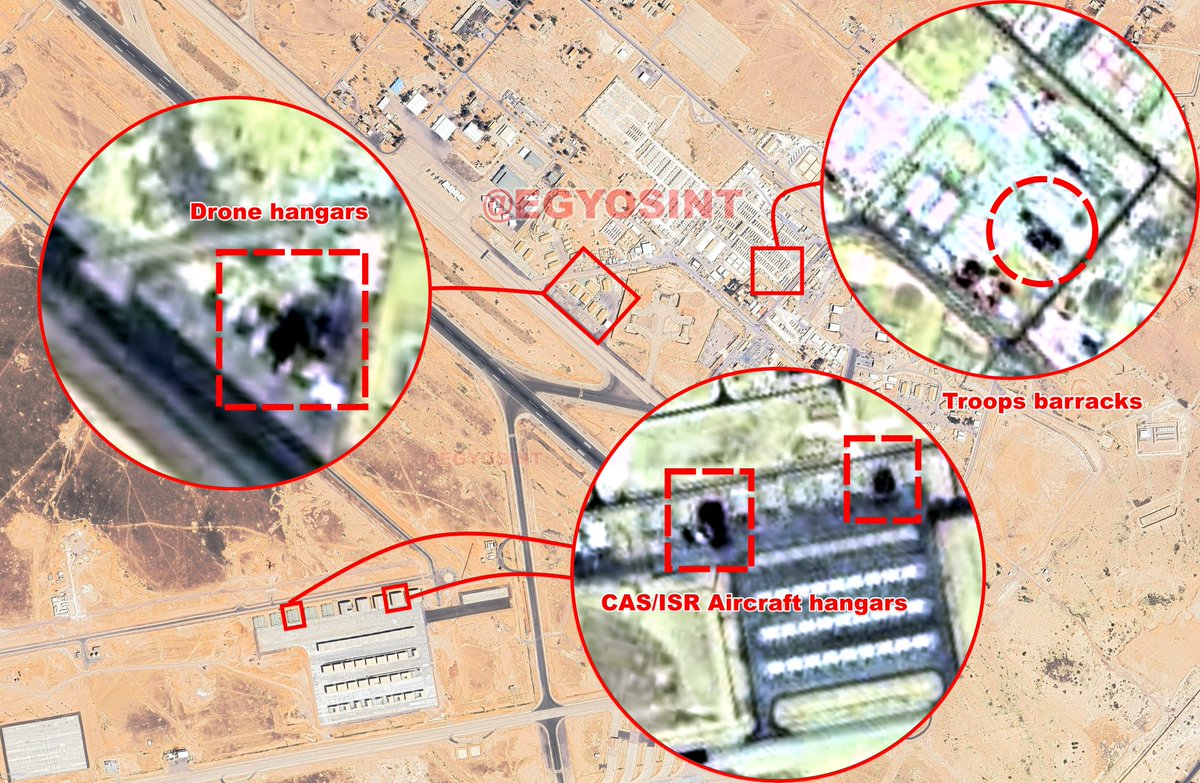
🛰️ Iranian state-controlled media has released high-resolution satellite imagery confirming significant damage at Muwaffaq al-Salti AB in Jordan. • Around 20 Containerized Living Units (CLUs) housing U.S. troops were completely destroyed (31°49'57"N, 36°47'47"E). • At least three drone hangars were heavily damaged or destroyed (31°49'53"N, 36°47'29"E). • Another aircraft hangar on the CAS/ISR apron was destroyed (31°49'26"N, 36°46'58"E).

🛰 Significantly more damage is visible at Muwaffaq al-Salti Air Base in Jordan. The base was not struck by a single missile but by what appears to have been a large, highly accurate salvo. Another hangar on the ISR/CAS apron was hit, while a major impact is visible in the troop housing area where U.S. service members were killed. Several additional drone/aircraft shelters were destroyed, including areas where U.S. MQ-9 Reapers have previously been spotted.


Houthis say they targeted Saudi Arabia's Abha International Airport with ballistic missiles and drones in response to Saudi airstrikes on Sana'a International Airport. Houthis also warned airlines against using Saudi airspace until the blockade on Sana'a Airport is lifted.


🛰 Significantly more damage is visible at Muwaffaq al-Salti Air Base in Jordan. The base was not struck by a single missile but by what appears to have been a large, highly accurate salvo. Another hangar on the ISR/CAS apron was hit, while a major impact is visible in the troop housing area where U.S. service members were killed. Several additional drone/aircraft shelters were destroyed, including areas where U.S. MQ-9 Reapers have previously been spotted.


🛰️ Iranian state media has now released high-resolution satellite imagery showing the aircraft hangar destroyed in an Iranian strike on Muwaffaq al-Salti Air Base in Jordan. The hangar was likely being used to shelter U.S. MQ-9 Reaper drones This is the same hangar I first ID as destroyed with low-resolution satellite imagery, posted below. ⬇️