EL OSO

34.1K posts

EL OSO

EL OSO

@ELOSOLICH

Trabajando en los mercados financieros desde 1990 . En particular mercados emergentes . Hincha del rojo

Katılım Eylül 2018
998 Takip Edilen7.2K Takipçiler
EL OSO
EL OSO@ELOSOLICH·
Perdón del 2027 😁
Español
0
0
0
97
EL OSO
EL OSO@ELOSOLICH·
Que buena noticia el Korn Ferry 🏌️‍♀️se jugará en el Olivos Golf la última semana de Febrero del 2026 ⛳️ @PacoAlemanGolf @joacoestevez Es asi estimados 🤔
Español
1
0
4
174
EL OSO
EL OSO@ELOSOLICH·
RT @TruthGundlach: People ask about muni’s and I typically don’t have much to say. But now, looking at the deficits caused by absurd spend…
English
0
23
0
25
EL OSO retweetledi
Kyle Potter
Kyle Potter@kpottermn·
NEW: In a letter to employees, United CEO Scott Kirby says the airline is prepping for oil to hit $175/barrel & “doesn't get back down to $100/barrel until the end of 2027.” United is shaving 3% of off-peak flights - “think redeyes, Tues/Wed/Sat flying” - this spring & summer.
Kyle Potter tweet mediaKyle Potter tweet media
English
177
2.6K
10.4K
1.9M
EL OSO
EL OSO@ELOSOLICH·
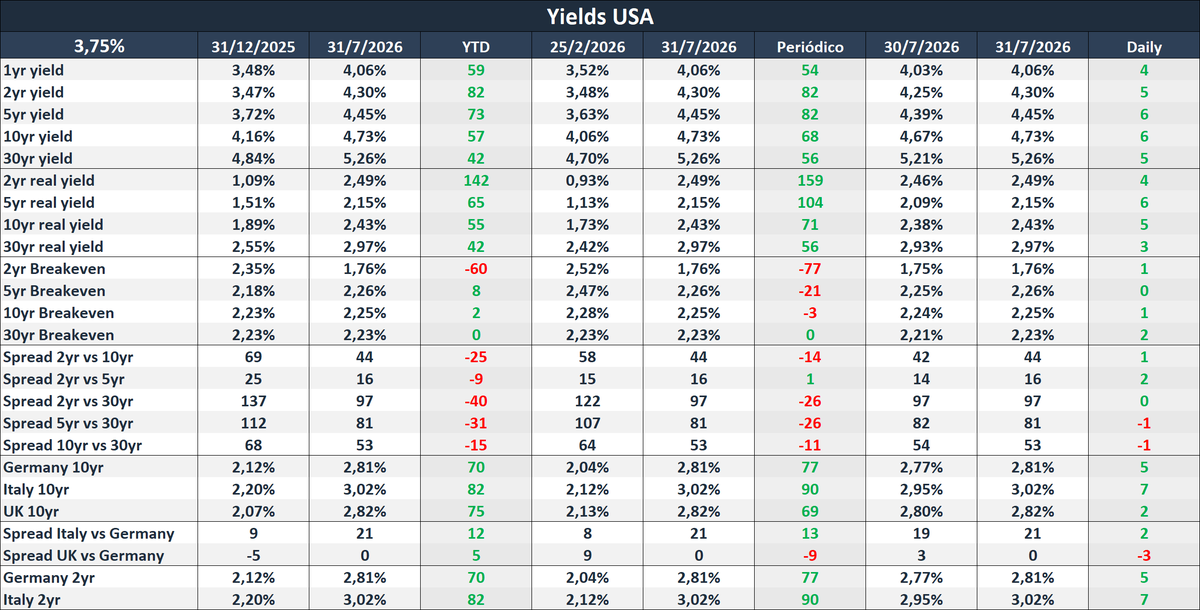
Recuerden donde estaba la tasa de antes de que empezara todo esto 3.95 % hoy 4.38 % Nada bueno y veremos hasta donde llega Dudo que DT imaginara este escenario y menos pensando en las elecciones de Noviembre Sumado ahora que vam a enviar tropas Pinta para largo esto Esperemos que no Buen fin de semana 🏌️‍♀️⛳️
EL OSO tweet media
Español
1
1
20
1.4K
EL OSO
EL OSO@ELOSOLICH·
Buen dia sigan de cerca la tasa de 2 años camino a 3.90 por 1 vez desde 2008 esta arriba de los Fed funds No es buena noticia STAY TUNED 👇
EL OSO tweet media
Español
1
17
46
2.6K
EL OSO retweetledi
eduardo yeyati
eduardo yeyati@eduardoyeyati·
El turismo es de los pocos sectores que genera empleo, divisas y valor agregado, y es resiliente a la competencia global. La miope destrucción del patrimonio cultural por un negocio individual es otro ejemplo del default de nuestra clase política. lanacion.com.ar/sociedad/autor…
Español
22
97
320
14.7K
EL OSO retweetledi
Sebastian Maril
Sebastian Maril@SebastianMaril·
[ENGLISH POST BELOW] 🛑La decisión de la Corte de Apelaciones en el caso por la Expropiación de YPF no será una simple “culpable” o “inocente” decisión. Será compleja. Vale aclarar que los jueces Robinson, Chin y Cabranes están evaluado el caso “de novo”. Es decir, sus decisiones no están influenciadas por el fallo de la Juez Preska. Los tres jueces sacan sus propias conclusiones evaluando el caso presentado desde el principio. No tienen que opinar si la Juez Preska estuvo en lo cierto o no. Tan solo deben interpretar cual es la correcta aplicación de las leyes. Esto no necesariamente se interpreta que sea mejor o peor para una de las partes. Entonces, el fallo puede tomar las siguientes cuatro formas: 1. Afirman el fallo de la corte inferior (mejor para los demandantes). 2. Desestiman la apelación (similar a lo primero para ser breves y simples). 3. Revierten el fallo de la corte inferior (mejor para Argentina y seguramente vuelve a la corte inferior para que haya un nuevo fallo). 4. Anulan el fallo (mejor para Argentina. El fallo de la corte inferior nunca existió). 5. Devuelven el caso a la corte inferior con instrucciones (neutro, pero depende de las instrucciones de los tres jueces). El fallo será largo y no será simple de interpretar en los primeros instantes posterior a su publicación. — 🛑 The decision by the Court of Appeals in the YPF Expropriation Case will not be a simple “guilty” or “not guilty” ruling. It will be complex. It is worth noting that Judges Robinson, Chin, and Cabranes are reviewing the case de novo. In other words, their decision is not influenced by Judge Preska’s ruling. Each of the three judges will reach their own conclusions by evaluating the case from the ground up. They are not tasked with determining whether Judge Preska was right or wrong, but rather with interpreting the correct application of the law. This doesn’t mean that it’s better or worse of a specific party. As a result, the ruling could take several forms: 1. Affirm the lower court’s decision (best outcome for plaintiffs). 2. Dismiss the appeal (similar to the above, for simplicity). 3. Reverse the lower court’s decision (best outcome for Argentina and likely remanded for a new ruling). 4. Vacate the decision (best outcome for Argentina; the lower court’s ruling is treated as if it never existed). 5.Remand the case to the lower court with instructions (neutral, but dependent on the panel’s guidance). The opinion will likely be lengthy and not easy to interpret in the immediate aftermath of its release.
Español
4
9
39
3K
EL OSO retweetledi
Shanaka Anslem Perera ⚡
JUST IN: Iran is charging $2 million per tanker to pass through the Strait of Hormuz. The Financial Times reported the payment. The IRGC confirms it by radio. And the world’s most important chokepoint has been converted from a military blockade into a toll road. The mechanism is precise. A tanker operator contacts intermediaries. The intermediaries negotiate with the IRGC. A fee is agreed, reportedly up to $2 million per voyage. Payment is made in cash, cryptocurrency, or barter. The vessel receives clearance. The IRGC hails the tanker on VHF radio, verifies its AIS transponder data, and grants passage. The tanker transits. It arrives. Roughly 89 to 90 vessels, including 16 oil tankers, successfully transited between March 1 and March 15 under some form of IRGC clearance according to Lloyd’s List Intelligence. Not all of them paid. Some were Iranian or allied ships. Some were Indian tankers that received diplomatic safe passage after government-to-government negotiations. Some were shadow fleet operators running dark with transponders off. But the Financial Times report confirms that at least one tanker operator paid the toll explicitly. The commercial precedent now exists. The $2 million sits on top of war-risk insurance that has surged to 3 to 5 percent of hull value where coverage exists at all. A VLCC valued at $120 million pays $3.6 to $6 million in war-risk premium for a seven-day single-voyage policy. Add the $2 million toll. Add the quadrupled charter rate of up to $800,000 per day. The total cost of moving a single cargo of crude through Hormuz now exceeds what it cost to move an entire fleet through the strait six months ago. Every dollar of that cost arrives at the consumer. The toll does not stay on the water. It enters the price of every barrel, every LNG cargo, every tonne of urea, every container of pharmaceuticals that the tanker carries. The $2 million is not a bribe. It is a tax levied by the IRGC on global commerce, collected at the narrowest point of the world’s most concentrated energy transit route, and passed through to four billion people downstream. The strategic innovation is that Iran has found a way to fund its war effort through the war itself. The IRGC closed the strait. The closure created scarcity. The scarcity created desperation. The desperation created willingness to pay. The $2 million per voyage funds the same provincial commands whose sealed packets created the closure. The feedback loop is self-financing: the blockade generates the revenue that sustains the blockade. The United States will frame this as state-sponsored extortion funding terrorism. The sanctions response is predictable: penalties on operators who pay, expanded designations on intermediaries, accelerated naval escorts under the six-allies pledge. But the enforcement faces a paradox. If the US sanctions every operator who pays the toll, it removes the only vessels currently moving oil through Hormuz. The molecules that are getting through, even at $2 million per transit, would stop entirely. The toll is extortion. The extortion is also the only functioning supply mechanism. The IRGC did not just close the strait. It reopened it selectively, on its terms, at its price. The blockade was the leverage. The toll is the monetisation. And the distinction between a military operation and a protection racket has collapsed into a radio frequency and a bank transfer. Full analysis: open.substack.com/pub/shanakaans…
Shanaka Anslem Perera ⚡ tweet media
English
38
264
625
174.7K
EL OSO retweetledi
Manpreet Kailon
Manpreet Kailon@preetkailon·
🚨 QUADRUPLE WITCHING ARRIVES TOMORROW. $4.7 TRILLION in derivatives expires. What it means → 4 types of derivatives expire simultaneously. Trillions in positions get closed or rolled. Why it matters → Volume surges. Prices can swing hard, especially in the final hour of trading. When it happens → 4x a year: March, June, September, December. Tomorrow is the March edition. Watch the market close carefully.
English
51
161
1K
118.4K
EL OSO retweetledi
First Squawk
First Squawk@FirstSquawk·
RIO TINTO GROUP: THE DISRUPTION TO ROUGHLY 30 MILLION TONS OF ANNUAL BAUXITE SUPPLY RAISES CONCERNS FOR ALUMINUM MARKETS, ESPECIALLY WITH BROADER REGIONAL RISKS IMPACTING OPERATIONS LINKED TO GLENCORE PLC AS THE CYCLONE THREATENS FURTHER FLOODING AND PROLONGED SHUTDOWNS.
English
0
2
18
11K
EL OSO retweetledi
Shay Boloor
Shay Boloor@StockSavvyShay·
U.S. prosecutors charge three individuals tied to $SMCI (including a co-founder) in an alleged scheme to smuggle $NVDA chips to China.
Shay Boloor tweet media
English
143
237
1.5K
371.5K
EL OSO retweetledi
El Masters
El Masters@TheMasters_ES·
Mateo Pulcini, el campeón del LAAC, está listo para cumplir su sueño de jugar el Masters. LAAC champion Mateo Pulcini is ready to fulfill his dream of playing The Masters Tournament. @LAAC_Golf | @TheMasters
Español
0
5
15
1.3K
EL OSO retweetledi
George Noble
George Noble@gnoble79·
Private credit didn't blow up because of Blue Owl or bad software loans or AI disruption. Those were SYMPTOMS. The disease is the same one I've seen 3 times in 45 years on Wall Street: Too much money, too much leverage, too little discipline, and a financial product sold as "safe" to people who didn't understand what they owned. Private credit grew to $3 trillion on a simple lie - that you could earn 9-10% yields with "semi-liquidity" on assets that have no liquid market. That's not investing. That's volatility laundering. And the Street dressed it up beautifully. "Private credit." Sounds so exclusive, so sophisticated. Illiquid loan sharking would be more accurate. And don't get me started on "private equity", another Wall Street rebrand designed to make LEVERAGED BUYOUTS sound like fine wine. They changed the name because the old one scared people. The risk didn't change. Just the marketing. Wall Street has always been brilliant at one thing: rebranding risk as exclusivity and selling it to people who don't know what they're buying. Now add oil at $113 a barrel and watch the whole thing come apart. The Strait of Hormuz is shut. The IEA is calling it the largest supply disruption in the history of the global oil market. The Fed held rates steady yesterday and the market just RIPPED AWAY expectations for even a single cut this year. Oil is the fuse. But the TNT was packed years ago. Oil above $100 means inflation stays sticky. No rate cuts. Every overleveraged borrower inside these private credit portfolios gets squeezed harder every single month. Interest coverage ratios deteriorate. Defaults tick up. Valuations get marked down. And when valuations drop, the leverage stacked on top of that leverage (the "back-leverage" that banks provide using those same loans as collateral) starts to unwind. And JPMorgan already started. They marked down software loan collateral and restricted lending to private credit funds. When the biggest bank in America pulls back, that's a SIGNAL. High-yield spreads just surged to 470 basis points. The widest in years. Credit markets are screaming what equity markets haven't fully heard yet. I've watched this exact pattern before. - Junk bonds in the '80s - Dot-com leverage in 2000 - Structured mortgage products in 2007 The product changes every time but the architecture never does: Wall Street creates something complex, sells it as safe, layers leverage on top, markets the yields to retail investors, and collects enormous fees on the way in. Then something breaks and the gates go up. The people who built the machine are fine - they already got paid. The people who bought the brochure are trapped behind locked doors. $265 billion in market cap already wiped from the major PE firms. I don't think we're close to done. And you know what? That's FANTASTIC. Perhaps we'll finally get some real price discovery. Just say no to mark to model. Holders of this fine merchandise will get the returns they deserve. The pension funds, endowments, and insurance companies that piled into this garbage should take the hit. No bailouts. NONE. This nonsense has gone on far too long and moral hazard is the predictable result. The only way to end this insanity is to let Mr. Market operate. Allow price discovery. Allow bankruptcy. No more money printing. No more crony capitalism. No more extend and pretend. Blow it all up. That is the only way. "But what about the individuals who get hurt!" Better to take the hit now and reset than continue down this road. Hyper-financialization is destroying our economy and enriching the fortunes of the few. This must stop. NOW. But I have little confidence it will. We'll get more of the same: Rule changes. Special accommodations. The inevitable big ease will come. Count on it. AND BUY GOLD
English
51
103
448
84.2K
EL OSO retweetledi
Michael A. Gayed, CFA
Michael A. Gayed, CFA@leadlagreport·
$VIX: 27.85 on March 13. 21.51 now. A 6+ point collapse in one week while oil trades near $100, the Fed just held, and private credit is cracking. Complacency doesn't announce itself. It just shows up in the $VIX.
Michael A. Gayed, CFA tweet media
English
4
7
44
5.7K
EL OSO retweetledi
Aleksey Berezutski 🇷🇺🎖
🚨BREAKING NEWS Qatar Gas CEO : We incurred a $20 billion loss at the facility we built for $26 billion two years ago.
English
874
6.6K
47.5K
3M
EL OSO
EL OSO@ELOSOLICH·
@germanfermo Hace una semana escribiste que se venia un rally en la bolsa americana ....🤔
Español
1
1
6
685
Sherman
Sherman@germanfermo·
👉 Lamentablemente, mucho inversor no profesional está mal aconsejado cuando le dicen que el oro es un “hedge” contra escenarios negativos 👉 Si dicho escenario negativo ocasiona una suba en tasas de interés (como la crisis actual), el oro termina siendo más castigado que los activos originales que se pretendían proteger
Español
12
9
102
8.5K
EL OSO retweetledi
Juan Jose Vazquez
Juan Jose Vazquez@juanjovazquez57·
$VIST: El timing de Galuccio para comprar Petronas Argentina y Equinor a buenos precios y enfocarse en expo la verdad es admirable. Ahora en abril-26 se destraba lock up period de la mitad de las acciones dadas a Petronas como parte de pago (3,6mill de papeles) y seguramente las recomprará VIST durante 2026 con caja generada por esta suba en los precios del petróleo.
Juan Jose Vazquez tweet media
Español
2
13
134
8K
EL OSO
EL OSO@ELOSOLICH·
RT @TruthGundlach: The 2 year U.S. Treasury yield has risen 50 basis points in less than three weeks. It now suggests a one Fed HIKE may…
English
0
13
0
51