Lou & Pat

4K posts

Lou & Pat banner
Lou & Pat

Lou & Pat

@Eagles2Two

Investment Professionals 40+years. Football Fanatics -Animal lovers. Philly born and bred. Philly / So. Jersey

Katılım Aralık 2010
690 Takip Edilen141 Takipçiler
Lou & Pat
Lou & Pat@Eagles2Two·
@StockSavvyShay He’s prob out already. These backward looking disclosures rarely are buy signals because of the lag. They only work if The buys are down by the time the 45 day lag is disclosed. Plenty of examples
English
0
0
1
1.1K
Shay Boloor
Shay Boloor@StockSavvyShay·
David Tepper initiated a $179M position in $SNDK last quarter. He’s one of the most successful macro-driven hedge fund managers alive and made billions buying distressed credit during the financial crisis.
Shay Boloor tweet mediaShay Boloor tweet media
English
57
84
1.2K
107.9K
Sara Eisen
Sara Eisen@SaraEisen·
Congratulations on kicking the can down the road. The Mayor’s deficit closing relies primarily on a huge bailout from Albany ($8b over 2 years) and delayed payments like pension costs which just get stretched farther into the future
Bernie Sanders@BernieSanders

Congratulations to Mayor Mamdani. He inherited a huge budget deficit, brought it down to zero, and still invested in childcare, housing and city infrastructure. When municipal governments stand with working families, not billionaires, there is nothing they cannot accomplish.

English
392
576
6.2K
567.3K
TrendSpider
TrendSpider@TrendSpider·
You can only own one Mag 7 name for the next 5 years. Which is it and why?
TrendSpider tweet media
English
53
5
100
46.6K
Ryan Detrick, CMT
Ryan Detrick, CMT@RyanDetrick·
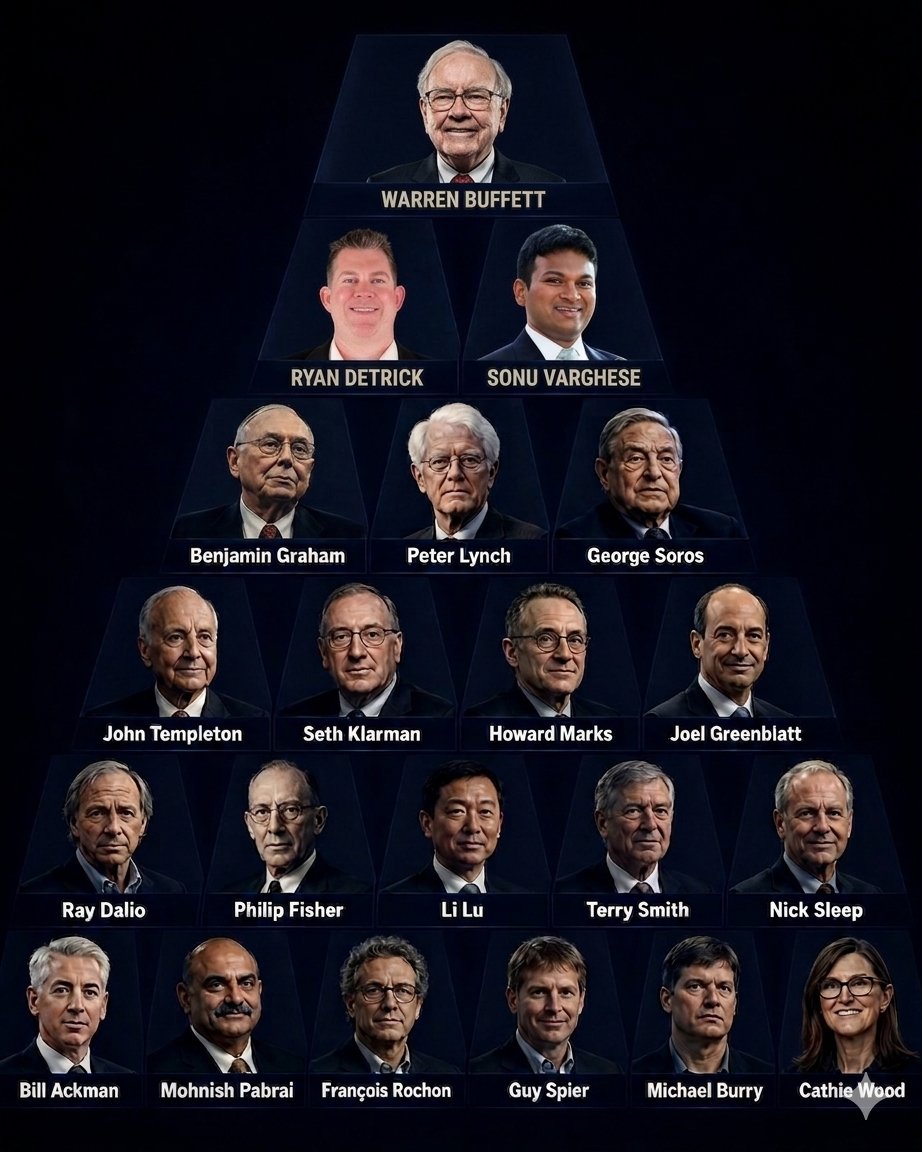
Pyramid of the best investors ever. Who is missing?
Ryan Detrick, CMT tweet media
English
993
61
742
508.6K
Lou & Pat
Lou & Pat@Eagles2Two·
@stoolpresidente Taking the time to respond to a click bait tweet leads me to believe it probably struck a nerve
English
0
0
0
12
Dave Portnoy
Dave Portnoy@stoolpresidente·
I’ve seen lots of people saying I would be loving this Vrabel story if it happened to a rival team. Those accusations are disgusting and despicable. Look at my 24 year history of running Barstool. I always keep it in between the white lines. I guess you can’t teach class.
CMCasey23@CMCasey23

@stoolpresidente Absolutely hilarious. If it wasn’t the Patriots you’d be eating this up

English
711
27
2.9K
942.2K
Lou & Pat
Lou & Pat@Eagles2Two·
@BeckyQuick I hope you put Paul’s entire discussion online later today. Terrific insights. Always interesting
English
0
0
0
8
Milk Road AI
Milk Road AI@MilkRoadAI·
The AI infrastructure race just went underwater. A Portland, Oregon startup called Panthalassa just raised $140 million in a Series B round led by Peter Thiel, the idea sounds wild until you understand the physics. Every AI data center on Earth has the same three problems, it needs massive amounts of electricity, it generates enormous heat that has to be cooled, and it requires land in places that are already running out of grid capacity. Panthalassa's answer is to eliminate all three constraints at once by taking the data center off the grid, off the land, and into the open ocean. And here's how it works, the company builds autonomous, self-propelled floating nodes made from plate steel, no anchor, no fuel, no cable to shore. As waves lift the platform, water is forced through an internal turbine, generating electricity continuously. That electricity runs AI inference chips onboard and the results go back to shore via low-Earth-orbit satellite. The surrounding ocean provides free supercooling, which one investor estimates could generate power at roughly two cents per kilowatt-hour. For context on why this matters, land based data centers spend up to 40% of their total energy budget just on cooling. Microsoft's Project Natick found that submerged servers had a failure rate of just 0.7% compared to 5.9% on land. The ocean doesn't just solve the cost problem but it solves the reliability problem too. Panthalassa's Ocean 3 pilot nodes are already under construction, with deployment in the northern Pacific targeted for August 2026 and commercial operations in 2027. The company has been building toward this for a decade with Ocean-1, Ocean-2, and Wavehopper prototypes already validated at sea, including a test in Puget Sound in 2024. The global underwater data center market was $3.2 billion in 2025 and is projected to reach $14.8 billion by 2034. China has already launched commercial-scale undersea data centers. The race to compute off the grid whether in space, underwater, or on the open ocean is no longer theoretical, it's being funded, permitted, and in Panthalassa's case, it's being built right now. The future is bright!
Milk Road AI@MilkRoadAI

The world is running out of places to put data centers (Save this). And two of the most powerful companies on the planet think the solution is to leave the planet entirely. Every AI model you use runs on infrastructure that drinks electricity like a small city and consumes water like a farm. Grid constraints are already threatening to block roughly 40% of planned data center builds because there simply isn't enough power or land to support it at the scale AI demands. So SpaceX filed an application with the FCC to launch up to a million satellites, each one functioning as an orbital data center running on free solar energy, tracking the dawn-dusk line in sun-synchronous orbit for near-constant sun exposure. Blue Origin followed months later with its own proposal, Project Sunrise, a constellation of over 50,000 dedicated compute satellites using laser inter-satellite links to pass data between nodes. The pitch is elegant but the engineering is brutal. Cooling, trivially solved on Earth with air and water, has no equivalent in space. Satellites would need closed-loop radiative panels, circulating coolant over the chips, radiating heat as infrared into deep space, and cycling it back and those panels are heavy, which drives up launch costs. Radiation is a second problem with no clean solution. Cosmic particles randomly flip bits inside chips corrupting computation., you either detect and correct the errors, run every calculation three times in parallel and vote on the right answer, or physically shield every server. All three approaches add mass, cost, or latency and bandwidth may be the most underappreciated constraint of all. Getting data from Earth to orbit and back over radio frequency is nowhere near fiber optic speed. The most viable near term use case isn't general cloud computing, it's AI inference specifically launch the satellite preloaded with model weights, send up a short query, receive a short answer. That's feasible but streaming training data back and forth is not. There's also a competitive subplot worth noting, Amazon whose founder Jeff Bezos is building orbital computing through Blue Origin formally petitioned the FCC to reject SpaceX's application, calling it speculative and facially incomplete. This isn't a debate about whether orbital data centers make sense. but rather about who captures the orbital spectrum and the regulatory runway before anyone else can build. One million satellites would be more than 60 times every satellite currently in orbit and the debris and spectrum consequences alone are enormous. Engineers are clear: large-scale orbital data centers are a 2030s reality at the earliest dependent on Starship dramatically cutting launch costs, radiation-hardened AI chips that don't yet exist commercially, and cooling architectures still being designed. Whoever wins this race owns something unprecedented, compute infrastructure running on free energy, above every country, beyond every grid, serving the entire planet at once.


English
44
86
419
132.6K
Dave Portnoy
Dave Portnoy@stoolpresidente·
I am so sick of all these delusional @sixers fans acting like they aren’t a bum franchise. It’s round 1 of the playoffs guys. You beat a bad Celtics team. Relax. If the Sixers win the title I’ll get a Sixers neck tattoo.
English
3K
250
7.5K
2.3M
Lou & Pat
Lou & Pat@Eagles2Two·
@SenWarren What a ridiculous take. You championed the blocked merger and now u blame others. Pathetic.
English
0
0
0
7
Elizabeth Warren
Elizabeth Warren@SenWarren·
Spiking fuel prices from Trump’s war was the nail in the coffin for twice-bankrupted Spirit airline. FWIW, JetBlue merger failed because a judge, appointed by Ronald Reagan, said the deal was illegal. Republicans are desperate to shift blame from higher costs hitting families.
English
14.3K
1.5K
7.9K
2.6M
Lou & Pat
Lou & Pat@Eagles2Two·
@MilkRoadAI @MilkRoad Also with cash flow no longer supporting massive buybacks by these corps and with all the new 2026 IPO‘s expanding share count - this would be the exact opposite of what we saw in the last decade-huge overall share count reduction. Not a good sign.
English
0
0
0
1.8K
Milk Road AI
Milk Road AI@MilkRoadAI·
Chamath Palihapitiya just laid out the most important valuation question nobody on Wall Street wants to answer. For 20 years, the Mag 7 won because they had the greatest business model ever invented, asset- ight software. You write the code once, you sell it to a billion people, the marginal cost of the next customer is basically zero. There is essentially no factories, no raw materials, no union workers, no physical infrastructure, just pure leverage, scale the revenue, barely scale the costs. That's how you get 30x, 50x, 60x earnings multiples and the market was paying for compounding economics that had no natural ceiling. But AI just blew that model up. The hyperscalers, Amazon, Microsoft, Google, Meta are now projected to spend between $600 and $725 billion on capex in 2026 alone, up from $250 billion just two years ago. That number is climbing, not plateauing and it's not just the chips and the data centers, it's the energy contracts underneath all of it. When Microsoft re signed Three Mile Island, they locked in a 20 year forward purchase agreement at more than $100 per megawatt hour nearly double the prevailing spot rate of $60 for wind and solar in the same region. That's a long term liability commitment baked into operating cash flows for two decades. Here's where Chamath's math gets uncomfortable. These five or six companies are now collectively spending so much that their capex has exceeded their free cash flow meaning they can no longer self fund growth from operations alone. In 2025 alone, hyperscalers raised $108 billion in new debt and projections put the total debt issuance over the next few years at $1.5 trillion. These are companies that, for two decades, were net cash accumulators and now they're going to the debt markets like everyone else with term loans, revolvers, and structured credit facilities. That's Chamath's core point and it's a devastating one for anyone still modeling these companies the old way. When a company is asset light, investors pay a premium for that lightness and the multiple reflects the belief that returns on capital will stay high indefinitely, because there's no heavy physical plant dragging them down. But when Google starts looking like a utility locked into 20-year energy contracts, carrying hundreds of billions in debt, spending half its revenue on physical infrastructure, the rational multiple compresses. You don't price a utility at 30x earnings, you price it at 12x. His conclusion is that stop trying to value the hyperscalers themselves and follow the money instead. A trillion dollars a year is flowing out of these companies into power companies, data center operators, chip manufacturers, cooling systems, fiber networks, rare earth metals. The companies on the receiving end of that spending are already underpriced because the market is still staring at the senders while ignoring who's cashing the checks. The asset-light era minted the most valuable companies in human history and the asset heavy era that's replacing it might be the best argument yet for owning everything around them instead.
English
85
213
1.6K
267.9K
Lou & Pat
Lou & Pat@Eagles2Two·
@MilkRoadAI @MilkRoad This calculation while very relevant assumes zero revenues from this spend. I don’t know if it’s zero or $1 trillion but it’s not negative.
English
0
0
1
1.2K
Milk Road
Milk Road@MilkRoad·
Computershare (the transfer agent for 58% of the S&P 500) just partnered with @Securitize to put actual shares onchain. Not derivative tokens or synthetic claims, but direct equity ownership in a wallet. Computershare serves 25,000+ companies, handling dividends & stock splits - and now they'll do it across both traditional and tokenized formats simultaneously. The TAM here is the entire $70T U.S. equity market. Tokenized equities today are ~$1.1B - that's 63,000x from the full TAM.
Milk Road tweet media
Milk Road@MilkRoad

x.com/i/article/2044…

English
4
6
37
7.2K
Lou & Pat
Lou & Pat@Eagles2Two·
@SthFLTrader @negligible_cap The Freedons afforded by the US allows one to live & work wherever they wish. Yes taxes are a part of the equation. If Ken feels better served elsewhere I have no issues with it.
English
0
0
2
185
Negligible Capital
Negligible Capital@negligible_cap·
Ken Griffin is “appalled” that Zohran used his $238m Manhattan penthouse in his tax the rich promotional video Citadel is now apparently considering bailing on their construction plans to build a new office in Midtown. The project would involve $6 billion in spending and would create 15k permanent jobs in NYC according to Citadel’s COO "It is shameful that he used Ken's name as the example of those who supposedly aren't carrying their fair share of the burdens associated with New York City's often costly and wasteful spending," the email said. "In doing so, the mayor has once again manifested the ignorance and disdain of the elite political class towards those who have been consistently committed to building one of the greatest cities in the world." Would be both incredibly petty but also hilarious if Citadel backed out of their plans over this
Negligible Capital tweet media
English
838
1.3K
12.6K
3.5M
Lou & Pat
Lou & Pat@Eagles2Two·
@felixprehn Buying VIX or VIXY OTM calls are another cheap hedge
English
0
0
1
578
Felix Prehn 🐶
Felix Prehn 🐶@felixprehn·
Bill Ackman turned $27 million into $2.6 billion in 30 days. Here's the exact trade, and why the same setup exists right now. In February 2020, Ackman saw COVID spreading through Italy and realized the US market hadn't priced in what was about to happen. He spent $27 million buying credit default swaps on the investment-grade corporate bond index. Basically insurance policies that pay out when companies start defaulting on debt. 30 days later the market collapsed 30%. His $27 million position was worth $2.6 billion. A 9,500% return in one month. Then he did something even smarter. He sold the hedge at the bottom and used the $2.6 billion to buy stocks at March 2020 lows. Hilton, Lowe's, Agilent. Bought them at maximum fear. Those positions doubled and tripled over the next 18 months. $27 million into $2.6 billion into an equity portfolio worth over $10 billion. All from one trade that started as a hedge. This wasn't luck. The setup was visible weeks before the crash if you were watching the right signals. Corporate credit spreads were widening. Italy's healthcare system was collapsing in real time. The VIX was still low because nobody believed it would reach America. The same type of asymmetric setup exists right now. Not the same trade. But the same structure. The Buffett Indicator just hit 232%. Highest in history. Buffett himself is sitting on $334 billion cash. Private credit funds are gating $4.6 billion in redemptions. The former Treasury Secretary just called for an emergency plan for a potential bond market crash. Oil is above $100. Everything is priced for the best case. The hedge costs almost nothing when everyone believes the best case. You don't need to be Bill Ackman. You need the same concept at your scale. Tail-risk hedging for a regular portfolio: Put options on SPY (S&P 500 ETF). A put 20% below current price expiring 6 months out costs roughly 1-2% of the position you're protecting. If the market drops 30%, that 1-2% position returns 10-15x. If the market doesn't drop, you lose the 1-2% premium and your portfolio keeps running. That's the Ackman structure in miniature. Small cost. Asymmetric payoff. Raise cash to 20-30%. Park in T-bills at 5.2%. You're getting paid to wait. Set limit orders 30-40% below current prices on companies you want to own forever. AAPL, MSFT, GOOG, AMZN. If the crash comes, you buy automatically at prices you chose in advance. Allocate 5-10% to commodities that benefit from chaos. Gold miners (GDX), uranium (CCJ), energy producers (XOM, CVX) with 3-4% dividend yields. The entire Ackman thesis was one insight: markets price the consensus, not the risk. When consensus is "everything is fine" and the risk is building underneath, the hedge is cheap. Right now, consensus is "the worst is over." The Buffett Indicator says otherwise. Buffett's own cash position says otherwise. The Fed printing $40 billion says otherwise. The hedge is cheap when nobody thinks they need one. every week i break down what institutional money is actually doing and the asymmetric setups building in real time. former banker. real trades. felixfriends.org/live (bill ackman spent $27 million on credit default swaps. 30 days later they were worth $2.6 billion. he sold the hedge at the bottom, bought stocks at maximum fear, and turned it into $10 billion. the setup was visible weeks before the crash if you watched the right signals. the buffett indicator just hit the highest level in american history. buffett is sitting on $334 billion cash. private credit funds are locking people's money behind gates. the former treasury secretary is calling for an emergency plan. the hedge costs 1-2% of your portfolio. the consensus says everything is fine. it always does.)
English
27
92
827
265.2K
CogginToboggan
CogginToboggan@CogginToboggan·
Never thought I’d hear a “let’s go Flyers” chant during a late-April Phillies game.
English
7
9
256
8.6K
Collin McLelland 🏴‍☠️
Microsoft pulled all of our GPUs from us a couple of weeks ago without explanation. I think it's likely because Anthropic needed compute and all the small guys like us got kicked out. It's part of the game and just how it goes, but highlights how much dependency risk companies are going to have on Microsoft and other cloud providers when it comes to compute for running inference on agents. Companies are going to deploy agents then just get rug pulled on their compute. Fortunately for us, we have deep experience in energy and our clients are some of the biggest energy producers in the world. We will eventually build on-prem compute for our clients on their energy assets. This will allow them to have closed loop systems where they own the energy, the compute, and the AI stack.
English
31
14
267
38.9K
ARK Invest
ARK Invest@ARKInvest·
Do you think prediction markets will become a standard tool in institutional investing within the next 5 years?
English
14
12
51
16.3K
Lou & Pat
Lou & Pat@Eagles2Two·
@joeszaka @kylascan I’ve witnessed headlines like this over 40 years in the markets and guess what.. none of them were signs of a top. Wait for the headline that says the market is never ever going down — that’s the bell ringer
English
0
0
4
1.7K
Joe Szaka
Joe Szaka@joeszaka·
The clearest credible assessment I’ve seen on the continuing market enthusiasm in a world wracked by risk. By @kylascan
Joe Szaka tweet media
English
16
22
423
85.2K