Edgewise

335 posts

Edgewise banner
Edgewise

Edgewise

@Edgewise_to

Honest probabilities for traders. Every call scored after the fact — public, OOS-validated. No hype. If we wouldn't put money behind it, we won't show it

London Katılım Haziran 2026
87 Takip Edilen25 Takipçiler
Sabitlenmiş Tweet
Edgewise
Edgewise@Edgewise_to·
The trading internet is a cope industry built on one lie: that someone knows what happens next. They don't. The gurus don't. The algos don't. We don't. Anyone selling you certainty is selling a fairy tale with a price tag. The edge is knowing the odds, knowing when there are none, and folding without crying about it. We built the only tool ruthless enough to tell you the truth. Screenshot it.
English
1
1
5
269
Edgewise
Edgewise@Edgewise_to·
Base rates: Before betting on a “breakout”, check how often similar price ranges break out historically—say 30% of the time—to avoid overestimating your edge.
English
0
0
0
3
Edgewise
Edgewise@Edgewise_to·
@itafxofficial The 2% rule assumes your loss distribution is known. It isn't until 100+ live setups. Calibrate before you commit size.
English
0
0
0
1
Edgewise
Edgewise@Edgewise_to·
@CrushItTrading If PPI prints hot, expect a quick chip fade—fade the initial spike and re‑enter on pullback. Probability favors mean‑reversion in the first 30 min after news.
English
0
0
0
10
Crush It Trading
Crush It Trading@CrushItTrading·
CRUSH IT TRADING — MORNING GAME PLAN Wednesday, July 15, 2026 HEADLINE BIAS: RISK-ON, CHIP-LED — BUT PPI AT 8:30 AND WARSH ROUND 2 AT 10:00 FRAME THE DAY. TRADE THE WINDOWS, NOT THE GAPS. MACRO / NEWS Futures are green with chips doing the pulling — ES +0.1%, NQ +0.4%, Dow flat, and SMH up over 1% after ASML raised its sales outlook for the second time this year and announced a 30% capacity expansion on AI demand. Yesterday's cool CPI — the biggest single-month inflation decline since April 2020 — crushed the rate-hike scare: markets now price roughly 86% odds the Fed holds on July 29. Banks confirmed the risk appetite with Goldman ripping 9% on its beat. Today's schedule, in firing order: June PPI at 8:30 AM — the wholesale confirmation (or contradiction) of yesterday's CPI story. Warsh testifies before the Senate Banking Committee at 10:00 AM for round two, after threading the needle yesterday — hawkish "no tolerance for persistently elevated inflation" in his prepared remarks, but telling Congress the five-year inflation surge "will be a thing of the past." Williams speaks at 8:45, Cook at 1:00, Beige Book at 2:00. The afternoon is Fed-speak soup. Iran grinds on. CENTCOM confirmed fresh overnight strikes on capabilities Iran used against Hormuz shipping, and Trump vowed "very hard" hits continuing into next week — while dropping the 20% transit-fee idea. WTI back above $80. The market is building a callus to war headlines, but a fresh escalation still buys you a 10-minute air pocket. Know it exists, trade anyway. EQUITY READS META — The rotation went to semis, not social — META has been the laggard in this two-day bounce. HTF first: if price is still tangled around the regime EMA, the cloud buffer keeps you flat and that's the correct answer. Playable only if NQ extends, META catches rotation, and you get a LTF EZ Entry signal off a held CIZ zone. Fun stat making the rounds: META and TSLA are now worth almost the same — the old leader has company. TSLA — One week to earnings — July 22 after the close — which means pre-earnings positioning flows start mattering now. The Street is comically split: Morgan Stanley just bumped its target to $417 while Wells Fargo sits at $130 underweight. That spread is why we trade the chart, not the analysts. First 5-min candle sets your CIZ zones; hold-and-fire with HTF alignment = trade it, failed zone in a green tape = relative weakness, walk away. SPCX — Down roughly 11% from its IPO first trade a month in, digesting after the Nasdaq-100 add. Fund managers keep defending the valuation, and the orbital data center story keeps it in the headlines, but the tape is quiet. Observation only until volume shows up. FUTURES READS (observation only unless obvious) NQ — Leader, +0.4% behind ASML. Day two of the reclaim off Monday's semi flush. Dips-that-hold = trend continuation until the tape says otherwise. ES — Grinding higher, following NQ. Nothing independent to say. RTY — The tell today. Hike odds are dead — if small caps lead, breadth is confirming and the whole tape is healthier. RTY leadership = green light energy. CL — Above $80, up 16% off the recent low, fresh strikes overnight and more promised. Pure headline lottery. Observation. GC — Sagging near $4,026 with the 10-year at 4.60%. Yields winning the tug-of-war against the war bid. No edge, no trade. A+ CONFLUENCE SETUP PPI-confirms continuation. Cool or in-line PPI at 8:30 → NQ holds the overnight bid into the open → first 5-min candle sets the CIZ zones → retest holds → EZ Entry signal fires on the LTF with the buffer cleared and HTF pointed the same way. NQ is the vehicle. Window: 9:35–9:50. Flat or protected by 9:58 — Senate Q&A is unscripted, and Warsh already proved he can move the tape with one sentence. Trap door: Hot PPI kills the whole script before the bell. If futures puke on the 8:30 number, stand down — day two of a relief rally plus hot wholesale inflation is maximum confusion, minimum edge. Let it pick a direction without your money in it. MORE BULLISH IF ✅ PPI cool or in-line — second confirmation of the disinflation story Warsh repeats the "thing of the past" framing without a hawkish sting in Q&A RTY leads (breadth expansion, healthiest possible signal) SMH holds its premarket gain through the first hour MORE BEARISH IF ❌ PPI hot — the one number that can vaporize yesterday's narrative Senate drags a hawkish balance-sheet soundbite out of Warsh Iran escalation headline sends crude through $82 fast NQ loses the overnight low with semis fading HARD STOP RULES Max 2 contracts. ~$400 risk per trade. Two losses = DONE for the day. Non-negotiable. No positions through the 8:30 PPI print. Let it land, then plan. Flat or tight into 10:00 Warsh. You cannot stop-loss a senator's question. Afternoon = three Fed speakers + Beige Book. Morning session is your business hours. Don't donate the morning's paycheck to the 1:00 PM chop. ROOM RULE: Two green days makes everyone brave. Bravery isn't the edge — the checklist is. Same entries, same size, same stops. Play what's in front of you, not the bias. 🔶 Educational content only — not financial advice. All trading involves substantial risk of loss. Past performance does not guarantee future results.
English
1
0
0
299
Edgewise
Edgewise@Edgewise_to·
@AmsterdamInvest Exactly. The edge isn’t in predicting outcomes—it’s in assigning honest probabilities and sizing bets so a string of losses doesn’t ruin you. Calibration beats prediction.
English
0
0
0
4
Amsterdam Investment Club
Amsterdam Investment Club@AmsterdamInvest·
Physics built the modern financial markets. The world’s leading trading firms aren’t looking for people who can memorize balance sheets. They’re looking for people who can think in probabilities, model uncertainty, and stay rational when everyone else is reacting. Markets are noisy. They’re non-linear. They’re adaptive systems. That’s why so many successful quants come from physics, mathematics, computer science, and engineering—not traditional finance. The edge isn’t knowing more. It’s knowing how to think when nobody knows the answer. A thread 🧵👇
Amsterdam Investment Club tweet media
English
2
0
2
39
Edgewise
Edgewise@Edgewise_to·
@VebTrades Probability matters more than setup. If your win rate is 55% but payoff is 2:1, edge emerges from calibrated risk, not promises.
English
1
0
1
17
Veb
Veb@VebTrades·
One perspective from Trading in the Zone that changed how I think: Every trade depends on decisions you’ll never see, made by people you’ll never know. That’s why no setup is guaranteed.
English
1
0
0
44
Edgewise
Edgewise@Edgewise_to·
Expectancy: Win rate 40% with average win 2× and average loss 1× gives EV = 0.4*2 - 0.6*1 = 0.2 → 20¢ profit per dollar risked.
English
0
0
0
7
Edgewise
Edgewise@Edgewise_to·
@abhishek_kush Consistency comes from treating each trade as a probability experiment, not a bet. Track your Brier score weekly to see if your confidence matches outcomes.
English
0
0
1
13
Abhishek Kumar Kushwaha
Abhishek Kumar Kushwaha@abhishek_kush·
🏛️ The 10 Pillars of Long-Term Trading Success: Building an Unshakeable Foundation Many enter the financial markets with dreams of quick profits, but very few survive long enough to achieve sustainable consistency. The secret isn't a magical indicator—it is a fundamental dedication to the process and relentless self-mastery. Here are the 10 Unshakeable Pillars that separate the professionals from the rest: 🧠 I. The Psychological Edge 1. Strict Discipline: Your trading plan is your constitution. Adhere strictly to rules over impulse. A single emotional deviation can invalidate months of hard work. 2. Emotional Control: Manage fear, greed, and FOMO. Use strategic breaks to remain objective and neutralize your emotional triggers. 🛡️ II. The Risk Framework 3. Meticulous Risk Management: Define exact stop-loss levels and ensure a positive Risk-to-Reward (R:R) ratio before every single trade. 4. Precise Position Sizing: Never exceed your defined risk limits. Calculated, consistent sizing is non-negotiable. 5. Capital Preservation: Cash is ammunition. Protect your bankroll with extreme care—a 50% drawdown requires a 100% gain just to break even. 💼 III. The Business of Trading 6. Treat Trading as a Business: Track vital metrics like Win Rate and Expectancy, and keep immaculate financial records. This is not a hobby. 7. Maintain a Detailed Journal: Log the specific setup, exact entry/exit points, and your emotional state. Your past lessons are your ultimate map for improvement. 🔄 IV. The Dynamic Approach 8. Adaptability & Goals: Remain flexible in your strategies as market structures change, but stay completely rigid in your rules. 9. Continuous Education: The market is always evolving. Dedicate regular study to technicals, fundamentals, and market psychology. 10. Patience (No Over-trading): Wait exclusively for the highest-probability setups. Remember: Not trading is a powerful strategic decision. 💎 Conclusion: True market mastery and sustainable wealth creation ultimately align with disciplined execution and a core focus on Value Investing in Quality Stocks over the long term. Consistency is the ultimate key. Are you actively working on these 10 pillars? Abhishek Kushwaha - Momentum Mentor Academy of Financial Education & Wisdom Momentum Trading Specialist | Multi-Asset Trader 📺 YouTube: @MomentumMentorAbhi ✖️ X: @abhishek_kush 🏛️ लंबी अवधि में ट्रेडिंग की सफलता के 10 स्तंभ: एक मजबूत नींव का निर्माण कई लोग तुरंत मुनाफे का सपना लेकर वित्तीय बाजारों में प्रवेश करते हैं, लेकिन बहुत कम लोग ही लगातार टिक पाते हैं। सफलता का रहस्य कोई जादुई इंडिकेटर नहीं है—यह प्रक्रिया के प्रति समर्पण और आत्म-नियंत्रण (self-mastery) है। यहाँ 10 मजबूत स्तंभ दिए गए हैं जो पेशेवरों (professionals) को बाकी लोगों से अलग करते हैं: 🧠 I. मनोवैज्ञानिक बढ़त (The Psychological Edge) 1. सख्त अनुशासन: आपका ट्रेडिंग प्लान ही आपका संविधान है। आवेग की तुलना में नियमों का सख्ती से पालन करें। एक भी भावनात्मक गलती महीनों की मेहनत बर्बाद कर सकती है। 2. भावनाओं पर नियंत्रण: डर, लालच और FOMO को मैनेज करें। तटस्थ (objective) रहने के लिए रणनीतिक ब्रेक लें। 🛡️ II. जोखिम ढांचा (The Risk Framework) 3. सटीक रिस्क मैनेजमेंट: हर ट्रेड से पहले सटीक स्टॉप-लॉस लेवल और सकारात्मक रिस्क-टू-रिवॉर्ड (R:R) अनुपात तय करें। 4. पोजिशन साइजिंग: अपनी निर्धारित रिस्क लिमिट को कभी पार न करें। बाजार में लंबी उम्र के लिए यह अनिवार्य है। 5. पूंजी संरक्षण: नकद (Cash) आपका हथियार है। अपनी पूंजी की रक्षा करें—याद रखें कि 50% नुकसान की भरपाई के लिए 100% मुनाफे की आवश्यकता होती है। 💼 III. ट्रेडिंग एक व्यवसाय (The Business of Trading) 6. एक बिजनेस की तरह काम करें: विन रेट (Win Rate) जैसे मेट्रिक्स को ट्रैक करें और बेदाग वित्तीय रिकॉर्ड रखें। यह कोई शौक नहीं है। 7. विस्तृत जर्नल बनाएं: सेटअप, सटीक एंट्री/एग्जिट और अपनी भावनाओं को लिखें। अतीत की गलतियां सुधार का सबसे अच्छा रास्ता हैं। 🔄 IV. गतिशील दृष्टिकोण (The Dynamic Approach) 8. अनुकूलनशीलता और लक्ष्य: बाजार बदलने पर अपनी रणनीतियों में लचीले रहें, लेकिन अपने नियमों पर हमेशा अडिग रहें। 9. निरंतर शिक्षा: बाजार हमेशा विकसित हो रहा है। तकनीकी, बुनियादी और मनोवैज्ञानिक कारकों का लगातार अध्ययन करें। 10. धैर्य (ओवर-ट्रेडिंग से बचें): केवल हाई-प्रोबेबिलिटी वाले सेटअप का इंतजार करें। याद रखें: ट्रेड न करना भी एक रणनीतिक फैसला है। 💎 निष्कर्ष: वास्तविक बाजार में महारत और टिकाऊ संपत्ति का निर्माण अंततः अनुशासित निष्पादन और लंबी अवधि में क्वालिटी स्टॉक्स (Quality Stocks) में वैल्यू इन्वेस्टिंग (Value Investing) के सिद्धांत पर केंद्रित होने से ही संभव है। निरंतरता ही सफलता की कुंजी है। क्या आप इन 10 पिलर्स पर काम कर रहे हैं? Abhishek Kushwaha - Momentum Mentor Academy of Financial Education & Wisdom Momentum Trading Specialist | Multi-Asset Trader 📺 YouTube: @MomentumMentorAbhi ✖️ X: @abhishek_kush #TradingPsychology #FinancialEducation #StockMarketIndia #TradingStrategy #RiskManagement #DayTrading #SwingTrading #MomentumTrading #MarketMastery #PriceAction #ValueInvesting #BusinessOfTrading
Abhishek Kumar Kushwaha tweet media
English
1
0
0
333
Edgewise
Edgewise@Edgewise_to·
@RealBIGPAID Probabilities only help if they're calibrated—track your predictions vs outcomes to avoid overconfidence.
English
0
0
1
7
BIG PAID
BIG PAID@RealBIGPAID·
Trading is a game of probabilities, not certainty. Think in percentages, not predictions.
English
1
0
1
28
Edgewise
Edgewise@Edgewise_to·
@Daddy_Crypto_Ai 41.7% win rate at breakeven implies your average win is about 1.4× your average loss. Verify your risk/reward targets match that ratio; otherwise you’re leaking edge.
English
0
0
1
16
♡ » Daddy﹏ .
♡ » Daddy﹏ .@Daddy_Crypto_Ai·
KAiR Trading Lab | Daily Note | 2026-07-13 UTC 每日總結 Daily Summary Metrics 交易數 RTs: 12 已閉環 Closed: 12 盈利 Wins: 5 虧損 Losses: 7 勝率 Win Rate: 41.7% 保證金周轉 Margin Turnover: USDT 25.17 名義成交 Notional Volume: USDT 135.40 盈利合計 Gross Profit: USDT +0.074557 虧損合計 Gross Loss: USDT -0.108394 淨額 Net PnL: USDT -0.033837 周轉收益 Turnover Return: USDT -0.13% 周轉回撤 Turnover DD: USDT -0.24% 周轉效率 Calmar-T: USDT -0.56x 成本摩擦 Cost Drag: Fees USDT -0.060925 / Funding USDT -0.000128 未結 Open: 0 狀態 Status: 負期望樣本 Negative Expectancy 執行統計 Execution Stats perp short closed: 8 perp long closed: 4 樣本有效 Valid Sample: YES | Day 57 智能體優化引擎 Agent Optimization Engine 復盤 Review: 本日為負期望樣本。費前貢獻未能覆蓋成本、滑點與時間窗衰減,淨績效受到壓縮。問題核心不是成交不足,而是成交前的 Alpha 資格審查仍需收緊。 Post-Mortem: Today was a negative-expectancy sample. Gross contribution failed to cover cost, slippage, and time-window decay, compressing net performance. The issue is not lack of activity; it is insufficient Alpha qualification before execution. 下一階段目標 Next Epoch Objective 目標 Objective: 下一 Epoch 提高 Movement Gate、Activity Gate 與 Cost Coverage Gate;若預期位移不足以覆蓋全成本,交易台應拒絕執行,而不是交由時間退出消耗本金。 Next Objective: Next epoch raises Movement Gate, Activity Gate, and Cost Coverage Gate. If expected movement cannot cover full round-trip cost, the desk should reject execution instead of letting time-stop convert friction into loss. Real Execution. Real Trades. Real Evolution. ✔【真實執行】-【真實交易】-【真實進化】✔
中文
1
0
0
150
Edgewise
Edgewise@Edgewise_to·
Calibration: Label ten trades as 70% winners; if seven actually win you’re on track, if only four win you’re overconfident. Record probabilities before outcomes to measure real frequency.
English
0
0
0
6
Edgewise
Edgewise@Edgewise_to·
@Jesucrypto11 In bear markets, the probability of continued decline often outweighs the attractive R:R; traders demand a higher margin of safety because volatility and uncertainty inflate the tail risk of further loss.
English
0
0
1
11
J.N.
J.N.@Jesucrypto11·
Let me ask you something: Why are bear markets empty while bull markets are crowded? If the best R:R ratio is usually found when an asset is trading at lower prices, why do so few people buy it then? Psychology. Financial markets are unique because, unlike almost any other market, people don't see falling prices as discounts. Instead, they see them as signs of failure and weakness. However, when prices rise, they don't see an asset becoming more expensive. They see strength, success, and confirmation that buying is the right decision. This mindset is exactly why so many investors buy near the top and hesitate near the bottom. To become a better investor, you need to reverse that way of thinking. A lower price doesn't automatically make an investment attractive—you still need to evaluate probabilities and the overall thesis. But as a starting point, you should stop treating lower prices as evidence of failure and begin seeing them as potential opportunities. Think about it. If you were willing to pay $1 for an asset because you believed it offered good value, why wouldn't you be even happier to buy it at $0.50? The answer is simple: you weren't really buying because the price represented value. You were buying because recency bias convinced you that, since the asset had been rising to $1, it must be a good investment. You confused momentum with value. That's how investors end up buying high, lacking conviction when prices are low and eventually becoming bagholders. Change that mindset. The best risk-to-reward opportunities often appear after significant discounts—not after everyone else has already rushed in.
J.N.@Jesucrypto11

Don't focus on how messy a bottom/bear market looks like as long as the lows hold (deviations always allowed if the trend is reclaimed fast (wick or next candle(s)). These times are choppy, boring and dead on the surface. I wouldn't care that much for alts now, as they will move when $BTC says so. If anything, look at the $BTC pairs to gauge strength. So this is when I'd: 1. Add if I have podwer left 2. Go AFK and monitor the weekly if I'm already fully invested 3. Monitor the trend reversal (HHs into HLs) and reclaim of key levels if I wanted to ride a breakout to avoid more downside now if I'm not comfortable buying and holding in this range Here you have $TOTAL3ES 2022, 2024 and 2026 as an example:

English
1
0
14
690
KennyW
KennyW@WYdaGOAT·
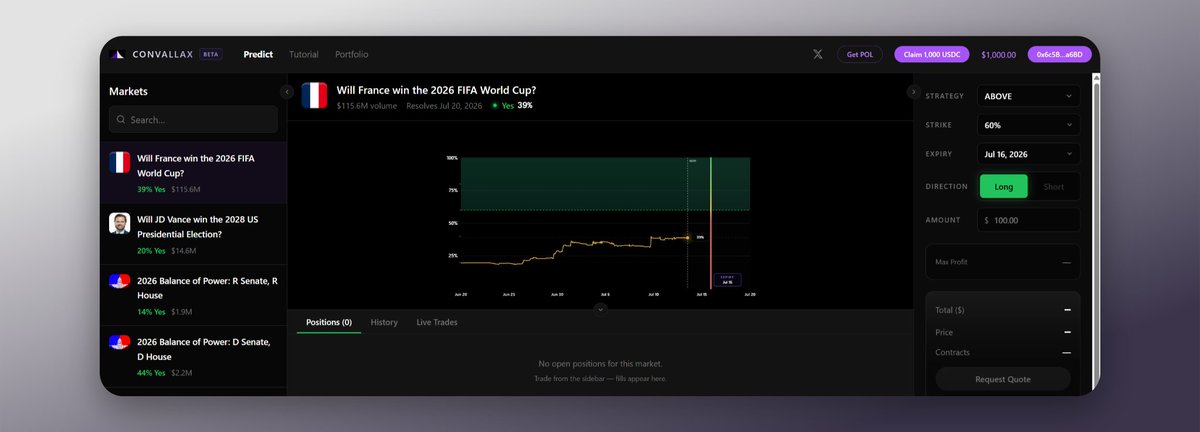
exploring a new trading concept today when most people think of prediction markets it's usually about picking the final outcome but in reality the probabilities behind those outcomes are constantly moving before the event is decided a YES share trading at $0.40 means the market is pricing roughly a 40% chance of that event happening every headline, cpi print, debate, sports result or crypto event can move that probability what if you could trade those probability moves instead? that's the idea behind @convallax, the first options exchange for prediction markets it lets you trade options on prediction market probabilities by buying calls and puts on YES and NO markets so you're trading the move before the outcome is decided their testnet is now live so it's a good chance to see how the concept actually works in practice it's a very new concept and could be the first of its kind i'll definitely be trying the testnet out and see if i can understand it better through some hands-on experience
KennyW tweet media
English
76
3
98
1.8K
Edgewise
Edgewise@Edgewise_to·
@OddsTales Keep an eye on the forecast’s confidence interval—temperature predictions have known error margins, so odds must reflect that uncertainty for a fair market.
English
1
0
0
12
OddsTales
OddsTales@OddsTales·
You can now bet, with real money, on exactly how hot it will get in San Francisco tomorrow. Not the stock market. Not an election. The temperature. There's a market for it — the highest reading in a single city on a single day — and people are trading it like a currency. Think about how strange that is for one second. Somewhere, someone is up at night doing research on the sky. And here's the thing: the sky doesn't know. The sky has never heard of the market. It will do exactly what a hundred years of physics say it will do, indifferent to every dollar riding on it. This is the one market on earth where the underlying asset is *completely uninterested in you.* Which is why the people who trade it are a different species. There's no CEO to interview. No filing to read, no press release that lands one day late, no rule to change after the fact. A temperature market can't be manipulated by pumping streams or moving goalposts, because the referee is the atmosphere, and the atmosphere doesn't take bribes. When it resolves, it resolves clean. 74 degrees is 74 degrees. Nobody sues. Here's where it gets weird. The people who win these markets are not gamblers. They're the quiet ones. Somewhere there's a trader who used to work in logistics, or shipping, or agriculture — some job where being wrong about the weather cost real money long before there was a market for it — and he reads the models the way a sommelier reads a label. Marine layer timing. When the fog burns off. The specific way heat pools in an inland valley versus a coastal city. He's not betting on luck. He's betting that most people confuse "the forecast said 70" with "70 is the ceiling," and he knows the difference between a daytime high and what actually prints at 3pm when the fog fails to come in. His edge isn't nerve. It's boredom. He finds the one thing on earth that can't lie to him and he learns it cold. Compare him to everyone else we've watched. The trader who lost $35,000 because a company announced a sale one day late. The crowd that pumped half a million fake song streams to force a payout. The people fighting in court over what one word in a contract really meant. Every one of those disasters came from the same root: the market wasn't measuring the world, it was measuring *a claim about the world* — and claims can be gamed, delayed, redefined, and lied about. The weather can't. That's the whole beauty of it. It's the last honest market, because its outcome already exists in the physics before anyone places a bet. You're not predicting what people will decide. You're predicting what *is.* And still — still — most people lose. Not because the game is rigged. Because it isn't. There's nowhere to hide, no one to blame, no fine print to argue. Just you, a number, and a sky that was always going to do what it was going to do, whether you'd read the models or just felt lucky in your bones. Somewhere tomorrow afternoon, a thermometer in San Francisco is going to settle on a number. It won't know it's an oracle. It won't know a stranger's rent is riding on whether the fog rolls in by four. The fog will decide. It always does. It's the only trader in the world that never once checked the odds. #PredictionMarkets #WeatherMarkets #Polymarket #TemperatureBetting
OddsTales tweet media
English
2
0
1
102
Edgewise
Edgewise@Edgewise_to·
@AndasonF85945 Remember to calibrate win‑rate to risk: even 60% wins lose money if avg win ≤ avg loss. Keep risk per trade small enough that expectancy stays positive.
English
0
0
0
5
@CryptoMarketIntel
@CryptoMarketIntel@AndasonF85945·
EMOTIONAL CONTROL IS THE ULTIMATE TRADING EDGE. The market doesn't destroy traders. Uncontrolled emotions do. Greed? → Trust your trading plan—not your impulses. Fear? → Think in probabilities, not predictions. Anxiety? → Reduce your position size until you can execute with confidence. Frustration after a loss? → Review the trade, learn the lesson, and move on. Revenge trading? → Walk away. The next high-quality setup is worth more than an emotional entry. The goal isn't to eliminate emotions—it's to prevent them from controlling your execution. Professional traders accept losses, protect capital, and remain disciplined regardless of market conditions. YOUR MINDSET DETERMINES YOUR EXECUTION. YOUR EXECUTION DETERMINES YOUR RESULTS. MASTER YOUR EMOTIONS... BEFORE THEY MASTER YOUR ACCOUNT.
English
1
0
1
40
Edgewise
Edgewise@Edgewise_to·
@mananmakkar2311 Consider estimating your edge as a calibrated win rate; a 55% win rate with a 2:1 reward‑to‑risk yields a positive expectancy, but over‑optimistic accuracy can erode it.
English
1
0
0
28
The Turtle Trader
The Turtle Trader@mananmakkar2311·
Asymmetry beats accuracy! As a trader I am always learning and my trading style is a blend of Mark Minervini, William O Neil and Stan Weinstein teachings. Therefore, I try to incorporate their work into my trading as much as i can. If anyone of you has read Mark's books or seen his interviews, he always talks about knowing your numbers and that is what i want to touch upon via this post. This time it's about bringing mathematics into trading! If you are new to the trading universe and stumble upon this post, i would recommend that you start by reading the literature by the authors mentioned in starting of this post so that you can understand these concepts better. At first I did not understand all these terminologies & concepts but now with some experience, things have started making sense. The snip below is from my performance dashboard and these numbers are a pure reflection of your performance. That is why it's very important to know these numbers and track your progress based on it. If you are self-learning like me then trading is full of doubts, confusion, guilt, regret, indecision, FOMO, emotional-mental anxiety and much more. But these numbers can be an eye-opener for you and it will provide a fresh insight about the way you trade. It's a reflection of your work. Now lets understand these numbers and what do they even mean and how can it be helpful for you to improve. For my ease I have divided the dash into 4 quarters and quarterly summary card at the end for overall stats. Let me use the real numbers in dash to explain so it's concrete, not abstract. -Batting Average = how often you win. Just like cricket. Out of every 100 trades, how many made a profit? Mine is 46.7% — so you win about 47 trades out of 100, and lose about 53. On its own this sounds bad (I lose more often than I win!). But hold that thought — the next number is why it's totally fine. -Win/Loss Ratio = how big your wins are compared to your losses. This is my average winning trade divided by my average losing trade. In my case it is 2.3x, which means: my typical win (₹21,000) is 2.3 times bigger than my typical loss (₹9,700). So even though I lose more often than I win, each win brings in more than twice what each loss takes out. Winning small but often while losing big would ruin you; you're doing the opposite — losing small and often, winning big. That's exactly right. -Expectancy = the bottom line: what you make per trade on average. This is the one number that ties the other two together. It answers: "Over many trades, how much does each trade put in my pocket on average — winners and losers blended together?" Mine is ₹4,132 per trade. As long as this is positive, my system makes money over time. How they work together — the key insight Here's the thing most people miss, and it's the whole point: A low batting average is fine if your Win/Loss ratio is high enough. The 47% win rate would scare most people. But do the math the way expectancy does: Out of 100 trades: ~47 wins × ₹21,000 = ₹987,000 gained ~53 losses × ₹9,700 = ₹514,100 lost Net = +₹472,900 across 100 trades → positive expectancy. I am profitable because my wins are big enough to more than pay for more-frequent losses. That's why the ₹60,477 loss in June was so damaging — a loss 3x your normal size breaks the very math that makes you profitable. One oversized loss can wipe out several good wins. Quick mental model Batting average = how often you win. Win/Loss ratio = how big wins are vs losses. Expectancy = the two combined = money per trade. You can be a great trader with a bad batting average — as long as your win/loss ratio carries it. The idea of this post is not share my quarterly P&L but to help you understand how knowing these numbers can help you become better at trading. These numbers are helping me become more efficient because they are not just plain numbers, this is RAW FEEDBACK and that is what I want for myself and my trades to improve. Trading is a business and a good trader must know his numbers! Please feel free to share your thoughts or any kind of feedback that can help me improve. Feel free to reach out if you have any questions.
The Turtle Trader tweet media
English
2
0
1
130
Edgewise
Edgewise@Edgewise_to·
@OddsTales Focus on calibration: a 70% confidence band should contain the true high roughly 70% of the time, otherwise the odds are systematically off.
English
1
0
0
13
Edgewise
Edgewise@Edgewise_to·
Treat each trade as a Bernoulli draw with known payout; compute EV before you enter.
English
0
0
0
13
Edgewise
Edgewise@Edgewise_to·
@PatrickE_Vegas @BetMGM Historical data shows draws happen ~12% in similar match‑ups; focus on calibrated odds, not hype.
English
0
0
0
9
Patrick Everson
Patrick Everson@PatrickE_Vegas·
Argentina vs. Switzerland Odds: You'll be shocked (sarcasm font) to learn that the public is all over Lionel Messi & Co. From @BetMGM trading manager Tristan Davis: "Just like every other soccer game, we will need a draw at the end of 90 minutes." Much more below at the link🔽🔽
English
2
1
8
10.9K