ralphellis@ralphyellis
*** Hyksos Mathematics - Algebra was Egyptian, not lslamic ***
In previous TwiXes we saw that the Israelites were the Hyksos Shepherd Pharaohs of Egypt, and thus the lsraelite Exodus from Egypt to Jerusalem was actually the Hyksos Exodus from Egypt to Jerusalem. They are exactly the same, excepting their presumed dates.
The lsraelites were the Hyksos:
x.com/ralphellis8731…
So who were the Hyksos people? History records that they were highly literate Semites from the Levant, who brought new technologies like the chariot and composite bow into Egypt. That is how these people were able to take over the Nile Delta region.
However, the Hyksos-lsraelites also brought (or adopted) all the mathematical wisdom of the Near East. Evidence for this can be seen in the Rhind Mathematical papyrus, now in the British Museum. This incredible document is dated to the reign of Pharaoh Apophis in the 16th century BC, which is some 2,000 years before lslam was invented by an uneducated barbarian warlord.
This 3 m long scroll discusses complex mathematics, algebra, and geometry, set out as questions and answers for students. The practical problems posed include dividing loaves of bread between people (in fractions), calculating the volume of a grain silo, calculating land areas, squaring the circle, and calculating the slope angle and area of various pyramids. And all in fractions, of course.
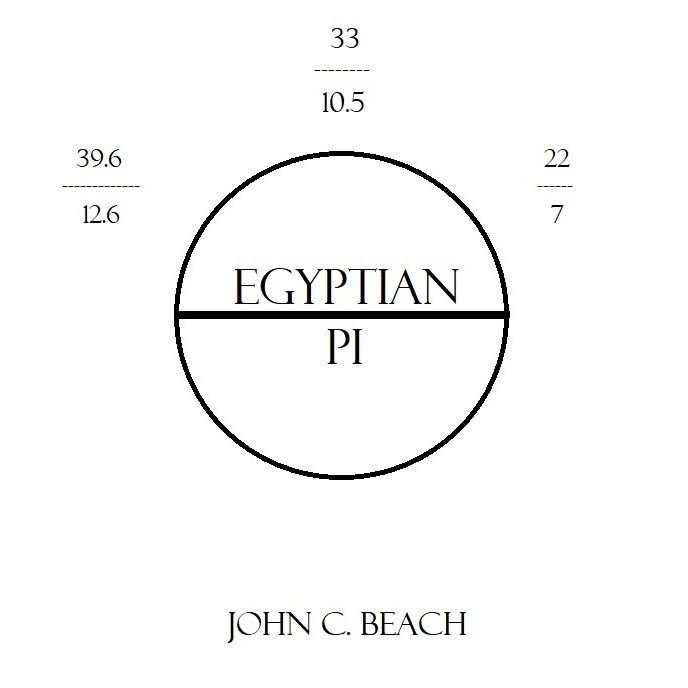
The treatment of circles is interesting. Rather than using Pi, it is assumed that a square is 0.89 of a circle. In the example given below, the diameter of the circle (cylinder) is 9, which gives a base area of 63.6. However, 8/9 ths of 9 is 8, and a square with 8 units on a side has an area of 64, which is close enough. This is the equivalent of using a Pi value of 3.16, instead of 3.1416. The fractional Pi of 22/7 is closer, at 3.143.
The Hyksos-lsraelite people’s curiosity in science and mathematics has continued into the modern era, with Jews being awarded about 207 Nobel Prizes in the sciences. Conversely, according to Wiki the billions of Muslims from around the world have only been awarded three Nobel Prizes in the sciences. Clearly, not all cultures value the sciences to the same degree, as can be seen in the current lsrael vs Hamas and Hezbollah conflicts.
The response to this observation is invariably that lslam had its Golden Age, and thereby invented the modern world. Untrue, this is pure taqqiyya. What actually happened, is that Medieval lslam borrowed and stole from other peoples and cultures, and claimed these inventions as their own. The Golden Age was based upon a large dhimmi-serf workforce of Christian and Jewish unbelievers, but when these numbers had been decimated by death and exile, the Muslim Golden Age of serf-sIave labour ended.
lslamic Inventions were Roman, Greek, and Persian.
academia.edu/8749355/Islami…
So yes, the oft-made claim that lslam invented algebra is completely wrong. The Hyksos-lsraelites were teaching algebra and geometry to their students 2,000 years before a savage Arabian warlord invented the barbaric and regressive creed of lslam.
The Rhind Mathematical Papyrus.
Hyksos-lsraelite mathematics.
en.wikipedia.org/wiki/Rhind_Mat…
Images.
The Hyksos Mathematical Papyrus.
There are 87 mathematical problems to be solved in this papyrus.
Ralph