Sabitlenmiş Tweet

Hilo de cosas que he hecho, porque el ultimo que tenía lo borre.
Español
Patobola 🏳️🌈🇪🇭🇵🇸
67.4K posts
@ElPatobola
Soy un Pato Esferico. Me gusta hablar de lenguas, politica internacional, banderas, economia y Paradox. Liberal progre y feminista. He/him

Epic Games CEO Tim Sweeney joked that Valve increased Steam Deck prices to fund Gabe Newell’s megayacht "There has been a rise in the cost of components that Steam customer spending funds ... and disruptions in the component parts supply chain for megayachts"

🚨🇺🇸 La mujer musulmana que hizo el saludo nazi y acosó a una mujer judía mientras gritaba "Heil Hitler" y le deseaba cáncer ha sido detenida por el Departamento de Policía de Beverly Hills. ¿Debería ser deportada?

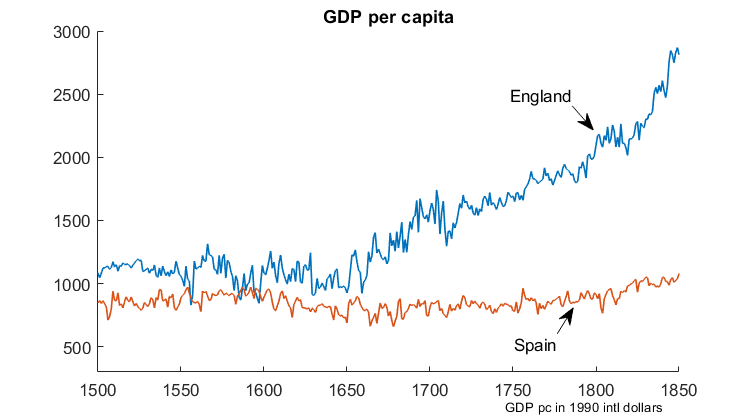
How has the Spanish economy performed over the very long run? To answer, I use Leandro Prados de la Escosura’s (@LdelaEscosura) data on real GDP per capita from 1277 to 2024. I express Spain’s figure as a ratio to Britain’s, since Britain was the first economy to achieve modern economic growth, from around 1660, and has been the leader, or close to it, ever since. Spain, within its present borders, was prosperous in the Late Middle Ages, well ahead of Britain, then a peripheral corner of Europe. The Black Death and its aftermath hit Spain harder, and by 1360, the two economies had converged. That parity held until 1600, when Spain began a long decline, in absolute terms (on the eve of the French Revolution, it was barely above its 1600 level, after a deep slump in between) and in relative terms (Britain pulled steadily away). The standard explanations, the Habsburg wars, and the serial bankruptcies run into one problem. They can account for the poor performance between 1550 and 1650, but not for the stagnation between 1650 and 1789. 140 years of stagnation is far more than wars and debt under the Habsburgs can explain. The series also shows that Spain did not benefit from its empire. That is a problem for every theory tying colonies to modern growth. At most, one can argue that colonies were a necessary condition for takeoff (I do not believe even that, but leave it for another day). One cannot argue that they were sufficient. The period from 1789 to 1936 was no kinder. The economy grew a little, and Spain built a modern but unfinished liberal state. Yet it never closed the distance to Britain. It is hard not to read the period from 1789 to 1936 as a national failure and the Civil War as its final consequence. The recent efforts of some historians to paint those years in brighter colors strike me as unfounded. Spain did not fail at modernization as badly as China, but it did not succeed. A deeply corrupt dynasty, closed and incompetent elites in Madrid, Barcelona, and Bilbao, and an economic policy built on intervention and protection (by 1920, Spain was the most protectionist economy in the Western world, so much for the friends of protection) together made the country a basket case. A cruel civil war left Spain at its historical low, with just 31% of the British GDP per capita. The foreign visitors who arrived in the early 1950s found a poor, backward country. Policy in the first twenty years of the dictatorship was awful. Autarky was not so much imposed by the Allies as chosen. Spain’s rulers, using their quasi-fascist Weltanschauung, believed growth would come from state intervention, closed markets, and unorthodox fiscal and monetary policy. Then, in 1959, policy changed. Spain adopted a more orthodox fiscal and monetary policy and opened to foreign investment and trade. The results were spectacular. For forty years, Spain grew briskly and became the modern country it is today. By 2001, it had reached 77% of British GDP per head. But the internal contradictions of two things eventually became binding: the growth model launched in 1959, and the political regime created by the 1978 constitution. By 2024, Spain had slipped back to 74% of British GDP per head. This is worse than it looks. Britain itself has done poorly over the past twenty years, and losing ground to a weak performer is a bad sign. Spain stands at a crossroads, economic and political. The country’s foundations no longer work, but its political and business elites have failed to understand this fundamental reality. A good grasp of its economic history helps make sense of its present predicament.

Which means I have now officially drawn EVERY pokemon! (Which also means twitter is going to horribly compress this even more)

I finished drawing every Generation 9 Pokemon!

This figure by Leandro Prados de la Escosura (@LdelaEscosura), from his new paper “Accounting for the Reversal of Fortune: Spain and Britain, 1501-1800,” is striking. Something very fundamental broke in Spain around 1560. Having a GDP per capita slightly above Britain's around 1560, Spain fell to less than 50% of it by 1790/99. Part of this was a drop in absolute level: Spanish GDP per capita was around 10% lower in 1790/99. But most of it was due to Britain taking off while Spain did not. Leandro argues that the evidence points to low input efficiency in Spain (plus ça change, plus c’est la même chose). Spain’s economic performance during the 19th century and the first half of the 20th century was not much better. You cannot understand Spanish history, or even current events, without appreciating its centuries of stagnation and decline. The figure also shows the growing consensus among economic historians: modern economic growth started in Britain around 1650, much earlier than conventional accounts of the Industrial Revolution suggest. Link to the paper: ehes.org/wp/EHES_302.pdf
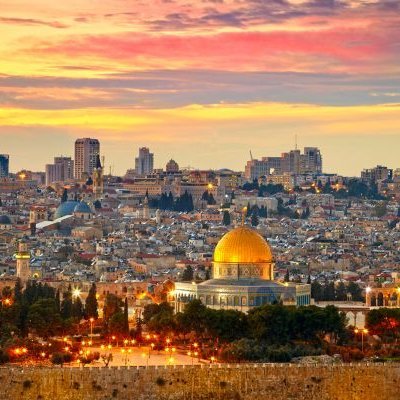


‼ Israel ordena el desplazamiento forzoso de los 200.000 habitantes de Tiro, en Líbano eldiario.es/internacional/…


In Tel Aviv, gay people can walk hand in hand, live together, embrace their sexual orientation. Across the Arab world, that kind of openness would be unthinkable. You must know this, but your unslakable antisemitic — sorry, ant-Zionist — bloodlust inhibits honest tweeting.


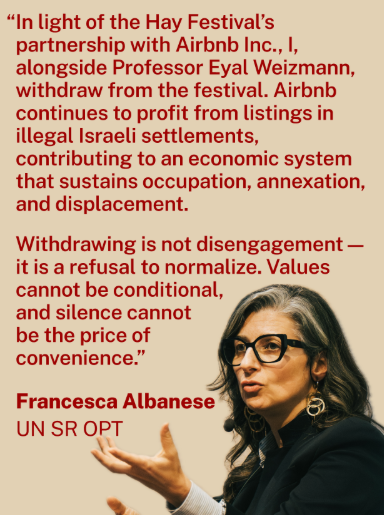


my heart sank. this is devastating.

Alex, an American IDF soldier, as killed himself after returning to the United States. He directly participated in Gaza.

"Tel Aviv is witnessing rare civil disobedience. A group of Israeli refuseniks are burning their draft papers on the main street. The reason for refusal: 'We will not kill children in Palestine and Lebanon.' The penalty: military prison. But they insist on going to prison rather than enlisting."