Elis

216 posts

Elis banner
Elis

Elis

@ElisJackson_

Meditations

United Kingdom Katılım Eylül 2013
82 Takip Edilen77 Takipçiler
Elis retweetledi
Mitch Burcham
Mitch Burcham@MitchBurcham·
A brand new Energy Attribute Certificate System was just unanimously approved in ERCOT. NPRR1264 This was the exact regulatory structure I envisioned when I wrote the original MetaWatt whitepaper and now we have the opportunity to compete for the administrative position using the technology we have been building over last year. Leveraging the new Multi-Party Computation wallets we will be releasing with @johncalhooon MetaWatt can offer market participants seamless blockchain functionality without any seed phrases, top-ups or confusion, while still giving them the opportunity to fully self custody and participate in the open protocol on their own terms with their own interface. The system is open, interoperable, scalable and secure. Energy attributes are structurally impossible to double spend and can be tracked through connected assets (batteries) with native transaction graphs. Please reach out if you are interested in learning more or helping us pursue the ERCOT RFQ.
English
1
4
8
220
Elis retweetledi
🏴‍☠️
🏴‍☠️@lTSSAUCE·
ZXX
4
650
2.9K
56.5K
Elis retweetledi
S Tominaga (Aka Dr Craig Wright)
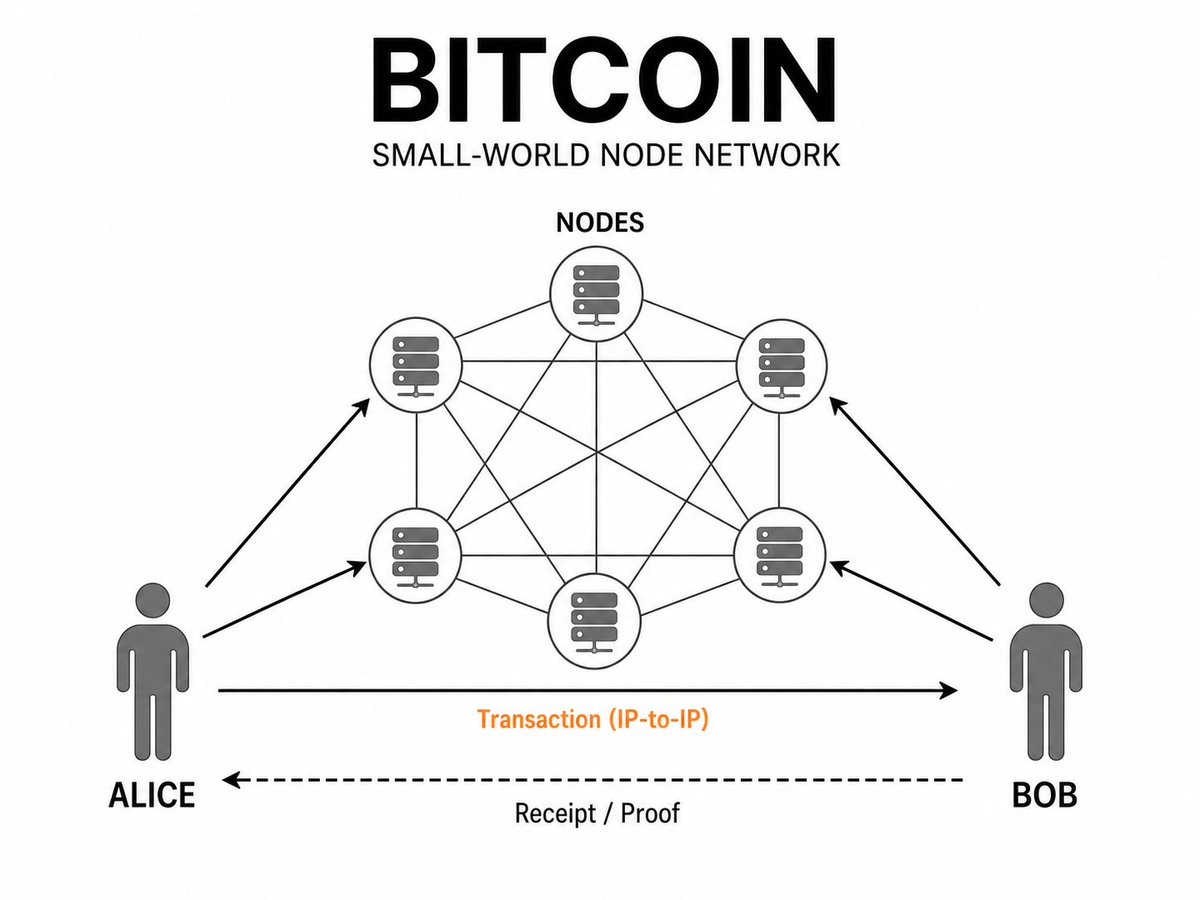
This is how Bitcoin is really designed. Alice sends to Bob. Alice also sends to nodes. Bob sends to nodes. Bob returns a separate proof — a receipt — showing that he has sent. The nodes are not decorative little saints sitting in a chapel of theory; they are densely interconnected economic actors, passing information through a web so robust that failure becomes not a drama but an edge case. Notice what is not being said. Alice is not a node. Bob is not a node. A spectator with software is not a node merely because he enjoys the costume. The nodes are the competitive parties that build, validate, propagate, and settle. Alice and Bob are peers. That is peer-to-peer: not a mystical commune of hobbyists, but a direct exchange between parties, with the network serving as the machinery of settlement. The elegance is that trust is not required. Trust is the tax paid by badly designed systems. In Bitcoin, Alice does not need to trust Bob to behave nobly. Bob does not need to trust Alice to remain honest. The system is constructed so that proof, propagation, economic interest, and record replace sentiment. And if someone reneges, the parties with an actual interest in the transaction still act. They propagate. They evidence. They settle. They do not need sermons on virtue, because incentives have already done what sermons pretend to do. That is the architecture: direct exchange, proof returned, nodes interconnected, incentives aligned, failure reduced, trust displaced by evidence. Bitcoin was not designed as a theatre for slogans. It was designed to work.
S Tominaga (Aka Dr Craig Wright) tweet media
English
26
121
311
13.4K
Elis
Elis@ElisJackson_·
@ruthheasman Great idea. Searching through multiple patent websites and trying to decipher the legal jargon has been extremely irritating. This will be a useful tool for blockchain developers into the future.
English
0
0
1
79
Ruth Heasman 🌳🌷🦚🐉😃
New app! BSVpatentforge.com - Use it to explore the BSV Patent library and surface novel use cases. A BSV builder's idea engine grounded in 3,350+ nChain and Teranode patents. (In alpha, there will be bugs!)
English
4
42
124
3K
S Tominaga (Aka Dr Craig Wright)
Yes, tax evasion exists. A startling discovery, no doubt. One imagines the revenue departments of the world fainting in their offices, having never encountered such a thing before someone downloaded a wallet. Except, of course, tax authorities collected tax when cash existed. They collected tax before computers. They collected tax before databases. They collected tax before “digital surveillance” became the lazy substitute for administrative competence. They managed this with books, ledgers, invoices, audits, field agents, inspections, reporting obligations, penalties, and the ancient bureaucratic art of asking where the money came from. Cash did not abolish taxation. Privacy does not abolish taxation. Peer-to-peer digital cash does not abolish taxation either. The mistake is assuming that because a payment can be private between parties, the commercial activity disappears from the world. It does not. Goods move. Services are performed. Businesses keep accounts. Employees are paid. Inventory changes. Assets are acquired. Invoices exist. Contracts exist. Lifestyle evidence exists. Banks, merchants, suppliers, customers, and counterparties exist. A private payment is not a magic cloak over economic reality. People still have obligations to report. If they do not report, that is evasion. And if they evade, tax offices do what they have always done: investigate, audit, inspect, subpoena, compare records, follow assets, and send agents into the field. The presence of privacy does not mean the absence of law. It means the state does not need to sit inside every transaction like a parasite with a clipboard. There are also far better and fairer ways to design tax systems than pretending every human being must be financially strip-searched in real time. Consumption taxes, invoice systems, merchant reporting, business audits, land and asset registers, payroll records, and targeted enforcement all existed before the fantasy that surveillance equals civilisation. Digital cash is not the end of taxation. It is the end of pretending that honest people must surrender privacy because dishonest people exist.
English
1
0
1
67
Bitcoin for Freedom
Bitcoin for Freedom@BTC_for_Freedom·
The government takes 46% of your salary. Then charges you 25% VAT on what’s left. Then inflates away the purchasing power of what remains. Then taxes your capital gains when you try to protect yourself. At what point is this not theft?
English
31
72
367
7K
Elis
Elis@ElisJackson_·
@CsTominaga @BTC_for_Freedom People in the service industry and tradesmen often prefer cash (for obvious reasons) so how is p2p digital cash with derived keys not just an even more private and efficient version. How would anyone know?
English
1
0
0
49
Elis
Elis@ElisJackson_·
@CsTominaga @BTC_for_Freedom If two parties interact direct IP-IP using type 42 key derivation. For example buying food from a farmers market. How would that still be a taxed? How would the gov even know?
English
1
0
1
129
Elis retweetledi
Mitch Burcham
Mitch Burcham@MitchBurcham·
BRC100 Identity Clients have the scalability and interoperability to underpin your entire digital life but nobody wants their entire life to depend on one seed phrase. MPC has been proven to bridge that gap for enterprise but hasn’t been accessible to the individual in a vendor neutral format. We aim to give you the tools to design your own sovereign vault, one that doesn’t depends on any single service provider or application. You can run it yourself. Provision secure signing on an enclave node. Provision a vault for your business or trust and enforce policy rules at the protocol level. Anything you want: open source, vendor neutral, unchanging. This is the future of digital identity.
John@johncalhooon

The Calhooon Brothers are partnering with Binary on a threshold MPC signing network. > CGGMP'24 threshold ECDSA on secp256k1. > The private key never exists. > Any t+1 parties cooperate to sign. Signing nodes will be discoverable via an overlay. > BRC-100 compatible. > 100% Rust/WASM. > Open source. Based on: eprint.iacr.org/2021/060 More soon.

English
1
4
17
1K
Elis retweetledi
Elis retweetledi
Babbage | BRC100
Babbage | BRC100@ProjectBabbage·
Question: What happens if a billion transactions each pay 10 sats in fees? That's 10 BILLION sats in fees just for the one block — 100 coins of fee revenue — on top of the fixed subsidy. The subsidy does not change, but the miner’s total block reward does. Since the 4/20 2024 halving, BTC’s subsidy has been 3.125 BTC per block. Even adding fees, a conservative average total reward has been only a little above that — roughly the low-3-BTC range. So a block carrying 100 coins in fees would be a completely different mining-revenue profile. The usual saying is “hash follows price.” But that's not the whole picture. Hash follows expected profit per hash. Price matters, but so do fees, difficulty, orphan risk, liquidity, and operating costs. Small blocks can create high fee rates by rationing scarce blockspace. Big blocks try the opposite strategy: lower fees per transaction, but VASTLY more transactions. The question is not TPS by itself. The question is sustained fee revenue per block. A thousandfold increase in coin price can change mining profitability. But so can a thousandfold increase in real, paying transaction volume — if that volume is persistent, liquid, and profitable after propagation and infrastructure costs. That is the opening for BSV: not “volume magically beats price,” but that fee volume can become miner revenue. If @BSVBlockchain can generate sustained high-fee blocks from real economic use, SHA-256 miners have a reason to notice.
English
11
16
51
2.9K
Elis retweetledi
S Tominaga (Aka Dr Craig Wright)
Let me be precise about what decentralization actually entails. When you see arguments around BTC—claims that it should only be used for cash, that certain transactions are “spam,” or that particular uses are invalid—that is not neutrality. That is control. The moment a group can assert how the system must be used, define acceptable behaviour, or constrain implementation, you are no longer looking at an open system. You are looking at a controlled one. A system is not permissionless if participants can be told they are using it “wrong,” or if their activity can be curtailed based on subjective rules. True decentralization means there is no authority capable of imposing those constraints—no gatekeeper dictating form, function, or purpose.
English
9
39
159
5K
Elis
Elis@ElisJackson_·
@deggen Couldn't agree more. We have been using the univeral test vectors for our rust stack, but simplifying how developers find parity between the BSV sdk implementations, and how to integrate with RUNAR contracts in those languages, would be ideal
English
0
0
1
71
Deggen
Deggen@deggen·
I think one of the main places we can improve the BSV Application Stack is consistency across languages. Test vectors for every interface. Performance profiling and optimization. Bringing the various rust and elixir implementations in as officially supported. First class integration with Rúnar. A treasure map for all those useful components and libraries no one has heard about.
English
2
6
43
1K
Elis retweetledi
Mitch Burcham
Mitch Burcham@MitchBurcham·
Yes my team and I have seen this first hand, we got excited about what the tech could do without actually looking for the pain the tech solved. It’s not that Zed or Indigo are useless apps it just that the pain isn’t strong enough to warrant the reeducation of the users and wasn’t strong enough for my team to rally to fight for that channel. So back to basics. @metawatt_io is almost ready for launch and we are taking it all the way.
Babbage | BRC100@ProjectBabbage

A direct challenge to BSV influencers @kurtwuckertjr @CsTominaga @GavinMehl @cresbabiera @hbgnostic @_b1nary_ and, to myself because I am more guilty of this than most of you: Start from pain, not from features. A small-business owner buried in invoices, or a filmmaker trying to distribute a movie without a monolithic middleman, doesn't need a taxonomy of BRCs. They need to know that the tech removes a specific friction they already feel. Reframe "#BSV can do X" to "this takes the pain out of Y" and do not stop until you have either (a) learned something new that changes your assumptions, or (b) solved that person’s pain point fully.

English
1
3
10
655
Elis retweetledi
DR22 Ω 🪬🎭
DR22 Ω 🪬🎭@DejaRu22·
Rest in Power John McAfee
English
36
554
4K
139.6K
Elis retweetledi
Deggen
Deggen@deggen·
Uuuum @Apple would you please open up developer access to p2p NFC payments hardware so we can fix this by using electronic cash rather than card account based payments? It’s clearly insecure, with US legislators getting close to signatures on CLARITY act, timing could be good. I can fix this, but not if you keep the door closed to innovative talent here in America.
vxdb@vxdb

Veritasium Exposes a Tap To Pay Flaw That Lets a Payment Terminal Steal $10,000 From a Locked iPhone

English
5
17
85
4.2K
Elis
Elis@ElisJackson_·
16) The real constraint on prosperity is not money, but access to abundant, low-cost electricity, and the future is priced in energy and time.
English
0
0
1
37
Elis
Elis@ElisJackson_·
15) The result is a convergence where energy powers production, secures the monetary and data layer, and reduces costs across the entire economy.
English
1
0
1
47
Elis
Elis@ElisJackson_·
1) Electricity is the foundation of the future because everything in the world ultimately runs on two inputs: energy and time. Every product, service, and supply chain depends on energy to produce and move things, and time to organise and operate them.
English
1
0
2
72