

Emilio Lamo de Espinosa
1.2K posts
Emilio Lamo de Espinosa
@EmilioLamo
Catedrático Emérito de Sociología (UCM). Autor de “Entre Águilas y dragones. El declive de Occidente” Premio Espasa 2021.
Madrid Katılım Kasım 2011
345 Takip Edilen3K Takipçiler
Atrapados por la geografía elmundo.es/opinion/2026/0…
Español
Emilio Lamo de Espinosa retweetledi

📚✨ Hoy celebramos el Día del Libro
Queremos recordarlo a través de estas cinco solapas con @VictorLapuente , @Amasensio , Pedro Simón
, @EmilioLamo , @VicenteVallesTV
Porque un libro no termina en su última página.
Empieza cuando se conversa.
Feliz Día del Libro
Español
Cómo acabar con la calidad docente universitaria de una vez por todas elconfidencial.com/cultura/digo-y…
Español
Emilio Lamo de Espinosa retweetledi


Emilio Lamo de Espinosa retweetledi

MAGA thinks Europe can't defend itself without America. Here's what they don't know.
1. France and Britain have 515 nuclear warheads and 8 nuclear missile submarines.
2. European defence spending hit €481 billion this year. That's more than Russia and China spend combined. The EU's ReArm Europe plan is mobilising another €800 billion.
3. European countries have over 1.7 million active troops. Russia has 1.3 million.
4. EU and UK air forces fly over 1,400 combat aircraft. Their navies have five aircraft carriers, over 60 submarines, more than 120 frigates and destroyers.
5. Europe has over 6,000 artillery pieces and that's before the biggest rearmament wave since the Cold War. Poland alone is adding 212 new howitzers.
6. The British SAS invented modern special forces. The US copied them to build Delta Force. From France's Foreign Legion to Poland's GROM, Europe's elite units are among the deadliest on earth.
7. Europe already has joint military commands ready to fight. The UK leads a 10-nation rapid reaction force across Northern Europe and the Arctic. Finland alone can mobilise 900,000 trained reservists all prepared to fight in arctic conditions.
8. Europe has its own satellite navigation (Galileo), its own defence programme (75 active projects) and is building its own rapid deployment force.
The "helpless Europe" story was never about defence.
It was about keeping Europe dependent and buying American weapons, relying on American intelligence, following American foreign policy.
Thanks to Trump, that now ends.

English
Emilio Lamo de Espinosa retweetledi

And 51% of Spaniards!
Republicans against Trump@RpsAgainstTrump
WOW. 46% of Italians and 37% of French people see the U.S. as a threat
English
Trump has backed himself into a corner with Iran. Any deal risks appearing, in his eyes, like a humiliating failure. The weight of that constraint presents a dangerous dynamic as the president threatens escalation, argues Hussein Banai for @newlinesmag. newlinesmag.com/argument/the-l…
English
Emilio Lamo de Espinosa retweetledi

I am not a military analyst. I'm a financial analyst focused on macroeconomic risk.
That different lens might explain why I see something most military strategists and investors are missing.
---
The New Rules of Warfare—And Why We Can't Opt Out
For nearly a century, warfare belonged to whoever controlled the biggest defense budget. Aircraft carriers. Stealth bombers. Multibillion-dollar weapons systems.
That model is changing in ways many aren't appreciating.
Ukraine and Iran are showing the West what 21st-century conflict actually looks like: decentralized, highly iterative, fast-changing, unmanned, and cheap. Neither the US nor Russia—beginning in 2022—appears prepared.
We might now have no choice but to show we can fight and win such a war.
The Ukraine Approach
Faced with a small defense budget, a much smaller population, and a vastly outnumbered army, Ukraine had to get creative. They couldn't match Russia's industrial capacity or spending. So they abandoned that playbook entirely.
They developed an entirely new way to fight, highly decentralized, iterative, and most importantly, cheap.
They also created Brave1—a completely new way to conduct war.
Frontline commanders log into an iPad and bypass central command entirely. They spend digital points to purchase equipment directly from hundreds of (Ukrainian) manufacturers. When they encounter a new threat, they message the manufacturer directly and work with the engineers to find a solution, even if that means they visit to the front. The result is hardware or software upgrades that once took months now take days.
Here's the crucial part: hundreds of manufacturers compete fiercely for these dollars by offering the best possible product as fast as possible. This isn't centralized procurement. It's a market. Competition drives innovation at scale. Weapons evolve as the enemy evolves in real time.
Units are also awarded points for confirmed kills, uploaded from drone video—a powerfully eloquent way to grade effectiveness.
But the real innovation might be how they decentralized manufacturing itself. Instead of building weapons in massive, centralized factories that make perfect targets for Russian bombing, Ukraine distributed production across hundreds of small manufacturers—workshops, machine shops, garages, and yes, kitchens. Each produces components or complete systems. This approach serves two purposes: speed and survival.
You can bomb a tank factory. You destroy production for months. You cannot bomb ten thousand kitchens. If one workshop gets hit, ninety-nine others keep producing. The network regenerates faster than Russia can destroy it. This is why the manufacturing process includes actual kitchens—it's not a metaphor. It's a strategy.
The Metric That Defines a New Era
The result is staggering: at least 70% of battlefield casualties now come from drones. This is the first time in over a century that the primary cause of combat death is neither a bullet nor an artillery shell. Since World War I, industrial warfare meant industrial killing. Ukraine has broken that equation entirely.
As a result, Russia is now controlling less territory than at any point since 2022 and going backward. In March, Ukraine made gains while Russia recorded no gains for the first time in two and a half years, and Drone-led offensives recaptured 470 square kilometers while paralyzing 40% of Russian oil exports.
Ukraine has lowered the "cost per kill" to less than $1,000 per casualty—a 99.98% reduction from the millions of dollars that were common in the post-9/11 wars. This isn't an incremental improvement. This is a complete inversion of modern military economics.
Yet the Western defense establishment is not learning from this.
Rheinmetall CEO Armin Papperger mocked Ukraine's entire approach. In The Atlantic, he called Ukrainian manufacturers "housewives with 3D printers," dismissing their work as "playing with Legos." They are not studying this revolution. They are mocking it.
And the "housewives with 3D printers" are beating the Russian army!
Ukraine Is Now in the Middle East
The US Military and Gulf states face an eerily similar problem. Iran's Shahed drones threaten shipping in the Strait of Hormuz—a chokepoint that funnels 21% of global oil. They cannot fend off Iran by firing a $4 million Patriot missiles at $20,000 drones.
They need what Ukraine has discovered: a decentralized, rapidly adaptive defense network that doesn't require centralized industrial capacity.
That's why Ukraine just signed historic 10-year defense deals with Saudi Arabia, Qatar, and the UAE.
Over 220 Ukrainian specialists are now on the front lines of the Persian Gulf—exporting not just weapons, but a completely new doctrine of how to fight.
The precedent is set. The model works. Everyone is watching.
Mosaic
On April 1st, Trump threatened to bomb Iran "back to the stone ages" if they don't reopen the Strait within weeks.
It's the classic 20th-century playbook: overwhelming offense force, massive bombardment, industrial-scale destruction.
The problem? That playbook doesn't work against distributed, cheap, rapid-iteration systems—especially when your enemy is organized under a mosaic structure.
Iran's "Mosaic Defense" doctrine is a decentralized command system where authority and capability are distributed across multiple geographic and organizational nodes.
Each region operates semi-autonomously with overlapping chains of command and pre-planned contingencies. It's designed so that when you destroy the center, the edges keep fighting. You cannot decapitate a system with no head. You cannot out-bomb your way to victory when your enemy is not centralized; this was the solution for 20th-century industrial warfare.
Defense Wins Championships
21st-century asymmetrical threats require defensive shields, not aggressive offenses. Ukraine has built exactly that: rapid-iteration defenses, decentralized manufacturing, commanders empowered to buy solutions in real time and rewarded for success.
That same defensive model may hold the key to opening the Strait of Hormuz. Not through massive offense, but through the ability to adapt and defend quickly.
Why We're Stuck
Whether you viewed this as a war of choice or not, it has now become a war to keep global trade open. And that makes it inescapable.
This is precisely why the US cannot declare victory and walk away from the Strait of Hormuz— or TACO.
Every adversary on the planet will interpret American withdrawal as confirmation that cheap asymmetric systems work against powerful centralized platforms.
And these adversaries might have sent us a message last month. In mid-March 2026, an unauthorized drone swarm penetrated Barksdale Air Force Base in Louisiana, home to the U.S. Air Force's Global Strike Command.
The fact that this happened not overseas but in the United States, and that these tests occurred just weeks ago, underscores how close this threat is now.
They didn't attack. They announced their presence. Every adversary watching learned that cheap drone networks can reach into the US.
The Global Supply Chain Risk
If the US abandons the Gulf while Iran holds the Strait contested, markets will price this as validation that cheap systems can hold global trade hostage. The current market disruptions will become permanent.
Supply chains will have to pivot from "just-in-time" efficiency back to "just-in-case" redundancy. Inflation returns as safety costs money. Trade routes diversify away from vulnerable chokepoints. The global friction tax becomes permanent.
The Unavoidable Truth
Once you prove that cheap, asymmetric systems can hold global trade hostage, that knowledge spreads globally and irreversibly. Every adversary learns the same lesson: you don't need a $2 trillion Navy—you need $20 million in drones and the will to use them.
Withdrawing while the Strait remains contested would permanently validate this model. Supply chains shift to "just-in-case" redundancy. Insurance costs rise. The friction tax becomes structural—baked into every global transaction for decades.
The cost of staying is measured in months. The cost of leaving is measured in decades of economic drag.
We cannot leave unfinished business.
English
Emilio Lamo de Espinosa retweetledi
Emilio Lamo de Espinosa retweetledi
Ha fallecido Carlos Westendorp, ex ministro de Asuntos Exteriores de España (1995-96) y ex embajador en Estados Unidos (2004-8), y buen amigo del @rielcano. DEP. 🇪🇸
Español
Emilio Lamo de Espinosa retweetledi
Charles Powell: "La monarquía española cuenta con un capital extraordinario en política exterior al servicio de los sucesivos gobiernos" agendapublica.es/noticia/20779/…
Español
Emilio Lamo de Espinosa retweetledi
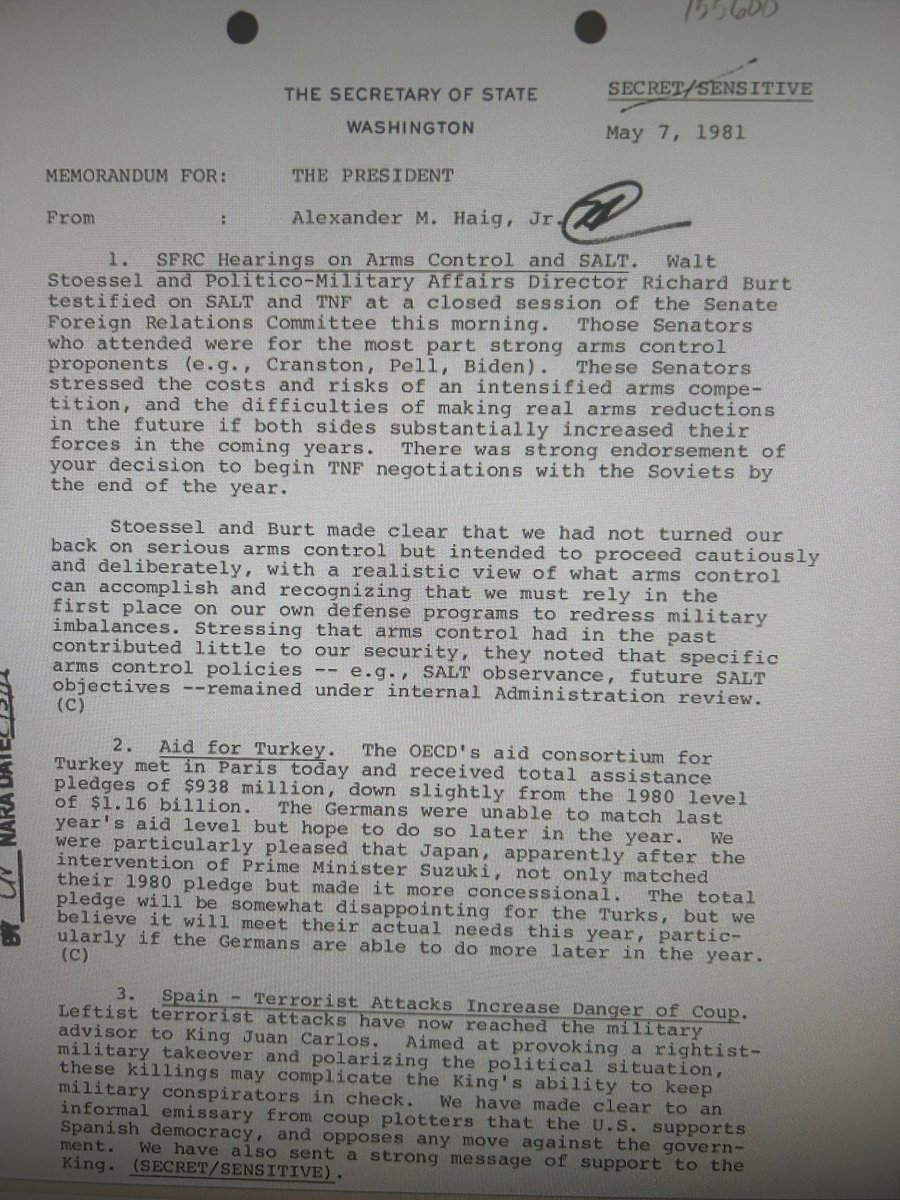
@Ciclodas Es del 7 de mayo de 1981. Eso es lo interesante: los golpistas seguían conspirando!
Español
Un plan 'out of the box' para la política exterior de España | Opinión elmundo.es/opinion/2026/0…
Español
Los debates que no tenemos en el PSOE
- elpais.com/opinion/2026-0…
Español
Emilio Lamo de Espinosa retweetledi

¿Hemos entrado en una Nueva Era? 🗺️
«Diálogos cosmopolitas. Una nueva era geopolítica» en la @la_march_madrid👉 bit.ly/49RPnK0
#Conferencias #Historia

Español
Emilio Lamo de Espinosa retweetledi