Peter

539 posts

Peter

Peter

@Epicurus1776

Katılım Şubat 2025
376 Takip Edilen7 Takipçiler
Shaiel Ben-Ephraim
Shaiel Ben-Ephraim@academic_la·
@SarahEttedgui She also said there is no such thing as the Palestinian people. Giving you a far better idea of what Zionism is.
English
11
3
82
3.4K
Sarah Ettedgui
Sarah Ettedgui@SarahEttedgui·
What Are We Actually Saying When We Say “Zionist”? Today would have been the birthday of Golda Meir, who once said: “One cannot and must not try to erase the past merely because it does not fit the present.” I found myself thinking about that line in the context of a question I have not been able to set aside. I was speaking with a friend recently, someone much smarter than I am by any measure of the word, and it left me with this: What, today, is the point of identifying as a Zionist? The original national project, the reestablishment of a Jewish state, has already been realized with the Israeli Declaration of Independence. That is a political fact. So what, precisely, are we describing when we use that term now? Are we, perhaps, shooting ourselves in the foot by failing to draw a clear line between the political Zionism of the early Zionists, which led to the establishment of the state, and what follows from that moment? That phase was necessary, grounded, and it achieved its purpose. What remains is not the creation of a state, but its continued existence and legitimacy. Part of what I am grappling with is whether continuing to describe this as a “belief” is even accurate. The right of a people to self-determination is not typically framed as something optional or contingent. It is grounded in the principle of Self-determination and, in this context, was recognized at the international level, including in United Nations General Assembly Resolution 181. We do not generally speak about the self-determination of other peoples, particularly Indigenous peoples, as something that must be continuously justified. We treat it as a given. Which brings me to the current discourse. “Anti-Zionism” is often presented as if it were simply criticism of Israeli policies, which is of course completely absurd. Plenty of people are critical of Israeli policies and do not identify as “anti-Zionist.” This is something else. Antizionists themselves apply internal rules and frameworks that go well beyond critique to determine who is fit to be accepted and who are deemed “the good Jews.” You see this in anti-normalization policies with perceived Zionists, in the adoption of boycott frameworks like BDS, and in the application of a settler-colonial lens to Jews. All of this is directed at attacking the legitimacy of Jewish self-determination in Israel. Practically speaking though, there is no existing mechanism in international law to dismantle a state against the will of its population. Which makes the hypocrisy of that claim even more striking. If all that is right, then perhaps we need to be more precise, as a community, or rethink how we speak, so as not to allow antizionists to shield themselves behind the claim that this is merely criticism of policies. For me, a Zionist has always meant nothing more and nothing less than recognizing the right of the Jewish people to self-determination in their ancestral homeland. And since this is a right, grounded in history and recognized in international law, calling it a “belief” is not the right way to frame it. I don’t really have a settled answer as to what purpose the label “Zionism” continues to serve, beyond its historical role in describing the movement that led to the reestablishment, and decolonization, of our homeland. Curious to hear how others are thinking about this. And if anyone has thoughtful book recommendations on the evolution of Zionism or post-statehood Jewish political thought, I would genuinely appreciate it.
English
34
6
58
2.6K
Peter
Peter@Epicurus1776·
@_ZachFoster @TaliaRinger Go tell Native American tribes that they’re “just religions” and call them Nazis when they laugh at you.
English
0
0
1
52
Zachary Foster
Zachary Foster@_ZachFoster·
The Jewish-Zionist obsession with being more than "just a religion" is a strange pathology. As if being a religion is a problem. As if Jewish converts undergo a DNA transfusion when they convert. As if black Jews, brown Jews & white Jews have shared common ancestry. As if shared values, rituals, & traditions are inferior than having shared blood. If only Jews thought more like the Nazis! Sincereley, -Zionism
English
23
25
104
6.6K
Peter
Peter@Epicurus1776·
@_ZachFoster @TaliaRinger “Religion” is a Western concept which in the case of Judaism specifically denies Jewish peoplehood and indigeneity. You don’t get to compulsively lie about Jews and then call them pathological.
English
0
0
0
64
Peter
Peter@Epicurus1776·
@AllanStRasmuss2 We stand with the Jews, now and forever. 🇩🇰🇮🇱
English
1
0
0
8
Peter
Peter@Epicurus1776·
@CultureExploreX One of the most loathsome societies on Earth, so not sure what your point is.
English
0
0
0
38
Culture Explorer
Culture Explorer@CultureExploreX·
Established in 1960, Islamabad sits at the foot of the Himalayas not like a city at war with its landscape, but like one trying to live with it. It is great to see that even in the modern age, people still hunger for proportion, beauty, and a public life.
Lily Lynch@lilyslynch

I had no idea Islamabad was so green

English
6
39
304
13.3K
Peter
Peter@Epicurus1776·
@aziz0nomics Palestine doesn’t have a right to exist as a genocidal imperialist death cultic theocracy, which is the only kind of state Palestinians seem to want.
English
0
0
0
9
John Aziz
John Aziz@aziz0nomics·
The best Palestinian response to the claim "Israel has a right to exist" is "yes, and so does Palestine". Not "no, you don't".
English
186
84
882
32.5K
Peter
Peter@Epicurus1776·
@JohnWight1 “Palestinian“ meant Jewish until the 1970s.
English
0
0
0
4
John Wight
John Wight@JohnWight1·
Palestine predates Judea, Samaria and Galilee by centuries. The Palestinians of today are the Hebrews of yesterday, and the Hebrews of yesterday are the Canaanites of the day before that. Israelis today are the non-semitic product of a white European settler colonial project. Ideology not history or genealogy informed the modern state of Israel's establishment in 1948.
Visegrád 24@visegrad24

@JohnWight1 Jesus was a Jew from Judea, born in Bethlehem of the house of David, and raised in Nazareth of Galilee.

English
231
312
996
47.9K
EatMyShortsPlz 📉
EatMyShortsPlz 📉@LucciCrypto·
@Average_NY_Guy Thank you for just demonstrating how much of psychotic cult you creatures truly are. Especially with all your little “God tricks”.
English
5
0
0
188
AP
AP@Average_NY_Guy·
If you’ve never experienced Passover in an Orthodox Jewish home, it’s almost impossible to understand how far it actually goes. People throw around the phrase “spring cleaning” and think that’s what it is. It’s not. It’s a full teardown and rebuild of how you live inside your own house, all for just one week. It doesn’t start a few days before the holiday. It starts weeks, sometimes even months earlier. Every cabinet gets emptied, every shelf is wiped down, and every corner is checked. We’re not just cleaning dirt, we’re on the hunt for chametz, any leavened grain product. Bread, cookies, crumbs, even something that fell behind a couch months ago. You move appliances, you vacuum inside drawers, you scrub surfaces you normally wouldn’t even think about, like high walls. Some people take apart their ovens, some pour boiling water over countertops, others line entire kitchens with foil or special coverings so nothing that touched chametz during the year comes into contact with Pesach food. And that’s just the beginning. In many homes, especially more careful or Hasidic ones, cleaning alone isn’t enough. The entire system gets replaced. Separate dishes, separate pots, separate utensils that were never used with chametz all year. Some families have full Pesach kitchens packed away in boxes eleven months of the year. And it goes further. In certain homes, you won’t eat there unless you know exactly how that kitchen was prepared, down to the smallest detail, and many won’t eat anything that wasn’t prepared in their own home, even if it’s from close friends. Then comes the halachic process. You don’t just clean and call it a day. There’s bedikat chametz, the formal search the night before Pesach, done with a candle and a blessing, where pieces of bread are traditionally placed around the house and then found. The next morning is biur chametz, burning whatever remains. Anything you can’t realistically get rid of gets sold through a rabbi in a formal transaction called mechirat chametz, because owning chametz on Pesach is forbidden, not just eating it. Then the eating itself changes completely. For seven or eight days depending on where you are, there is no bread, no pasta, no flour products unless they are specifically made as matzah, which is unleavened bread made quickly so it doesn’t rise. And matzah itself is a whole world. It has to be made in under 18 minutes from the moment water touches flour, because otherwise it could start fermenting and become chametz. Some only eat shmurah matzah, which means matzah that has been supervised from the time the wheat was harvested to make sure it never came into contact with moisture. Others insist on handmade matzah, not machine. There are also families who won’t eat anything that has even a question of moisture that could have caused fermentation. Then you have kitniyot, which is legumes and similar foods like rice, corn, beans, and peanuts, which adds another layer. Ashkenazi Jews, Jews of European descent, traditionally don’t eat these on Pesach. Sephardic Jews, from Middle Eastern and North African backgrounds, generally do. So even within Orthodox Judaism, what your Pesach looks like depends on your background. One family is eating rice, and another wouldn’t let it into the house. One family is comfortable with certain processed Pesach foods, another will only eat simple, basic items they prepared themselves. And it keeps going. Some peel every vegetable because maybe something touched it in a factory. Others won’t use any product unless it has a very specific Pesach certification, meaning rabbinic approval that it meets all Passover standards. Many won’t eat out at all, not even in kosher restaurants, because they don’t trust anyone else’s standards. In certain homes, even food prepared before Pesach won’t be touched once the holiday starts. Everything is fresh, controlled, and intentional. Then comes the Seder. It’s not just a meal. It’s a structured reliving of Yetziat Mitzrayim, the Exodus from Egypt, guided step by step through the Haggadah, with four cups of wine, matzah on the table, maror eaten to feel the bitterness, korech put together like a reminder you can actually taste, children asking questions, and everyone leaning like free people. It’s built to make it feel like you yourself left Egypt. And that’s the point behind all of this. We’re not just avoiding bread because of some random restriction. Chametz represents inflation, ego, something that rises. Matzah is simple, flat, controlled. The Torah commands us to remember the Exodus as if you yourself left Egypt. All the cleaning, all the restrictions, all the effort, it forces you to step out of your normal life and enter a completely different mode. You feel it physically. Your house looks different, your kitchen functions differently, your diet changes, your schedule changes. You can’t ignore it even if you wanted to. And if you step back, it’s actually insane in the most literal sense. Thousands of years later, Jews are still removing every crumb of bread from their homes because of something that happened in Egypt. Entire industries exist around this. Families plan their lives around it. Kids grow up expecting it as normal. There is no other nation on earth that has maintained something this detailed, this demanding, and this consistent for this long. Empires came and went, languages disappeared, cultures vanished, and Jews are still arguing over how to kasher a countertop and whether a product is acceptable for Pesach. You can call it stubbornness, but it’s more than that. It’s continuity, it’s identity, it’s a direct line from the Torah to a kitchen in Brooklyn in 2026. And for those of us who live it, it’s real. It’s exhausting, it’s expensive, it’s sometimes overwhelming. But it’s also something we take seriously in a way that barely exists anywhere else. Because this is what it means to be part of Am Yisrael, not just believing something but living it in a way that shapes your entire life, down to the crumbs you can’t keep in your house for one week a year. And after all of that, after the cleaning, the stress, the shopping, the kashering, all the details that never seem to end, you sit down at the Seder with your family and it all comes together. You look around the table, your kids are asking the same questions kids have asked for generations, and you realize it worked. This whole system actually worked. It kept us the same people. So wherever you are, whatever your level, whether your kitchen looks like a full Pesach operation or you’re just doing what you can, there’s something powerful about being part of this. Wishing you a happy and kosher Pesach, wherever you are, physically and spiritually.
English
115
166
1.3K
86.9K
Peter
Peter@Epicurus1776·
@CultureExploreX @EthanLevins2 Another “western civilization” account revealed as a Neo-Nazi Qatar puppet. You are part of the rot, not the light.
English
0
0
0
11
Culture Explorer
Culture Explorer@CultureExploreX·
Muhammad Iqbal believed the real problem is not lack of knowledge, but weak character. He stated the Quran calls people to face the world, think, and act, not just believe. His idea of the self means building strength through discipline and responsibility. In the end, what matters is simple: knowledge means nothing if it doesn’t change who you are. newsletter.thecultureexplorer.com/p/discipline-m…
Culture Explorer tweet media
English
6
6
59
10.1K
Culture Explorer
Culture Explorer@CultureExploreX·
That is one point of view. But the claim that Iran uniquely threatens humanity ignores some basic realities. Since Ayatollah Ali Khamenei became Supreme Leader in 1989, Iran has not launched a conventional invasion of another country or started a full-scale war. The last major war Iran fought was the Iran–Iraq War, which ended in 1988 and began when Iraq invaded Iran. Much of the criticism instead focuses on Iran’s support for proxy groups in the region. Yet proxy warfare is hardly unique to Iran. Intelligence services such as the CIA, KGB, and Mossad have also supported allied militias, insurgents, and covert operations to shape conflicts without direct war. At the same time, none of this means the Iranian regime is beyond criticism. Many Iranians themselves protest its political repression, limits on civil liberties, and economic mismanagement. The government has imposed strict controls on dissent, the press, and social life, which has led to serious internal tensions. But Iran’s story is not only that of a regime. It is also a civilization of more than eighty million people with deep intellectual and cultural traditions. Despite sanctions and isolation, the country has built a strong scientific base, expanded education dramatically since the 1980s, and developed major advances in fields like engineering, medicine, and aerospace. Reducing Iran to a simple villain or a victim misses the reality. A nation can have a flawed government, a proud civilization, and a complicated role in global politics all at the same time.
English
6
1
3
244
Culture Explorer
Culture Explorer@CultureExploreX·
Kudos to Giorgia Meloni for drawing a line when it matters. History rarely remembers the leaders who quietly followed the crowd. It remembers the ones who refused to drag their nations into another war and chose restraint when the world was pushing toward conflict.
Amock_@Amockx2022

BREAKING : Italian 🇮🇹 Prime Minister Giorgia Meloni has given shock to US & Israel "Italy will withdraw the army from US led adventure in Middle East and will not participate in the war against Iran" 🔥 Leaders with spine and courage are standing for humanity. Mad Respect 🫡

English
29
39
263
12.8K
Peter
Peter@Epicurus1776·
@CultureExploreX Lmao imagine thinking it’s a win to refuse fighting back against the Antichrist that’s been trying to destroy you for half a century. What a loser.
English
0
0
0
3
Peter
Peter@Epicurus1776·
@CultureExploreX Who exactly do you think is responsible for this destruction?
English
0
0
0
9
Peter
Peter@Epicurus1776·
@CultureExploreX And it produced one of the most evil cultures imaginable.
English
0
0
0
30
Culture Explorer
Culture Explorer@CultureExploreX·
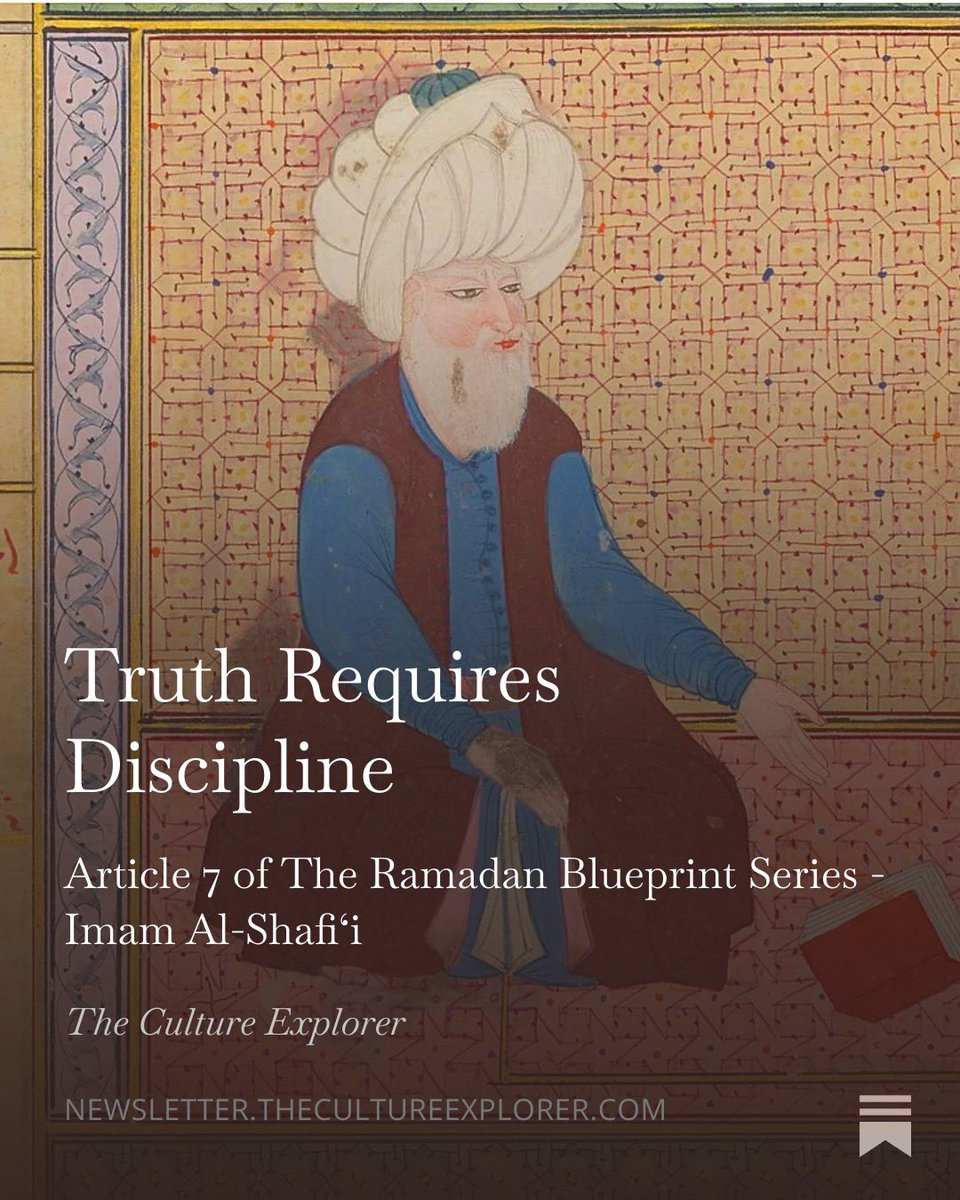
In the 8th century, scholars across the Muslim world argued endlessly about how to interpret God’s law. Every region had its own method. Truth was slowly dissolving into opinion. Then Imam Al-Shafi‘i stepped in and changed everything. Instead of another ruling, he built a method: anchor law in the Quran, the Prophet’s tradition, scholarly consensus, and careful reasoning. His insight matters today because when a society loses its method for finding truth, knowledge quietly turns into opinion. newsletter.thecultureexplorer.com/p/truth-requir…
Culture Explorer tweet media
English
9
4
44
5.5K
Arne Nielsen
Arne Nielsen@TonzerpArne·
@Epicurus1776 @BEsbensen Nej og du kan ikke overbevise folk længere. Der er 6millioner grunde 🥳 Den største grund er jødisk adfærd..
Dansk
1
0
1
19
Brian Esbensen 🇵🇸 🇺🇦 🇿🇦
Definitionen på det modsatte af et retssamfund: Fem israelske soldater gruppevoldtager en palæstinensisk fange (så han må på hospitalet med smadret anus og skadede organer). Det bliver optaget på overvågningsvideo. Alle soldater går fri. x.com/AFpost/status/… #dkpol
AF Post@AFpost

Israel dropped charges against 5 IDF soldiers who were caught on camera beating and raping a Palestinian prisoner. Follow: @AFpost


Dansk
10
10
93
2.9K
Muman
Muman@Mustafa51334151·
@moseshessstan It's an Arab land. It's not theirs. So yes, it is antagonizing.
English
3
0
5
537
Peter
Peter@Epicurus1776·
@Remroum How’s that been working out for y’all?
English
0
0
0
89
Remi Kanazi
Remi Kanazi@Remroum·
Do not cower to Zionists. Shame them. Do not welcome them in your spaces. Do not make them feel comfortable. Why should those genocide loving fascists be treated any different than any other flat out racist. Don’t normalize Zionism. Don’t normalize Zionists taking up space.
English
30
750
2.3K
25.5K
Peter
Peter@Epicurus1776·
@Villgecrazylady They are sociopaths because millions of psychotic Muslims have been trying to genocide them for a century?
English
0
0
0
3
Mel
Mel@Villgecrazylady·
There is literally no scenario on earth in which they are not the victims. We are dealing with an entire society of absolute sociopaths.
Mel tweet media
English
281
4.3K
21.4K
371.7K