Eric Fine

506 posts

Eric Fine

Eric Fine

@EricFine123

EM economist and bond investor for 30+years Disclosures: https://t.co/Gl2tsi0aNn.

Katılım Temmuz 2024
863 Takip Edilen494 Takipçiler
Eric Fine
Eric Fine@EricFine123·
@BrentAHensley1 @SantiagoAuFund However, there are clear implications for fx, that’s how a lot of the costs will be borne. DM will experience stagflation the risk of it imo. That has implications, too, however fast.
English
0
0
0
18
Brent A Hensley
Brent A Hensley@BrentAHensley1·
This is has been a huge gamble by Trump. The fall out will last for decades. Huge spectrum of possible outcomes. But what if one of the outcomes is Iran’s nuclear program and ballistic missile program are neutralized. The straits of Hormuz are reopened in a couple weeks. This might actually produce the most outrage among the people in the Western world.
English
4
0
3
646
The 48 Laws of Power
The 48 Laws of Power@48LawsofPowerr·
Which book made you understand human nature for the first time?
English
9
7
64
4.9K
Eric Fine
Eric Fine@EricFine123·
@newstart_2024 Didn’t mean to trigger. And fine you’re a better physicist than I am, congratulations (I’m not one). Sequencing is important and im simply saying this observation is old, not sure what logic excludes attention to sequence.
English
0
1
1
20
Eric Fine
Eric Fine@EricFine123·
@newstart_2024 There was a whole book on this, no? The Trouble With Physics. The motive wasn’t the focus of the book, but this is basically an old fact, no?
English
3
0
2
2.6K
Camus
Camus@newstart_2024·
Eric Weinstein unleashes a bombshell: Theoretical physics froze in 1973—right as "Crocodile Rock" topped the charts—and hasn't advanced at the deepest level since. Youngest living Nobel in theoretical physics? Always under 50... until string theory took over as "quantum gravity." Now it's over 70. The field stopped producing breakthroughs. His wild claim: The Biden White House reportedly told Marc Andreessen they deliberately stagnated parts of theoretical physics—cocooning string theory as the "only game in town." Dissenting ideas? Career suicide. The trick? Hammer "quantum gravity is the holy grail" on repeat until it feels true. (Weirdly, that phrase barely appears in books before 1972.) Safe, harmless pursuit—no real risk even if foreign students dive in. Why? To avoid dangerous progress that could shatter the speed-of-light limit and get us to the stars... before humanity's tools become too lethal on one fragile planet. Weinstein's rallying cry: Physics is our only path off Earth. Break the stagnation, surpass Einstein, reach the cosmos. The end of physics as we know it might be glorious—if we seize this brief window before wars erupt. Clip from his ARC 2025 talk (4:05 of high-stakes provocation). Does this ring true—the deliberate stall on breakthrough physics? Or is string theory just a victim of its own complexity? What's your take on the "holy grail" mantra?
English
223
1.1K
5.2K
147.6K
Eric Fine
Eric Fine@EricFine123·
@DTAPCAP Interesting. It’s the vibe of the last few hours, agree. Markets closed on a negative vibe, they are discounting infinity future. Let’s see.
English
0
0
0
38
Dan Tapiero
Dan Tapiero@DTAPCAP·
Is the most important thing about the Iran war that Russia and China did not come to Iran's aid? Unipoloar world confirmed. Global map gets redrawn. Cuba friendly takeover soon. The rogue government era around world is over. What could be more bullish for US?
English
109
30
470
34.1K
Mossad Commentary
Mossad Commentary@MOSSADil·
🚨 JUST IN: UAE orders the closure of Iranian institutions in Dubai, including the Iranian Hospital, Iranian Community Schools, and the Iranian Club. All dispatched staff have been ordered to leave the country immediately. Stay connected, follow @MOSSADil.
Mossad Commentary tweet media
English
181
2.5K
8.9K
175.2K
Soutik Biswas
Soutik Biswas@soutikBBC·
‘India is like three countries stacked in an economic ladder: 25m live in ‘Australia’-like affluence, ~200m in a ‘Philippines’-style service economy, while the rest struggle in conditions closer to sub-Saharan ‘Africa’. bloomberg.com/opinion/articl…
English
90
895
4.7K
259.9K
Eric Fine
Eric Fine@EricFine123·
@Fathers_Diary Both my parents grew up in poverty. What you say is true. But my father also always told me the preponderance of his bad traits came from poverty. He didn’t like it when I glorified poverty in retrospect.
English
0
0
0
47
Fathers Diary
Fathers Diary@Fathers_Diary·
Nobody works harder than the first born son who understands he's the only hope for himself and his family. That man will do anything he can to cut out poverty from the family.
English
10
19
137
6.9K
Eric Fine
Eric Fine@EricFine123·
@Fathers_Diary That I will never really have a good answer to your question.
English
1
0
0
70
Fathers Diary
Fathers Diary@Fathers_Diary·
Mature men who are age 30+, what is the hardest truth you've learned so far?
English
101
5
69
31K
Eric Fine
Eric Fine@EricFine123·
@Fathers_Diary It’s true but it’s not true. Give and you will receive. Something.
English
0
0
0
88
Fathers Diary
Fathers Diary@Fathers_Diary·
CORRECT ME IF I'M WRONG BUT, I turn 38 this year and I have realised , as a man, no one cares about you. Not your wife. Not your family. Not your friends. Not your workmates. Nobody. People act like they care, but deep down, they don't. You are on your own. Always on your own.
English
851
271
2.6K
143.1K
Natalia Gurushina
Natalia Gurushina@NGurushina·
Backstops multiplying - many EMs are not taking chances: >tight policy stance (Türkiye’s hawkish hold) >cutting fuel taxes (Brazil) >committing to keeping gasoline prices close to current levels (Mexico) >introducing fuel price caps for the first time in 30 years (South Korea).
English
3
8
49
5.4K
Dr Andreas Krieg
Dr Andreas Krieg@andreas_krieg·
Saudi, UAE and Qatar are reviewing trillions of dollars worth of investment pledges to absorb financial shock of US-Israel-Iran War to which they have become collateral damage Collectively they pledged $3.6 trillion in Trump's America alone reuters.com/world/middle-e…
English
24
348
824
61.9K
Gerard DiPippo
Gerard DiPippo@gdp1985·
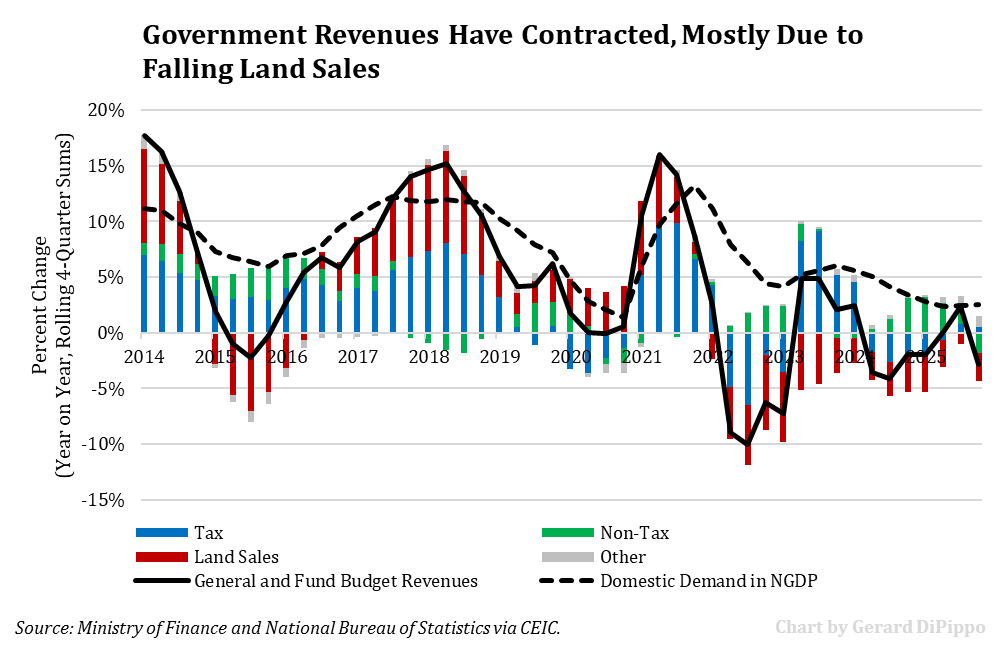
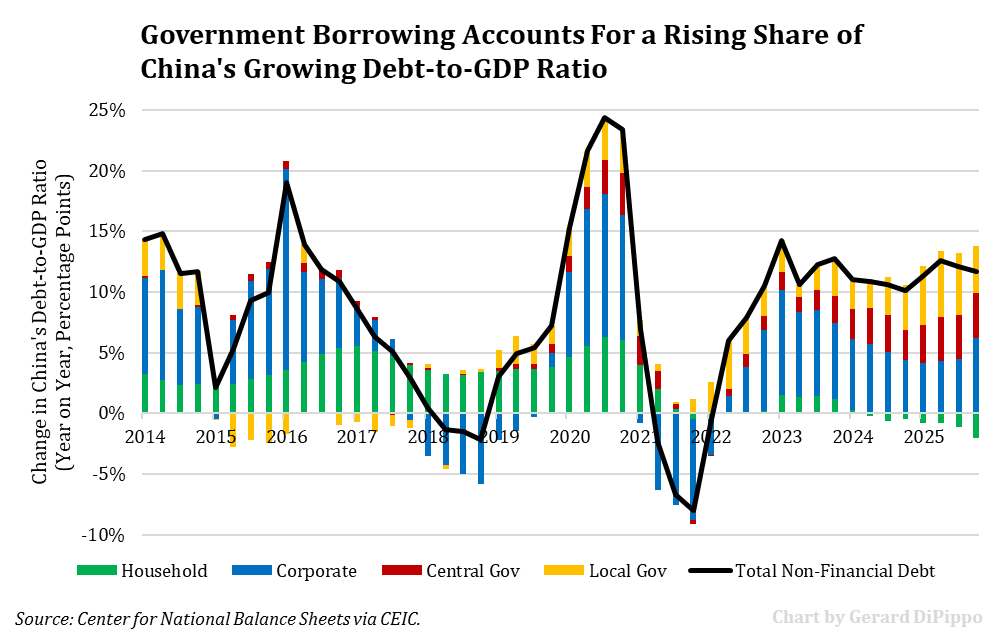
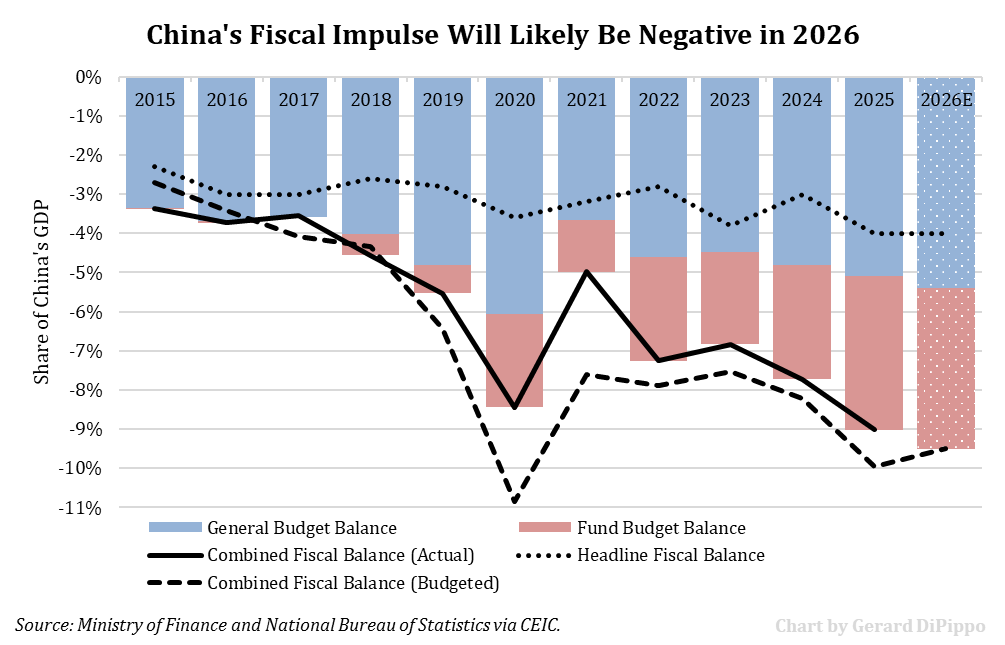
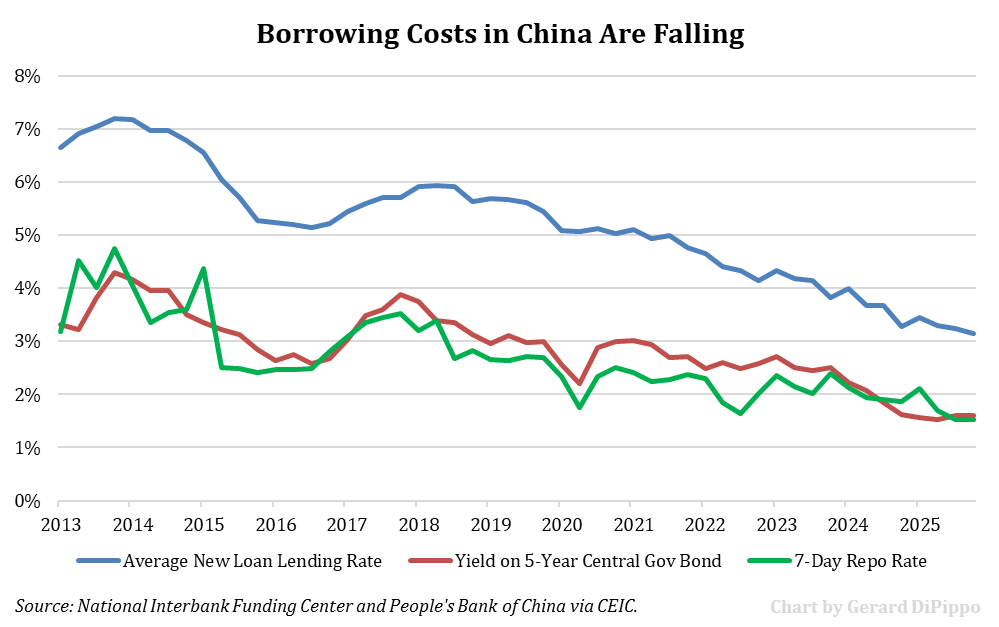
@Lingling_Wei's latest China newsletter frames Beijing's 2026 budget as that of a frugal “iron rooster.” In my view, the binding constraint on Beijing’s fiscal capacity isn’t resources; it’s fiscal conservatism. Yes, government revenues have fallen, largely due to continued declines in land sales. And yes, the government (central and local) is borrowing more, partly offsetting the collapse in household borrowing due to the property crisis. But China’s budget for 2026 is, on the margins, conservative, with a fiscal impulse (change in the deficit relative to GDP) likely in negative territory, given China’s tendency to underspend relative to what it budgets. Beijing should be borrowing more, and on the central balance sheet. Borrowing costs are in secular decline, and China is a net capital exporter. Beijing absolutely could borrow more. The problem is that it doesn’t want to. Why? Fiscal conservatism and a lack of an easy path toward reigniting domestic demand. My view is that support for households makes sense structurally but less so cyclically. China’s twin structural-cyclical problem remains the collapse of the property sector. Issuing 300 billion yuan to capitalize banks isn’t a “red flag”; it’s a step in the right direction, only it should be far, far larger. Clear out the bad property debts, clear the market as quickly as possible, and get domestic demand humming again. Wasting years waiting for the property sector to correct itself means wasting years of growth and consumer sentiment. But that requires using the central balance sheet and recognizing that Beijing will, one way or another, be heavily indebted.
Gerard DiPippo tweet mediaGerard DiPippo tweet mediaGerard DiPippo tweet mediaGerard DiPippo tweet media
Jonathan Cheng@JChengWSJ

Frugal ‘Iron Rooster’ Budget Signals Pain for Growth and Consumers @Lingling_Wei wsjchina.cmail19.com/t/d-e-ghjlryd-…


English
12
22
70
44.5K
Eric Fine
Eric Fine@EricFine123·
@NGurushina Totally right as a general point. And markets sure seem poised, let’s say. But as we know/agree, (and have written about) CNY is further anchoring a number of key EMFXs. That’s arguably a secular phenomenon. EM is not a monolith as you always say!
English
0
0
1
78
Natalia Gurushina
Natalia Gurushina@NGurushina·
You ain’t seen nothing yet? – EMFX volatility spiked recently on the back of the Middle East turbulence, but it is still way below the previous peaks in all regions
Natalia Gurushina tweet media
English
1
8
40
3K
Eric Fine
Eric Fine@EricFine123·
@michaelxpettis So excellent. Michael, you are a living positive externality.
English
0
0
2
128
Michael Pettis
Michael Pettis@michaelxpettis·
The Economist argues here that China should set a higher GDP growth target because the current target (4.5-5.0%) is too low and will make the economy’s current problems, including surging debt, worse. “The proof,” it says, “lies in China’s prices. They have been falling, by some measures, for three years. This persistent deflation is a worry in itself—it increases the burden of debt, limits the room for monetary easing and mutes price signals, given the reluctance even in China to cut wages in money terms. It is also a sign of a deeper problem. It suggests that output is falling short of what the country could produce if its capital and labour were more fully employed.” But this is the wrong way to look at the Chinese economy. Chinese deflationary pressures are not an unexpected aberration but rather a consequence of its current growth model. Falling prices suggest not that there is a shortfall in output but rather that output is growing faster than what domestic – and, increasingly, foreign – demand can absorb. In a system in which excessively high GDP growth targets are met mainly by increasing investment in infrastructure and manufacturing (and, not too long ago, in the property sector), it seems a little perverse to argue that boosting output in a system already suffering from excess capacity in property, infrastructure and manufacturing will cause prices to rise. If anything, increasing investment in an already investment-heavy economy will tend to worsen the very imbalances that have produced falling prices in the first place. When production capacity expands more rapidly than the purchasing power of households and businesses, prices must adjust downward to clear inventory that banks are increasingly reluctant to finance. In China’s case, the imbalance is reinforced by the structure of the economy, which systematically channels resources toward investment and production rather than toward household income and consumption. The article also argues that a higher GDP growth target will make it easier to manage the country’s debt burden. But this assumes that there is no connection between GDP growth and the debt burden. In fact, the opposite is true. The overwhelming majority of lending in the Chinese financial system is used to fund investment, with a very small share going to fund consumption. If investment were healthy, it should be impossible in such a financial system for the debt-to-GDP ratio to rise – except occasionally in the very short term – because the investment itself would generate faster increases in economic value than in debt-servicing costs. But over the past fifteen years China has suffered from among the fastest increases in the debt-to-GDP ratio in history. This is strong evidence that a rising share of debt is funding non-productive manufacturing capacity, infrastructure and property. More generally, there is a pretty strong correlation between the investment contribution to Chinese growth and the rise in the country’s debt-to-GDP ratio. To put it another way, China can only set GDP growth targets much above a sustainable GDP growth level – perhaps around 2–3 percent – by accelerating credit creation. In that case, a higher GDP growth target would require even faster growth in debt, and would raise the debt burden further rather than reduce it. The article does hedge against the likelihood of increasing non-productive investment by arguing that a higher GDP growth target could be achieved by directing resources to households to boost consumption. While this sounds attractive on paper, and while China has spoken for nearly a decade about the need to rebalance with an acceleration in consumption growth, there is a reason why this has proved so difficult. There is also a reason why no country in China’s position has ever managed to rebalance without a slowdown – or even a contraction – in growth. In rapidly growing economies where high investment is powered by even higher savings, low consumption is not an accident or an oversight. It is fundamental to the way the economy is structured. Businesses and governments receive a disproportionately large share of GDP, while households receive a disproportionately small share. These imbalances are embedded in the mechanisms that drive growth. If China is to boost the consumption share of GDP, it would require reversing the transfers implicit in the national distribution of income. This could be done by raising wages, raising interest rates, increasing the value of the currency, raising current social-safety-net payments (future promises will not affect current consumption except after many years of credibility building), and/or increasing other forms of household income. In each case, however, the policies that increase household income simultaneously reduce the resources available to subsidize investment and manufacturing. What many analysts fail to grasp about Chinese manufacturing – just as they failed to understand Japanese manufacturing in the 1980s, is that while China’s very large manufacturing sector is globally competitive, it is also far less efficient than most analysts assumed. If it were genuinely efficient, it would be profitable without subsidies. Yet in many cases it is only marginally profitable despite large transfers that directly and indirectly subsidize its costs. Among these transfers are an undervalued currency, abundant and cheap credit, artificially low interest rates on household savings, and government overspending on logistics, infrastructure and transportation networks that reduce costs for manufacturers. These policies boost manufacturing competitiveness, but they do so by transferring income from households to producers. If the global competitiveness of China’s manufacturing sector depends on these direct and indirect transfers, reversing those transfers in order to raise household income would necessarily undermine that competitiveness. The process of rebalancing therefore requires a structural shift away from investment and manufacturing toward consumption and services. Japan provides a useful example. Between 1991 – when Japan’s consumption share of GDP bottomed out – and 2008, Japan succeeded in increasing its consumption share by roughly 10 percentage points of GDP. But during that same period Japan not only lost roughly half its share of global GDP, it also experienced a decline of roughly one-third in the manufacturing share of its economy. This implies a drop in its share of global manufacturing of roughly two-thirds. These were not coincidental; they were the nearly-inevitable consequences of rebalancing income toward households. For China, the implication is straightforward. Increasing the consumption share of GDP necessarily implies slower overall growth and a smaller manufacturing share of the economy. The idea that China can simultaneously dedicate resources to increasing output while dedicating even more resources to increasing demand is hard to reconcile with either logic or historical experience. My conclusion, therefore, is the opposite of the Economist’s. Chinese deflationary pressures, its huge trade surpluses, its surging debt burden, and its increasingly unviable investment in property, infrastructure and manufacturing are all direct consequences of a political obsession with too-high GDP growth targets. Maintaining these targets requires ever-increasing credit expansion and ever-greater investment in sectors that are already suffering from excess capacity. It is not an accident that no country with Chinese-style imbalances has ever adjusted without a slowdown – or even a contraction – in GDP growth. Rebalancing toward consumption requires shifting income from producers to households, and this necessarily reduces the pace of investment-driven growth. For this reason, raising China’s GDP growth target would almost certainly make the underlying problems worse rather than better. The real challenge for Chinese policymakers is not how to increase growth targets, but how to accept lower growth – and a smaller share of global manufacturing – while restructuring the economy and rebalancing the domestic drivers of growth. economist.com/leaders/2026/0…
English
25
53
280
57.4K
Eric Fine
Eric Fine@EricFine123·
@kkmaway If they haven’t been inflated away yes.
English
0
0
1
36
Eric Fine
Eric Fine@EricFine123·
@kkmaway Interesting topic, I can see that. I found that allocators who were PMs ask tougher questions. Those who are currently managing often ask questions that are too involved and imply we’re supposed to have the exact same view, so it can be a bit weird, but awesome when it aligns.
English
0
0
0
26