
Sabitlenmiş Tweet
Dan Tapiero
9.9K posts

Dan Tapiero
@DTAPCAP
Founder/CEO/CIO-@50TFunds. DTAP Capital/AGCOA/GBI. Macro PM-20yrs. 5GOATS. Btc+Bullion hodler.
50Tfunds.com Katılım Mayıs 2018
5.8K Takip Edilen138.2K Takipçiler

@jedi6900 They have no longs. No one in the US has ever really gotten long. The asset is considered on the periphery not core to asset allocation.
English

@BrianSozzi Looks like it could go to 200. Beach ball held underwater for 25 years. Imagine the geniuses sitting underneath that place. People have no context as I sit here having a coffee in Paris. This type of company doesn't really exist in the rest of the West. Intc will figure it out.
English

Deutsche Bank on Intel:
"Intel's recent surge, with its stock price finally surpassing its 2000 dot-com bubble peak after 26 years on Friday (+23.6%), offers a potent lesson for investors, particularly those drawn to the exciting, yet volatile, world of technology stocks. This comeback highlights both the potential for huge gains and the inherent risks and patience required when investing in individual equities.
It’s obviously been a wild ride with the stock still down over -70% from its peak as recently as Q3 last year, a quarter of a century later. Since August 2025 its up well over +300% though. The last leg of this impressive jump followed a strong Q1 2026 earnings report on Thursday, where the company significantly beat analysts' expectations, including a big beat in revenue forecasts for Q2. Intel's single-day percentage gain was its largest since October 1987, bringing its year-to-date increase to +124%. Even the federal government benefited, with its unconventional stake in Intel, acquired last August, growing roughly fourfold from $8.9 billion to around $36 billion.
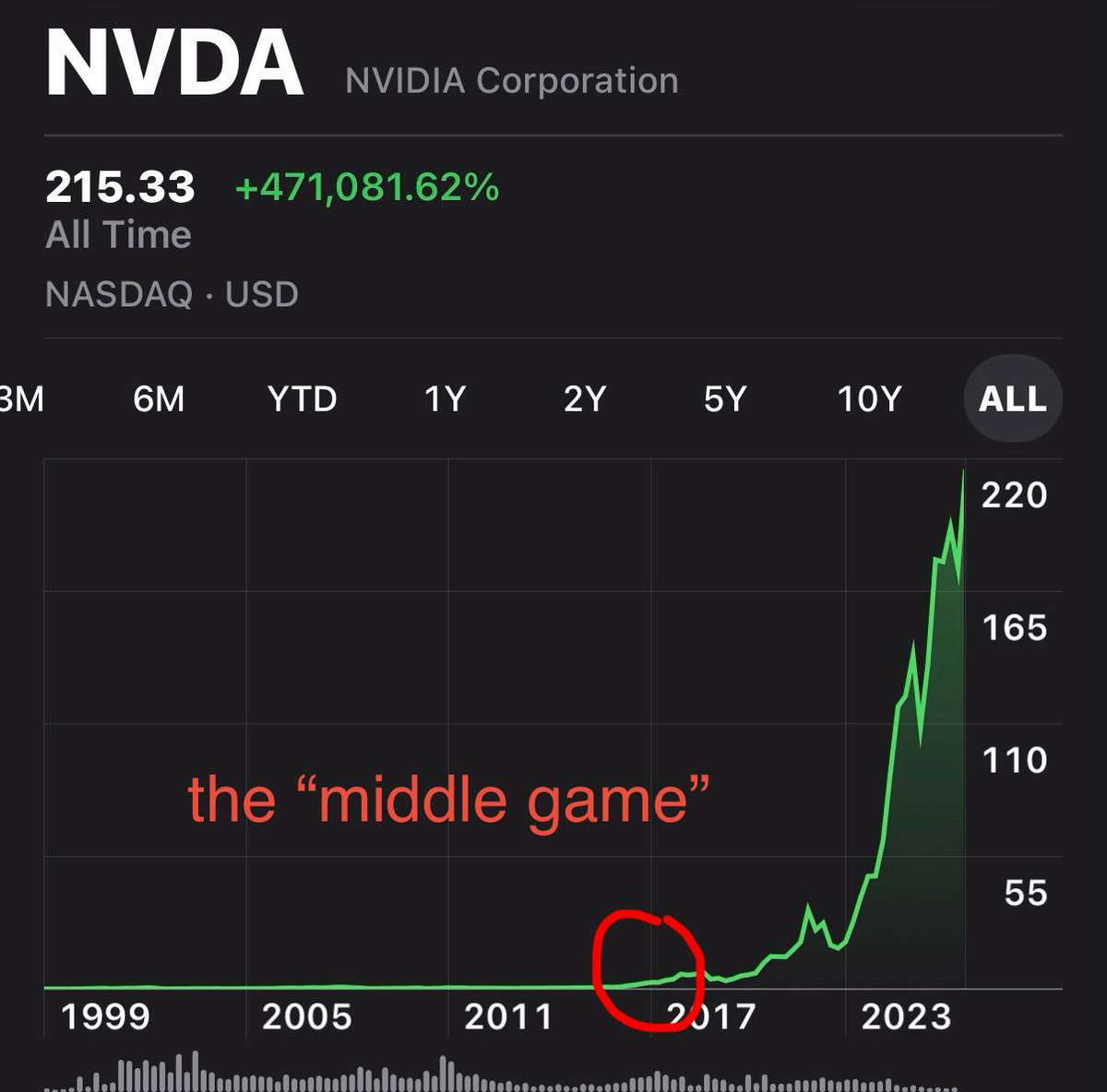
However, the fact that it took Intel 26 years to surpass its record high, during a period when the S&P 500 climbed approximately +370% (over +650% including reinvested dividends), highlights not only the volatility of investing in single stocks but also the perils of picking the wrong entry point in high-beta sectors such as technology. Imagine waiting a quarter of a century for your investment to break even, while the broader market delivered substantial returns. This raises the question: could a similar fate await today's high-flyers? Could Nvidia, for instance, only surpass its recent peaks in 2052, a scenario reminiscent of Intel's journey? While any tech analyst would likely scoff at such a comparison, citing numerous differences, Intel's history serves as a powerful reminder of the inherent uncertainty in individual stocks. It was the second largest stock by market cap at its peak in 2000."
More on this V/@SPYJared @YahooFinance finance.yahoo.com/markets/articl…

English

$BTC - BITCOIN WHALES ACCUMULATE AT FASTEST PACE IN A YEAR
Bitcoin “whales” added about 45,000 BTC last week, the largest weekly accumulation since July 2025, according to Cex. IO.
Whales—wallets holding 100 to 10,000 BTC—bought in sync rather than separately, signaling stronger bullish momentum. Long-term holders have now accumulated over 1 million BTC in the past three months.
English

@____Holyspawn @adam3us @Apple Well said. Exhausted crypto twitter people toxic and exiting...pivoting to ai or energy or tiktok or whatever.
English

@DTAPCAP @adam3us @Apple Leaving? Do you understand after all these years that this is one of those monetary revolution that occur once in a millenia?
Leave for fking what?
You will support #Bitcoin till the last day of your life if you have a brain, common sense, logic and a minimum of ethics.🌹
English

Insane.
So a 4 star admiral testifying to Congress now sounds like @adam3us.
Boys and girls-btc is becoming embedded within US power infrastructure.
Game over.
Valued only at $1.5T.
65% less than @Apple.
I'm not leaving. I'm not pivoting away from this space. It's early.
Bitcoin Policy Institute@bitcoinpolicy
BREAKING: ADM Paparo, 4-star Admiral and Commander of U.S. Indo-Pacific Command, just testified before the Senate that “Bitcoin shows incredible potential” as a tool for U.S. national security. Watch the full exchange:
English

What's going on?
50T Team,
It's obviously been a rough few days, few weeks, and few months for our portfolio of blockchain/crypto businesses. I had always expected extended consolidation around 100k BTC and so was expecting a traditional 35% pullback from the highs. This current drawdown however is more than I was expecting and comes as a result of many different variables all hitting at once as they normally do during extended bear phases.
Capital fracturing, as I call it, has been a main driver. Simply put, capital today has too many options and too many distractions. Certainly, within the digital asset ecosystem there are too many initiatives/ventures/businesses with the result being that too much good capital is being thrown at weak projects. Also, the pull for capital to be invested in AI, space, robotics, energy, etc. must come from somewhere and, as we have seen, it has come from crypto and traditional tech/SaaS etc. Concurrently, as a result of geopolitics, gold has been rallying for 2yrs with the recent blowup to 5k pulling trillions of dollars away from the digital gold narrative that supported BTC for the past 5-10yrs. On top of that, we now have a Manhattan-project style command US economy that revolves around nearly unlimited capital being put into actual infrastructure build to support the energy needs to power AI at a scale and a degree that has not been required before. Moreover, this is all happening at light speed and at a pace that is becoming difficult for humans to respond.
Overlayed on this backdrop is the choice of a new Federal Reserve Governor Kevin Warsh who is excellent and in conjunction with Bessent will act as the right stewards for monetary and fiscal policy going forward. Yes, Powell has been the least competent Chairman of my lifetime, but he is definitely not a criminal and Trump's overt attack of his moral stature was unnecessary and also helped drive the last $1000 dollars of the gold rally. Clearly, if one looks just at yesterday's employment data (and there is a ton more underlying weak data), the jobs situation for the bottom 80% of the population, however you measure it, is not good and has not been good for a while. Powell's inability to see the fraying and his hesitance to accommodate given what is a dire jobs situation is deeply unfortunate but will be rectified with new leadership. The failure of the current Fed, of course, has led to a much tighter liquidity position than anticipated and we are now suffering the result of such intransigence.
Indeed, one can feel the absence and literal destruction of liquidity now playing out. The hint that AI will displace other economic entities and activities has led to massive drops across the software sector, the one day $10 trillion loss in gold and silver from their highs, the several trillion dollar collapse in crypto/ blockchain projects and businesses, the massive illiquidity in commercial real estate across the US, not to mention the potential destruction of businesses and liquidity held in the PE sector that AI may now have rendered frozen and/or impaired are just a few signs that liquidity is no longer plentiful and must be increased. Wholesale selling of Blackstone, Apollo stock as well as the many private investing entities investing also are feeling the stress though not so publicly. Further, the demands for capital for giant upcoming potential IPOs, SpaceX etc. are like nothing we have seen before. That capital must come from somewhere and usually when capital is plentiful and sufficient the markets can absorb such needs. At this time it appears the demands on capital markets are too great given the existing liquidity availability and we will start to see this liquidity destruction impact the underlying economy to a greater degree unless some action is taken by traditional policymakers (i.e. rate cuts to act as an offsetting mechanism for the capital needs required for the numerous innovations that are being delivered today). A lower USD would also be helpful. As measured by the Fed trade weighted dollar we are near the highest levels ever. Another 10-20% drop in this measure would be a helpful monetary offset.
Many entities in the old world of traditional business/banking/commercial real estate will unlikely be able to keep up with current rate of innovation and will suffer. Much employment sits in traditional areas. Businesses and individuals both need offsets. We have many smart policymakers and levers to offset the ongoing liquidity destruction. There are many answers. Just one. Imagine if individual's monthly mortgage payments were cut in half overnight. I'm sure that would do a lot to help buffer the radical changes impacting individual's personal liquidity situation and the perceptions about their future liquidity position. If traditional banks were to begin paying savers the current market rate rather than 0, that would be another easy way for individuals to feel an offset. Unfortunately, we have always had market turbulence when a new Fed chairman takes over. We saw it with the handoffs to Greenspan, to Bernanke, to Yellen and Powell and now unfortunately to Warsh, even though it is unwarranted. Understandably, the frenetic pace of action coming out of the White House, while a net positive in my view, also does damage to the placidity and confidence that markets require to function. So, while I am as optimistic as ever on the next few years growth prospects and America's leadership of the world economy, clearly, at the moment the capital needs to drive that growth are insufficient and are driving this current bout of liquidation, risk aversion and capital destruction. Another few months of such action will begin to impair those growth prospects. Hopefully markets will soon settle and focus on just how bountiful is our medium and long term future.
Dan T
English

@DTAPCAP I think you're neglecting to mention the elephant in the room. The fact that Wall Street and most policy makers see Warsh as a hawk and will hurt not help the liquidity environment.
English

@TradesByDave 18 mo ago btc price was 60k. If u bought it then u were ok.
English

Let me walk you through the events of the war so far:
1. The United States and Israel tried regime change; it didn’t work. Or rather, they got regime change—Iran became an Islamic Revolutionary Guard Corps–led military dictatorship. That was not an improvement.
2. The U.S. won an overwhelming military victory with air and naval power and scarcely a boot on the ground. But it destroyed less of Iran’s missile- and drone-launching capabilities than at first appeared.
3. Then there was a hostage crisis. Iran took both the Gulfies and the Strait of Hormuz hostage. The result was a massive economic shock for the world that required a rapid resolution.
4. The choice was between 1) military escalation (boots on the ground or strikes on Iranian infrastructure), and 2) a diplomatic deal. Trump chose 2.
5. In Islamabad, the U.S proposed big economic concessions in return for some kind of change in the status of Iran’s enriched uranium stockpile, as well as the reopening of the strait. Contrary to the president’s social media feed, the Iranians did not accept.
6. In any case, the devil of any deal will be in the details, not the Truth headline. (When the small print finally comes out, every former Obama and Biden official will be ready to tell The New York Times that it’s worse than the 2015 Joint Comprehensive Plan of Action.)
7. Meanwhile, the Iranians have survived regime change and discovered that closing the strait is just as powerful a lever in economic warfare as they had always hoped. It’s not, despite the Russian quip, an “economic nuke,” because unlike a nuclear weapon you can use it.
8. Where we go from here is fairly predictable. I would be surprised if Trump now deploys ground forces. There will be more negotiation, so Islamabad, here we come. There may have to be more bombing, if the Iranians dust down the North Vietnamese playbook of stringing the U.S. negotiators along. And the final compromise will take longer to be agreed upon than Mr. Market currently believes. The consensus in prediction markets is this will be over by the end of May, but remember: It took Henry Kissinger more than four months to get the 1973–1974 oil embargo lifted.
English

Ripple pays its bills by dumping 300 MILLION XRP on its own holders
When XRP launched in 2012, 100 BILLION tokens were created at once, all at genesis
The founders kept 20 billion for themselves and gave the other 80 billion to the company
In December 2017, Ripple locked 55 billion XRP into smart contracts so they couldn't just dump the supply whenever they wanted
That escrow releases 1 billion XRP every single month on the 1st, automatically, with zero human intervention required
Ripple typically relocks 70 to 80% back into new escrow contracts and they keep the rest, which is roughly 200 to 300 million XRP, to fund the entire company
At XRP's current price, 300 million tokens is $400 million, every single month
Ripple's CEO Brad Garlinghouse told the Financial Times directly that the company "would not be profitable or cash flow positive without selling XRP." The CEO himself admitted the entire company runs on dumping its own token
Ripple paid MoneyGram over 61 million dollars in "market development fees" to use XRP
MoneyGram then told reporters: "We sell XRP as soon as we receive it because we don't hold any XRP"
Ripple pays partners in XRP, the partners dump it on the market immediately, and Ripple announces it as adoption
The SEC called this out in their own complaint
They wrote that MoneyGram "became yet another conduit for Ripple's unregistered XRP sales into the market, with Ripple receiving the added benefit that it could tout its inorganic XRP use and trading volume"
The co founder who left, Jed McCaleb, kept 9 billion XRP on his way out, spent 8 years dumping from a wallet the community named 'Tacostand,' and walked away with 3.2 billion dollars. Ripple had to sue him just to slow the sales down
The bull case for the last decade has been "banks are coming"
Bank of America, Santander, PNC, American Express, and JPMorgan all partnered with Ripple. None of them actually use XRP
They use Ripple's messaging software without ever touching the token
Ripple still holds around 39 billion XRP in escrow, roughly 39% of total supply
Every holder of XRP is being slowly diluted by the company itself, by design, on a monthly schedule that's written into the blockchain
XRP is now down 6 consecutive months
A big reason is that every month, a new batch of supply hits the market from the same wallet, and everyone knows it's coming
The company that fought the SEC for 5 years and won is funded almost entirely by printing its own token and selling it to the people who believe in it


English

@vivekrajan1380 @adam3us @Apple The US military is unlike any organization that exists. They've just gone on record.
English

Today Bitcoin was recognized as a strategic tool on the world stage, confirmed by the U.S.’s most senior commander responsible for our posture against China.
This is the result of years of policy work and educational initiatives. I’m beyond proud of the BPI team and the years of effort that it took to get us to this point.
Bitcoin Policy Institute@bitcoinpolicy
BREAKING: ADM Paparo, 4-star Admiral and Commander of U.S. Indo-Pacific Command, just testified before the Senate that “Bitcoin shows incredible potential” as a tool for U.S. national security. Watch the full exchange:
English

On April 18, a hacker minted 116,500 rsETH tokens out of nothing. Not stolen from a wallet. Created from a forged cross-chain message, a phantom packet that told Kelp DAO’s bridge to release real tokens backed by zero collateral. The attacker deposited those phantom tokens as collateral on Aave and borrowed $236 million in real ETH against them. Within hours, $5.4 billion fled Aave. The protocol’s ETH pool hit 100% utilization. AAVE dropped 19%.
Then Justin Sun withdrew $154 million from Aave. After securing his own exit, he posted publicly: “Kelpdao hacker, how much you want? Let’s just talk. You can’t spend $300 million anyway.”
The man who extracted first offered to negotiate second. But that is not the deepest layer.
The deepest layer is this: April 2026 just produced a single month in which every major system failure on earth was caused by the same mechanism. Not hacking. Not force. Verification Cost Inversion. Every system trusted a representation of value instead of verifying the value itself. And every system collapsed at the exact point where trust replaced verification.
The rsETH was a representation of staked ETH. Nobody verified the cross-chain message that created it. A single DVN verifier, a 1-of-1 trust assumption, was the entire security model for a bridge holding $292 million. The representation said “backed.” The reality said “phantom.” Aave accepted the representation.
Five days earlier, Brent futures represented oil at $95. HSBC’s CEO revealed a barrel reached Sri Lanka at $286. Insurance twentyfold. Shipping plus $40. War premiums uninsurable. The benchmark had diverged from physical reality by 200%. Every central bank and sovereign budget trusted the representation.
Seven days earlier, Apple’s App Store represented a Ledger Live app as reviewed and approved. The reality was a phishing tool that drained $9.5 million from fifty-plus victims who trusted the store’s representation of safety.
That same week, RAVE token represented a $6 billion market cap. ZachXBT documented 95% of supply in nine wallets. When those nine sold, $6 billion evaporated on $52 million in liquidations. Representation to reality: 115 to 1.
On April 16, a Crédit Agricole vault in Naples represented itself as secure. Three men went through the floor into a 2,500-year-old sewer nobody verified as an attack surface.
The mechanism is identical in every case. Verification costs time, money, and cognitive effort. Trust costs nothing. As systems grow more complex, verification costs rise faster than the systems they are meant to verify. At some threshold, participants stop verifying and start trusting representations. That threshold is where every April 2026 failure occurred.
This is not a security problem. It is an economic law. The cost of verifying has exceeded the cost of trusting in every domain simultaneously. Oil benchmarks trust paper over physical. DeFi bridges trust single verifiers over redundant proof. App stores trust scans over behavioral testing. Token markets trust market caps over wallet distribution. Banks trust walls over geology.
The entire global system is now running on representations that have decoupled from the realities they describe. The rsETH was not staked ETH. The $95 barrel was not $95. The approved app was not safe. The $6 billion market was nine wallets. The vault was not sealed.
When the cost of verification exceeds the cost of trust, every system becomes a representation of itself. April 2026 is the month the representations defaulted. All of them. At once.

English

Blockchains are the only venue in the world where one can issue net new assets without permission and distribute these assets globally to anyone with an internet connection
Every category-defining outcome in crypto has been downstream of permssionless issuance and global distribution – stablecoins, perps, prediction markets, synthetic dollars, memecoins, NFTs
This is the technological unlock for blockchains – enabling a new marketplace of supply and demand side participants, who would have otherwise been censored, to coordinate at scale
While it’s unclear what the next iterations of net new assets will be (RWA perps and collectibles are interesting front-runners), on-chain will remain the path of least resistance
English

Had a great debate with @arjunsethi from Kraken at NEARCON about when AI agents will actually be ready to manage real capital.
My take: agent reliability is a step function.
At 90% accuracy, it's a cool demo, but doesn't really change anything. Even at 98%, it's not good enough. But at 99.8%, it changes everything.
Right now we're still around 90%, which puts us in the "cool experiment" territory, but you can see it starting to poke through. That's why everyone's excited; we're rapidly ascending the reliability curve. But we're not there yet.
Think self-driving cars circa 2017. Small pockets of places willing to try them, frequent failures, high risk tolerance, human drivers as guardrails. That's where we are right now with "self-driving wallets."
Arjun says he'd put 100% of his crypto into an AI agent within 6-12 months. I don't believe it. 2 years, maybe. But I'll be checking back in 12 months!
English

The sentiment gap just keeps getting more insane.
There's a full on institutional Wolf of Wall Streets tokenization bull run happening right now. Larry Fink is saying we are literally going to tokenize everything, Scott Bessent saying $3T in stablecoin supply by 2028.
Meanwhile, the average CT trader is completely BTFO, liquidated, and just barely paying attention now.
I'm choosing zoom out.
I'm choosing to be patient.
I'm choosing to be a delusional bull.
English