Evan Spiegel

64 posts

Evan Spiegel banner
Evan Spiegel

Evan Spiegel

@evanspiegel

CEO @Snap

Katılım Aralık 2010
43 Takip Edilen250.6K Takipçiler
Evan Spiegel retweetledi
AWE
AWE@ARealityEvent·
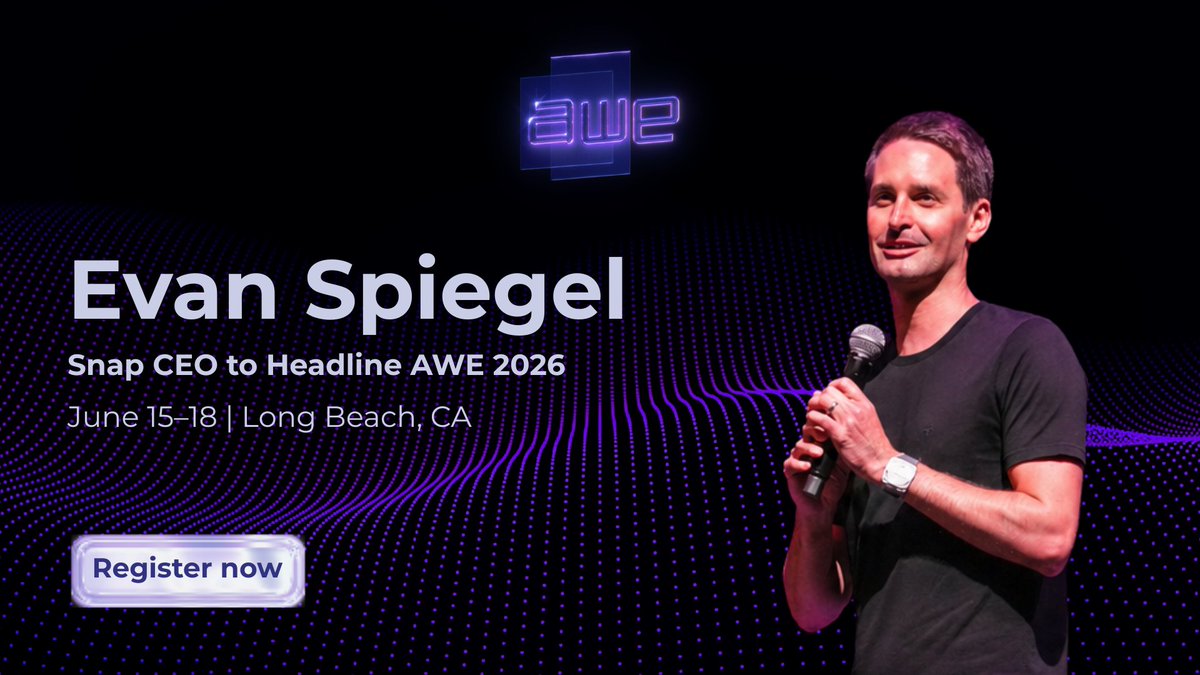
📢 @evanspiegel (CEO, @Snap) is headlining #AWE2026 Join us June 16 for his keynote: "Making Computing More Human." Plus, explore the latest in AI smartglasses, physical AI, and robotics. ⏳ Save $400. Early Bird ends May 7 🎫 awexr.com/usa-2026/ #AWE2026 #XR #ISpatial
AWE tweet media
English
4
12
40
27.2K
Evan Spiegel retweetledi
Lenny Rachitsky
Lenny Rachitsky@lennysan·
My biggest takeaways from @evanspiegel: 1. Distribution is the biggest bottleneck in consumer, not product. The only two consumer social apps to break through since Snapchat—TikTok and Threads—both solved distribution. TikTok spent billions on paid ads. Threads piggybacked on IG’s social graph. Organic app discovery is effectively over. If you’re building a consumer product today, your distribution strategy matters more than your product. 2. Software is no longer a moat. Snap learned this 15 years ago, and everyone is discovering it now with AI. Stories got copied. Lenses got copied. Snapchat+ got copied. Evan has learned that the things that are hard to clone are ecosystems—millions of developer-built AR lenses, creator relationships—and hardware. Thus why he’s been so adamant about investing in hardware. The lesson applies even more today as AI makes software even easier to build (and copy). 3. Snapchat cracked early growth by focusing on close friends, not the most friends. The conventional wisdom was that network effects meant bigger networks were always stickier—there was no way to beat Facebook. But Snapchat discovered that connecting someone to their best friend, partner, or spouse delivered more value than connecting them to everyone they’d ever met. Quality of connections mattered more than quantity. This insight allowed them to grow despite having far fewer total users than competitors. 4. “If you want to have a good idea, you have to have lots of ideas.” Snap’s design team presents hundreds of new ideas every week. New designers present work on their first day. There’s no gate, no filtering process to get ideas in front of Evan. This high-velocity, non-hierarchical structure is what enables Snap to innovate at scale. 5. Stories exist because Snap refused to build what users asked for. Customers kept asking for a “send to all” button to blast Snaps to everyone. But when Snap talked to people about social media broadly, they heard: “I feel pressure. Everything is permanent. There are likes and comments, so there’s judgment. I can only post pretty, perfect things.” Stories solved the underlying problems: easy sharing without spam, no public metrics to reduce pressure, 24-hour disappearance for a fresh start, and chronological order. Listen for insights, not feature requests. 6. Snap had 200 employees before hiring its first PM—on purpose. Evan’s concern was that the traditional tech org structure reduces designers to producing visuals in response to PM direction. By telling designers, “If you need PM support, do it yourself,” Snap locked in a design-led culture before adding coordination layers. The order in which you introduce roles shapes your culture permanently. 7. Snap is mapping every job to be done—across the Snapchatter journey and the advertiser journey—and handing each one to an AI agent. One example: a go-to-market agent takes a product idea and in one shot writes the spec, identifies sign-off stakeholders, does legal and trust-and-safety risk analysis, writes blog and marketing materials, and is starting to build visuals. The organizing principle isn’t “Where can we use AI?”—it’s “What are the jobs to be done?” 8. Successful companies need both innovative flat teams and structured hierarchical teams—and leaders must create healthy dialogue between them. This comes from Safi Bahcall’s book Loonshots. Large organizations need hierarchy and operational rigor to deliver at scale, but that makes people risk-averse and promotion-focused. Small, flat teams are better for innovation but can’t deliver at scale. The companies that win have both types of organizations, and leadership’s job is creating mutual respect and constructive dialogue between them. At Snap, the small design team constantly innovates while the larger org serves a billion users reliably. 9. Snap hires designers almost entirely based on portfolio, and the two things that matter are range and the story behind the work. If everything looks the same, the person is expressing themselves, not solving for users. Range is the signal that separates designers from artists. Most designers join right out of school; diverse backgrounds like 3D animation and electrical engineering are prized. 10. Evan’s contrarian AI take: the tech industry massively underestimates societal pushback on AI adoption. Technology leaders assume people will adopt new tools as they emerge. Evan predicts a period of significant resistance and argues that the industry needs to put humanity’s goals ahead of business goals. Building great AI capability is necessary but not sufficient—earning human trust is the harder problem.
Lenny Rachitsky@lennysan

Software is not a moat Over the last 15+ years, nearly every innovation @EvanSpiegel and his team shipped got copied. Stories. AR glasses. Swipe-based navigation. The camera-first interface. And yet @Snapchat is the only independent consumer social app that has lasted. Nearly 1 billion MAUs. ~$6B in annual revenue. Over 8 billion AI photos shared on Snapchat *every day*. In our in-depth conversation, we discuss: 🔸 Why distribution—not product—is now the biggest challenge for startups 🔸 How Snap keeps inventing with a 9-to-12-person design team 🔸 How AI is changing the way designers work 🔸 Why humanity's comfort with AI will be a bigger bottleneck than the technology 🔸 Why Evan is calling this year a "crucible moment" for Snap Listen now 👇 youtu.be/-7Yol5vX5xw

English
43
85
702
137K
Evan Spiegel
Evan Spiegel@evanspiegel·
Thank you @lennysan for a great conversation! :)
Lenny Rachitsky@lennysan

Software is not a moat Over the last 15+ years, nearly every innovation @EvanSpiegel and his team shipped got copied. Stories. AR glasses. Swipe-based navigation. The camera-first interface. And yet @Snapchat is the only independent consumer social app that has lasted. Nearly 1 billion MAUs. ~$6B in annual revenue. Over 8 billion AI photos shared on Snapchat *every day*. In our in-depth conversation, we discuss: 🔸 Why distribution—not product—is now the biggest challenge for startups 🔸 How Snap keeps inventing with a 9-to-12-person design team 🔸 How AI is changing the way designers work 🔸 Why humanity's comfort with AI will be a bigger bottleneck than the technology 🔸 Why Evan is calling this year a "crucible moment" for Snap Listen now 👇 youtu.be/-7Yol5vX5xw

English
20
12
173
25.7K
Evan Spiegel retweetledi
Gennaro
Gennaro@fourweekmba·
Great interview by @davidsenra to @evanspiegel, some key learnings: 1. The thesis was formed before the company Spiegel did not discover his philosophy while building Snapchat. He arrived at Stanford already holding it. Growing up at Crossroads School, literally named for the intersection of arts and sciences, he was already bothered by a specific problem: computers pull people away from each other. The computer lab during lunch instead of the schoolyard. The screen instead of the moment. This is not a founder who pivoted into a vision. The vision preceded the product by years. Snapchat opening into the camera rather than a feed is not a UX decision, it is a philosophical position encoded in software. 2. Edwin Land as operating model, not just inspiration Spiegel keeps returning to Land not for motivational reasons but as a structural template. Three specific parallels worth noting: Land realized he could not let other companies sit between him and the end consumer, so he owned the factories. Spiegel manufactures core display components in the US and UK for the same reason. Control is not pride; it is a prerequisite for differentiation. Land wanted to invent, not manufacture, but learned he had to control manufacturing to protect the invention. Spiegel wants to build software experiences, but learned he had to control hardware to protect the experience. Land and Jobs, in that famous meeting, described looking at an empty table and seeing the final product, then reverse-engineering the organization to invent toward it. Spiegel uses identical language: "I see it very clearly before we've built it. If I can't see it, we're off track." This is not vision as metaphor. It is a literal product development methodology. 3. The Facebook Poke moment is the most important strategic inflection in Snap's history In 2012, at 22 years old, Spiegel watched the largest social company on earth clone his product, put a download link at the top of every Facebook app, and lose. Snapchat was number one in the App Store on Christmas Day. Most founders would have celebrated. Spiegel treated it as a warning. The lesson he extracted: software has no moat, ever, and the advantage went to Snapchat not because the software was better but because the relationships were already there. Your best friend on Snapchat represents half your communication, you do not need 500 friends, you need the right one. That is a fundamentally different theory of network effects than the dominant "more nodes = more value" model everyone else was using. This single insight drove everything that followed: stories, augmented reality as a platform, and ultimately glasses. Each was an attempt to build something structurally harder to copy than software. 4. The advertising inversion and what it actually cost Snap built its ad business upside down relative to Google and Meta, concentrated on a small number of large US brand advertisers rather than a long tail of small and medium businesses optimizing for lower-funnel performance. This was not a strategic error. It was the fastest path to early revenue. Large customers can move millions of dollars quickly. But the ceiling was visible from the beginning. A diversified, durable ad business requires small and medium customers optimizing against real performance outcomes, app installs, purchases, return on ad spend. Snap did not have that infrastructure. The last three years have been a structural rebuild of the entire advertising stack, sales culture, and go-to-market motion. The company is essentially mid-surgery while also launching a new hardware category. The most honest line in the conversation: "We do need to reaccelerate the advertising business." Not past tense. 5. Snapchat as the balance sheet for a 12-year R&D bet This is the most underanalyzed structural fact about Snap. A $7 billion revenue business with meaningful cash flow has been quietly funding hardware R&D since 2014. No venture capital firm would have supported that time horizon. No spinout could have sustained it. The only entity capable of funding a decade-plus speculative hardware platform was a profitable consumer internet company with near-billion-user scale. Spiegel is explicit: "Snapchat is the best possible vehicle to reinvent the computer." The app is not the endgame. It is the engine that makes the endgame possible. When analysts evaluate Snap purely as a social/messaging platform competing with Meta and TikTok, they are mis-reading the unit of analysis. The correct frame is: self-funded deep-tech platform company using consumer software cash flows to build the post-smartphone computing layer. 6. The hardware thesis is about the human body, not the technology Spiegel is not bullish on glasses because augmented reality is technically exciting. He is bullish because holding a small screen in your hand while ignoring the world in front of you is, in his framing, obviously wrong as a long-term human behavior. Seven to eight hours a day staring at a screen is not a stable equilibrium. The consumer spectacles launch this year is not a product launch. It is a test of whether the thesis about human behavior is correct at scale. The developer platform (Gen 4/5) has already validated that creators will build for the platform. The consumer launch validates whether people will change how they live. The alien thought experiment he raises, what if extraterrestrials watching Earth think smartphones have taken over humanity, is not a joke. It is his actual framework for why the problem matters. 7. Kind vs. nice is a genuine management insight, not a culture deck platitude The distinction Spiegel draws between kindness and niceness has structural implications for how Snap operates. Nice protects people from discomfort. Kind wants the best for them, which sometimes requires delivering discomfort. In a creative organization, fear and creativity are mutually exclusive, fear kills generative output. But a culture that avoids hard feedback in the name of warmth produces the same result through a different path. The weekly design review, nine to twelve people, hundreds of ideas, less than 1% shipped, only works if no one is attached to their ideas. The moment someone treats an idea as territory, the volume collapses. Spiegel's "kind but uncompromising" culture is the operating condition that makes that volume possible. 8. Turning down billions was not courage — it was arithmetic The decision to reject acquisition offers in his early twenties looks like conviction from the outside. Spiegel describes it differently: they already had enough money to live well (both he and Bobby had liquidity), they loved what they were building, and, critically, selling would have required compromising on every choice that made Snapchat what it was. Private over public. Ephemeral over permanent. Camera-first over feed-first. No likes over engagement optimization. A buyer would not have preserved those choices. A buyer would have optimized them away. The product that would have survived acquisition would not have been Snapchat. The cleaner formulation: selling your best idea to work on someone else's version of it is not a rational trade at any price. Some Mental Models at Work - No Moat in Software — The foundational Snap insight. Defensibility must come from networks, ecosystems, or hardware — never from code alone. - Vision-Led Reverse Engineering — See the product first, then organize the company to invent toward it. Technology serves vision, never the other way. - Self-Funded R&D Flywheel — Use profitable consumer business to fund long-duration bets that no external capital would support. - Network Effects Depth over Breadth — One deeply connected relationship is worth more than 500 weak ones. Intensity beats scale at early stages. - Kind ≠ Nice — Organizational cultures that optimize for comfort produce the same creative paralysis as hostile ones, just more slowly.
David Senra@davidsenra

Evan Spiegel. Snap. Tomorrow. April 12, 2026. Available everywhere you get podcasts. @evanspiegel @Snap


English
12
7
81
31.2K
Evan Spiegel retweetledi
Cas and Chary XR
Cas and Chary XR@CasandChary·
Real AR glasses for consumers might be closer than we think. I tested Snap’s dev kit… and something surprised me. Full breakdown: youtu.be/GnX3U5AMeAU?si…
YouTube video
YouTube
Cas and Chary XR tweet media
English
12
8
28
12.4K
Evan Spiegel retweetledi
The Story Is
The Story Is@CNNTheStoryIs·
“What’s so inspiring to us and what motivates us is how many people want to return home, want to rebuild and want the support to do that,” @evanspiegel said. He told @Elex_Michaelson about creating the Department of Angels to help those affected by the LA fires. #snapchat #ceo
English
12
6
25
12.7K
Evan Spiegel retweetledi
The Story Is
The Story Is@CNNTheStoryIs·
“In a wild turn of events, our office parking lot became the fire camp for firefighters from all over the country," @evanspiegel said. The @Snapchat CEO and cofounder joined @Elex_Michaelson on set and described what he experienced during the Palisades fire one year ago.
English
3
6
18
7.9K
Evan Spiegel retweetledi
Businessweek
Businessweek@BW·
.@emilychangtv heads to the Venice boardwalk to spend a day with Snap Co-founder and CEO @evanspiegel They talk about AI + AR, Specs, and whether Silicon Valley is...overrated. Watch the full episode of The Circuit bloom.bg/43UwKlo
English
30
9
56
33.6K
Evan Spiegel retweetledi
Karthik Mahadevan
Karthik Mahadevan@KarthikIO·
good times! really rooting for @evanspiegel and the @Snap specs that are due to launch next year! already know they're gonna be sick!
English
22
4
42
35.8K
Evan Spiegel retweetledi
AWE
AWE@ARealityEvent·
📢 Huge AWE USA 2025 announcement! AWE is thrilled to add @EvanSpiegel, CEO and Co-Founder of Snap, to the AWE Main Stage for the first time ever! It's a huge moment and you'll want to be there 🟡 See the confirmed speakers here ⬇️ hubs.li/Q03gMl0n0 @Spectacles @SnapAR
AWE tweet media
English
60
15
107
30.8K
Evan Spiegel retweetledi
G.
G.@MIUMWAH·
Oh so the vogue runway app got a new update where you can try on clothes from collections!
G. tweet mediaG. tweet mediaG. tweet media
English
112
13
106
0