Esteban Cruz

36.9K posts

Esteban Cruz banner
Esteban Cruz

Esteban Cruz

@Evanshm

Doctor en la ciencia lúgubre. Economía Política. Profesor en la Universidad de Sevilla. En @RedMMT #ChangeEconomics #StopCorrupcion. Hago papers.

Entre Cáceres y Sevilla Katılım Ocak 2011
2.7K Takip Edilen3.1K Takipçiler
Esteban Cruz retweetledi
Levy Institute
Levy Institute@LevyEcon·
On May 8, we welcome William H. Janeway as speaker for our Levy Anniversary Conference. Once labelled a “theorist-practitioner of financial economics” by Minsky himself, Janeway is a critical voice exploring capitalism in the Innovation Economy Register: connect.bard.edu/register/levya…
Levy Institute tweet media
English
0
2
3
176
Esteban Cruz
Esteban Cruz@Evanshm·
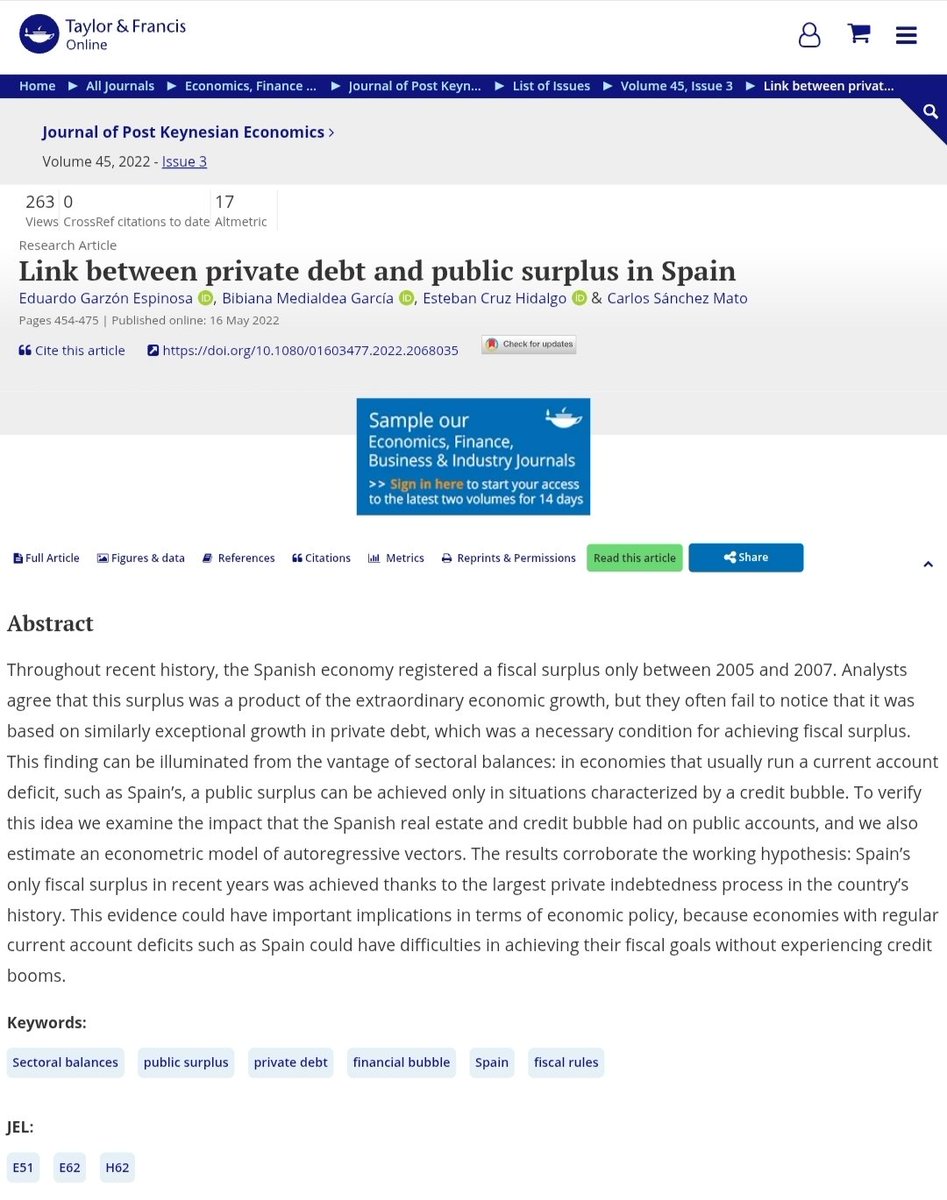
Si vemos la imagen completa dada por los balances sectoriales, ¿podemos hablar de que este es un dato positivo? ¿Acaso son "insostenibles" las cuentas públicas realmente? ¿Qué ocurre con la insostenibilidad de las cuentas privadas derivada de la posición del balance del SP?
Antonio Sanabria@SanabriaAnto

Tras la crisis financiera de 2008 hicieron falta 10 años para recuperar un déficit presupuestario inferior al 3% del PIB. Sin embargo, en 5 solo años se ha reducido el elevado saldo negativo de 2020, ocasionado entonces por la COVID-19, hasta alcanzar el mejor dato desde 2007.

Español
0
0
2
83
Esteban Cruz retweetledi
Red MMT
Red MMT@RedMMT·
El Pais, ese diario que posturea como progre pero te vende la agenda económica neoliberal.
El búho enmascarado@el_buho69812

Señores de @el_pais, reducir el ahorro financiero neto del sector privado cuando la tasa de desempleo es del 10% no es un buen dato. Ni siquiera tenemos que entrar a valorar un mero residuo contable.

Español
0
1
4
118
Esteban Cruz retweetledi
Emanuele Citera
Emanuele Citera@MannyCitera·
📉 Speculation or Fundamentals? European Natural Gas Price Swings Post 2020 Our new working paper by @LevyEcon analyzes the dramatic swings in European natural gas prices during 2020-2024 and the energy crisis. Check it out here: levyinstitute.org/publications/s…
English
0
7
17
836
Esteban Cruz retweetledi
Omar Montoya Suárez
Omar Montoya Suárez@OmarMontoyaSua1·
Hayek no es un pensador independiente, sino un cuadro orgánico del capital financiero. La creación de la Sociedad Mont Pelerin (1947) y el impulso del Institute of Economic Affairs (IEA) en Londres no fueron actos de caridad académica. 1/9
Español
2
31
93
3.2K
Esteban Cruz retweetledi
Levy Institute
Levy Institute@LevyEcon·
James Galbraith has been with the Institute since 1995. As we celebrate Levy’s 40th Anniversary and welcome him as a speaker at our anniversary conference, we now take a moment to reflect on Galbraith’s contributions, distinct impact on fed budget policy and continuing legacy. 🧵
Levy Institute tweet media
English
1
9
22
4K
Esteban Cruz retweetledi
Jostein Hauge
Jostein Hauge@haugejostein·
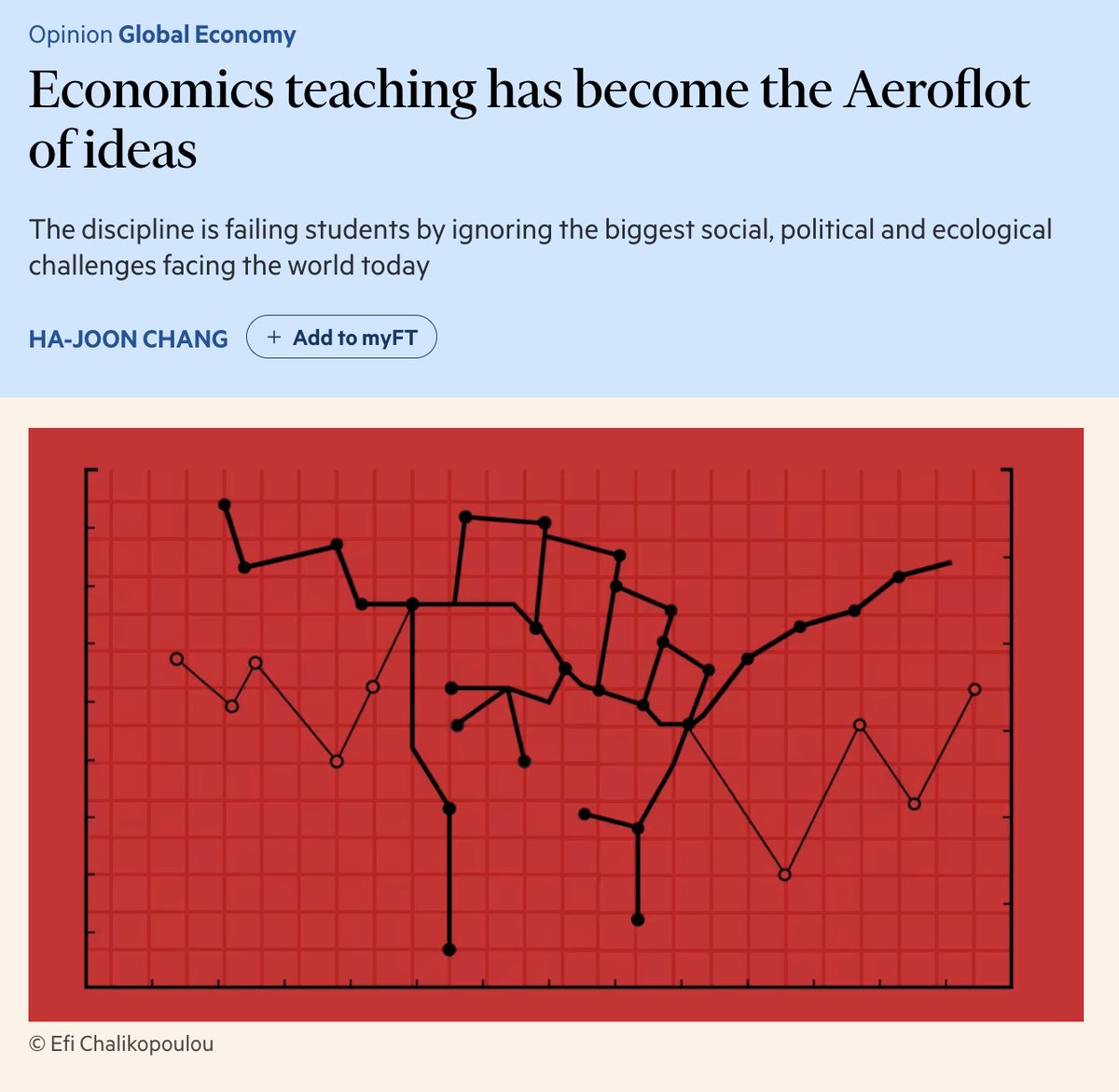
Ha-Joon Chang compares mainstream economics to Catholicism in the Middle Ages. “Economics today resembles Catholic theology in medieval Europe: a rigid doctrine guarded by a modern priesthood who claim to possess the sole truth. Dissenters are shunned.”
Jostein Hauge tweet media
English
68
569
2.4K
187.6K
Esteban Cruz retweetledi
AEHE
AEHE@_AEHE·
¡YA ESTÁ AQUÍ! «La Guerra Civil española noventa años después» En el episodio n.º 97 de TODO COMENZÓ AYER, el podcast divulgativo de la @_AEHE , volvemos con un programa monográfico debatiendo con Ricardo Robledo, @lourenzofp Prieto, Eduardo González Calleja y @angelvinashist.
AEHE tweet media
Español
1
6
14
790
Esteban Cruz retweetledi
Maria Cristina Barbieri Góes
It’s official: I am now Co-Editor of Challenge, alongside @KappesSylvio , with @Lprochon as Editor-in-Chief. A journal with 65 years of publishing heterodox and post-Keynesian thought: #journal-metrics" target="_blank" rel="nofollow noopener">tandfonline.com/journals/mcha2…
English
2
5
16
864
Esteban Cruz retweetledi
Jostein Hauge
Jostein Hauge@haugejostein·
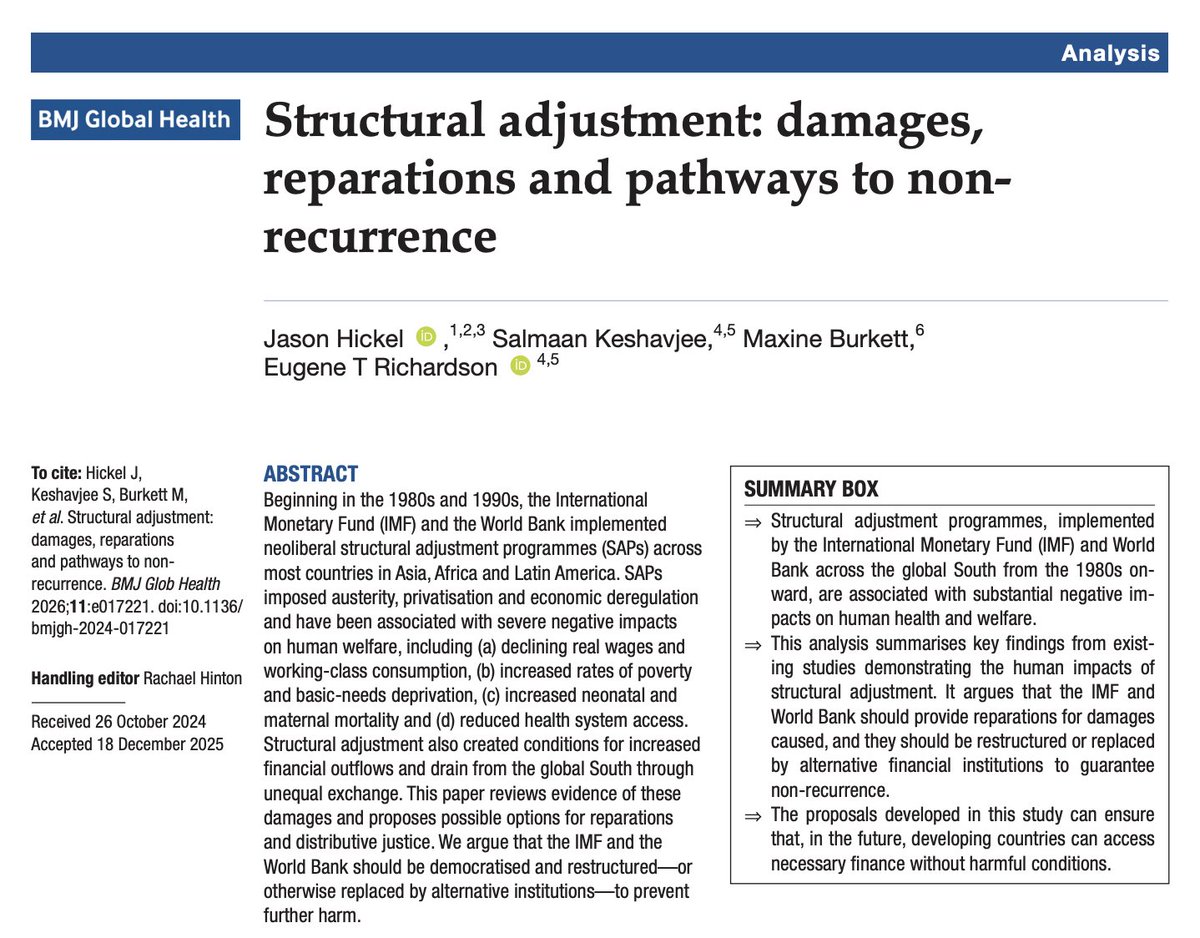
The backlash I’ve seen against this paper in the last few days is, frankly, strange. Some economists and social scientists seem disgruntled because the paper does not establish causality from structural adjustment programmes (SAPs) to economic devastation across the Global South. The paper does not claim to do this, nor is it pitched as a research article. It reviews evidence. Perhaps the most striking weakness of the criticism this paper has received is the criticism's failure to grapple with the many studies the paper *does* cite that support the claim that SAPs contributed to economic decline in many countries around the world. Even the World Bank and the IMF have openly admitted that SAPs in the 1980s and 1990s caused harm in developing countries. What this backlash reveals, above all, is an enduring unwillingness to reckon with — and properly study — the historical record of harm caused by the Washington Consensus across the Global South.
Jostein Hauge tweet media
English
25
114
431
28.7K
Esteban Cruz retweetledi
Jason Hickel
Jason Hickel@jasonhickel·
Regarding this piece on the social impacts of structural adjustment (jasonhickel.org/s/e017221full.…)... it is quite strange that some people have criticized it by saying it does not implement original statistical assessment to establish causality. Strange, because this is very clearly *not* a research paper. Nor is it a systematic review paper. It is simply a short analysis paper, clearly labelled as such, which is intended to "discuss topical issues" as per BMJ guidelines.  It is obviously beyond the remit of such a piece to undertake original statistical assessment, and indeed the piece makes no claim to such an undertaking. Instead, it provides citations to examples of previously published research that has explored the impact of SAPs on various social outcomes, including studies that *do* undertake to assess causal effect.  In other words, it is incorrect to claim there is no evidence on the causal effects of SAPs. There is such evidence, and we cite key examples, including studies that account for endogeneity and selection biases. This literature deserves to be better known.  For instance, see: -On poverty: link.springer.com/article/10.105… -On poverty and inequality: degruyterbrill.com/document/doi/1… -On child and maternal health: link.springer.com/article/10.118… -On child health: academic.oup.com/ije/article/48… -On health system access and neonatal mortality: sciencedirect.com/science/articl… -And there are many others we were forced to cut for brevity And yes, the piece also cites political economy research that does not rely on statistical analysis, because these are also recognized as valuable contributions to the literature.  Along these lines, I encourage everyone to read Mike Davis' masterpiece "Planet of Slums", which includes a chapter on SAPs. As for the figures, none of them claim to demonstrate causality.  They are included purely as illustrations of broad trends in social indicators during the adjustment period - social indicators that are assessed by the studies we cite. Someone asked about using 1980 as the starting point for liberalization.  This is common convention: Chang, Pollin, Weisbrot, Baker, Rosnick and others use 1980 to generally distinguish between the developmentalist and neoliberal periods.   In Sub-Saharan Africa, for the majority of countries that were SAPed, comprising most of regional GDP, 1980 was the year immediately prior to first implementation.  Most of the rest first implemented in 1982 and 1983, and of course any assessment of effects should assess interventions on a country-specific basis. As for India's 1981 loan, the IMF insisted on adjustment conditions, the Indian government said they could not accept externally imposed conditions, so it was agreed they would implement "homegrown conditionality", with policies generally aligned with IMF preferences.  The policies affected food prices, which is why we see an increase in BNPL poverty. As for China, their agreement with the World Bank was signed in 1988 and implemented in 1990.  While healthcare and some other sectors began to be liberalized earlier, in the 1980s, the BNPL basket was not substantially affected until 1990. As for the question of national income, researchers have found liberalization had a negative impact on growth in non-manufacturing regions, which is evident in the case of LatAm and SSA, but this does not apply in regions with higher manufacturing. Regarding Kenya, we see an increase in infant mortality after 1986, and the same pattern in child mortality.  We note that some of this is attributable to HIV (and cite research showing that this pathway too is exacerbated by SAPs), but we also know from work by IRD and CERDI researchers that, in Kenya, HIV is responsible for a minor share of the change in the child mortality trend.  Even removing HIV, there is increasing child mortality after 1986 compared to the pre-SAP trend.  Several studies indicate that adjustment was associated with increased child deaths in Sub-Saharan Africa. In sum, existing research provides valuable information on the social harms related to structural adjustment.  And this should not be surprising; after all, we know there were mass protests and riots across much of the South during the adjustment period. They were literally called "IMF riots".  People don't riot for no reason, they riot because they are desperate. The IMF and WB themselves recognized this, and relaxed some of their more extreme conditions. Why care about all this? Because every man who was impoverished by these policies is my brother, every mother who died needlessly during childbirth is my sister. Nothing will shake my conviction in that fact.
English
9
90
355
30.9K
Esteban Cruz retweetledi
LO + VIRAL
LO + VIRAL@SuperViiral·
El facha de Schrödinger Una genialidad más de Vaya Semanita
Català
24
911
2.7K
134.6K
Esteban Cruz retweetledi
Pablo Malo
Pablo Malo@pitiklinov·
Los autores de este artículo, dos de los científicos del comportamiento más influyentes del mundo, realizan una autocrítica sincera sobre el tema de los nudges (empujoncitos). Durante años creyeron que los pequeños “nudges” (empujones sutiles) podían resolver grandes problemas sociales y ambientales haciendo que las personas tomaran mejores decisiones individuales: comer más sano, ahorrar más, reducir su huella de carbono, vacunarse, etc. Hoy admiten que se equivocaron. Según ellos, el enfoque conductual ha caído en una trampa: al centrarse casi exclusivamente en modificar el comportamiento individual, ha desviado la atención de las verdaderas causas de los problemas, que son sistémicas (diseño de mercados, incentivos corporativos, políticas económicas, entornos laborales y comerciales). En lugar de cambiar los sistemas que empujan a la gente hacia decisiones perjudiciales, la ciencia del comportamiento ha terminado culpando sutilmente a los individuos por sus “malas elecciones”, ofreciendo soluciones superficiales que no resuelven los problemas de fondo. Chater y Loewenstein concluyen que ha llegado el momento de cambiar de dirección: la ciencia conductual debe dejar de obsesionarse con nudges individuales y empezar a presionar por cambios estructurales reales en las empresas, los mercados y las políticas públicas. Parchear el comportamiento de las personas ya no es suficiente.
Rob Sica@robsica

"As behavioural scientists, we have fallen into the trap." #selection-861.124-861.181" target="_blank" rel="nofollow noopener">archive.ph/cjsBq#selectio

Español
77
1K
3.2K
189.9K